
- Education
- Lab-Grown Diamonds
- Lab-Grown Diamond vs Cubic Zirconia: How They Really Differ
Lab-Grown Diamonds
Lab-Grown Diamond vs Cubic Zirconia: How They Really Differ
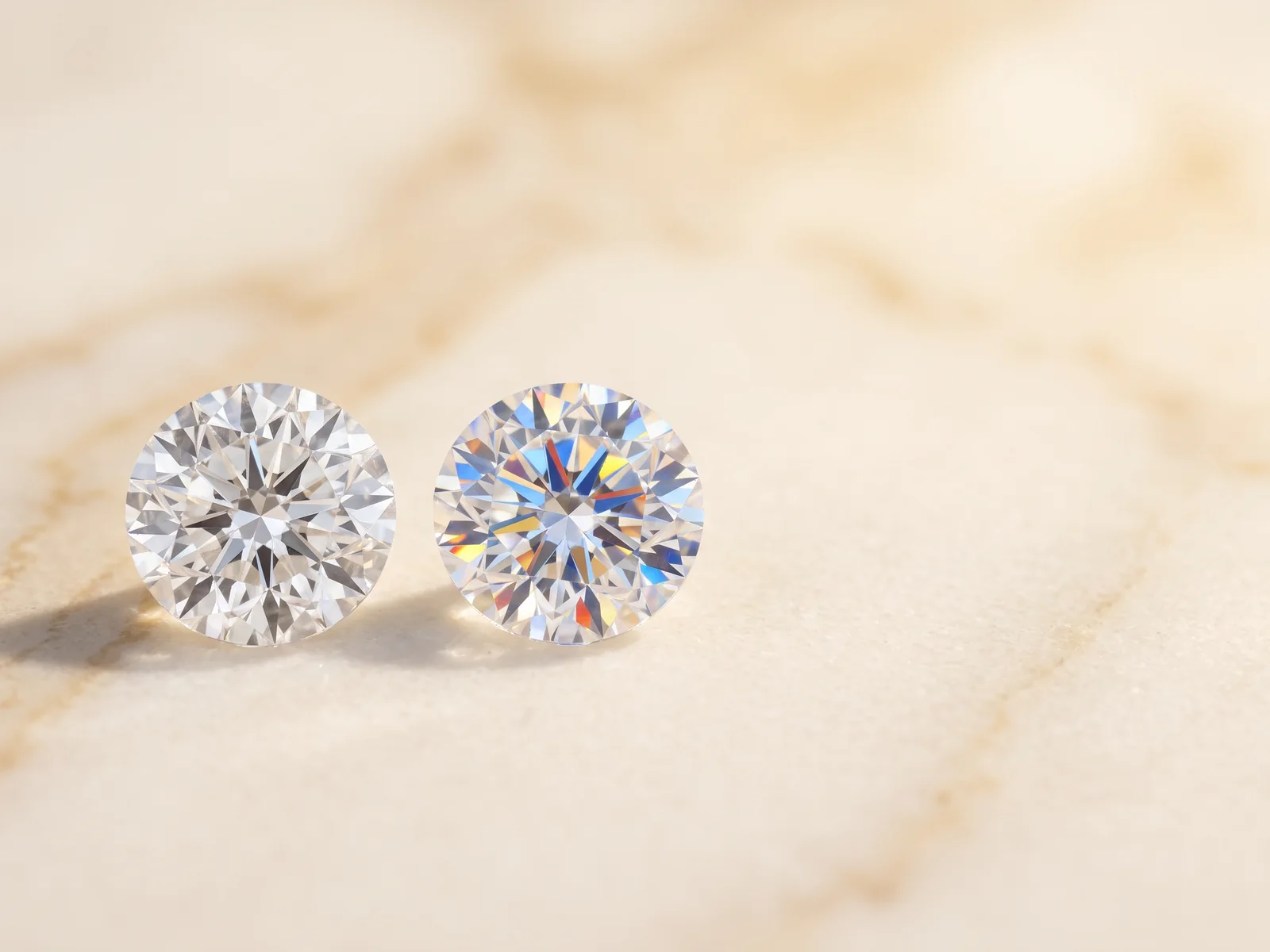
In a lab-grown diamond vs cubic zirconia comparison, the two stones can look alike in a shop window, but one is real diamond and the other is an imitation. Knowing the difference protects your money and helps you read any label or report.
 Reviewed by Raj Sood, Graduate Gemologist (GIA), AJP (GIA)Master jeweller and Graduate Gemologist (GIA) · reviewed 4 November 2026
Quick answer
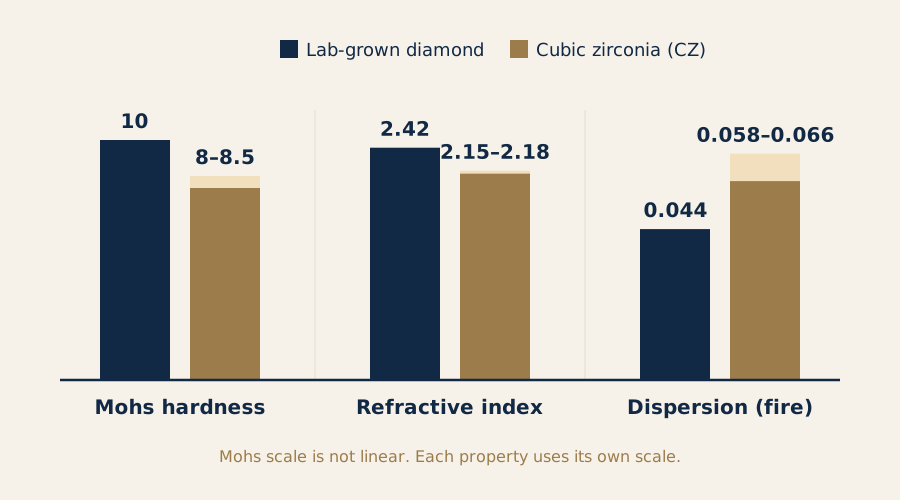
A lab-grown diamond is real diamond: carbon crystal, 10 on the Mohs scale, refractive index 2.42, physically identical to mined diamond. Cubic zirconia (CZ) is a cheaper imitation made of zirconium dioxide, about 8–8.5 on the Mohs scale with a refractive index near 2.15. CZ scratches and dulls with daily wear; a lab-grown diamond keeps its polish with normal care.
What is the difference between a lab-grown diamond vs cubic zirconia?
A lab-grown diamond is diamond. It is made of carbon atoms locked in the same cubic crystal structure as a mined diamond, so it has the same hardness, refractive index, density and heat conductivity. The only difference is where it formed: in a laboratory over a few weeks, rather than deep in the Earth over a very long time. If that sounds too neat, our explainer on why a lab-grown diamond is real diamond goes through the science.
Cubic zirconia, usually shortened to CZ, is not diamond at all. It is a diamond simulant: a different material made to imitate the look of diamond. CZ is zirconium dioxide (ZrO2) grown in a factory, and it costs a tiny fraction of either a lab-grown or a natural diamond. CZ is a synthetic material in its own right, but it is not a synthetic diamond, and it should never be sold as one.
So the real question is diamond versus imitation. A synthetic or lab-grown gem has the same chemistry and crystal structure as the natural gem. A simulant only copies the appearance. Glass, white sapphire, moissanite and CZ are all simulants of diamond. For the wider picture of how lab-grown stones are graded and priced, start with our complete lab-grown diamonds guide, and if any term here is new, the GemTrove jewellery glossary explains it in plain English.
How are lab-grown diamonds and cubic zirconia made?
Lab-grown diamonds are made in one of two ways. HPHT (high pressure, high temperature) recreates the conditions deep underground: a press squeezes carbon around a small diamond seed at roughly 5–6 gigapascals and 1,300–1,600 °C until new diamond crystallises. CVD (chemical vapour deposition) works at low pressure: a gas mix of methane and hydrogen is turned into a plasma, and carbon settles layer by layer onto flat diamond seed plates. Either way, a 1 carat finished stone usually takes weeks of growth. Our page on how HPHT and CVD diamonds are grown walks through each step.
Many CVD diamonds are given a heat or pressure treatment after growth to improve their colour. That is normal, but it must be disclosed, and a reputable report will say so. See what post-growth treatment means on a report for the detail.
Cubic zirconia is made by a process called skull melting. Zirconium oxide powder is mixed with a stabiliser, usually yttrium oxide or calcium oxide, and heated to about 2,700 °C inside a water-cooled copper container. The outer layer stays solid and acts as its own crucible (the "skull"), and as the melt cools, column-shaped crystals form. A single run produces many kilograms of material in hours to days, which is why CZ is so inexpensive. It has been mass-produced as a jewellery stone since the mid-1970s.
After that, the paths split. A lab-grown diamond is cut, polished and graded one stone at a time, just like a mined diamond. Most CZ is cut by machine in very large batches, and cutting precision varies a lot from one supplier to the next.
How do a lab-grown diamond and cubic zirconia compare side by side?
| Property | Lab-grown diamond | Cubic zirconia (CZ) |
|---|---|---|
| What it is | Real diamond, grown in a laboratory | Diamond simulant (imitation) |
| Chemistry | Carbon (C) | Zirconium dioxide (ZrO2) with a stabiliser |
| Mohs hardness | 10 | about 8–8.5 |
| Refractive index | 2.42 | about 2.15–2.18 |
| Dispersion (fire) | 0.044 | about 0.058–0.066 |
| Specific gravity (density) | 3.52 | about 5.6–6.0 |
| Heat conductivity | Very high | Very low |
| Thermal diamond tester | Tests as diamond | Does not test as diamond |
| Grading report | Yes, usually IGI or GIA | No grading report |
| After years of daily wear | Keeps its polish and sharp facet edges | Edges round off, fine scratches, dull look |
| 1 ct-size round, approx AUD | about $800–$2,500 loose | about $5–$50 loose |
Two numbers explain most of the visible difference. Refractive index measures how strongly a material bends light; the higher it is, the more light a well-cut stone returns to your eye as white brilliance. Dispersion measures how much the stone splits white light into rainbow colours, which jewellers call fire. Diamond has more brilliance; CZ has more fire.
The density difference matters too. Because CZ is about 1.7 times denser, a CZ the same size as a 1 carat round diamond (about 6.4–6.5 mm across) weighs roughly 1.6–1.75 carats. That is why CZ is often sold by millimetre size rather than carat weight.
Lab-grown diamond vs cubic zirconia: which looks better?
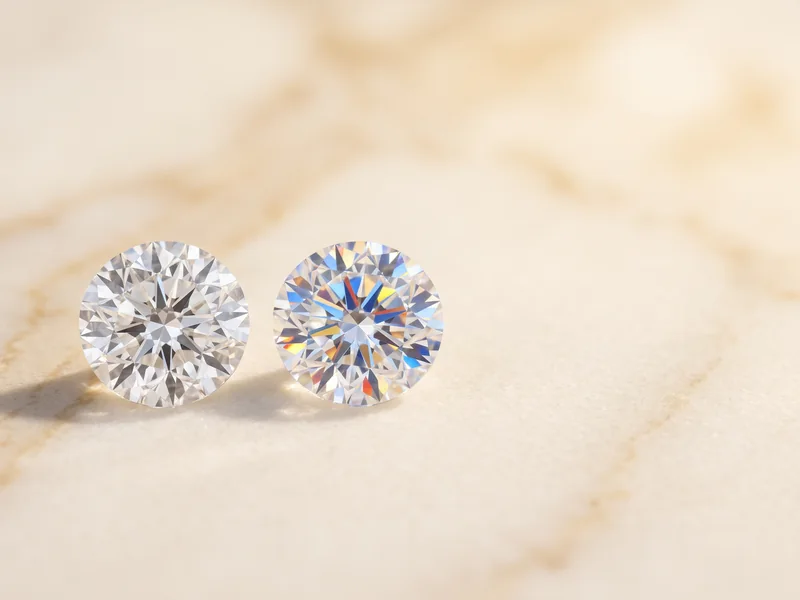
Brand new and seen at arm's length under bright shop lights, a well-cut CZ can fool most people. Look closer, or for longer, and the differences show. A diamond's high refractive index gives crisp, bright white flashes and sharp contrast between light and dark facets. CZ returns less white light and more coloured flashes, so it can look slightly glassy, with a rainbow "disco" effect that some people describe as too much fire.
CZ is also usually perfectly colourless and free of inclusions, because the factory controls the melt. Oddly, that perfection can be a giveaway: a large stone with no inclusions at all and no trace of colour is more often CZ than diamond. Lab-grown diamonds are graded on the same D-to-Z colour scale as mined diamonds, and most sold in Australia sit in the D–H range; our guide to lab-grown diamond colour grades shows where the visible changes start. A small number of HPHT stones show a faint grey-blue tint, covered in our piece on blue nuance in some HPHT stones.
Cut matters as much as material. A poorly cut lab-grown diamond can look flat, and a precisely cut CZ can look lively. When comparing lab-grown stones, check the cut grade and proportions; our page on judging cut quality in lab-grown diamonds explains what the numbers mean.
Not sure which one is right?
Send us the stones you are looking at and our gemologist will tell you which to choose and why.
Does cubic zirconia scratch or go cloudy over time?
Yes, with daily wear it does, and this is the biggest practical difference. CZ sits at about 8–8.5 on the Mohs scale (a ranking of scratch resistance from 1, talc, to 10, diamond). That sounds close to 10, but the Mohs scale is not even: the gap between corundum at 9 and diamond at 10 is larger than the gap between talc and corundum. In practice, diamond is several times harder than anything else you will wear it against.
- Facet edges wear: the sharp junctions between facets slowly round off from knocks and rubbing, so the sparkle softens.
- Fine scratches build up: contact with harder materials, and with other gems in a jewellery box, leaves a network of surface marks.
- It looks cloudy: CZ does not change inside, but scratches plus a film of skin oil and soap make the surface look milky.
- It can chip: CZ is fairly brittle, so a hard knock on a claw-set edge can break off a small piece.
A CZ in a ring worn every day often looks noticeably duller within a few years, while one in occasional earrings can stay bright far longer. A lab-grown diamond, like any diamond, keeps its polish for decades; it can still chip from a sharp blow on a thin edge, because hardness is not the same as toughness. Diamonds also attract grease, so they need regular cleaning; our page on caring for a lab-grown diamond at home covers the routine.
Related guideMoissanite vs Cubic ZirconiaHow can you tell a lab-grown diamond from cubic zirconia?
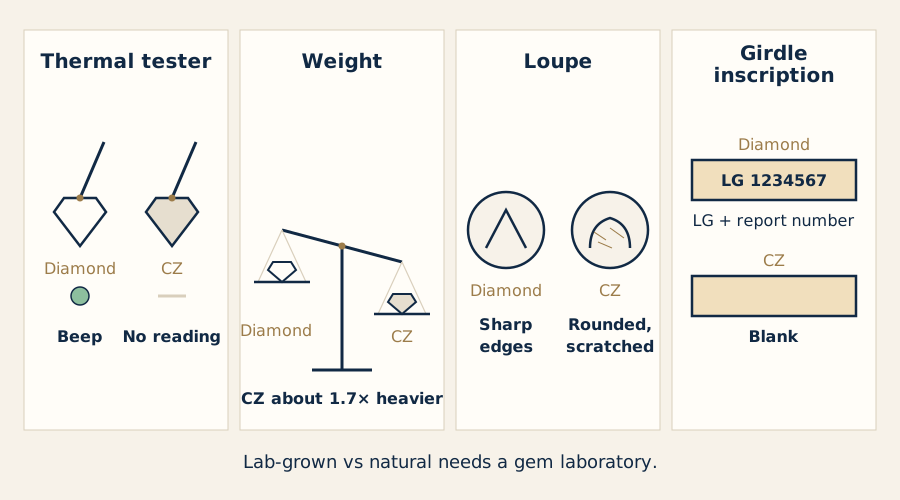
Telling lab-grown diamond from CZ is straightforward for a jeweller. Telling lab-grown diamond from natural diamond is not, and needs laboratory equipment. Here are the checks that separate diamond from CZ, from most to least reliable:
- Thermal diamond tester: diamond conducts heat hundreds of times better than CZ. A lab-grown diamond tests as diamond; CZ does not. Our page explains why lab-grown stones pass a diamond tester.
- Report and inscription: most lab-grown diamonds have a report number laser-inscribed on the girdle (the thin outer edge), often with the words "LG" or "Laboratory-Grown". CZ has no report and no inscription.
- Weight: on a jeweller's scale, a loose CZ weighs about 1.7 times more than a diamond of the same millimetre size.
- Loupe (10× magnifier): look for rounded, worn facet edges and surface scratches on CZ. Diamond edges stay sharp.
- Fog test: breathe on the stone. Diamond disperses the heat and clears in a second or two; CZ stays fogged a little longer. Useful, not conclusive.
- Read-through test: place a loose round stone table-down on printed text. Through CZ you may see blurry lines; a well-cut diamond breaks the light up so you cannot.
One caution: moissanite also passes a basic thermal tester, so jewellers use a multi-tester that checks electrical conductivity as well. See where moissanite sits against lab-grown diamond and our moissanite and CZ comparison if you are weighing all three. To understand the lab-grown and mined side of the question, read how lab-grown compares with natural diamond.
What should the report and the label say in Australia?
A lab-grown diamond of any real size should come with an independent grading report, most often from IGI or GIA. The report should state clearly that the stone is laboratory-grown, list its shape, measurements, carat weight, colour, clarity and cut details, and note any post-growth treatment. IGI reports usually state the growth method (HPHT or CVD). Check that the report number matches the girdle inscription.
CZ does not get a grading report, because there is nothing to grade: it is a manufactured imitation with consistent colour and clarity. It may come with a small card or a supplier's description, which is fine, as long as it calls the stone cubic zirconia.
| Wording you might see | What it means | Is it clear? |
|---|---|---|
| Lab-grown / laboratory-grown diamond | Real diamond made in a laboratory | Yes |
| Synthetic diamond / lab-created diamond | Real diamond made in a laboratory | Accurate, though less familiar to shoppers |
| Natural diamond | Diamond formed in the Earth and mined | Yes |
| Cubic zirconia / CZ | A diamond simulant, not diamond | Yes |
| Simulated diamond / diamond simulant | An imitation, often CZ | Accurate only if the material is named |
| "CZ diamond" or "diamond" for a CZ | Suggests CZ is diamond | No: likely misleading |
Under the Australian Consumer Law, businesses must not engage in misleading or deceptive conduct or make false claims about what goods are made of, and the ACCC enforces those rules. In plain terms, a CZ cannot be described as a diamond, and a lab-grown diamond must not be passed off as natural. Vague environmental or ethical claims need care too; our article on using the term conflict-free carefully explains why. If a listing only says "brilliant stone" or "diamond look", ask exactly what the material is and get the answer in writing.
How much does a lab-grown diamond cost compared with cubic zirconia in Australia?
The price gap is large in both directions. Lab-grown diamonds cost much less than natural diamonds, and CZ costs far less again. In CZ jewellery, most of what you pay is for the metal and the labour, not the stone.
| Item (1 ct-size round, about 6.5 mm) | Approximate price range (AUD) |
|---|---|
| Loose CZ | about $5–$50 |
| CZ solitaire in sterling silver | about $30–$250 |
| CZ solitaire in solid 9ct or 18ct gold | about $300–$1,500 |
| Loose lab-grown diamond, G–H, VS | about $800–$2,500 |
| Lab-grown diamond solitaire in 18ct gold | about $2,500–$5,500 |
| Loose natural diamond, G–H, VS | about $7,000–$15,000 |
These are broad ranges only. Lab-grown prices have fallen steadily as production has grown, and they vary with cut, colour, clarity and certification; our page on what really sets lab-grown diamond prices explains the factors. Neither CZ nor lab-grown diamond has a strong resale market, so choose either for wearing, not for resale. A lab-grown diamond is still worth insuring for its replacement cost; see whether to insure a lab-grown diamond.
The lab-grown price drop is also what makes larger sizes realistic. If you are looking above the 1 carat mark, our guide to choosing a 2 carat lab-grown stone covers what to check, and for pieces with many stones, see lab-grown studs and tennis bracelets.
Browse lab-grown diamonds
Is cubic zirconia ever a sensible choice?
Yes, as long as you know what you are buying. CZ is an honest material when it is sold under its own name. Common sensible uses:
- Fashion and costume jewellery you will wear occasionally or for one season.
- Travel rings for holidays or work sites where you would rather not wear a valuable ring.
- Trying a shape or size before committing, for example a 2 ct-size CZ to see how it sits on your finger.
- A placeholder stone while you choose or save for a diamond, set in a ring designed to take the diamond later.
For an engagement ring or anything worn every day, the wear described above is the deciding factor: a lab-grown diamond will still look the same in 20 years, and a CZ will not. If you start with a CZ placeholder, make sure the setting is made to suit the exact millimetre size of the diamond you plan to fit, because a CZ and a diamond of the same weight are different sizes.
How to choose between a lab-grown diamond and cubic zirconia: step by step
- Decide how often you will wear it. Daily wear points to diamond; occasional or fashion wear makes CZ reasonable.
- Set a realistic budget in AUD. Compare like with like: a 1 ct lab-grown diamond against a 1 ct-size CZ in the same metal.
- Ask exactly what the stone is. Get the material named on the receipt: "lab-grown diamond" or "cubic zirconia", never just "diamond look".
- For lab-grown, read the report. Check it says laboratory-grown, note colour, clarity, cut and any post-growth treatment, and match the report number to the girdle inscription.
- Compare millimetre sizes, not carats. CZ is heavier, so carat weights between the two are not comparable.
- Look at it in daylight and under a loupe. Check for sharp facet edges and a balance of white brilliance and fire.
- Plan care and insurance. Clean either stone with warm soapy water and a soft brush; insure a lab-grown diamond for its replacement cost.
Free consultation
Talk to a gemologist
Compare stones in person or online with Raj Sood, Graduate Gemologist (GIA), AJP (GIA).
Book a consultationShop this shape
FAQ
Common questions
Is cubic zirconia a real diamond?
No. Cubic zirconia is zirconium dioxide, a diamond simulant that imitates the look of diamond. A lab-grown diamond, by contrast, is real diamond made of carbon.
Does cubic zirconia pass a diamond tester?
No. CZ conducts heat poorly, so a thermal diamond tester will not read it as diamond. Lab-grown diamonds do test as diamond, and so can moissanite on a basic tester, which is why jewellers use multi-testers.
Does cubic zirconia go cloudy?
CZ does not change internally, but with daily wear its facet edges round off and fine scratches and grime build up, so it looks dull or milky. Professional repolishing can help, though replacing the stone often costs less.
Can a jeweller tell a lab-grown diamond from CZ?
Yes, easily, with a thermal tester, a loupe or a scale. Telling a lab-grown diamond from a natural one is harder and needs gem laboratory equipment.
Is a lab-grown diamond worth the extra cost over CZ for an engagement ring?
For a ring worn every day, most people find it is, because a diamond keeps its sharp polish and sparkle for decades while CZ visibly wears. For occasional fashion jewellery, CZ can be a reasonable choice.
Can I swap a CZ for a lab-grown diamond later?
Usually yes, if the setting fits the diamond's millimetre size. Because CZ is denser, a diamond of the same carat weight is larger, so the claws may need adjusting or the setting remade.

Ask a gemologist
Not sure which diamond to choose?
Raj Sood is a Graduate Gemologist (GIA) and master jeweller. Bring the stones you are considering, or send the reports, and he will tell you honestly which one is better and why.
Keep learning
Related guides
 Lab-Grown DiamondsLab-Grown Diamonds vs Natural Diamonds
 Lab-Grown DiamondsMoissanite vs Cubic Zirconia
 Lab-Grown DiamondsDo Lab-Grown Diamonds Test as Diamonds
 Lab-Grown DiamondsShould a Lab-Grown Diamond Be Insured?Lab-Grown DiamondsHow Are Lab-Grown Diamonds Manufactured?
 Lab-Grown DiamondsAre Lab-Grown Diamonds Real DiamondsLab-Grown DiamondsLab-Grown Diamond Cut Quality
Explore more
More guides on this topic
Education