
- Education
- Lab-Grown Diamonds
- Lab-Grown Diamond Cut Quality: How to Find High Quality Cut Diamonds
Lab-Grown Diamonds
Lab-Grown Diamond Cut Quality: How to Find High Quality Cut Diamonds
Cut is the one quality factor that decides how much a diamond actually sparkles, and not every lab-grown stone is among the high quality cut diamonds just because it was grown in a laboratory. Here is how to read cut on a lab-grown report, and the checks a Melbourne jeweller selling both natural and lab-grown makes before recommending a stone.
 Reviewed by Raj Sood, Graduate Gemologist (GIA), AJP (GIA)Master jeweller and Graduate Gemologist (GIA) · reviewed 4 November 2026
Quick answer
A high quality cut diamond, lab-grown or natural, returns most of the light that enters it as brightness, fire and sparkle. For a round lab-grown diamond, look for an Excellent or Ideal cut grade on the report, Excellent polish and symmetry, a table of about 54–58%, depth of about 59–62.5% and a pavilion angle near 40.6–41°.
What does cut quality mean in a lab-grown diamond?
Cut quality describes how well a diamond's facets (the flat, polished surfaces) are angled, proportioned and finished. It is different from shape. Round, oval or pear is the outline; cut quality is how well that outline has been faceted to handle light. A lab-grown diamond is chemically, physically and optically diamond, as our page on whether lab-grown diamonds are real diamond explains, so it follows exactly the same optics as a natural one.
Cut is also the one quality factor set entirely by people. The grower largely decides colour and clarity inside the growth chamber, but the cutter decides how bright the finished stone looks. Two lab-grown diamonds with the same carat, colour and clarity can look completely different on the hand because of a degree or two in their angles.
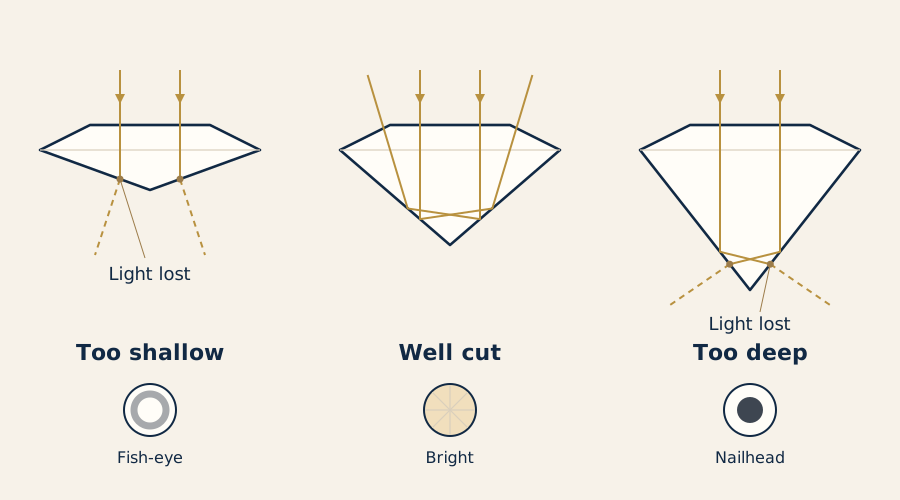
Diamond has a refractive index of about 2.42, which means it bends light strongly, and a critical angle of about 24.4°. Light striking a pavilion facet (on the lower, pointed half of the stone) at more than that angle from the perpendicular is reflected back inside instead of leaking out the bottom. A well-cut stone uses this to bounce light back up through the top. Gemmologists describe the result in three ways:
- Brightness: the white light returned to your eye from the top of the stone.
- Fire: flashes of rainbow colour, caused by diamond's dispersion (about 0.044) splitting white light into colours.
- Scintillation: the pattern of sparkle and contrast you see as the stone, the light or your head moves.
If you are new to the topic, our complete guide to lab-grown diamonds covers the basics, and the glossary of jewellery terms explains any word here you have not met before.
How is cut graded on a lab-grown diamond report?
Only the round brilliant receives a full overall cut grade on most reports, because its proportions can be measured against decades of light-performance research. Which grade you see depends on the laboratory and the report type:
| Laboratory and report | What it says about cut |
|---|---|
| IGI lab-grown diamond report (rounds) | Cut grade on a scale from Ideal and Excellent down through Very Good, Good, Fair and Poor |
| GIA laboratory-grown diamond assessment | A simpler descriptive assessment (Premium or Standard) rather than the full 4Cs grading scale |
| GIA natural diamond grading report (rounds) | Excellent, Very Good, Good, Fair, Poor |
| Most labs, fancy shapes | No overall cut grade; polish, symmetry, measurements and proportions are listed instead |
GIA moved lab-grown diamonds to a simpler descriptive system, so a GIA document for a lab-grown stone will not read like its natural diamond report. Our page on how GIA's Premium and Standard lab-grown assessments differ sets out what each covers. Most lab-grown diamonds sold in Australia carry an IGI report, so IGI's cut scale is the one you will see most often.
Alongside the cut grade, a report gives separate grades for polish (the surface finish of each facet) and symmetry (how precisely the facets line up and meet). The trade shorthand Triple Excellent or 3EX means Excellent (or Ideal) cut, Excellent polish and Excellent symmetry. The report should also state that the stone is laboratory-grown, the growth method (CVD or HPHT) and whether it has had any treatment after growth; see what post-growth treatment means on a report.
What proportions make high quality cut diamonds?
The cut grade is calculated from measured proportions. If you know what the numbers mean, you can see why two Excellent stones still differ. These are typical ranges for top-grade round brilliants; a stone can sit slightly outside one figure and still perform well if the others balance it.
| Measurement | Typical range on top-grade rounds | What goes wrong outside it |
|---|---|---|
| Table (as % of width) | about 54–58% | Too large: less fire. Too small: can look darker and smaller |
| Total depth (% of width) | about 59–62.5% | Too deep: looks small for its weight. Too shallow: dull, glassy look |
| Crown angle | about 34–35° | Flatter crowns return less fire |
| Pavilion angle | about 40.6–41.0° | Below about 40.2°: fish-eye ring. Above about 41.4°: dark centre (nailhead) |
| Girdle | thin to slightly thick | Very thin edges chip; very thick girdles add hidden weight |
| Culet | none or pointed | A large culet shows as a dot in the centre |
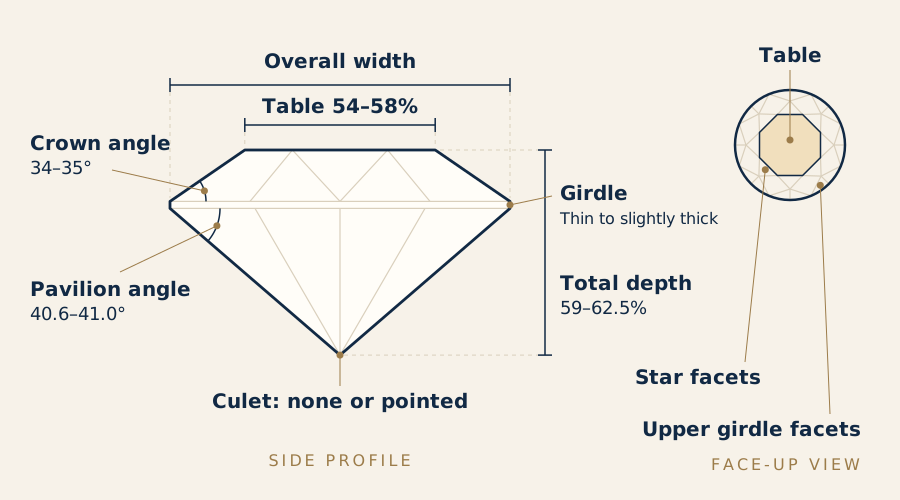
Crown and pavilion angles work as a pair. A slightly steeper crown can balance a slightly shallower pavilion, which is why labs grade the combination rather than each number alone. Two terms worth knowing: a fish-eye is a grey ring that appears when the pavilion is too shallow and the girdle reflects in the table; a nailhead is a dark centre that appears when the pavilion is too deep and light leaks out through the pavilion.
Beyond the report, some sellers show reflector images such as ASET or Idealscope photos, which map where a stone gathers light, and hearts and arrows images, a pattern of eight arrows face-up and eight hearts face-down that appears only when the facets are very precisely aligned. These images are useful evidence, but they show symmetry and light return, not a separate grade.
Are lab-grown diamonds cut better than natural diamonds?
Often, but not automatically. Cutters of natural diamonds have always balanced beauty against weight. A natural crystal that could become a beautifully cut 0.95 carat or a slightly deep 1.01 carat is often cut for the 1.01, because crossing the 1 carat mark is worth more money than the lost sparkle. Lab-grown rough costs much less, so there is less pressure to hold weight and more lab-grown rounds are cut to top grades.
The rough itself also differs. CVD (chemical vapour deposition) diamonds grow layer by layer on a flat seed plate, producing square, tabular crystals. HPHT (high pressure, high temperature) diamonds grow as blocky cuboctahedral crystals. Our page on how lab-grown diamonds are grown by CVD and HPHT explains both. Flat CVD plates can tempt cutters towards shallower stones that face up larger but lose brightness, so proportions still need checking.
| Lab-grown | Natural | |
|---|---|---|
| Cut grading scale | Same optics; IGI grades rounds Ideal to Poor, GIA uses Premium/Standard | GIA and IGI grade rounds Excellent (or Ideal) to Poor |
| Pressure to save weight | Lower, because rough costs less | Higher, especially near 0.50, 1.00 and 2.00 ct |
| Common cut grades on offer | Mostly Ideal or Excellent rounds | Wide spread from Excellent to Good |
| Typical cut risk | Spread (shallow) stones cut to look larger | Deep stones cut to keep weight |
| Price gap between top and average cut | Smaller | Larger |
| Looks to the eye | Identical to natural at the same cut | Identical to lab-grown at the same cut |
A well-cut lab-grown diamond and a well-cut natural diamond look the same, and cut cannot tell you which is which. Only laboratory equipment can separate them, as covered in why lab-grown diamonds pass a standard diamond tester. For a full side-by-side on value, rarity and resale, read our lab-grown vs natural diamond comparison.
Not sure which one is right?
Send us the stones you are looking at and our gemologist will tell you which to choose and why.
How do you judge cut quality in fancy-shaped lab-grown diamonds?
Ovals, pears, emeralds, radiants, cushions and other fancy shapes get no overall cut grade from GIA or IGI, so the judgement falls to you and your jeweller. Check these points on the report and the video:
- Length-to-width ratio: divide length by width. Common preferences are about 1.30–1.50 for ovals, 1.45–1.75 for pears and 1.00–1.05 for a square cushion or princess.
- Depth: most fancy shapes look their best at about 58–66% depth. Deeper stones look smaller for their weight.
- Bow-tie: a dark band across the middle of ovals, pears and marquises. A faint bow-tie that moves is normal; a solid one that never changes is a cut problem.
- Outline symmetry: both halves should mirror each other, with no flat shoulders or bulging sides.
- Girdle at the points: a very thin girdle at a point or corner is more likely to chip.
- Polish and symmetry grades: aim for Excellent or Very Good.
Cut consistency matters even more when stones are paired or used in numbers. Studs need two diamonds with matching size, ratio and light return, which we cover in how to match two lab-grown diamonds for earrings. For the tiny stones in a halo or band, which are rarely graded individually, see lab-grown melee in pavé and halo settings.
Does cut matter more than colour and clarity in a lab-grown diamond?
For most lab-grown buyers, yes. Lab-grown diamonds are commonly sold in high colour grades (often D to H) and eye-clean clarity (often VS), so the stones on offer are already similar in those two Cs. Cut becomes the biggest visible difference between them. A well-cut G colour stone usually looks brighter and whiter than a poorly cut E, because strong light return masks a faint tint. Our guide to lab-grown diamond colour grades explains where colour still matters, such as in larger fancy shapes.
Cut is also what makes a diamond look like a diamond next to its imitations. Moissanite has a higher refractive index (about 2.65–2.69) and more than double diamond's dispersion (about 0.104), so it shows noticeably more rainbow fire. Cubic zirconia has a lower refractive index (about 2.15), a hardness of about 8–8.5 on the Mohs scale against diamond's 10, and its facet edges round and scratch over time. See how moissanite differs from lab-grown diamond and lab-grown diamond compared with cubic zirconia.
Related guideLab-Grown Diamonds for Earrings and Tennis BraceletsWhat should honest lab-grown wording look like in Australia?
Under the Australian Consumer Law, sellers must not mislead or deceive, and the ACCC enforces that rule for jewellery like any other product. In practice, honest wording about a lab-grown diamond and its cut looks like this:
- Say what it is, every time: lab-grown diamond, laboratory-grown diamond or laboratory-created diamond, on the tag, the listing, the invoice and the report.
- Cut claims match the report: Ideal or Excellent only when the grading report says so. Terms such as super ideal or premium cut are a seller's description, not a lab grade.
- Hearts and arrows backed by images: the pattern should be shown in a scope photo, not just claimed.
- Treatments disclosed: if the report notes post-growth treatment, so should the seller.
- No put-downs either way: lab-grown is real diamond, not fake, and natural diamond should not be sold as an investment.
- Ethics and environment claims need evidence: origin is not the same as a verified supply chain.
Two of those claims trip up sellers most often. Our guides on using the term conflict-free carefully and questions to ask about lab-grown sustainability claims explain what a seller should be able to show you.
How much do high quality cut diamonds cost, lab-grown or natural?
A top cut costs more than an average one in both natural and lab-grown diamonds, but the gap is much smaller for lab-grown. That is good news: in lab-grown, choosing the better cut is usually a modest step up rather than a big jump. These are broad, approximate ranges for a 1 carat round, G colour, VS clarity:
| 1 ct round, G, VS | Approximate price range (AUD) |
|---|---|
| Lab-grown, Ideal or Excellent cut | about $1,000–$3,000 |
| Lab-grown, Very Good or Good cut | about $800–$2,500 |
| Natural, Excellent cut | about $9,000–$16,000 |
| Natural, Good cut | about $7,000–$12,000 |
Prices move with the market, and lab-grown prices in particular have fallen over recent years. Cut is only one part of the picture; growth method, size, colour, report type and demand all play a part, as set out in what really sets lab-grown diamond prices. Whatever you pay, insure for replacement value; see whether to insure a lab-grown diamond.
Cut is hard to judge from a photo, which is a real reason to see stones in person or insist on a 360° video and reflector images. Our page on buying lab-grown online versus in a showroom weighs both. The setting matters too: claws that sit too high or cover too much of the crown can dull even a well-cut stone.
Browse lab-grown diamonds
How do you choose high quality cut diamonds? Step by step
- Confirm the report. Check the lab (IGI or GIA), that the stone is stated as laboratory-grown, the growth method, any post-growth treatment and that the laser inscription number matches.
- Read the cut grades. For rounds, aim for Ideal or Excellent cut with Excellent polish and symmetry.
- Check the proportions. Table about 54–58%, depth about 59–62.5%, crown about 34–35°, pavilion about 40.6–41°, girdle thin to slightly thick, no large culet.
- For fancy shapes, do the maths. Work out the ratio, check depth, and look for a fixed bow-tie in a 360° video.
- Look in normal light. View the stone or video away from spotlights, and ask for an ASET or hearts and arrows image if offered.
- Compare face-up size. Compare millimetre measurements, not just carat, and be wary of stones that look large because they are cut shallow.
- Plan the setting and care. Choose claws or a bezel that leave the crown open to light, and keep it clean; see caring for a lab-grown diamond day to day.
Free consultation
Talk to a gemologist
Compare stones in person or online with Raj Sood, Graduate Gemologist (GIA), AJP (GIA).
Book a consultationShop this shape
FAQ
Common questions
Are lab-grown diamonds cut as well as natural diamonds?
They can be cut to exactly the same standard, and many lab-grown rounds are graded Ideal or Excellent. Because lab-grown rough costs less, cutters have less reason to keep extra weight, but you still need to check the proportions on the report.
What is the best cut grade for a lab-grown diamond?
For rounds on an IGI report, Ideal is the top cut grade, with Excellent close behind. Pair it with Excellent polish and symmetry for a well-finished stone.
Does GIA grade cut on lab-grown diamonds?
GIA now uses a simpler descriptive assessment for lab-grown diamonds, describing them as Premium or Standard rather than giving the full 4Cs grades used on its natural diamond reports. IGI reports still give a separate cut grade for lab-grown rounds.
Do fancy-shaped lab-grown diamonds have a cut grade?
Usually not. Most labs list polish, symmetry and proportions for ovals, pears and other fancy shapes, so you judge cut from the ratio, depth, outline and a 360° video.
Is a lab-grown diamond with a shallow cut worth buying?
A slightly shallow stone faces up larger for its weight, but if the pavilion angle drops below about 40.2° it can show a grey fish-eye ring and look glassy. Check the angles and view it in normal light before deciding.
Can you tell a lab-grown diamond from a natural one by its cut?
No. Cut quality looks the same in both, and only laboratory equipment can tell lab-grown from natural diamond. The report and laser inscription are how you confirm which one you have.

Ask a gemologist
Not sure which diamond to choose?
Raj Sood is a Graduate Gemologist (GIA) and master jeweller. Bring the stones you are considering, or send the reports, and he will tell you honestly which one is better and why.
Keep learning
Related guides
 Lab-Grown DiamondsLab-Grown Diamonds vs Natural Diamonds
 Lab-Grown DiamondsGIA Premium vs Standard Lab-Grown Diamond Assessments
 Lab-Grown DiamondsWhat Actually Drives Lab-Grown Diamond Prices?
 Lab-Grown DiamondsShould a Lab-Grown Diamond Be Insured?Lab-Grown DiamondsAre Lab-Grown Diamonds Real DiamondsLab-Grown DiamondsHow Are Lab-Grown Diamonds Manufactured?
 Lab-Grown DiamondsDo Lab-Grown Diamonds Need Different Care?
Explore more
More guides on this topic
Education