
- Education
- Lab-Grown Diamonds
- Lab-Grown Diamond Terms in Australia: ACCC Rules and Honest Wording
Lab-Grown Diamonds
Lab-Grown Diamond Terms in Australia: ACCC Rules and Honest Wording
A lab-grown diamond looks the same as a natural one, so the words used to describe it are your main protection. Here is what lab-grown diamond terms mean, what Australian consumer law expects of sellers, and what to check on the report and receipt.
 Reviewed by Raj Sood, Graduate Gemologist (GIA), AJP (GIA)Master jeweller and Graduate Gemologist (GIA) · reviewed 4 November 2026
Quick answer
Australian Consumer Law, enforced by the ACCC, bans misleading descriptions, so a lab-grown diamond must be clearly identified as lab-grown, laboratory-grown, laboratory-created or synthetic. Words such as 'natural' or 'mined', 'cultured' on its own, or 'eco-friendly' without evidence, can mislead. The grading report and invoice should both say laboratory-grown, and many stones carry a matching girdle inscription.
What do lab-grown diamond terms actually mean?
A lab-grown diamond is real diamond: crystalline carbon with the same hardness (10 on the Mohs scale), the same refractive index (about 2.42, a measure of how strongly a gem bends light) and the same density (about 3.52) as a diamond mined from the ground. The difference is origin. A lab-grown diamond is grown in a reactor over a few weeks, while a natural diamond formed 150 kilometres or more below the surface, typically between one and three and a half billion years ago. For the full background, start with our complete lab-grown diamonds guide.
Because the material is identical, you cannot tell the two apart by eye, by weight or with a basic diamond tester. The only practical way a buyer knows what they are getting is through words: on the price tag, the online listing, the grading report and the invoice. That is why lab-grown diamond terms matter so much, and why honest jewellers are careful with them.
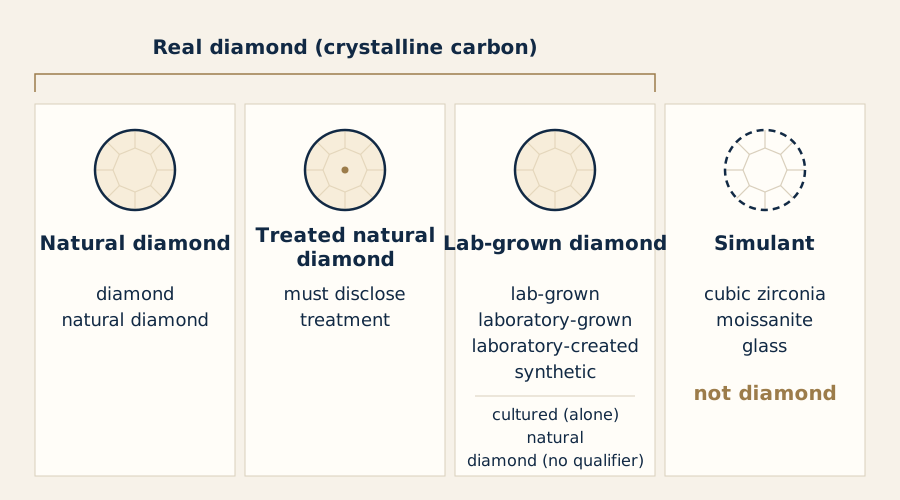
International industry standards, including ISO 18323 (the international standard on diamond terminology) and the CIBJO Diamond Book (the rulebook of the world jewellery confederation), treat the word diamond on its own as meaning a natural diamond. So a lab-grown stone must always carry a qualifier right beside the word diamond: lab-grown, laboratory-grown, laboratory-created, lab-created or synthetic. All five describe exactly the same thing. 'Synthetic' sounds harsh to some people, but in gemmology it simply means made by people with the same chemistry and crystal structure as the natural gem. It does not mean imitation. Our explainer on why lab-grown diamonds count as real diamond covers the science in more depth.
A simulant is something else again: a material that only looks like diamond, such as cubic zirconia, moissanite or glass. Simulants are not diamond at all, so they should only ever be described with the word diamond in a phrase such as 'diamond simulant'. If any of these words are new to you, our plain-English jewellery glossary defines them.
Related guideAre Lab-Grown Diamonds Real DiamondsWhat are the ACCC rules for lab-grown diamonds in Australia?
There is no diamond-specific code in Australian law. Instead, lab-grown diamond sales are covered by the Australian Consumer Law (ACL), which the ACCC (Australian Competition and Consumer Commission) enforces alongside state and territory fair trading offices. The same rules apply to a corner jeweller, a national chain and an overseas website selling to Australians. Three principles do most of the work:
- Section 18, misleading or deceptive conduct: a business must not act in a way that misleads or is likely to mislead. Intent does not matter. What counts is the overall impression left on an ordinary buyer.
- Section 29, false or misleading representations: a business must not make false or misleading claims about goods, including their standard, quality, grade, composition or history. Describing a lab-grown stone as natural, or implying a mined origin, falls squarely here.
- Omissions and fine print: leaving out a key fact can itself mislead. The ACCC's long-standing view is that a disclaimer in small print does not fix a headline that gives the wrong impression.
In practice that means the qualifier should appear wherever the stone is described, and be as easy to see as the word diamond: the product title, the tag, the photo caption, the grading report and the receipt. A listing that says '1.5 ct diamond ring' in large type and mentions 'lab' only in a specifications tab is the kind of thing the overall-impression test is designed to catch. Penalties for companies that breach these provisions can run into tens of millions of dollars, and a buyer who was misled into a purchase may be entitled to remedies such as a refund.
The ACCC has also focused on environmental and sustainability claims, publishing guidance for businesses that says such claims must be specific, accurate and backed by evidence. That matters because lab-grown diamonds are often marketed on ethics and the environment, which we cover below. This page is a buyer's guide rather than legal advice: it sets out the principles so you can spot wording that should prompt a question. They apply equally in a shop and on a screen, as our comparison of buying online versus in a showroom explains.
Which lab-grown diamond terms are allowed, and which mislead?
The table below sorts the wording you will meet into three groups: clear and accepted, acceptable only with care, and words that should make you stop and ask. The accepted terms line up with ISO 18323, the CIBJO Diamond Book and the US Federal Trade Commission's guides for the jewellery industry, which many international sellers also follow.
| Term | Acceptable for lab-grown? | Why |
|---|---|---|
| Lab-grown / laboratory-grown | Yes | Clear, widely understood and matches report wording |
| Lab-created / laboratory-created | Yes | Same meaning; common in the United States |
| Synthetic diamond | Yes | Correct gemmological term; means the same material, not an imitation |
| [Manufacturer]-created diamond | Yes, if clear | Accepted in US guidance, provided 'created' sits right beside 'diamond' |
| Cultured diamond | Not on its own | Borrowed from pearls; ISO and CIBJO advise against it; US guidance allows it only next to 'laboratory-grown' |
| Grown or man-made diamond | Unclear | 'Grown' alone could describe any crystal; it needs 'laboratory' with it |
| Natural, genuine, mined, earth-grown | No | These words imply a stone from the ground |
| Diamond (no qualifier) | No | Under ISO and CIBJO standards, 'diamond' alone means natural |
| Simulant, CZ, moissanite | Different product | Not diamond at all; must never be sold as a diamond of any kind |
Watch also for marketing phrases that sit between categories, such as 'above-ground diamond', 'eco diamond' or 'sustainably created'. They are not automatically misleading, but they should never replace a plain qualifier, and any environmental word needs evidence behind it. Note too that 'real' is a tricky one: a lab-grown diamond genuinely is diamond, but the word 'real' is traditionally used to suggest a natural stone, so CIBJO advises against it for describing lab-grown origin.
Moissanite and cubic zirconia are also made in laboratories, so 'lab-created moissanite' is honest wording, but it is not a diamond. Moissanite is silicon carbide, about 9.25 on the Mohs scale, with a refractive index of about 2.65 and strong double refraction that makes facet edges look doubled under a loupe. Our side-by-side on how lab-grown diamond differs from moissanite goes through the physical differences.
How does a lab-grown diamond compare with a natural diamond?
Physically, very little separates the two. The differences are in how they formed, how a laboratory identifies them, what they are called and what they cost.
| Natural diamond | Lab-grown diamond | |
|---|---|---|
| Material | Crystalline carbon | Crystalline carbon |
| Mohs hardness | 10 | 10 |
| Refractive index | About 2.42 | About 2.42 |
| How it formed | Deep in the earth, mostly 1–3.5 billion years ago | In a CVD or HPHT reactor over a few weeks |
| What a lab looks for | Natural mineral inclusions, nitrogen content (most natural diamonds are type Ia) | Metallic flux inclusions (HPHT), layered growth and strain patterns (CVD); most are type IIa, a type rare in nature |
| Correct name | Diamond or natural diamond | Lab-grown, laboratory-grown, laboratory-created or synthetic diamond |
| 1 ct G–H VS round (approx. AUD) | About $7,000–$15,000 | About $800–$2,500 |
| Second-hand market | Exists, though usually well below the original retail price | Very limited |
Diamond type is a scientific classification based on how much nitrogen or boron sits in the crystal. Roughly 98% of natural diamonds are type Ia, containing measurable nitrogen, while most lab-grown diamonds are type IIa, which is nearly nitrogen-free. Being type IIa does not prove a stone is lab-grown, because some of the world's most famous natural diamonds are type IIa too, but it is one reason gem laboratories screen these stones with advanced instruments such as spectroscopy and fluorescence imaging.
For you as a wearer, this means a standard thermal diamond tester will read both as diamond, and some HPHT-grown stones containing boron can even trigger the moissanite warning on electrical testers. Our page on how lab-grown diamonds behave on a diamond tester explains why. Day to day, both are equally hard and tough, so caring for a lab-grown diamond is the same as caring for a natural one: warm soapy water, a soft brush and a professional check of the claws every year or so.
Not sure which one is right?
Send us the stones you are looking at and our gemologist will tell you which to choose and why.
What should a lab-grown diamond grading report say?
A grading report is an independent laboratory's description of a stone. For a lab-grown diamond it is also the clearest written record of origin, so it is worth knowing exactly where to look. The main laboratories issuing lab-grown reports are IGI (International Gemological Institute), which grades a large share of the lab-grown diamonds sold in Australia, and GIA (Gemological Institute of America), along with others such as HRD and GCAL.
| What to look for | Where it appears | What it tells you |
|---|---|---|
| Report title | Top of the report | Should name a laboratory-grown diamond report, not a standard natural diamond report |
| Origin statement | Near the top or in the comments | The words 'laboratory-grown' or 'lab-grown' stated plainly |
| Growth method | Comments or a dedicated field | CVD or HPHT (explained below) |
| Post-growth treatment | Comments | 'As grown', or a note that the colour was improved after growth |
| Girdle inscription | Inscription field | A laser-etched reference, usually including 'LG' or the word lab-grown plus the report number |
| Grades | Grading section | Colour, clarity and cut on IGI and most other labs; GIA has moved lab-grown reports to a simpler descriptive system |
| Fluorescence | Grading section | How strongly the stone glows under ultraviolet light |
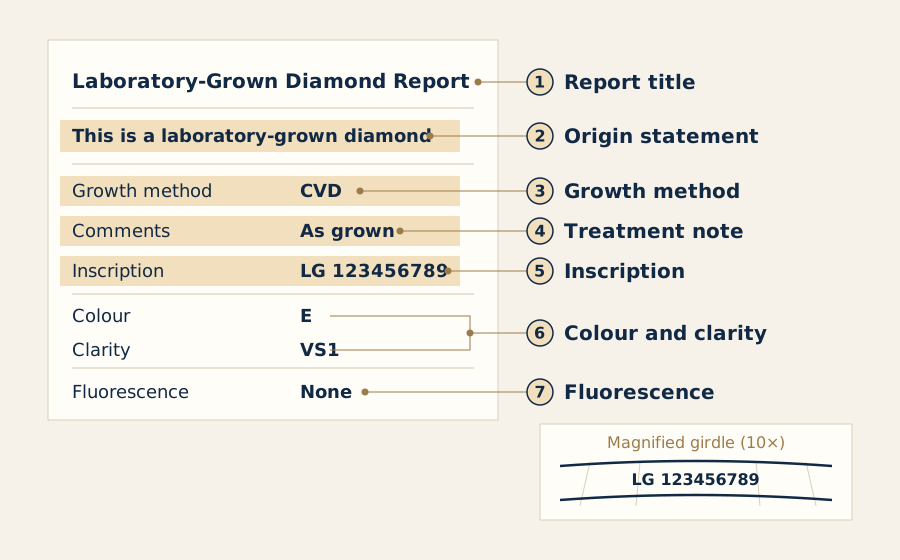
The girdle is the thin outer edge of the diamond, and the inscription on it is microscopic, typically only visible with a 10× loupe or the jeweller's microscope. It links the physical stone to its report, so always check the numbers match. You can also enter the report number on the laboratory's website to confirm the details online. An inscription can be polished off, though, so it supports the report rather than replacing a laboratory test.
Two report fields are worth a closer look. Fluorescence behaves differently in lab-grown stones; some CVD diamonds show orange or red reactions and some HPHT stones glow blue-green, as covered in fluorescence in lab-grown stones. And if you are buying a pair, both reports should show the same origin and similar grades, which our guide to matching a pair of lab-grown stones walks through.
What do CVD, HPHT and 'as grown' mean on a report?
These are the two ways lab-grown diamonds are made, plus a note about what happened afterwards. Neither method is better in itself; a well-made stone from either process can grade highly.
- CVD (chemical vapour deposition): a thin diamond seed plate sits in a vacuum chamber filled with methane and hydrogen. Microwave energy turns the gas into a plasma, and carbon settles on the seed layer by layer. Growth takes several weeks and often produces a slightly brownish crystal.
- HPHT (high pressure, high temperature): a press recreates conditions similar to those deep in the earth, roughly 5–6 gigapascals and 1,300–1,600 °C. Carbon dissolves in a molten metal such as iron, nickel or cobalt and crystallises onto a seed. Tiny metallic inclusions are a common sign.
- As grown: the stone has had no treatment since it left the reactor.
- Post-growth treatment: many CVD diamonds are heated under pressure after growth to remove the brown tint and improve the colour grade. Coloured lab-grown diamonds, such as pinks, are often irradiated and annealed to create their colour. This is legitimate when disclosed, and the report should say so.
Disclosure is the key word. Under the overall-impression test, a seller who knows a stone has been treated should say so, just as they would for a treated natural diamond. If the report notes a post-growth process and the listing does not, ask why. Our step-by-step on how CVD and HPHT growth work shows each stage of production.
Can sellers call lab-grown diamonds sustainable or conflict-free?
This is where honest wording most often slips. Lab-grown diamonds avoid mining, which is a real difference, but that does not make every environmental or ethical claim true. Growing a diamond uses a lot of electricity, and the footprint depends heavily on where that power comes from: a reactor running on hydro or solar power is very different from one running on coal. Cutting and polishing also happen in factories with their own labour and energy questions.
Under the ACCC's guidance on environmental claims, words such as 'sustainable', 'eco-friendly', 'carbon neutral' or 'green' need to be specific and supported by evidence, such as independent certification or published energy data for the actual grower. A vague claim with nothing behind it can mislead even if the seller believes it. The same care applies to ethics: the Kimberley Process, the international certification scheme for rough natural diamonds, defines conflict diamonds narrowly, and 'conflict-free' means different things to different people. Our guide to using the term conflict-free carefully untangles it.
If a seller makes a sustainability claim, it is fair to ask who grew the diamond, what powered the reactor and what independent evidence supports the claim. We have set out the questions to ask about sustainability claims so you can put them to any jeweller, including us.
How much do lab-grown diamonds cost in Australia?
Lab-grown diamonds cost much less than natural diamonds of the same size and grades, and retail prices have fallen steeply over the past several years as production has grown. As a Melbourne jeweller selling both natural and lab-grown diamonds, we see people choose either for sound reasons: some want the rarity and geological story of a natural stone, others want a larger or higher-grade diamond for the same budget. Honest wording should let you compare on fair terms.
| Round lab-grown diamond, G–H colour, VS clarity | Approximate price range (AUD) |
|---|---|
| 0.50 ct | About $400–$1,200 |
| 1.00 ct | About $800–$2,500 |
| 2.00 ct | About $1,800–$5,000 |
| 3.00 ct | About $3,000–$9,000 |
These are broad ranges only and move quickly with the market, the exact grades, the cut quality and the setting. For more detailed figures, see our current Australian lab-grown price ranges, and for the reasons behind them, our page on what pushes lab-grown prices up or down. The lower cost also makes larger total weights realistic in multi-stone pieces, which is why lab-grown stones in earrings and tennis bracelets have become so common.
Price itself is a place where wording matters. Be wary of comparisons that set a lab-grown price against an inflated 'natural equivalent' figure, or of language suggesting a lab-grown diamond will hold or grow its value. The resale market for lab-grown diamonds is very limited, so it is wise to buy one because you like the stone, not as a store of money.
Browse lab-grown diamonds
How to check lab-grown diamond wording before you buy: step by step
- Read the listing or tag. Make sure 'lab-grown', 'laboratory-grown', 'laboratory-created' or 'synthetic' sits right beside the word diamond, as prominently as the carat weight.
- Check the report title and origin statement. It should be a laboratory-grown diamond report from an independent lab such as IGI or GIA.
- Note the growth method and treatment. Look for CVD or HPHT, and whether the stone is 'as grown' or treated after growth.
- Verify the report online. Enter the report number on the laboratory's website and confirm the weight, measurements and grades match.
- Match the inscription. Ask to see the girdle inscription under a loupe or microscope and check it against the report number.
- Question any extra claims. Ask for evidence behind words such as 'sustainable', 'eco' or 'ethical', and be cautious of claims about future value.
- Get it in writing. Your invoice should name the stone as laboratory-grown and quote the report number, which also helps when insuring a lab-grown diamond.
Free consultation
Talk to a gemologist
Compare stones in person or online with Raj Sood, Graduate Gemologist (GIA), AJP (GIA).
Book a consultationShop this shape
FAQ
Common questions
Is it legal to call a lab-grown diamond a diamond in Australia?
Yes, because it is diamond, but it must be clearly qualified as lab-grown, laboratory-grown, laboratory-created or synthetic. Under the Australian Consumer Law, using the word diamond without a qualifier could give the misleading impression that the stone is natural.
What does the ACCC say about lab-grown diamonds?
The ACCC has no diamond-specific code. Lab-grown diamonds fall under the general Australian Consumer Law rules against misleading or deceptive conduct and false representations, which look at the overall impression a description leaves on an ordinary buyer.
Is a synthetic diamond the same as a lab-grown diamond?
Yes. Synthetic, lab-grown, laboratory-grown and laboratory-created all describe the same thing: real diamond made in a laboratory. Synthetic does not mean imitation; an imitation is called a simulant.
Is a cultured diamond the same as lab-grown?
It refers to the same product, but the word cultured is discouraged by ISO and CIBJO standards because it borrows from cultured pearls and can blur the origin. If you see it, it should sit right beside 'laboratory-grown'.
How can I tell if my diamond is lab-grown?
Not by eye or with a basic diamond tester. Check the grading report and the girdle inscription, and if there is no report, a gem laboratory can identify the stone using advanced instruments.
Does the receipt have to say a diamond is lab-grown?
The law does not name a specific document, but leaving the origin off the paperwork could contribute to a misleading impression. It is sensible to ask for 'laboratory-grown diamond' and the report number to be written on your invoice.

Ask a gemologist
Not sure which diamond to choose?
Raj Sood is a Graduate Gemologist (GIA) and master jeweller. Bring the stones you are considering, or send the reports, and he will tell you honestly which one is better and why.
Keep learning
Related guides
 Lab-Grown DiamondsAre Lab-Grown Diamonds Real Diamonds
 Buying Knowledge & Custom ProcessLab-Grown Diamond Price Guide Australia
 Lab-Grown DiamondsAre Lab-Grown Diamonds Conflict-Free? How to Use the Term CarefullyLab-Grown DiamondsShould a Lab-Grown Diamond Be Insured?Lab-Grown DiamondsWhat Actually Drives Lab-Grown Diamond Prices?
 Lab-Grown DiamondsLab-Grown Diamond vs Moissanite
 Lab-Grown DiamondsDo Lab-Grown Diamonds Need Different Care?
Explore more
More guides on this topic
Education