
- Education
- Wedding Bands & Eternity
- Bezel Set Diamond Wedding Band Guide: Styles, Fit, Metals and Care
Wedding Bands & Eternity
Bezel Set Diamond Wedding Band Guide: Styles, Fit, Metals and Care
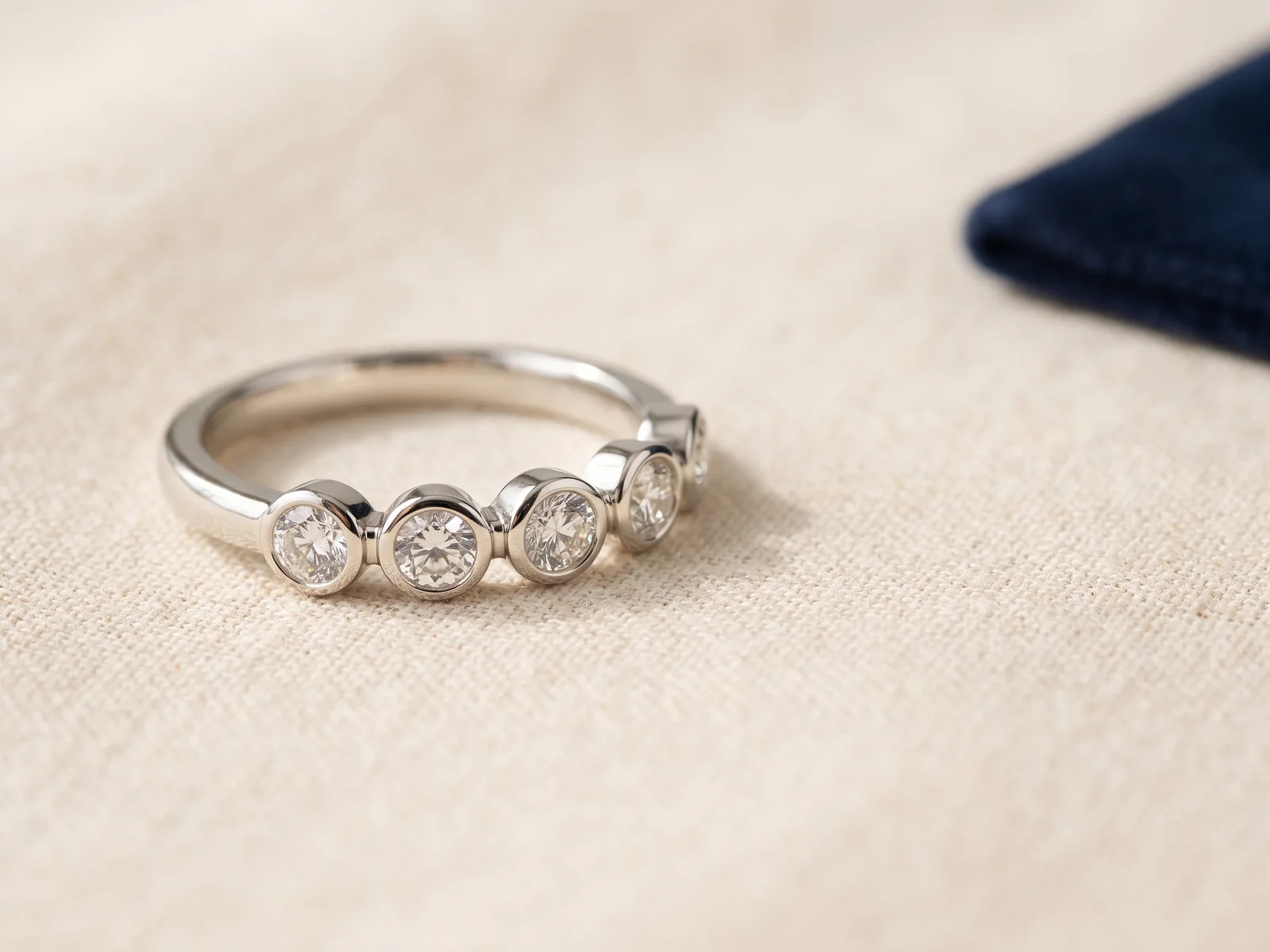
A bezel set diamond wedding band is the low, smooth, snag-free way to wear diamonds every day. Here is how the setting works, what size and metal to choose, and how to make sure it sits neatly beside your engagement ring.
 Reviewed by Raj Sood, Graduate Gemologist (GIA), AJP (GIA)Master jeweller and Graduate Gemologist (GIA) · reviewed 4 November 2026
Quick answer
A bezel set diamond wedding band holds each diamond in a thin collar of metal instead of claws, so the stones sit low, snag-free and protected. Choose full bezels for security or half bezels for more sparkle, stones of about 1.5–3 mm for everyday wear, and a band at least 1.6 mm thick in 18ct gold or platinum.
What is a bezel set diamond wedding band?
A bezel setting holds a diamond inside a thin rim of metal that wraps around its girdle (the narrow outer edge where the top and bottom of the stone meet). Instead of claws gripping the stone at four or six points, the jeweller forms a collar that fits the diamond closely, drops the stone in, then pushes and smooths the metal over its edge. That last step is called burnishing, and it is what locks the stone in place.
A bezel set diamond wedding band repeats that collar for every stone along the band. The result is a ring with a smooth, rounded surface and no raised points to catch on clothing, hair or gloves. If any of these terms are new, our glossary of jewellery terms explains them in plain English, and if you are unsure whether you need a band or a ring, start with the difference between a wedding ring and a wedding band.
Bezel bands come in three common layouts:
- Half eternity: stones across the top third to half of the band, plain metal underneath. Easier to resize and more comfortable between the fingers.
- Full eternity: stones all the way around. More sparkle from every angle, but very limited resizing.
- Station or spaced bezels: individual collars spaced along a plain band, often five to nine stones, for a lighter, more minimal look.
The bezel is also popular for centre stones. If you like the clean look, our guide to bezel set engagement rings covers the same setting holding a single larger diamond.
Full bezel vs half bezel: what is the difference?
A full bezel wraps the entire girdle of every stone in metal. It is one of the most protective settings for small diamonds: the edge, which is the part most likely to chip, is never exposed. The trade-off is that a little less light enters the stone from the sides, and the metal rim frames each diamond, which can make individual stones look slightly smaller face-up.
A half bezel (sometimes called a partial bezel) wraps two opposite sides of each stone, usually the edges facing the outer rims of the band, and leaves the other two sides open. Light can enter between the stones, so a half bezel band looks brighter and the diamonds appear to run together in a line. It still protects the most exposed edges, so it is a good middle ground for people who want sparkle without claws.
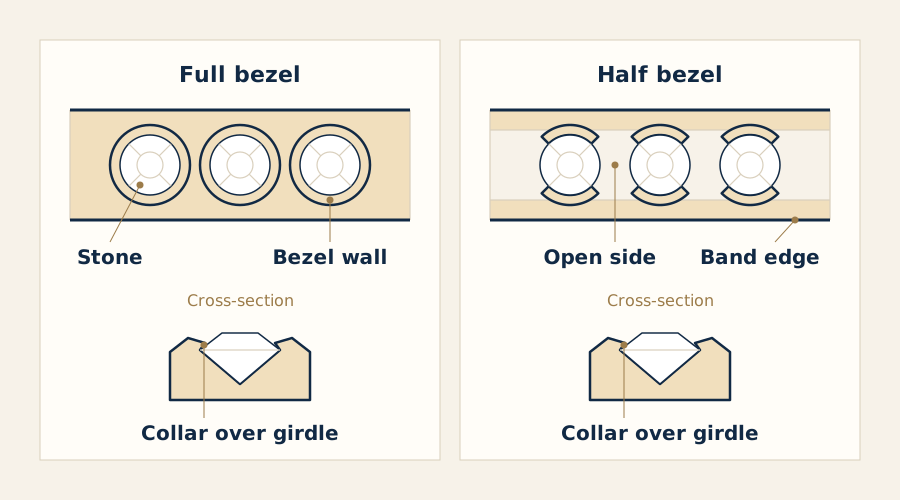
| Full bezel | Half bezel | |
|---|---|---|
| Metal around each stone | The whole girdle | Two opposite sides |
| Light and sparkle | Good; slightly framed look | Brighter; stones read as a line |
| Edge protection | Highest | High on the exposed edges |
| Snag risk | Very low | Very low |
| Cleaning | Dirt can collect under closed backs | Easier; open sides let water through |
| Look | Polka-dot, modern, defined | Continuous, closer to a channel band |
Neither is better in every case. If you work with your hands or wear gloves, a full bezel gives the most peace of mind. If you want the band to sparkle like a claw-set eternity ring while staying smooth, a half bezel is the closer match. If you are still deciding whether to have diamonds at all, our comparison of whether a diamond band or a plain band suits you sets out the practical differences.
How does a bezel setting compare with claw, channel and flush settings?
Diamond wedding bands are commonly made in one of these five settings, as well as pavé. Each holds the stones differently, and that affects sparkle, comfort, security and how easy the ring is to repair later.
| Setting | How stones are held | Snag risk | Sparkle | Security | Resizing and repairs |
|---|---|---|---|---|---|
| Claw (shared prong) | Small claws shared between stones | Higher | Highest; most light enters | Good; claws wear over years | Claws can be re-tipped |
| Channel | Stones sit in a groove between two metal walls | Low | Good from the top | High | Stones can loosen if walls bend |
| Full bezel | A collar of metal around each stone | Very low | Good; framed look | Very high | Bezel opened and re-burnished to replace a stone |
| Half bezel | Metal on two sides of each stone | Very low | Very good | High | Similar to full bezel |
| Flush (gypsy) | Stone sunk into a drilled seat level with the metal | Lowest | Lower; small sparkle points | Very high | Simple; suits thicker bands |
The bezel and the channel look similar from a distance, because both give a smooth line of metal along the band's edges. The difference is that a channel holds every stone between the same two walls, so if one wall is bent, several stones can loosen at once. A bezel holds each stone in its own collar. Our page on channel-set diamonds and how they are repaired goes into that setting in more depth.
Flush setting is the most protective of all, because the stone's table (the large top facet) sits level with the metal surface. It needs a thicker, heavier band and shows less of each diamond, so it is more common in men's bands and in single-stone designs.
What diamond size and how many stones suit a bezel band?
Bezel bands usually use round brilliant diamonds between about 1.5 and 3 mm across. Stones this small are often called melee (small diamonds under about 0.20 carat). Because the bezel wall adds metal on each side, the band ends up about 0.6–1.0 mm wider than the stones themselves.
| Stone size | Approx. carat each | Band width (approx.) | Stones in a full eternity, size N | Approx. total carat |
|---|---|---|---|---|
| 1.5 mm | 0.015 ct | 2.1–2.5 mm | about 24–26 | about 0.35–0.40 ct |
| 2.0 mm | 0.03 ct | 2.6–3.0 mm | about 19–21 | about 0.55–0.65 ct |
| 2.5 mm | 0.06 ct | 3.1–3.5 mm | about 15–17 | about 0.90–1.00 ct |
| 3.0 mm | 0.10 ct | 3.6–4.0 mm | about 13–14 | about 1.30–1.40 ct |
These are typical figures only. The exact count depends on your finger size, how thick the bezel walls are and how much metal sits between the collars. A half eternity uses roughly half the stones, so a 2.0 mm half eternity might carry 9 to 11 diamonds and about 0.30 carat in total.
Most bezel bands use round brilliants, but collars can also hold ovals, marquise or emerald cuts set east-west (turned sideways across the band) for a more distinctive look. Our overview of every diamond shape shows how each outline reads at a small size.
Diamond is 10 on the Mohs hardness scale, with a refractive index of about 2.42, so even small stones throw strong sparkle. Because melee is so small, colour and clarity are much harder to see than in a centre stone. Most bezel bands use G–H colour and VS–SI clarity. In yellow or rose gold, the warm metal of the bezel tints the stones anyway, so slightly warmer colour is rarely noticeable.
Thickness matters as much as width. For a band worn every day, look for at least 1.6 mm of metal under the stones, and closer to 2 mm if you are hard on your hands. The shape of the band in cross-section also changes how it feels; our explainer on band profiles such as court, flat and D-shape shows each one.
Not sure which one is right?
Send us the stones you are looking at and our gemologist will tell you which to choose and why.
Will a bezel set diamond wedding band sit flush with my engagement ring?
This is the question we are asked most. A band sits flush when it touches the engagement ring along its length with no visible gap. Whether a bezel band does that depends far more on your engagement ring than on the band.
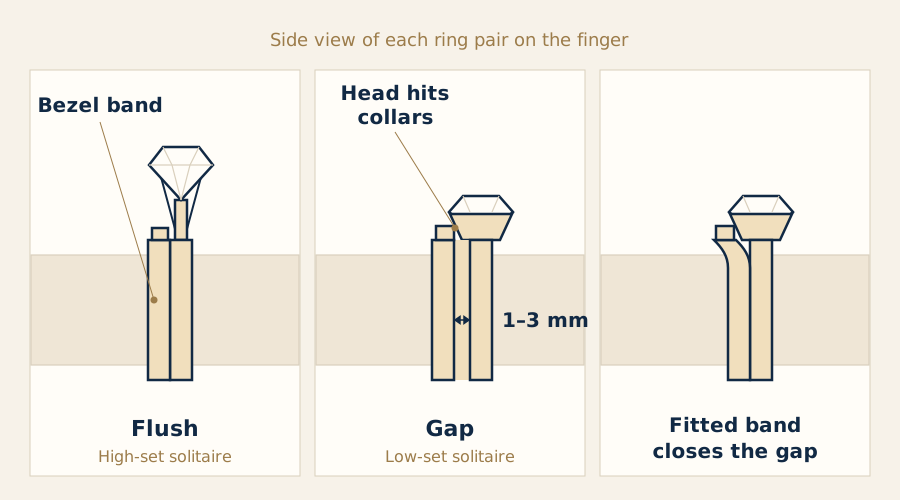
- High-set solitaire: if the centre stone sits well above the finger, a straight bezel band slides underneath and sits flush.
- Low-set or cathedral ring: the head or the shoulders can meet the bezel collars before the bands touch, leaving a gap of 1–3 mm.
- Halo rings: the halo often overhangs the band; a slightly narrower bezel band or a fitted band usually solves it.
- Bezel engagement rings: the centre bezel can clash with the band's collars, so a contoured band or a plain section under the centre stone is common.
A small gap is not a fault. Some people like a little space between the rings, and it stops the metals rubbing. If you want them touching, a contour or fitted band is shaped to curve around the engagement ring. See fitted and curved wedding bands for how they are made, and our guide to matching a band to your engagement ring for style pairings.
Shape matters too. Square and angular centre stones have corners that can catch on round bezel collars; our page on bands that suit a princess cut engagement ring covers that pairing, and a heart's wide lobes raise similar questions, covered in our guide to wedding bands that sit well beside a heart. If your engagement ring is itself bezel set, our notes on pairing a band with a bezel engagement ring explain how to keep both collars from clashing.
Related guideHow to Match a Wedding Band to an Engagement RingWhich metal suits a bezel set wedding band?
The metal does two jobs in a bezel band: it holds the stones, and it forms most of what you see. The common choices:
- Platinum (usually 95% pure): dense and naturally white. When it is scratched, the metal moves rather than wearing away, so a platinum bezel keeps its thickness well over decades. It costs more and feels heavier.
- 18ct white gold: 75% gold alloyed with whiter metals and usually rhodium plated for a bright white finish. The plating wears and is typically renewed every year or two, depending on wear.
- 18ct yellow or rose gold: warm colours that suit vintage-style rings and make the bezel collars read as a feature. No plating needed.
- 14ct and 9ct gold: less gold and more alloy, so they are a little harder and cost less, but they tarnish more readily over time than 18ct.
Most people match the band's metal to their engagement ring, because two different metals worn together for years can wear each other unevenly. Our guide to choosing wedding ring metals compares weight, colour and upkeep in more detail.
Is a bezel set diamond wedding band good for everyday wear?
For most people, yes. A bezel band has no claws to snag on knitwear, hair or surgical gloves, and the metal collar protects each stone's edge from knocks. That makes it a common choice for nurses, vets, chefs, tradespeople and anyone who washes their hands often. The low profile also means the band sits comfortably against the fingers on either side.
Bezels are not indestructible. A hard knock can dent a collar, and a dented collar can loosen its stone. Closed-back bezels, where metal covers the underside of the stone, can trap soap and lotion, which dulls the diamonds. Open-back bezels let light and water through and stay brighter.
Bezel bands also suit men's rings, often as a single bezel or flush set diamond in a wider band. Our men's wedding band styles page covers widths, profiles and stone options for those designs.
How much does a bezel set diamond wedding band cost in Australia?
Bezel setting takes more bench time than claw setting, because each collar is formed, fitted and burnished by hand. That labour, plus the metal and the total carat weight, sets the price. Bands can use natural diamonds or laboratory-grown diamonds. Lab-grown diamonds are real diamond, grown in a laboratory rather than mined; they look the same and cost much less, especially as total carat weight rises.
| Band (18ct gold, G–H, VS–SI) | Lab-grown (approx. AUD) | Natural (approx. AUD) |
|---|---|---|
| Half eternity, about 0.30 ct total | about $1,500–$2,800 | about $2,200–$4,000 |
| Full eternity, about 0.60 ct total | about $2,000–$3,800 | about $3,500–$6,500 |
| Full eternity, about 1.00 ct total | about $2,500–$4,500 | about $5,000–$9,000 |
These are broad ranges only and move with metal and diamond prices. Platinum usually adds several hundred to over a thousand dollars, depending on band weight. A full eternity costs more than a half eternity of the same stone size, because it carries roughly twice the diamonds and twice the setting work. To weigh that cost against a band with no stones at all, see how plain and diamond bands compare on price and upkeep.
Create your eternity ring or wedding band
How do you care for and repair a bezel set band?
Clean the band every few weeks in warm water with a drop of dishwashing liquid and a soft toothbrush, working the bristles around the base of each collar. Rinse well and dry with a lint-free cloth. Have it checked by a jeweller about once a year, especially if you wear it daily.
- Loose stone: the jeweller re-burnishes the collar to close it back over the girdle.
- Chipped or lost stone: the bezel is opened, a matched diamond fitted and the collar closed again.
- Dented collar: can usually be reshaped, though a badly thinned wall may need to be rebuilt.
- Resizing: half eternity bands can usually be resized through the plain section; full eternity bands generally cannot be resized by more than a fraction of a size, if at all, so measure carefully before you order.
Repairs to bezel bands are similar in principle to other set bands; our page on how jewellers repair set diamond bands explains the bench work involved.
How do you choose a bezel set diamond wedding band? Step by step
- Bring your engagement ring. Try bands beside it and look from the side for gaps or collars hitting the setting.
- Choose full or half bezel. Full for the most protection, half for more light and a continuous line of diamonds.
- Pick half or full eternity. Half eternity if you may need resizing later; full eternity only once your size is settled.
- Set the stone size. About 1.5–2.5 mm for a fine band, 3 mm for a bolder one; check the total width in millimetres.
- Check the thickness. Ask for at least 1.6 mm of metal under the stones for daily wear.
- Match the metal. Usually the same metal as your engagement ring, so the two wear evenly.
- Confirm natural or lab-grown. Ask for the diamonds' origin, colour and clarity in writing.
- Decide if it needs to be fitted. If there is a gap you do not want, ask about a contour or custom fitted band shaped to your ring.
For everything else, from budgets to engraving and timing, read our full wedding ring buying guide.
Free consultation
Talk to a gemologist
Compare stones in person or online with Raj Sood, Graduate Gemologist (GIA), AJP (GIA).
Book a consultationShop this shape
FAQ
Common questions
Are bezel set wedding bands less sparkly than claw set bands?
Slightly, because the metal collar blocks some light from the sides. A half bezel lets in much more light and comes close to a claw-set band, while staying smooth and snag-free.
Can a bezel set eternity ring be resized?
A half eternity bezel band can usually be resized through its plain section. A full eternity band has stones all the way around, so it generally cannot be resized by more than a fraction of a size, if at all.
Do bezel set diamonds fall out?
Rarely. In a full bezel each stone is held by metal around its whole edge, and a half bezel still grips two sides, which is very secure. A hard knock can dent a collar and loosen a stone, so have the band checked about once a year.
Will a bezel set wedding band fit with my engagement ring?
It depends on how high your engagement ring sits. High-set rings usually sit flush with a straight bezel band; low-set, halo and bezel engagement rings may need a contoured or fitted band to close the gap.
Can I get a lab-grown bezel set wedding band?
Yes. Lab-grown diamonds are real diamond and are widely available in the small sizes used in bezel bands. They look the same as natural diamonds and cost considerably less.
Are bezel set bands good for nurses and healthcare workers?
They are a common choice, because there are no claws to tear gloves or trap dirt on top. Choose an open-back design and clean it regularly, as frequent hand washing can leave residue under the stones.

Ask a gemologist
Not sure which diamond to choose?
Raj Sood is a Graduate Gemologist (GIA) and master jeweller. Bring the stones you are considering, or send the reports, and he will tell you honestly which one is better and why.
Keep learning
Related guides
 Wedding Bands & EternityHow to Match a Wedding Band to an Engagement Ring
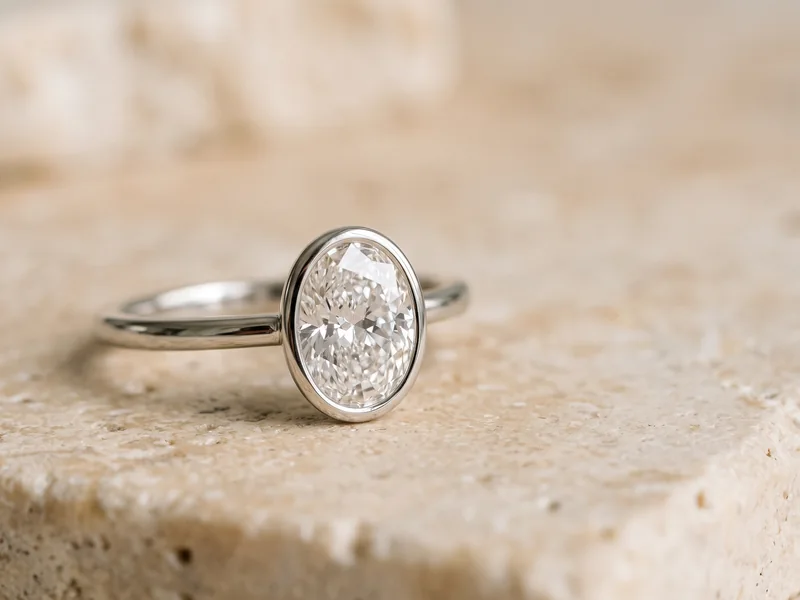 Engagement Rings & SettingsBezel Set Engagement Rings
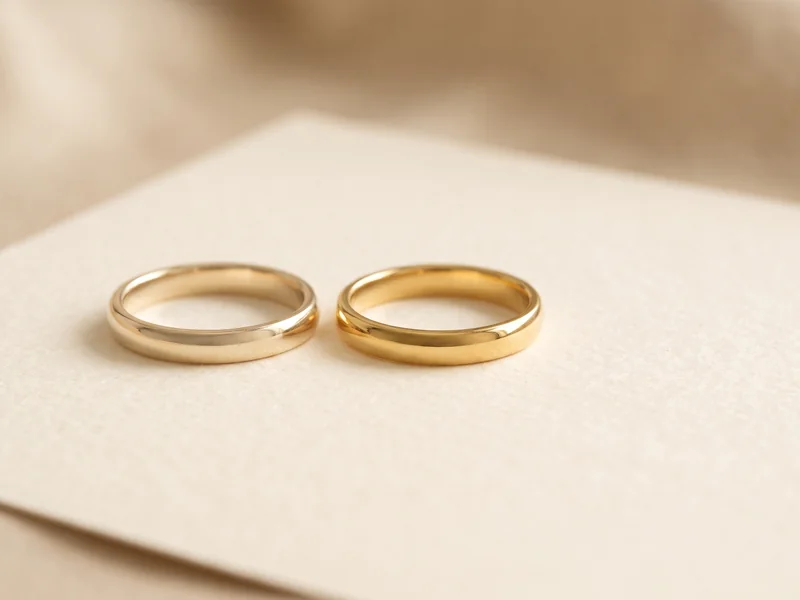 Wedding Bands & EternityFitted Wedding Bands Explained | Custom Curved BandsWedding Bands & EternityWedding Ring Buying Guide
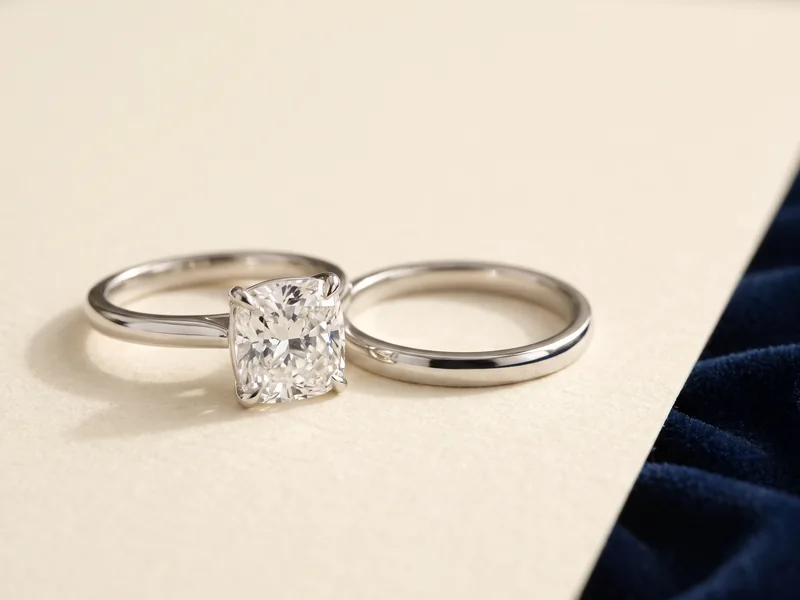 Wedding Bands & EternityWedding Ring vs Wedding Band
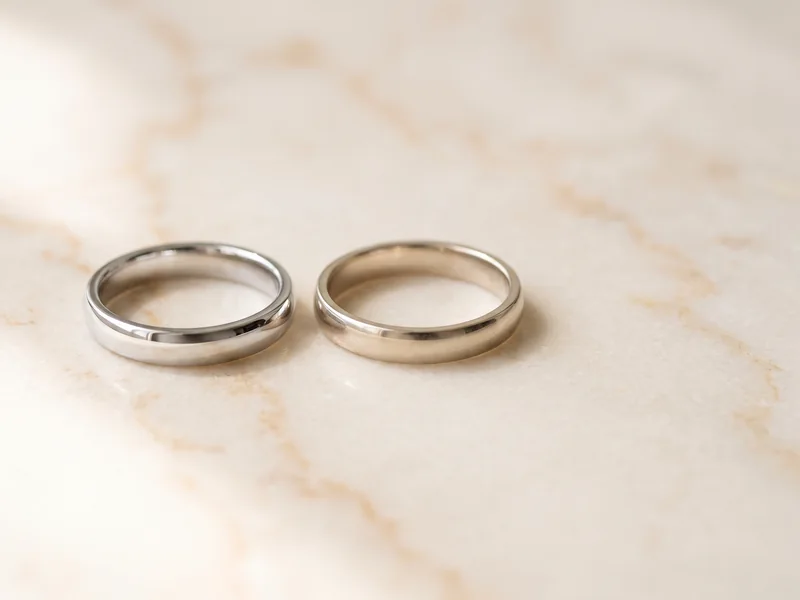 Wedding Bands & EternityMen’s Wedding Band Guide
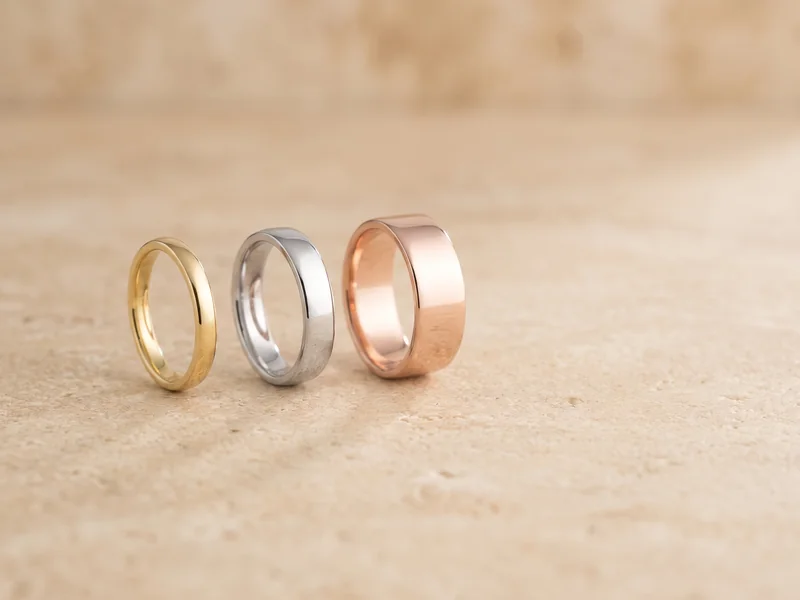 Wedding Bands & EternityWedding Band Profiles Explained
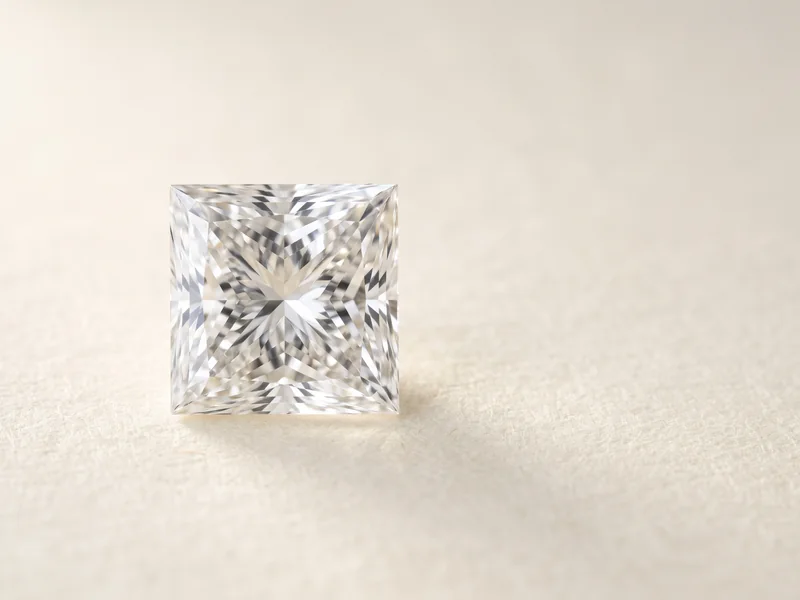 Wedding Bands & EternityBest Wedding Band for Princess Engagement Rings
Explore more
More guides on this topic
Education