
- Education
- Wedding Bands & Eternity
- Wedding Ring vs Wedding Band: How to Choose a Wedding Band for Your Engagement Ring
Wedding Bands & Eternity
Wedding Ring vs Wedding Band: How to Choose a Wedding Band for Your Engagement Ring
Most Australians say wedding ring and wedding band interchangeably, but the words hint at a real choice. Here is what each term means, and how to choose a wedding band for your engagement ring so the two sit well together for decades.
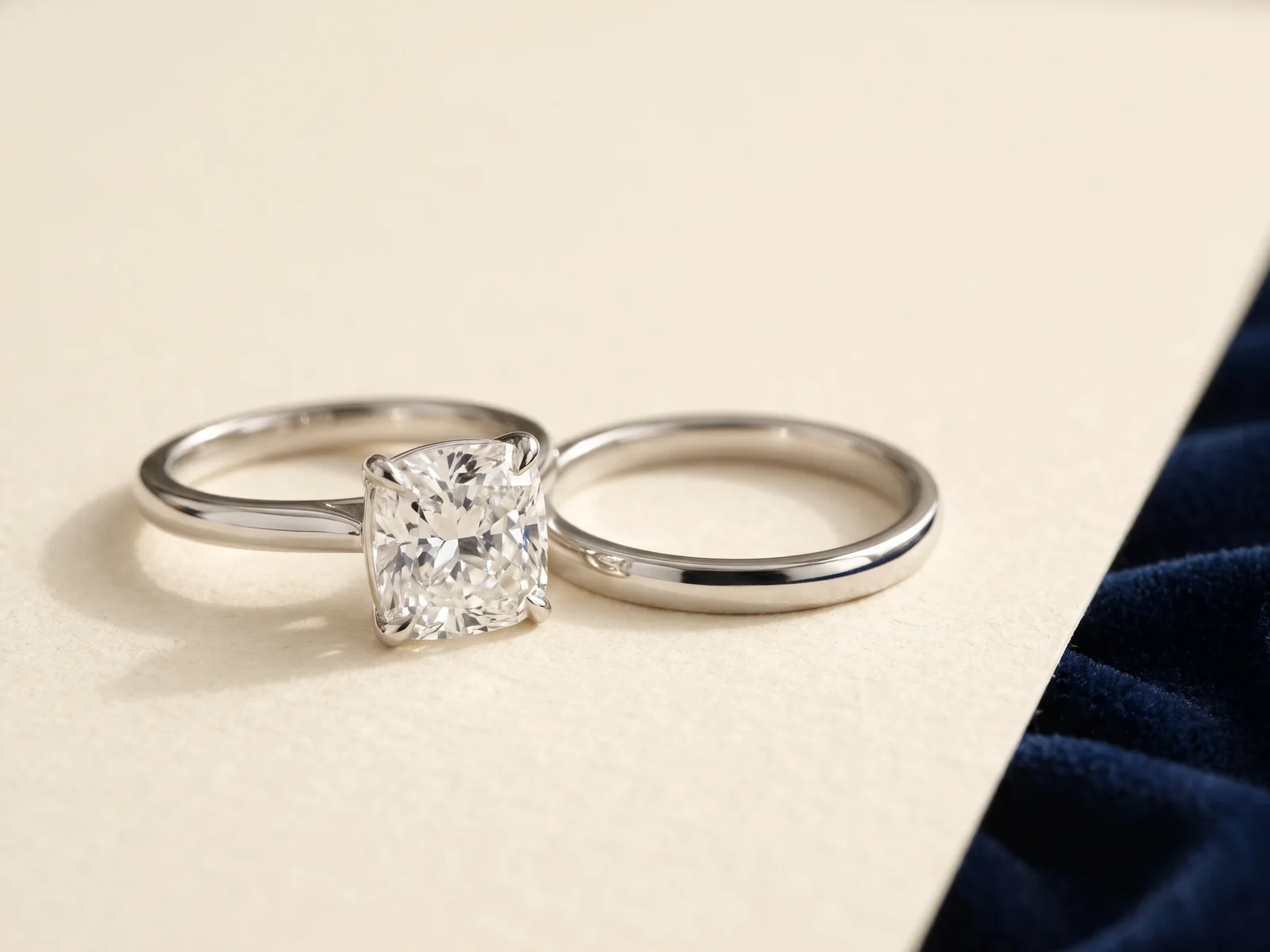
 Reviewed by Raj Sood, Graduate Gemologist (GIA), AJP (GIA)Master jeweller and Graduate Gemologist (GIA) · reviewed 4 November 2026
Quick answer
In Australia, “wedding ring” and “wedding band” mean the same thing: the ring exchanged at the ceremony, with “band” stressing its slim, even shape. To choose a wedding band for an engagement ring, match the metal, decide between a flush fit and a small gap, keep the width similar (about 1.5–3 mm) and choose a comfortable profile.
What is the difference between a wedding ring and a wedding band?
In everyday Australian use, wedding ring and wedding band mean the same thing: the ring you exchange during the ceremony and wear afterwards. Jewellers tend to say “band” because most wedding rings are a continuous loop of metal of even width, with or without small diamonds, while “ring” is simply the broader word. Neither is more correct, and you will see both used side by side in our complete wedding ring buying guide.
Where the words do start to matter is in what sits around the band. An engagement ring carries a centre stone, usually raised in a setting. A bridal set is an engagement ring and wedding band designed to be worn together. An eternity ring is a band set with stones all the way round (full eternity) or across the top only (half eternity). It is often given later, for an anniversary or a birth, although many people now wear one as their wedding band.
| Term | What it means | Typical look |
|---|---|---|
| Wedding ring | The ring exchanged at the ceremony; in Australia, the same as a wedding band | Any style |
| Wedding band | The same ring, with the word stressing a band of even width | Plain or diamond-set, about 1.5–8 mm wide |
| Engagement ring | Given at the proposal; carries a centre stone | Solitaire, halo, three-stone and so on |
| Bridal set | Engagement ring and band made to sit together | Matched metal, flush or contoured fit |
| Eternity ring | A band set with stones all or half the way round | Often given later; sometimes worn as the wedding band |
So the real question behind “wedding ring vs wedding band” is rarely vocabulary. It is how the band will sit, look and wear beside the engagement ring you already have, every day, for decades. That is what the rest of this guide covers. Any term here you have not met before is defined in our A to Z of jewellery terms.
Which finger and in what order do you wear a wedding band and engagement ring?
In Australia both rings usually go on the fourth finger of the left hand. The common custom is to wear the wedding band closest to the hand, with the engagement ring above it, so the band sits “nearest the heart”. There is a practical reason too: most engagement ring settings are designed to rest on top of a slim band, rather than have a band push against them from above.
Customs vary. In several European and Orthodox traditions the wedding ring is worn on the right hand, and plenty of Australians move the engagement ring to the right hand after the wedding, or wear only the band at work. None of these is wrong, but the order changes which band shapes work, because a band worn above the engagement ring meets the setting from the other side.
- Band first, engagement ring on top: the traditional order and the one most bands are designed around.
- Engagement ring first, band on top: works with straight bands and low settings; check the band does not lever the setting sideways.
- Soldered together: a jeweller joins the two rings at the base so they never twist apart. Neat and comfortable, but you can no longer wear them separately, and any resize means working on both.
Should a wedding band sit flush or leave a gap?
A band sits flush when it touches the engagement ring along its whole length, with no daylight between them. That happens when the engagement ring’s setting is high enough for a straight band to slide under the gallery (the side of the setting beneath the stone), or when the setting is narrow enough not to overhang the shank (the band of the engagement ring itself).
A gap appears when something on the engagement ring sticks out below the shank line: a low bezel, a halo, a wide basket of claws, or a large or elongated stone such as an oval, pear or marquise over about 1 carat. A straight band then rests against that widest point and stands off from the shank, usually by somewhere between 1 and 3 mm. Some people like the look, others find it untidy. Our guide to how much gap is normal between the two rings shows what each distance looks like on the hand.
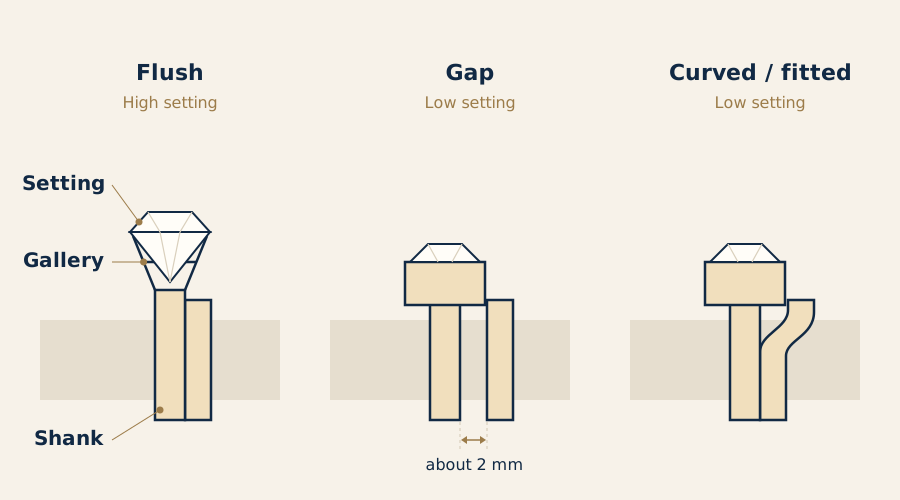
If a straight band will not sit flush, you have four main options:
- Accept the gap: simplest and keeps both rings independent.
- Curved or contour band: a band with a gentle dip that follows the setting. Compare the look in our curved vs straight wedding band comparison.
- Fitted band: a band shaped to match your exact engagement ring, often made from a scan or impression of it. See how custom fitted bands are made.
- Notched band: a straight band with a small cut-out where the setting sits; tidy, but only suits that one engagement ring.
Low settings are the most common cause of a gap, because the stone sits close to the finger for everyday practicality. If yours is one of them, our page on bands that pair with low-profile settings goes through the choices in detail.
What width and profile should a wedding band be?
The profile is the shape of the band’s cross-section, as if you sliced through it. It changes how the band feels, how it catches light and how well it sits next to another ring.
- Flat: square edges and a flat top. Sits neatly against an engagement ring but can feel sharper on the finger.
- Court (comfort fit): rounded inside and out. Slides on easily and is the most comfortable for wide bands.
- D-shape (half-round): flat inside, domed outside. A classic look that pairs well with most engagement rings.
- Knife-edge: the outside rises to a ridge. Looks finer than its width, popular beside solitaires.
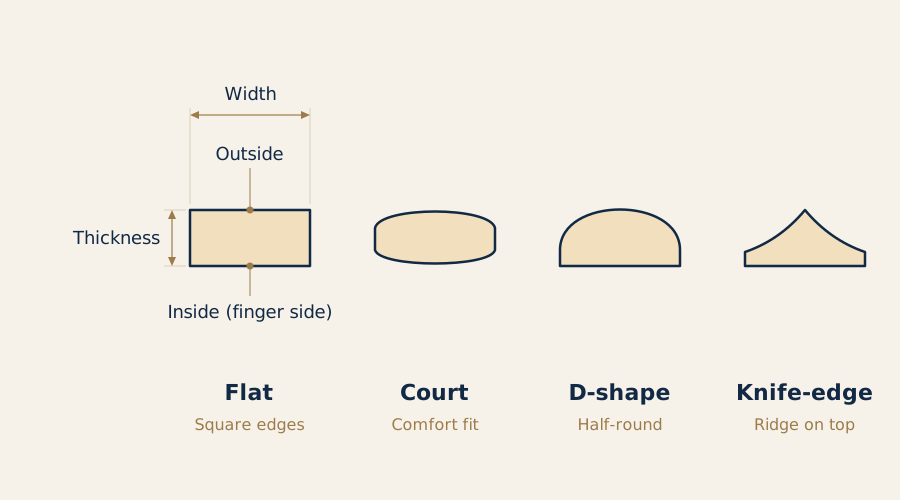
| Width | How it looks | Typical wearer |
|---|---|---|
| 1.5–2 mm | Fine and delicate; lets the centre stone lead | Beside most solitaires and halos |
| 2–3 mm | Balanced; matches most engagement ring shanks | The most common choice for a pair |
| 3–4 mm | Noticeable; can overpower a fine engagement ring | Worn alone or beside a wider shank |
| 4–6 mm | Classic men’s width | Most men’s bands |
| 6–8 mm | Bold and substantial | Larger hands, or a statement band |
A good rule is to keep the wedding band within about 0.5 mm of the engagement ring’s shank width, so the pair reads as a set. Thickness (the depth from inside to outside) matters too: bands under about 1.3–1.5 mm thick can bend over years of daily wear, especially in softer metals. Our guide to every wedding band profile, with pros and cons covers the less common shapes, and the men’s wedding band guide covers widths, alternative metals and comfort for wider bands.
Not sure which one is right?
Send us the stones you are looking at and our gemologist will tell you which to choose and why.
How to choose a wedding band for each engagement ring shape?
The centre stone’s shape decides how much it overhangs the shank, and that decides whether a straight band can sit flush. This table is the quickest way to see what usually happens:
| Engagement ring | With a straight band | Common band choices |
|---|---|---|
| Round solitaire, high setting | Usually sits flush | Plain or diamond band, 1.5–2.5 mm |
| Round or any shape with a low halo | Often a small gap | Curved or fitted band |
| Oval, pear, marquise | Wide or pointed stone can push the band away | Curved, fitted or notched band |
| Princess, emerald, radiant, Asscher | Square corners and claws can catch | Straight band with low claws, channel or bezel setting |
| Cushion | Flush if the setting is raised; gap if it has a low halo | Straight or fitted band |
| Heart | Wide lobes and a point can catch a straight band | Contoured band |
| Three-stone | Side stones widen the setting | Fitted band, or accept a gap |
Rounds are the easiest shape to pair; see our guide to bands that suit round engagement rings. Square shapes need a little more care, because the corner claws sit low and can rub a diamond band. Our princess-cut band pairing guide shows which settings avoid that. Cushions often come with a halo, which changes everything; the cushion engagement ring band guide covers both the solitaire and halo versions.
Plain or diamond wedding band: which suits your engagement ring?
A plain band lets the centre stone do the talking, wears well, can be engraved inside and is straightforward to resize. A diamond band adds sparkle and can make a modest centre stone look part of a larger design. Neither is the default; our plain vs diamond wedding band breakdown compares cost, upkeep and look.
If you choose diamonds, the setting style matters for both look and wear:
- Shared-prong (shared-claw): each claw holds two neighbouring stones, showing the most diamond and the least metal.
- Channel: stones sit between two walls of metal, with no claws to catch hair or clothes.
- Bezel: each stone sits in its own thin rim of metal; very secure and smooth to touch.
- Pavé: tiny stones held by small beads of metal, giving a carpet of sparkle on a fine band.
Our page on shared-prong vs channel-set bands explains which one suits an active life, and bezel-set diamond bands covers the smoothest option. As a guide, a 2 mm band usually carries stones of about 1.5–2.0 mm (roughly 0.015–0.03 carat each); larger stones need a wider band and stand taller. Get the proportions right with our guide to diamond sizes for wedding bands.
Small diamonds in bands can be natural or laboratory-grown. Lab-grown diamonds are real diamond, grown in a laboratory rather than mined, and cost much less; natural diamonds are mined and rarer. Whichever you choose, the paperwork should say which it is. One practical note: a full eternity band, set all the way round, usually cannot be resized by more than a fraction of a size, so it pays to measure carefully.
Does the wedding band need to match the engagement ring metal?
It does not have to, but there are good reasons to match both the metal and its purity. Rings worn together rub against each other thousands of times a day, and the harder metal slowly wears the softer one. An 18ct white gold band next to a platinum engagement ring will, over years, usually wear the platinum more, because most white gold alloys are harder; a 9ct band beside an 18ct ring can wear the 18ct shank.
| Metal | Pure content | Points to know |
|---|---|---|
| Platinum (950) | 95% platinum | Dense and heavy; scratches move metal rather than lose it, so it develops a soft patina |
| 18ct gold | 75% gold | Rich colour; white gold is usually rhodium-plated and needs replating every year or two |
| 14ct gold | 58.5% gold | Harder wearing than 18ct, slightly paler colour |
| 9ct gold | 37.5% gold | Lower cost; colour differs noticeably from 18ct side by side |
Colour is the other reason. Rhodium-plated white gold and platinum look identical when new, but once the plating wears the gold shows a faint warm tint, and the pair stops matching. Mixing colours on purpose, such as a yellow gold band beside a platinum engagement ring, is a perfectly good look; just keep the purities similar so neither wears faster.
Should you design the engagement ring and wedding band together?
If you can, it helps. When both rings are planned at once, the jeweller can set the head of the engagement ring at a height that lets a straight band sit flush, match the shank and band widths exactly and use the same alloy for both. Often this is done in CAD (computer-aided design), where you see the pair modelled before any metal is cast. Our guide on planning both rings at the same time covers the trade-offs, including the case for keeping the proposal a surprise.
If the engagement ring already exists, a band can still be made to suit it. This is especially common with older rings, whose settings were not designed with a modern band in mind. See making a band around an heirloom ring for how the old ring is measured and protected during the process.
For couples, the partner’s band is a separate decision. Some choose the same metal and profile, others pick completely different styles. Our piece on whether couples’ bands need to match looks at the options, from identical bands to a shared engraving inside two different rings.
Related guideHow to Match a Wedding Band to an Engagement RingHow much does a wedding band cost in Australia?
Price depends mainly on metal, width and weight, then on any diamonds and how much custom work is needed. These are broad ranges only; metal prices move often, and exact quotes depend on size and design.
| Band type | Approximate price range (AUD) |
|---|---|
| Plain 18ct gold, about 2 mm | about $800–$1,800 |
| Plain platinum, about 2 mm | about $1,200–$2,500 |
| Men’s plain 18ct gold, about 5 mm | about $1,800–$4,000 |
| Lab-grown diamond half-eternity, about 0.25–0.50 ct total | about $1,200–$3,000 |
| Natural diamond half-eternity, about 0.25–0.50 ct total | about $2,000–$5,000 |
| Custom fitted or curved band | about $1,500–$4,000 or more |
Wider and heavier bands cost more because they use more metal; platinum costs more than 18ct gold for the same design partly because it is much denser, so a band weighs more. Diamond bands rise with total carat weight and whether the stones are natural or lab-grown. A fitted band costs more than a straight one because it is shaped to a single engagement ring.
Create your ring or wedding band
How to choose a wedding band for an engagement ring, step by step
- Check the side view. Look at your engagement ring from the side and note whether the setting or halo sits below the shank line.
- Decide flush or gap. If the setting overhangs, choose between accepting a gap, a curved band or a fitted band.
- Match the metal and purity. Use the same metal and carat as the engagement ring so neither wears the other faster.
- Match the width. Keep the band within about 0.5 mm of the engagement ring’s shank width, usually 1.5–3 mm.
- Choose the profile. Flat or knife-edge sits neatly against a solitaire; court or D-shape is most comfortable for daily wear.
- Pick plain or diamond. If diamond, choose a setting style that will not rub the engagement ring’s claws.
- Try them together. Wear both for several minutes, in the order you plan to wear them, before you decide.
- Confirm the size. Wide bands and full eternity bands often need a half size larger and can be hard to resize later.
Once the pair is on your hand, a little care keeps them sitting well together. Our wedding band care checklist covers cleaning, claw checks and when to replate white gold.
Free consultation
Talk to a gemologist
Compare stones in person or online with Raj Sood, Graduate Gemologist (GIA), AJP (GIA).
Book a consultationShop this shape
FAQ
Common questions
Is a wedding ring the same as a wedding band?
Yes, in Australia the two terms mean the same thing: the ring exchanged at the wedding ceremony. “Band” simply stresses the ring’s even, continuous shape.
Does the wedding band go on before the engagement ring?
Traditionally yes; the band is worn closest to the hand and the engagement ring sits above it. Many people wear them the other way round, and either order is fine as long as the band does not push the setting sideways.
Does my wedding band have to match my engagement ring?
It does not have to match in style, but matching the metal and purity helps both rings wear evenly. Mixed metal colours are a deliberate look many people like.
Why won’t my wedding band sit flush with my engagement ring?
The setting, halo or stone sits lower or wider than the engagement ring’s shank, so a straight band rests against it. A curved, notched or fitted band can close the gap.
How wide should a wedding band be next to an engagement ring?
Most women’s bands beside an engagement ring are about 1.5–3 mm, ideally within about 0.5 mm of the engagement ring’s shank. Men’s bands are usually 4–6 mm.
Can a diamond wedding band be resized?
A half-eternity band can usually be resized a size or so through the plain metal at the back. A full eternity band, set all the way round, generally cannot be resized more than a fraction of a size.

Ask a gemologist
Not sure which diamond to choose?
Raj Sood is a Graduate Gemologist (GIA) and master jeweller. Bring the stones you are considering, or send the reports, and he will tell you honestly which one is better and why.
Keep learning
Related guides
 Wedding Bands & EternityHow to Match a Wedding Band to an Engagement RingWedding Bands & EternityHow Much Gap Should There Be Between an Engagement Ring and Wedding Band?
 Wedding Bands & EternityCurved vs Straight Wedding BandsWedding Bands & EternityFitted Wedding Bands Explained | Custom Curved BandsWedding Bands & EternityWedding Ring Buying Guide
 Wedding Bands & EternityMen’s Wedding Band Guide
 Wedding Bands & EternityWedding Band Profiles Explained
 Wedding Bands & EternityBest Wedding Band for Princess Engagement Rings
Explore more
More guides on this topic
Education