
- Education
- Wedding Bands & Eternity
- Fitted Wedding Band Guide: Contoured, Notched and Shadow Bands That Sit Flush
Wedding Bands & Eternity
Fitted Wedding Band Guide: Contoured, Notched and Shadow Bands That Sit Flush
A gap between your engagement ring and wedding band is common, and a fitted wedding band is the usual fix. Here is how fitted bands work, which style suits each ring shape and how one is designed without forcing the look of your engagement ring.
 Reviewed by Raj Sood, Graduate Gemologist (GIA), AJP (GIA)Master jeweller and Graduate Gemologist (GIA) · reviewed 4 November 2026
Quick answer
A fitted wedding band is a band shaped to follow your engagement ring, so the two sit flush with no gap. It is usually contoured (curved or V-shaped) or notched to clear the centre setting. You need one when the setting sits low or has a halo, bezel or wide claws; if not, a straight band will usually sit flush.
What is a fitted wedding band?
A fitted wedding band is a wedding band shaped to sit snugly against one particular engagement ring. Instead of a plain straight circle, the band is curved, notched or cut away exactly where the engagement ring's centre setting would otherwise push it aside. The result is two rings that touch along their whole length, with no wedge of skin showing between them. If you are still sorting out the terms, our explainer on how a wedding ring differs from a wedding band covers the basics.
Jewellers use several names for the same idea: contoured band, curved band, shaped band, notched band, shadow band, or simply a band that 'sits flush'. They all solve the same problem, and the right one depends on how your engagement ring is built. Words such as gallery, shank and halo come up a lot below; each is defined in our glossary of jewellery terms.
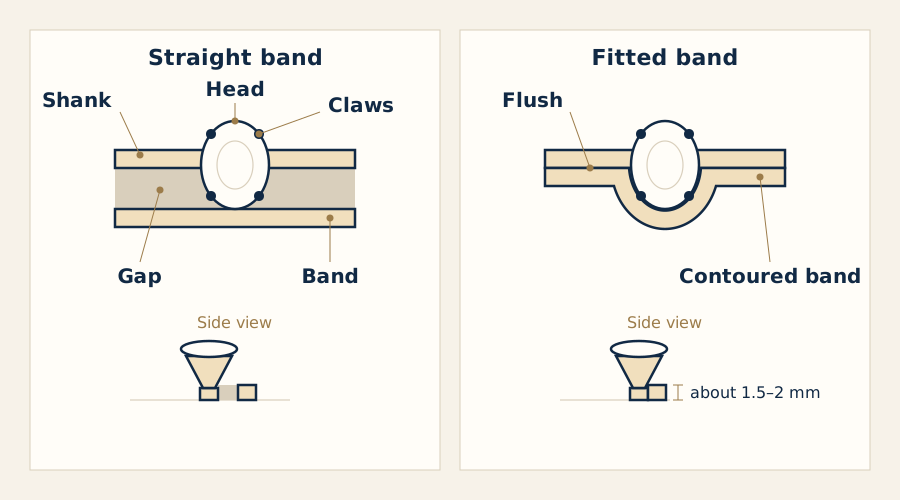
Seen from above, flush means the inside edges of both rings touch all the way around the finger. Seen from the side, it means the band slides under or around the head (the part of the engagement ring that holds the centre stone) instead of bumping into it. A gap of even 1–2 mm is easy to see on the hand. It also traps soap and lotion, and it gives the engagement ring room to tilt or spin.
Why won't my wedding band sit flush with my engagement ring?
Almost every gap has the same cause: part of the engagement ring's setting sits lower than the top of its shank (the band of metal that goes around the finger). A straight wedding band hits that part before the two shanks can meet. The usual culprits are:
- A low-set head: the centre stone sits close to the finger, so the claws reach down to shank level.
- A halo: a ring of small diamonds around the centre stone that is wider than the shank.
- A hidden halo or under-bezel: a row of stones or a rim of metal tucked under the centre stone, invisible from above but in the way from the side.
- Cathedral shoulders: metal that sweeps up from the shank to the head and bulges sideways as it rises.
- Wide claw bases or a bezel: claws that splay outwards, or a full metal rim around the stone.
- A large, deep centre stone: the pointed bottom of the stone (the pavilion) needs room, so the head is wider low down.
A typical wedding band stands about 1.5–2 mm off the finger. For a straight band to slide underneath, the lowest part of the head generally needs to clear the top of the shank by at least that much. Low-profile settings, which many people choose because they catch less on clothing and gloves, rarely do. Our guide to pairing bands with low-set engagement rings looks at those settings in more detail.
There are two ways to close a gap: change the band, or change the engagement ring. Raising the head, slimming the gallery (the open metalwork under the stone) or removing a hidden halo can let a straight band through, but it alters the look and height of the engagement ring, may mean unsetting and resetting the centre stone, and is hard to undo. In most cases it is better to fit the band to the ring than to force the ring to suit a band. The band's cross-section matters too: a rounded comfort-fit or court profile sits differently from a flat one, as explained in our breakdown of band profiles.
What types of fitted wedding band are there?
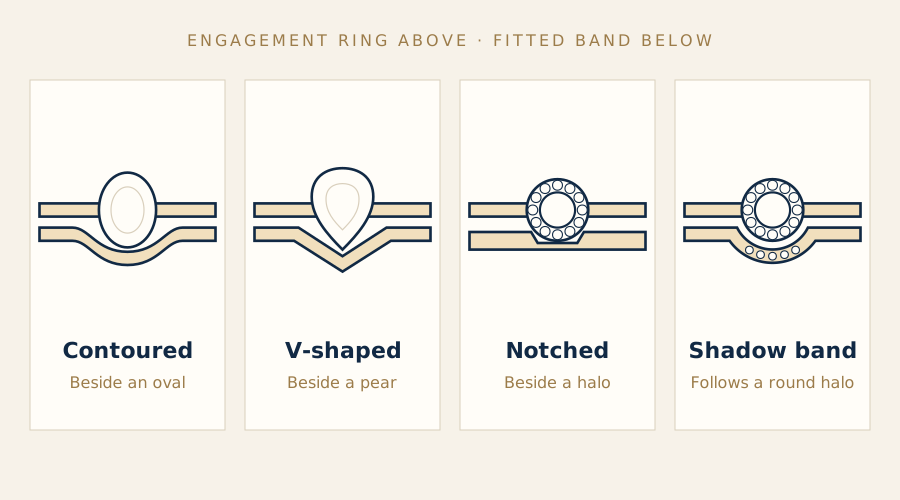
Fitted bands fall into four broad styles, and the table also includes the alternative of a straight band under a raised setting. It compares how each one works and what you give up with it.
| Style | How it fits | Usually suits | Trade-off |
|---|---|---|---|
| Contoured (curved) | A gentle arc that follows the outline of the head | Ovals, rounds, cushions, low claw settings | Most wearable alone, though the curve still shows |
| V or chevron (wishbone) | A pointed dip that cups a point or a narrow head | Pears, marquises, hearts with the point towards the band | Strong, decorative look; less versatile on its own |
| Notched | A small cut-out in the top edge that the setting drops into | Halos, princess, emerald and bezel settings | Can look like a gap or a fault when worn alone |
| Shadow band | Mirrors the halo or setting outline, often diamond-set | Halos, clusters, ornate vintage rings | Most tailored look; really only pairs with that one ring |
| Straight band, high setting | A standard band slides under a raised head | Settings that clear the shank by about 2 mm or more | Most versatile; not possible with low settings |
Many fitted bands are diamond-set, with natural or lab-grown diamonds in claw, pavé, channel or bezel settings following the curve. Stones in a tight curve are usually kept small, often around 1.3–2.0 mm, so they sit evenly and do not crowd each other. Bezel-set diamond bands have a smooth metal rim around each stone, which makes them less likely to catch on the engagement ring's claws.
Related guideCurved vs Straight Wedding BandsWhich fitted wedding band suits each engagement ring shape?
Most pairing advice treats every engagement ring the same, but the shape of the centre stone decides where the setting gets in the way and which fitted style works. In Australia the wedding band is traditionally worn first, closer to the hand, with the engagement ring above it, so the band meets the side of the head facing your wrist.
| Centre shape | Where the band hits | Usual fitted solution |
|---|---|---|
| Round | Evenly spaced claws, often a basket underneath | Gentle contour, or a straight band if the head is raised |
| Oval | The wide side of the stone and its claws | Soft, shallow curve that follows the belly of the oval |
| Pear | The round end (if the point faces the fingertip) or the point | Asymmetric curve, or a V cupping the point |
| Marquise | A sharp point at each end | V or chevron band; a notch for very low settings |
| Princess | Square corners and corner claws | Notched band or straight band; curves fight the straight lines |
| Cushion | Soft corners, often a halo | Gentle contour or notch under the halo |
| Emerald | Long straight side and step-cut corners | Straight band if the head clears it; otherwise a neat notch |
| Heart | The point, usually set facing the wrist | V band that echoes the point and protects it |
| Any shape with a halo | The halo's outer edge | Shadow band or notched band |
For rounds, a fitted band is often optional: a well-made round solitaire can be built high enough for a straight band, as our guide to bands that pair with round engagement rings shows. Princess cuts are the opposite case, where a curve looks out of place against square corners; see wedding bands for princess cut rings. Cushions sit in the middle, and halo cushions in particular often need a notch or shadow band, covered in our cushion engagement ring band guide.
Not sure which one is right?
Send us the stones you are looking at and our gemologist will tell you which to choose and why.
Is a fitted wedding band worth it?
A fitted wedding band solves the gap, but it also ties the band to one ring. Weigh both sides before you choose:
- For: no visible gap, so the two rings read as one set.
- For: less spinning and tilting, because the band helps hold the engagement ring's head in place.
- For: you keep the engagement ring exactly as it is, with no changes to the setting.
- Against: a notched or shadow band can look unusual worn on its own, for example while the engagement ring is being cleaned or repaired.
- Against: resizing is more limited, because stretching or shrinking the band moves the curve; plain bands usually allow about one size either way, and diamond-set bands less.
- Against: it is made to measure, so it costs more and takes longer than a stock straight band.
- Against: if you later change or remodel the engagement ring, the band may no longer fit it.
If you want the band to work alone as well, a gentle contour is the most wearable choice. Whether to add diamonds is a separate question: our comparison of plain and diamond-set wedding bands covers durability and upkeep, and choosing diamond size for a band explains how stone size changes the band's width and height.
What metal and width should a contoured wedding band be?
Match the metal of the engagement ring wherever you can: 18ct white gold with 18ct white gold, platinum with platinum. Rings in different metals are different in hardness, so the softer one wears faster where they rub. Colour matters too. White gold is usually rhodium plated and is re-plated every year or two, while platinum is naturally white and develops a soft grey patina over time, so a mixed pair can drift apart in colour.
- Width: most women's fitted bands are about 1.5–2.5 mm wide, so they balance the engagement ring's shank rather than overpower it.
- Height: about 1.5–2 mm off the finger; much thinner and a curved band can bend out of shape over the years.
- Curve depth: only as deep as needed to clear the setting. A deeper curve than necessary looks forced and is weaker at the dip.
- Profile: matching the engagement ring's profile (flat, court or knife-edge) helps the two rings look made for each other.
- Gold purity: 9ct, 14ct and 18ct are common in Australia; 18ct is the usual match for bridal rings.
Men's bands rarely need fitting because they are usually worn alone, but width, profile and metal choices are covered in the guide to men's wedding bands. If you are wondering whether a contoured band for one partner should echo a straight band for the other, read whether couples' bands need to match.
Can you get a fitted band made for an existing or heirloom ring?
Yes, and this is one of the most common reasons people need one. Older engagement rings, especially vintage halos, cluster rings and rings with ornate galleries, were often made to be worn alone, so no off-the-shelf band will sit against them. A fitted band is designed around the ring as it is, which means a fragile heirloom does not have to be altered. Our guide to designing a band around an inherited ring covers the extra care older rings need, such as checking worn claws before any fitting.
If you have not bought the engagement ring yet, you have more options. Planning both rings at the same time lets the jeweller raise the head slightly or shape the shoulders so a straight or gently curved band fits, rather than working around a finished ring. The pros and cons are set out in designing the engagement ring and band as a pair.
How much does a fitted wedding band cost in Australia?
A fitted band is made to order, so it usually costs more than a stock straight band in the same metal. The main things that move the price are the metal, the width and height, the number and size of diamonds, and how complex the shape is. These are broad ranges only.
| Fitted band type | Approximate price range (AUD) |
|---|---|
| Plain contoured band, 18ct gold | about $900–$2,000 |
| Plain contoured band, platinum | about $1,300–$2,800 |
| Diamond-set contoured or V band | about $2,000–$5,000 |
| Diamond-set shadow band for a halo | about $2,500–$6,000 |
Diamond-set bands can use natural or lab-grown diamonds; lab-grown stones usually cost less, which matters more as the number of stones goes up. For the wider buying picture, including budgets and timing before a wedding, see the complete wedding ring buying guide.
Design a fitted wedding band
How do you stop fitted rings rubbing, twisting or wearing?
Even a well-fitted pair touches all day, and metal against metal wears over the years. A few habits keep both rings in good shape:
- Watch diamonds against claws: diamond is 10 on the Mohs scale and gold only about 2.5–3, so stones in a band that rub on the engagement ring's claws can wear them thin.
- Consider soldering: joining the two rings stops rubbing and twisting completely, but you can then no longer wear them separately, and they are resized together.
- Check claws regularly: have both rings looked over about every 6–12 months, more often if they rub.
- Clean the join: soap and lotion collect where the rings meet; a soft brush and warm soapy water clears it.
More detail on wear points is in how to stop two rings wearing each other, and the wedding band care checklist sets out what to check and when. If you plan to add an eternity or anniversary ring later, a fitted band affects how a third ring sits, so it is worth reading about planning a ring stack over the years before you finalise the shape.
How to design a fitted wedding band, step by step
- Try a straight band first. Put a plain band beside the engagement ring; if it sits flush, you may not need a fitted band at all.
- Decide which side the band sits. Traditionally it goes on first, closer to the hand; some people wear one on each side.
- Choose the style. Contoured, V, notched or shadow band, based on the centre shape and setting.
- Match metal, width and profile. Same metal and purity, about 1.5–2.5 mm wide, with a profile that echoes the engagement ring.
- Measure and model. The engagement ring is measured or scanned and the band is drawn in CAD (computer-aided design) around it.
- Test a prototype. A 3D-printed resin model is tried against the real ring to check the curve, the gap and the comfort.
- Make and hand-fit. The band is cast, any diamonds are set, and the curve is fine-tuned against the engagement ring before polishing.
- Check the pair. Wear both rings, look from above and from the side, and decide whether to solder them together.
Fitting is only half the job; the band should also suit the engagement ring's style, colour and detail. Our guide to matching a band to your engagement ring covers those choices.
Free consultation
Talk to a gemologist
Compare stones in person or online with Raj Sood, Graduate Gemologist (GIA), AJP (GIA).
Book a consultationFAQ
Common questions
What is the difference between a fitted and a contoured wedding band?
A fitted wedding band is any band shaped to sit flush with one engagement ring. A contoured band is one type of fitted band, with a curve along its length; notched and shadow bands are the other main types.
Why is there a gap between my wedding band and engagement ring?
Part of the engagement ring's setting, such as low claws, a halo or a hidden halo, sits lower than the top of its shank. A straight band hits that part first, so the two shanks cannot meet.
Can a fitted wedding band be worn on its own?
A gently contoured band looks fine on its own. A notched or shadow band can look unusual alone, because its shape only makes sense next to the engagement ring.
Can you resize a contoured wedding band?
Usually by about one size either way for a plain band, as long as the curve is kept in the right place. Diamond-set bands have less room, and a large change may mean remaking the band.
Should I solder my wedding band and engagement ring together?
Soldering stops rubbing and twisting and keeps the fit perfect. The trade-off is that you can no longer wear the rings separately, and they are resized together.
How long does a custom fitted wedding band take to make?
Typically about 3–6 weeks, including design, a prototype fitting and making. Allow extra time before a wedding in case the curve needs adjusting.

Ask a gemologist
Not sure which diamond to choose?
Raj Sood is a Graduate Gemologist (GIA) and master jeweller. Bring the stones you are considering, or send the reports, and he will tell you honestly which one is better and why.
Keep learning
Related guides
 Wedding Bands & EternityCurved vs Straight Wedding Bands
 Wedding Bands & EternityWedding Bands for Low-Profile Engagement Rings
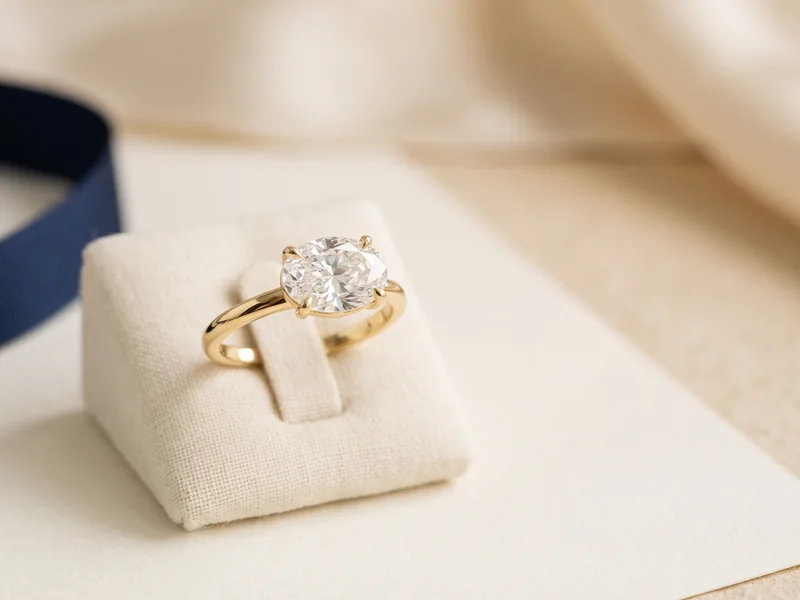 Wedding Bands & EternityHow to Match a Wedding Band to an Engagement Ring
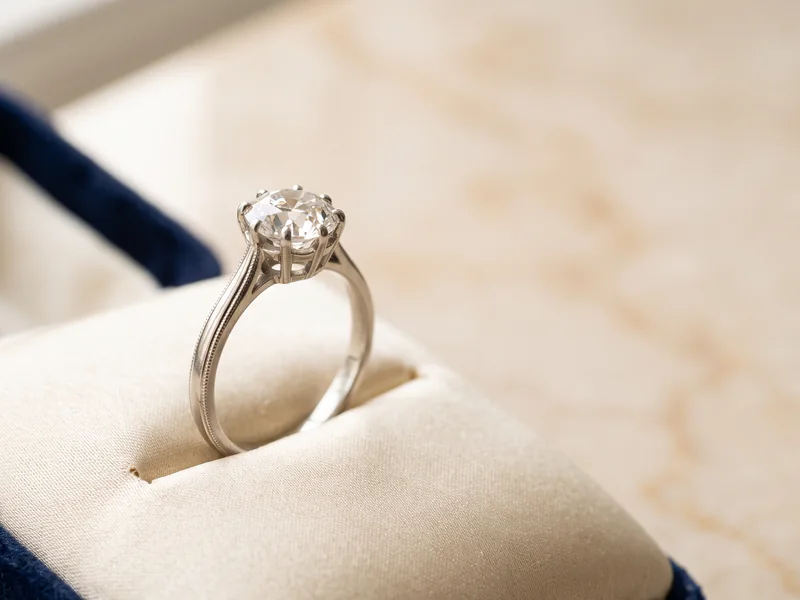 Wedding Bands & EternityCustom Wedding Band Around an Heirloom Engagement RingWedding Bands & EternityWedding Ring Buying Guide
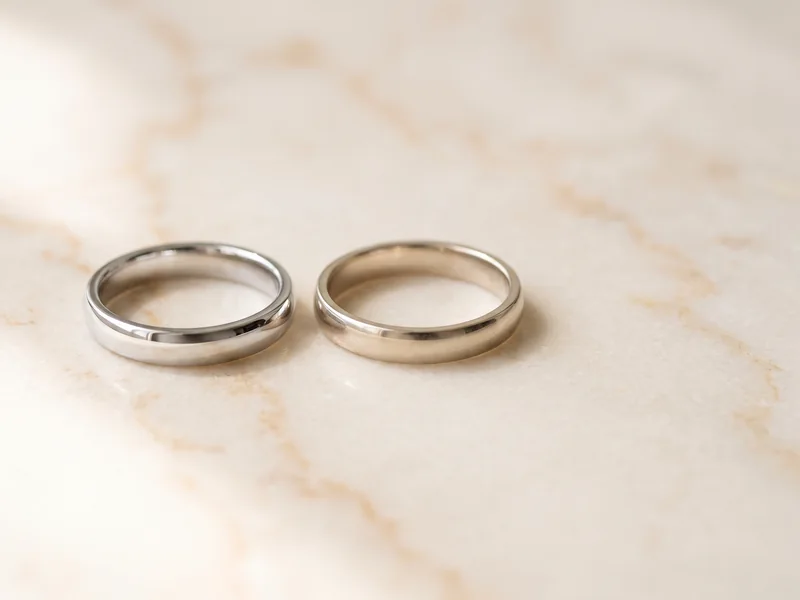 Wedding Bands & EternityMen’s Wedding Band Guide
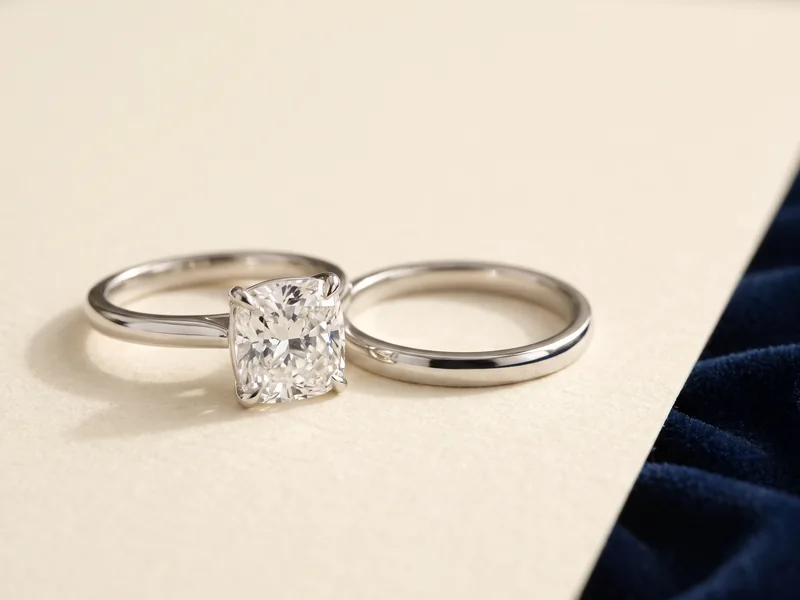 Wedding Bands & EternityWedding Ring vs Wedding Band
 Wedding Bands & EternityWedding Band Profiles Explained
Explore more
More guides on this topic
Education