
- Education
- Wedding Bands & Eternity
- How to Match a Wedding Band to an Engagement Ring: The Australian Guide
Wedding Bands & Eternity
How to Match a Wedding Band to an Engagement Ring: The Australian Guide
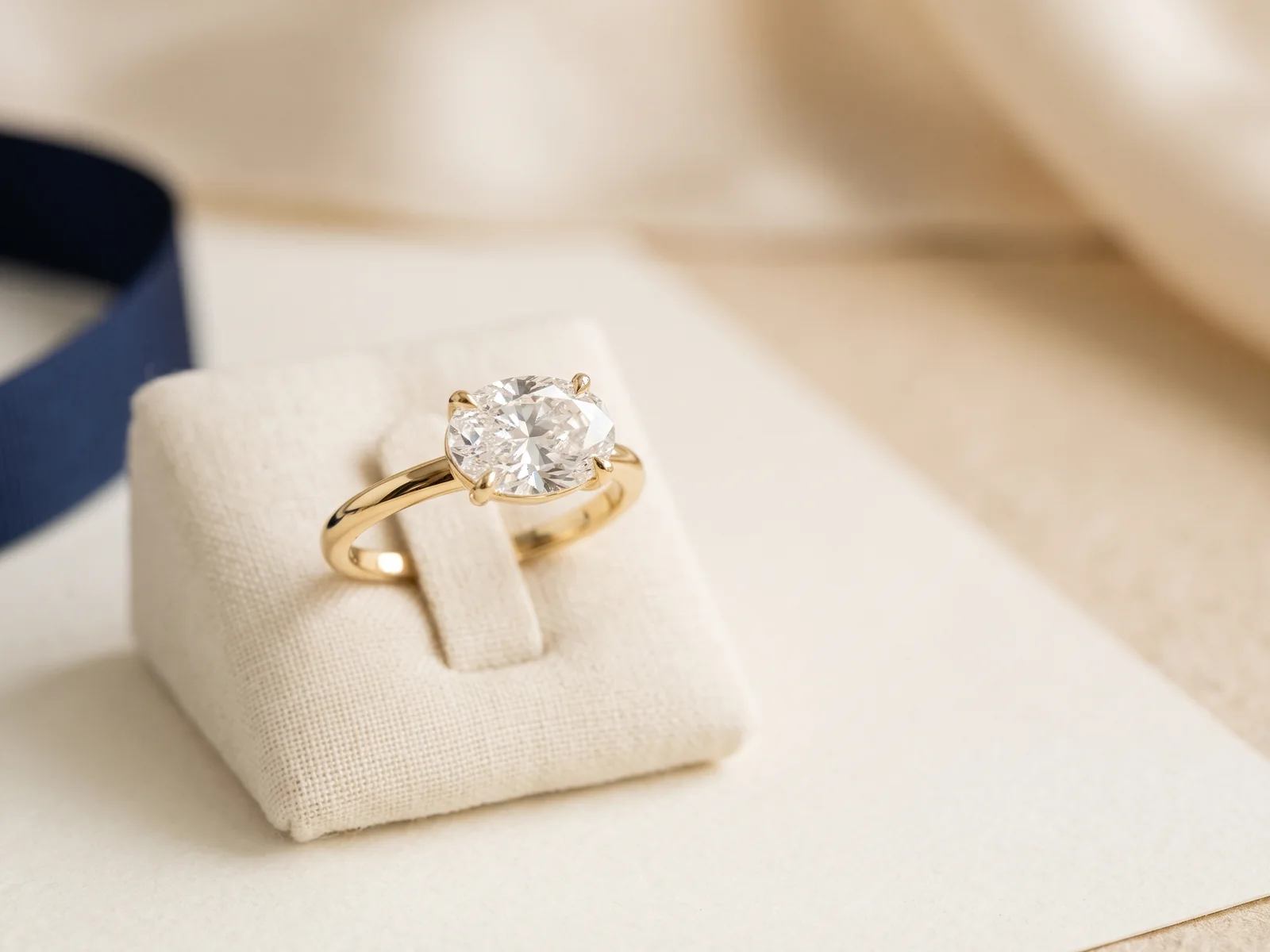
Most engagement rings are chosen first and the wedding band months later. That is why so many bands sit crooked or leave an awkward gap. Here is how to match a wedding band to an engagement ring so the pair looks planned and wears well for decades.
 Reviewed by Raj Sood, Graduate Gemologist (GIA), AJP (GIA)Master jeweller and Graduate Gemologist (GIA) · reviewed 4 November 2026
Quick answer
To match a wedding band to an engagement ring, decide first whether it should sit flush or leave a gap, then match the metal, keep the width within about 0.5 mm of the engagement ring's band, and choose a profile and diamond size that suit the centre stone's shape. Bring the engagement ring when you try bands on.
How do you match a wedding band to an engagement ring?
Matching a wedding band to an engagement ring comes down to four decisions, in this order: how the two rings sit together (the fit), which metal the band is made from, how wide the band is and what shape it has in cross-section (its profile), and whether it is plain or set with diamonds. Get the fit right first. Metal, width and diamonds are easy to adjust in a design; a band that cannot sit against the engagement ring is a problem you live with every day.
A quick note on words. In Australia most people use wedding ring and wedding band to mean the same thing, though jewellers often say band for a slimmer ring of even width. Our explainer on the difference between a wedding ring and a wedding band sorts it out. For budgets, sizing and timing, the complete wedding ring buying guide is the place to start.
The engagement ring sets the rules. Before you look at bands, check these features on it, or ask your jeweller to measure them. Any unfamiliar term is explained in our glossary of jewellery terms.
- Shank width: the width of the engagement ring's band (the shank), measured at the base of the finger. Most sit between 1.5 and 3 mm.
- Setting height: how far the centre stone sits above the finger. A low setting often blocks a straight band.
- What sits underneath: a gallery (the open metalwork below the stone), a hidden halo or a claw basket can all hang down to the shank line.
- Centre stone shape and width: wide shapes such as ovals, cushions and emerald cuts overhang the shank more than a round.
- Metal and fineness: the hallmark inside the shank, such as 18ct or PT950, tells you exactly what to match.
Should a wedding band sit flush or with a gap?
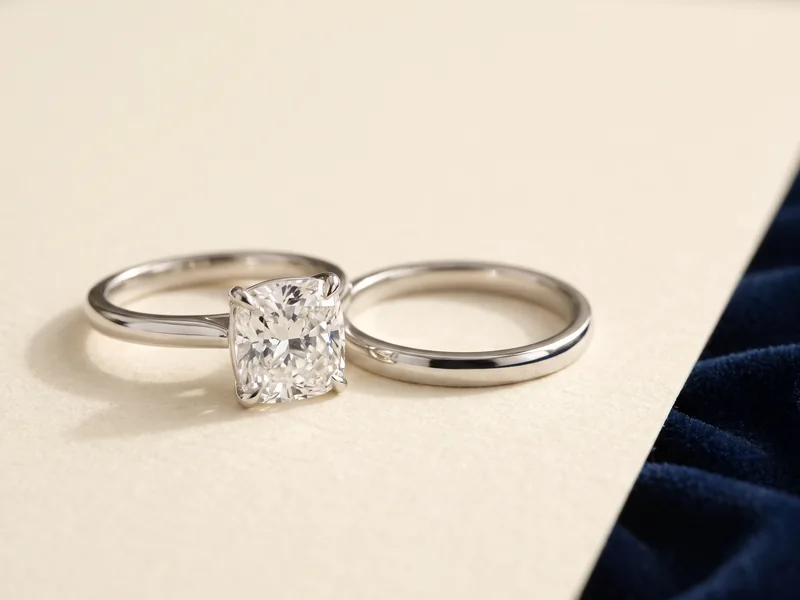
A flush fit means the two rings touch along their full length with no light showing between them. A straight band only sits flush if nothing on the engagement ring hangs below the line of its shank on the side facing the band. Raised settings on cathedral shoulders (shoulders that sweep up to the head) usually allow it. Low-set stones, wide ovals and emerald cuts, and halos often do not: the band hits the setting and is pushed away, leaving a gap of 1–3 mm under the stone.
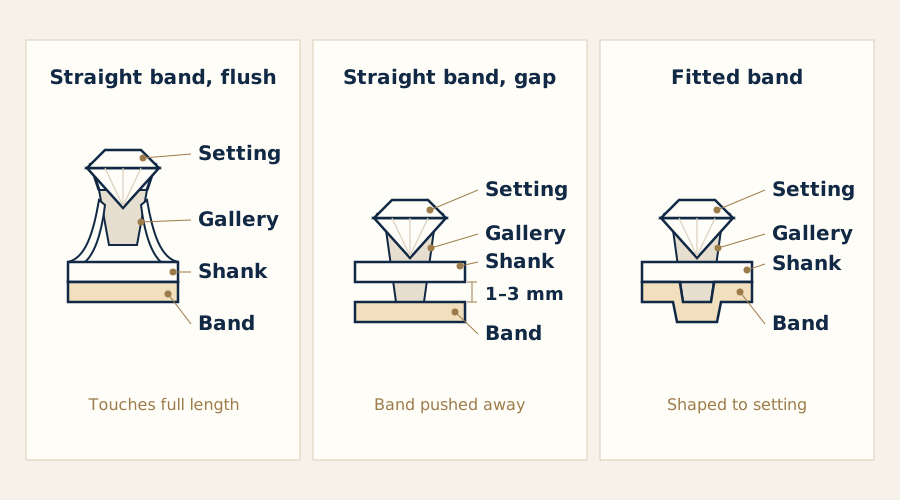
A gap is not wrong. Plenty of people like the floating look, and it keeps the band from rubbing the setting. What you want to avoid is an accidental gap, where the band tilts or rolls because it is half touching the setting. If you want flush and the engagement ring will not allow a straight band, the band has to change shape.
| Fit | How it works | Suits | Watch for |
|---|---|---|---|
| Straight, flush | Plain straight band slides under a raised setting | Solitaires on cathedral or high claws | Check the head does not spin the band sideways |
| Straight with gap | Straight band stops against the setting | Low settings, people who like a floating look | Band can twist and rub claws if it is not quite clear |
| Curved or V band | Band bows or peaks to follow the stone | Pears, marquises, hearts, ovals, halos | Only lines up when worn the right way round |
| Fitted (contour) band | Made to the exact outline of your engagement ring | Low-profile, vintage and heirloom rings | Works with one engagement ring only |
| Notched band | A small cut-out lets the setting drop in | Settings that hang just below the shank line | The notch shows when the band is worn alone |
Our page on how fitted, custom-curved bands are made shows the contour option in detail, and curved versus straight bands compares the two looks side by side. If your stone sits close to the finger, the guide to bands that work with low-profile engagement rings covers every workaround.
Which wedding band suits each engagement ring shape?
The centre stone's outline decides how much of the band it covers and which lines look natural beside it. Rounded shapes suit soft curves and pavé; step cuts (shapes with long, flat facets like the emerald and asscher) suit clean channel lines and baguettes. Pointed shapes almost always suit a curved or contoured band.
| Engagement ring shape | Straight band flush? | Pairings that work |
|---|---|---|
| Round solitaire | Usually, if set on raised claws | Plain court band, claw-set or pavé band of 1.8–2.2 mm |
| Oval | Often not when set low; the wide sides overhang | Curved band, fitted band, or straight band with a deliberate gap |
| Princess | Usually, but corners can catch | Channel-set or plain straight band; check corner claws clear |
| Cushion | Depends on the halo | Straight band under a raised halo; curved band if the halo sits low |
| Emerald and asscher | Often not; wide step cuts overhang | Channel-set, baguette or plain flat band, sometimes with a small gap |
| Radiant | Usually under a raised head | Straight channel or claw-set band |
| Pear | Rarely | V or curved band that follows the point |
| Marquise | Rarely | Chevron or double-curve band to frame both points |
| Heart | Rarely | Contoured band; the point catches a straight band |
We go deeper on the most common shapes in separate guides: wedding bands that pair with round engagement rings, bands that work beside a princess cut and pairing a band with a cushion engagement ring. Each one shows straight, curved and fitted options for that shape.
Related guideCurved vs Straight Wedding BandsShould your wedding band be the same metal as your engagement ring?
For rings that touch every day, the safest choice is the same metal at the same fineness: 18ct yellow with 18ct yellow, platinum with platinum. Two rings that rub together wear each other, and when one metal is harder than the other, the softer one loses more. Over ten or twenty years that can thin the side of an engagement ring's shank or round off the edges of a claw.
- Platinum (PT950): 95% platinum. Dense and heavy; it tends to move and develop a soft patina rather than wear away. Pairs best with platinum.
- 18ct gold: 75% gold, alloyed with other metals for colour and strength. Yellow, white and rose 18ct sit well together if you want two-tone.
- 9ct gold: 37.5% gold. A harder alloy with a paler colour, so a 9ct band next to an 18ct engagement ring can look slightly different and wear it faster.
- White gold: usually plated with rhodium (a bright white metal) that wears off over time, often within 12–24 months. Replate both rings together so they stay the same colour.
- Platinum with white gold: they look similar when new, but platinum is greyer and the two metals wear at different rates against each other. 18ct white gold is usually the harder alloy, so it can mark the platinum ring. Avoid this pairing for rings that rub.
Mixing colours on purpose, such as a rose gold band beside a yellow gold engagement ring, is a style choice, not a mistake. Just keep the fineness the same (18ct beside 18ct) so hardness and wear stay close.
Not sure which one is right?
Send us the stones you are looking at and our gemologist will tell you which to choose and why.
How wide should a wedding band be next to an engagement ring?
A wedding band usually looks balanced when it is the same width as the engagement ring's shank, or within about 0.5 mm of it. Much wider and the band starts to compete with the centre stone; much narrower and it can look like an afterthought. Width also changes how big the centre stone looks: a fine band makes a stone appear larger by contrast.
| Engagement ring shank | Band widths that balance | Effect |
|---|---|---|
| 1.5 mm (fine) | 1.5–2.0 mm | Delicate stack; suits most solitaires |
| 2.0 mm (classic) | 1.8–2.5 mm | The most common pairing |
| 2.5–3.0 mm (solid) | 2.5–3.0 mm | Strong, even look; suits larger stones and halos |
| Tapered shoulders | Match the width at the base of the finger | Measure where the band will actually sit |
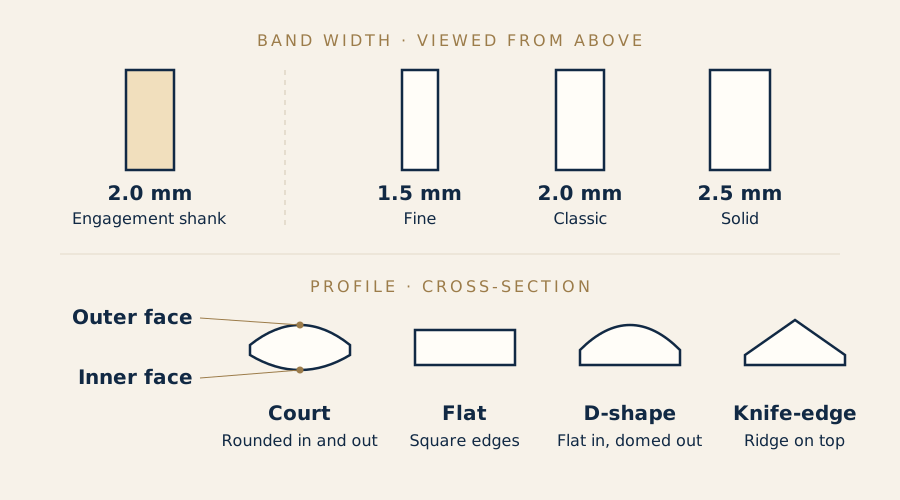
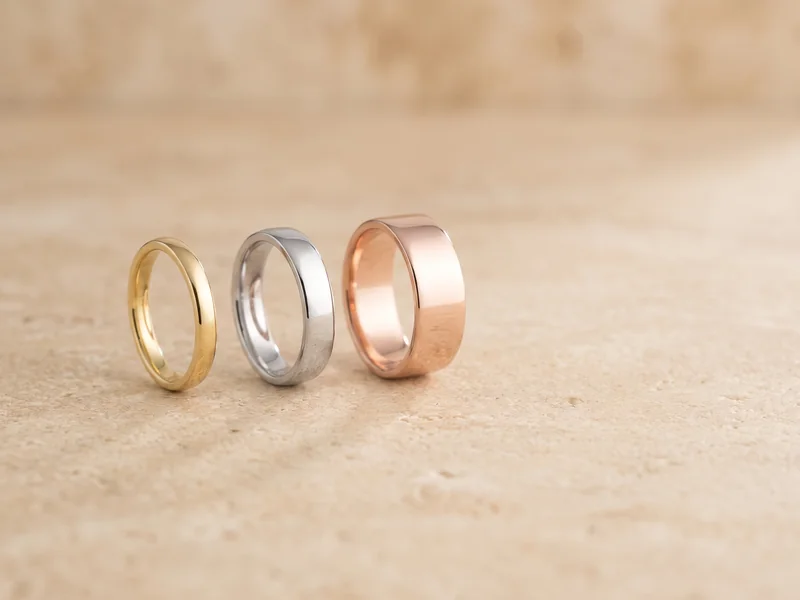
The profile is the band's shape in cross-section. A court profile is rounded inside and out, a D-shape is flat inside and domed outside, a flat profile has square edges, and a knife-edge rises to a ridge. Matching the engagement ring's profile makes the two read as a set, and flat side walls help them sit closer against each other. Thickness matters too: aim for at least about 1.5 mm of metal depth so the band keeps its shape. Our guide to band profiles and comfort fit has diagrams of each.
If the band will carry diamonds, its width limits stone size. A 2 mm band typically holds stones of about 1.5–1.8 mm across; our page on choosing diamond size for a wedding band sets out the full range.
Plain or diamond wedding band: which suits your engagement ring?
A useful rule of thumb: the busier the engagement ring, the plainer the band. A halo, pavé shoulders or a three-stone ring already carries a lot of sparkle, and a polished band gives the eye somewhere to rest. A plain solitaire is where a diamond wedding band with a solitaire really earns its place, adding sparkle along the finger. The trade-offs are set out in plain versus diamond-set wedding bands.
- Claw or shared-prong: each stone held by small claws shared with its neighbours. The most light and sparkle, but claws need checking.
- Channel: stones held between two walls of metal. Smooth, snag-free and well suited to princess, emerald and radiant rings.
- Bezel: each stone wrapped in a thin rim of metal. Very secure and modern.
- Pavé: many small stones set close with tiny beads of metal. Matches pavé shoulders on an engagement ring.
Compare the first two in detail in shared-prong and channel-set bands, and see how bezel-set diamond bands wear if you work with your hands. Whichever you choose, keep the band's diamond colour within a grade or two of the engagement ring's accent stones, so one ring does not look whiter than the other. Mixing natural and lab-grown diamonds across the two rings is fine, as long as every stone is clearly disclosed on the paperwork.
How do you stop a wedding band rubbing against your engagement ring?
Diamond is 10 on the Mohs hardness scale and gold and platinum sit around 2.5–4.5, so diamonds in a band will slowly grind into the metal of the ring beside it. The usual signs are a shiny flat spot on the engagement ring's shank, thinning claw tips or a band that has started to wear a groove. Most of it is preventable.
- Match metals and fineness so neither ring wears faster.
- Choose a band whose diamonds sit below its edges, such as channel or bezel, if it touches the engagement ring all day.
- Solder the two rings together so they cannot move against each other. This is reversible but makes resizing a joint job.
- Check both rings every 6–12 months for loose stones and worn claws.
Our page on stopping stacked rings from rubbing explains each fix, and the wedding band care checklist lists what to look at during a check-up.
Should you choose the wedding band at the same time as the engagement ring?
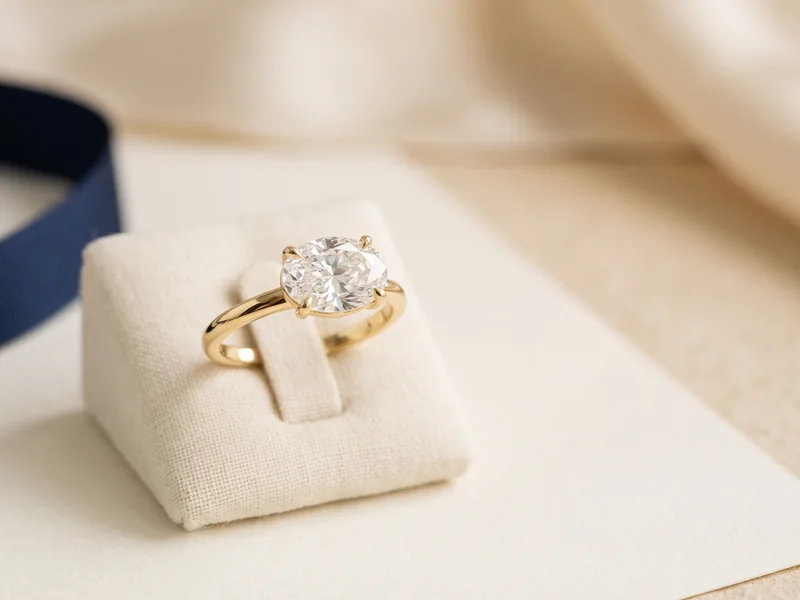
If you can, yes, or at least design the engagement ring with the band in mind. Small decisions early, such as raising the head by half a millimetre or keeping the gallery clear of the shank line, can be the difference between a straight band sitting flush and needing a fitted one. Our guide on designing the engagement ring and band as a pair covers what to plan.
If the engagement ring came first, or it is a family piece you do not want to alter, a band can be made around it instead. See building a band around an heirloom ring. And if you are also wondering whether your partner's band should echo yours, read whether couples' wedding bands need to match.
As a broad guide only, a plain 2 mm band in 18ct gold often sits around AUD $800–$1,800, platinum around $1,200–$2,500, and a 2 mm diamond half-eternity band about $1,000–$2,500 with lab-grown diamonds or $1,800–$4,500 with natural diamonds. A fitted band usually costs more than a straight one because it is made to the shape of one ring. Prices move with metal markets and exact specifications.
Design your engagement ring and wedding band
How do you match a wedding band to an engagement ring, step by step?
- Check the hallmark. Note the engagement ring's metal and fineness, such as 18ct yellow or PT950, and plan the band in the same.
- Measure the shank. Record its width at the base of the finger and its profile (court, flat, D-shape or knife-edge).
- Look side-on. See whether anything on the engagement ring sits below the shank line; if it does, a straight band will leave a gap.
- Decide flush or gap. Choose straight, curved, notched or fitted to get the look you want.
- Pick the style. Plain for a busy engagement ring, diamond-set for a simple solitaire, matching the setting type and diamond colour.
- Try them together. Wear both rings for a few minutes, move your hand, and check the band does not twist or touch the claws.
- Plan the care. Book a check every 6–12 months and replate white gold rings together.
Free consultation
Talk to a gemologist
Compare stones in person or online with Raj Sood, Graduate Gemologist (GIA), AJP (GIA).
Book a consultationShop this shape
FAQ
Common questions
Does a wedding band have to sit flush with the engagement ring?
No. Flush is a popular look, but a small gap is common with low settings and halos and can reduce rubbing. The aim is a fit you choose, not a band that tilts or half touches the setting.
Can my wedding band be a different metal from my engagement ring?
Yes, but rings that rub wear unevenly when the metals differ in hardness. If you want two colours, keep the fineness the same, such as 18ct rose beside 18ct yellow, and avoid pairing platinum with gold for rings worn together all day.
How wide should a wedding band be?
Beside an engagement ring, most bands are 1.5–2.5 mm wide. Matching the engagement ring's shank width, or staying within about 0.5 mm of it, usually looks balanced.
What wedding band suits an oval engagement ring?
Ovals are wide, so a straight band often leaves a gap under a low setting. A gently curved or fitted band sits flush, while a straight band works under a raised setting or if you like the gap.
Should the wedding band have diamonds if the engagement ring has a halo?
It is a personal choice, but a halo already adds a lot of sparkle, so many people choose a plain or finely set band to balance it. If you do add diamonds, keep their size and colour close to the halo stones.
Can a jeweller make a band to fit my existing engagement ring?
Yes. A fitted or contour band is made to the outline of your ring, which suits low-profile, vintage and heirloom engagement rings that will not take a straight band.

Ask a gemologist
Not sure which diamond to choose?
Raj Sood is a Graduate Gemologist (GIA) and master jeweller. Bring the stones you are considering, or send the reports, and he will tell you honestly which one is better and why.
Keep learning
Related guides
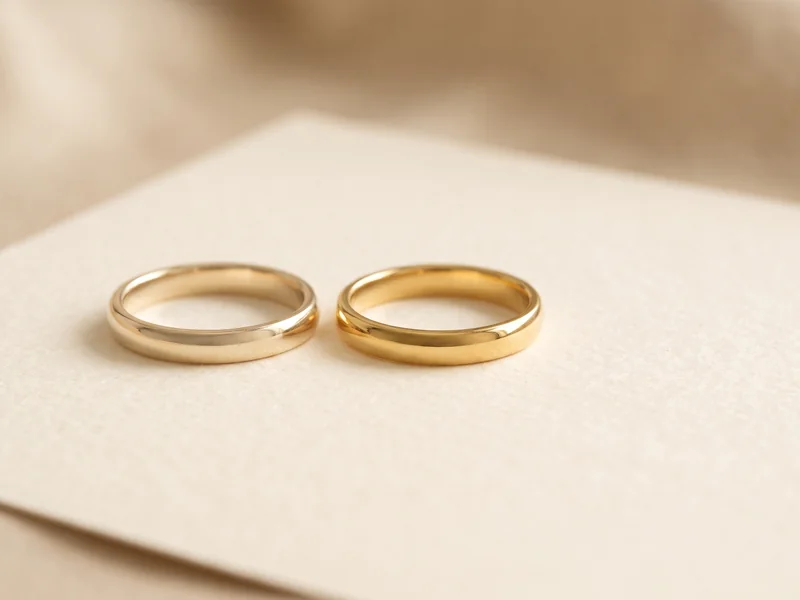 Wedding Bands & EternityFitted Wedding Bands Explained | Custom Curved BandsWedding Bands & EternityCurved vs Straight Wedding Bands
 Wedding Bands & EternityWedding Band Profiles Explained
 Wedding Bands & EternityShould You Design the Engagement Ring and Wedding Band Together?Wedding Bands & EternityWedding Ring Buying GuideWedding Bands & EternityShould Couples’ Wedding Bands Match?
 Wedding Bands & EternityWedding Ring vs Wedding Band
 Wedding Bands & EternityMen’s Wedding Band Guide
Explore more
More guides on this topic
Education