
- Education
- Wedding Bands & Eternity
- Men's Wedding Band Guide: Width, Profile, Metal and Fit
Wedding Bands & Eternity
Men's Wedding Band Guide: Width, Profile, Metal and Fit
A men's wedding band is worn every day for decades, through work, sport and the gym. Width, profile, metal and fit matter more than they first appear, and this guide explains each one in plain terms.
 Reviewed by Raj Sood, Graduate Gemologist (GIA), AJP (GIA)Master jeweller and Graduate Gemologist (GIA) · reviewed 4 November 2026
Quick answer
Most men choose a men's wedding band 5–6 mm wide and about 2 mm thick, in a court (comfort fit) profile that slides easily over the knuckle. Platinum and 18ct gold wear well and can be resized; titanium is light and tungsten carbide resists scratches, but neither resizes easily. Try widths on, and allow for wider bands fitting tighter.
What is a men's wedding band?
A men's wedding band is a plain or lightly decorated ring worn to mark a marriage, in Australia usually on the fourth finger of the left hand. Unlike most women's bands, it is normally worn on its own rather than beside an engagement ring, so it does not have to sit against anything. That frees you to choose the width, profile and metal purely on comfort and looks. If the terms ring and band seem interchangeable, our explainer on the difference between a wedding ring and a wedding band sorts it out.
Men's bands are usually wider and thicker than women's, typically 5–8 mm wide against about 2–4 mm, because men's fingers tend to be larger and a narrow band can look thin on a broad hand. Six decisions shape almost every men's band:
- Width: how wide the band is across the top of the finger, in millimetres.
- Thickness: how deep the metal is from the inside of the band to the outside.
- Profile: the shape of the band's cross-section, which decides how it feels.
- Metal: platinum, gold in several carats and colours, or alternative metals such as titanium.
- Finish and detail: polished, brushed or hammered, with or without diamonds.
- Size: the Australian letter size, adjusted for the width you choose.
We cover each of these below. Any word you have not met before is defined in our plain-English jewellery glossary, and if you are buying rings for both partners, the complete wedding ring buying guide puts everything in one place.
How wide and thick should a men's wedding band be?
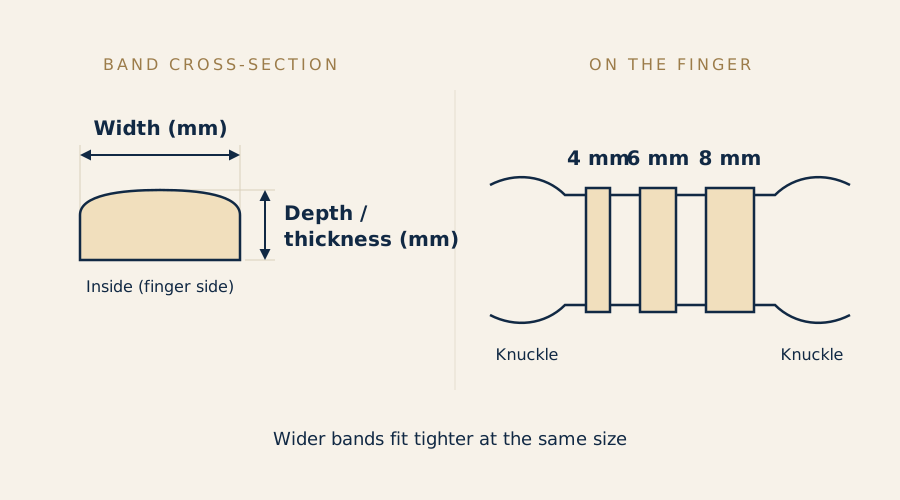
Width is the first thing people notice and the main thing that decides how a band looks on the hand. A band that suits a slim finger can look like a thread on a large one, and a wide band can feel restrictive on short fingers because it covers more of the space between the knuckles.
| Width | How it looks | Often suits |
|---|---|---|
| 3–4 mm | Slim and understated | Slim fingers, or men who rarely wear jewellery |
| 5 mm | Classic and modest | Small to medium hands |
| 6 mm | Balanced, the middle ground | Most hands; the most common choice |
| 7 mm | Substantial | Larger hands and longer fingers |
| 8 mm and wider | Bold and heavy | Big hands; can limit how far the finger bends |
As a rough starting point, men around ring size Q or smaller often settle on 4–5 mm, sizes R to U on 5–7 mm, and size V and above on 6–8 mm. These are tendencies, not rules: plenty of men with large hands like a slim band, and the only reliable test is trying widths on. Our comparison of how women's and men's band widths differ explains why couples often end up with different widths in the same design.
Thickness (also called depth) is the measurement most people forget to ask about. It changes the weight, the comfort and how long the band lasts:
- Light, about 1.3–1.6 mm: lower metal cost and lighter feel, but it can bend if crushed and wears thin sooner over decades.
- Medium, about 1.8–2.0 mm: the usual balance of strength, weight and comfort for daily wear.
- Heavy, about 2.2–2.8 mm: solid and weighty in the hand, more metal to resize and refinish, but a higher price and a thicker feel between the fingers.
As a guide to weight, a 6 mm court band about 2 mm deep weighs roughly 8–11 g in 18ct gold and 12–15 g in platinum, depending on size. Because gold and platinum are priced by weight, thickness moves the price almost as much as width does.
Related guideWomen's vs Men's Wedding Band WidthsWhat are the different men's wedding band profiles?
The profile is the shape you would see if you cut the band through and looked at the end. Two bands of the same width and metal can feel completely different because of profile. Look at both the outside (what people see) and the inside (what touches your finger).
| Profile | Outside | Inside | How it feels | Suits |
|---|---|---|---|---|
| Flat | Flat top, square edges | Flat | Crisp and modern; sharp edges can dig in unless softened | Clean, architectural looks |
| D-shape (half-round) | Domed | Flat | Traditional; can feel tight going over the knuckle | Classic plain bands |
| Court (comfort fit) | Domed | Curved | Smooth and easy to slide on and off | Most men, especially wider bands |
| Flat court | Flat top | Curved | Modern look with court comfort | Men who want a flat look without sharp edges |
| Bevelled or chamfered edge | Flat top with angled edges | Flat or curved | Defined, with softer edges than a plain flat | Two-tone and brushed designs |
| Knife edge | Peaked ridge along the centre | Flat or curved | Slim-looking from above | Less common in men's bands |
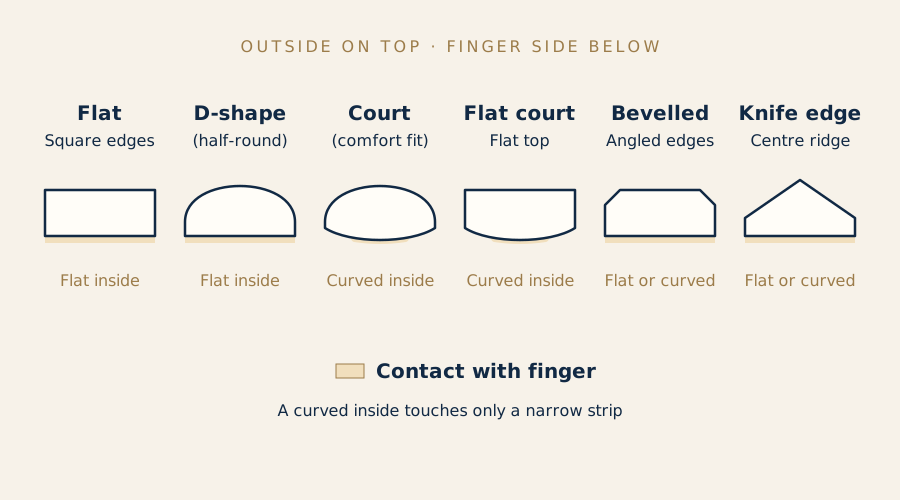
Comfort fit simply means the inside of the band is curved, so only a narrow strip touches the finger and the edges roll over the knuckle instead of catching it. In Australia this is usually called a court profile. A comfort fit wedding band is worth considering from about 5 mm upwards, because a wide, flat-inside band presses on a lot of skin at once. The trade-off is that a curved inside uses slightly less metal against the finger, so some men find a court band feels a touch looser than a flat-inside band of the same size.
Profiles apply to every kind of band, not just men's. Our page on every wedding band profile, with cross-sections goes into the less common shapes, such as concave and double-court, in more detail.
What is the best metal for a men's wedding band?
There is no single best metal; the right one depends on how you use your hands, the colour you like and whether you want to be able to resize or refinish the band later. Here is how the common choices compare.
| Metal | Colour | Weight on the hand | How it wears | Resizing |
|---|---|---|---|---|
| Platinum (Pt950) | Naturally white | Heaviest | Scratches move metal rather than remove it, giving a soft matte patina; very little metal lost over time | Yes, easily |
| 18ct yellow or rose gold | Warm yellow or pink | Heavy | Scratches over time; can be repolished many times | Yes, easily |
| 18ct white gold | White, usually rhodium plated | Heavy | Plating wears to a faint warm tone; needs replating | Yes, easily |
| 9ct gold | Paler yellow, rose or white | Medium | Harder than 18ct, so it resists dents; lower gold content | Yes, easily |
| Palladium (Pd950) | Naturally white | Medium | Similar look to platinum, lighter | Yes, but fewer workshops work with it |
| Titanium | Darker steel-grey | Very light | Scratches, can't be polished out as easily as gold | Very limited |
| Tungsten carbide | Grey to gunmetal | Heavy | Very scratch resistant, but brittle; can crack if struck hard | No |
Platinum used in Australian jewellery is typically 95% pure, stamped Pt950. It is dense, about 21 g per cubic centimetre, so a platinum men's wedding band feels noticeably heavier than gold. It stays white without plating and is hypoallergenic for most people.
Gold is described in carats: 18ct is 75% pure gold and 9ct is 37.5%, with the rest made of alloy metals that add hardness and set the colour. White gold is usually coated in rhodium, a bright white metal of the platinum family, and many wearers have it replated every one to two years. Rose gold gets its colour from copper; yellow gold needs no plating at all.
On tungsten vs titanium wedding bands: titanium is about a fifth of the weight of platinum and about 6 on the Mohs scratch-hardness scale, so it is very comfortable but does scratch. Tungsten carbide is about 9 on the Mohs scale, close to sapphire, so it keeps its polish for years, yet it is brittle: a hard knock on tiles or concrete can crack it. Neither can be resized in the usual way, so if your finger size changes, the band generally has to be replaced. Both are also slower to remove in an emergency than gold or platinum.
Not sure which one is right?
Send us the stones you are looking at and our gemologist will tell you which to choose and why.
Should a men's wedding band have diamonds or a special finish?
Finish changes the character of a plain band more than most people expect, and it affects upkeep:
- High polish: mirror bright; shows fine scratches within weeks but can be repolished.
- Satin or brushed: fine parallel lines that give a soft sheen and hide everyday scuffs; it gradually polishes itself in patches and can be refreshed by a jeweller.
- Sandblasted or matte: a frosted, even surface; very understated.
- Hammered: small dimples across the surface; hides wear well and gives a handmade look.
- Two-tone or contrast: for example a brushed centre with polished bevelled edges, or white and yellow gold together.
A men's diamond wedding band usually keeps the stones low and protected. The most common style is flush setting (also called gypsy setting), where each diamond sits in a drilled hole level with the metal surface, so there is nothing to catch. Channel setting, with diamonds held in a groove between two metal walls, is the other common choice. Our comparison of shared-prong and channel-set bands explains why shared-prong (claw) styles are less often chosen for men who use their hands a lot.
In men's bands, diamonds of about 1.5–2.5 mm (roughly 0.015–0.06 carat each) are typical, either a single stone, a small row or a full circle. Our guide on choosing diamond size for a wedding band sets out what each size looks like, and plain bands versus diamond-set bands weighs up cost, upkeep and resizing. Diamonds can be natural or lab-grown; both are real diamond, and the lab-grown option costs much less.
Is a men's wedding band safe for hands-on work?
If you work with tools, machinery, ropes or heavy materials, the band you choose matters for safety as well as wear. Any ring can catch on equipment, and a caught ring can cause a serious finger injury known as ring avulsion. Many tradespeople take their band off at work, or wear a silicone band on site and keep the metal band for the rest of the day.
- Profile: a court or flat court with rounded edges is less likely to catch than a flat band with square edges.
- Height: flush-set or plain bands sit lower than claw-set stones.
- Metal: gold and platinum dent and scratch but can be repaired and resized; tungsten carbide resists scratches but can crack.
- Removal: in an emergency, gold and platinum bands are quick to cut off; harder materials take longer.
Our guide on choosing a men's band for trade, farm and workshop jobs covers width, metal and finish for physical work in more detail.
How do you find your men's ring size in Australia?
Australia uses letter sizes from A to Z, with half sizes in between (for example T½), the same system as the United Kingdom. Many men fall somewhere between about R and W, but sizes vary widely, so always measure rather than guess.
- Measure at the end of the day when your hands are warm; fingers are smaller in the cold and early morning.
- Check the knuckle. The band must pass over the knuckle without force but not spin loosely on the finger behind it.
- Measure in the width you will wear. A 7–8 mm band covers more of the finger and often needs up to half a size larger than a 4 mm band.
- Allow for profile. A court profile can feel slightly looser than a flat-inside band of the same size.
- Avoid string or paper methods if you can; a jeweller's sizing ring in the right width is far more accurate.
Gold, platinum and palladium bands can usually be resized up or down a size or two. Bands with diamonds all the way round, engraved patterns or inlays are harder to resize, and titanium, tungsten carbide and ceramic bands generally cannot be resized at all.
Should a men's wedding band match your partner's ring?
It does not have to. Many couples choose the same metal colour or finish so the rings feel related, without being identical. Matching often works best in one detail: a shared metal, a similar profile, or the same brushed or hammered finish. Our guide to matching a wedding band to an engagement ring covers the partner's side of the set.
Your partner's band has a harder job than yours, because it has to sit beside an engagement ring. It may need to sit flush (touching along its length) or leave a small, even gap, and our page on the right gap between an engagement ring and band shows both. Depending on the engagement ring, that band might be straight or curved, as explained in curved versus straight bands, or shaped precisely to the ring, which is covered in how fitted, custom-curved bands work. A low ring needs special thought too; see bands that clear a low-set engagement ring.
If one of you is wearing a family ring, a band made around an heirloom engagement ring can tie it to a new men's band in the same metal. Some couples plan all three rings at once; designing the engagement ring and band together explains when that helps. And if you wear your band next to a signet or another ring, read how to stop two rings wearing against each other, because different metals can wear each other down.
How much does a men's wedding band cost in Australia?
The price of a men's wedding band is driven mainly by the metal, its weight (width times thickness times size) and any diamonds or detailed work. Gold and platinum prices move with the world metal markets, so treat these as broad ranges for a plain 6 mm court band at around size T.
| Plain 6 mm court band | Approximate price range (AUD) |
|---|---|
| Titanium | about $200–$600 |
| Tungsten carbide | about $200–$600 |
| 9ct gold | about $900–$1,800 |
| 18ct yellow, rose or white gold | about $2,000–$4,000 |
| Platinum (Pt950) | about $2,500–$4,500 |
| Diamond-set (flush, about 0.10–0.50 ct total) | add about $800–$4,000 |
A heavier depth, a wider width or a larger size adds metal and therefore cost. Lab-grown diamonds in a band cost considerably less than natural diamonds of the same size and grade. Handmade bands and custom profiles cost more than cast stock designs because of the extra workshop time.
Create your own men's wedding band
How to choose a men's wedding band: step by step
- Think about your daily life. Note your work, sport and how often you will take the band off; this guides metal and profile.
- Try widths on. Start at 6 mm and go up or down a millimetre until it looks in proportion to your hand.
- Choose the profile. Compare a flat, D-shape and court on your finger; check comfort over the knuckle and when you make a fist.
- Pick the metal. Decide on colour first, then weigh resizing, weight and scratch behaviour.
- Decide on finish and detail. Polished, brushed or hammered, and whether you want flush-set diamonds.
- Get sized properly. Measure late in the day, in the same width and profile as your chosen band.
- Ask about thickness and weight. Confirm the depth in millimetres and the approximate weight in grams before you order.
Once it is on your hand, a little care keeps it looking right for decades: a professional clean and check each year, repolishing when you want a fresh finish, and replating for white gold. Our year-by-year wedding band care checklist lists what to do and when.
Free consultation
Talk to a gemologist
Compare stones in person or online with Raj Sood, Graduate Gemologist (GIA), AJP (GIA).
Book a consultationShop this shape
FAQ
Common questions
What is the most common width for a men's wedding band?
Most men choose between 5 and 6 mm, with 6 mm the usual middle ground. Larger hands often suit 7–8 mm, while 4 mm suits slim fingers or a very understated look.
What is a comfort fit wedding band?
It is a band with a curved inside, usually called a court profile in Australia. The rounded inner edges slide over the knuckle easily and press on less skin, which is especially noticeable in wider bands.
Is tungsten or titanium better for a men's wedding band?
Tungsten carbide resists scratches far better but is heavy and brittle, so it can crack if struck hard. Titanium is very light and tough but scratches more; neither can be resized in the usual way.
Is platinum or gold better for a men's wedding band?
Both wear well and can be resized and repolished. Platinum is heavier, naturally white and loses very little metal over time, while 18ct gold offers yellow, rose or white colours, usually at a lower price.
Should I size up for a wide wedding band?
Often, yes. Bands of about 7 mm and wider cover more of the finger and can fit tighter, so many men need a quarter to half size larger; try a sizing ring in the same width to be sure.
Can a men's wedding band be resized?
Gold, platinum and palladium bands can usually be resized by a size or two. Full-circle diamond bands are harder, and titanium, tungsten carbide and ceramic bands generally cannot be resized.

Ask a gemologist
Not sure which diamond to choose?
Raj Sood is a Graduate Gemologist (GIA) and master jeweller. Bring the stones you are considering, or send the reports, and he will tell you honestly which one is better and why.
Keep learning
Related guides
 Wedding Bands & EternityWedding Band Profiles Explained
 Wedding Bands & EternityWomen's vs Men's Wedding Band WidthsWedding Bands & EternityHow to Choose a Men’s Wedding Band for Hands-On Work
 Wedding Bands & EternityPlain vs Diamond Wedding BandsWedding Bands & EternityWedding Ring Buying Guide
 Wedding Bands & EternityWedding Ring vs Wedding Band
 Wedding Bands & EternityBest Wedding Band for Princess Engagement Rings
 Wedding Bands & EternityHow to Match a Wedding Band to an Engagement Ring
Explore more
More guides on this topic
Education