
- Education
- Lab-Grown Diamonds
- CVD Diamond Brown Tint: Why Some Lab-Grown Diamonds Look Brown or Grey
Lab-Grown Diamonds
CVD Diamond Brown Tint: Why Some Lab-Grown Diamonds Look Brown or Grey
Brown tint is the colour issue most closely tied to CVD diamond growth, and it is the reason many CVD stones are treated before they reach a jeweller. Here is what causes brown and grey tones, how reports disclose them, and how to check a stone before you choose.
 Reviewed by Raj Sood, Graduate Gemologist (GIA), AJP (GIA)Master jeweller and Graduate Gemologist (GIA) · reviewed 4 November 2026
Quick answer
A brown or grey tint in a CVD lab-grown diamond comes from the growth process. Brown is caused by vacancy clusters and strain built in during fast growth; grey is linked to other defects and tiny dark inclusions. Most producers lighten brown with post-growth HPHT annealing. Choose G or better, check the report wording, and view it in daylight.
What causes a brown tint in CVD diamonds?
CVD stands for chemical vapour deposition. A thin diamond seed plate sits in a sealed chamber filled with a gas that is mostly hydrogen with a few per cent methane. Microwaves turn the gas into a glowing plasma at roughly 700–1,200°C, and carbon atoms settle onto the seed layer by layer, building a flat, squarish block of rough over several weeks. Our page on how lab-grown diamonds are made, step by step covers the reactors in detail, and why growing a diamond at home isn't practical explains why this takes industrial equipment.
What comes out is real diamond, with the same carbon lattice, the same hardness (10 on the Mohs scale) and the same refractive index (about 2.42) as a mined stone; our explainer on why lab-grown stones are genuine diamond goes through the science. But fast growth leaves tiny flaws in the crystal lattice. The main cause of brown is vacancy clusters: groups of missing carbon atoms that absorb light across the visible spectrum, more strongly towards the blue and violet end. Take away more blue than red and the light that reaches your eye looks warm brown.
Several things in the growth run make brown more likely:
- Faster growth rates: carbon stacks up before the lattice can settle neatly, trapping more vacancies.
- Nitrogen in the gas: growers often add a trace of nitrogen to speed growth, and more nitrogen generally means more brown.
- Uneven plasma or temperature: patches that run hotter or cooler grow differently, building strain into the crystal.
- Thick growth runs: strain and defects accumulate as layers pile up, which is also why CVD stones can show layered growth patterns.
As a result, a lot of as-grown CVD rough is visibly brown, from a faint warmth to a definite tea colour. That single fact explains why post-growth treatment is so widespread in CVD production, and why it is worth understanding before you read a report. For the bigger picture, start with our complete guide to lab-grown diamonds.
Why do some CVD diamonds look grey?
Grey is less well understood than brown, and gemmologists usually describe it as a mix of causes rather than one defect. A grey tint in a CVD diamond reads as a cool, slightly steely or smoky tone instead of warmth. The causes most often linked to it are:
- Residual defects after treatment: annealing can remove the brown component and leave a faint grey cast behind.
- Hydrogen-related defects: CVD grows in a hydrogen-rich gas, and some hydrogen-related centres absorb light fairly evenly, which the eye reads as grey.
- Trace boron: very small amounts of boron push colour towards blue, and in combination with brown-absorbing defects the result can look grey-blue.
- Tiny dark inclusions: many pinpoints of non-diamond carbon (graphite-like specks) spread through a stone can dull and grey the whole face-up appearance, even when each one is too small to see.
Grey is often called a nuance: an undertone that sits alongside the main colour grade rather than replacing it. Natural diamonds can carry brown, grey and blue nuances too, and our guide to brown, grey and blue nuance in diamonds that grade colourless explains how it shows up even in stones with a good grade. If any of these terms are new, the plain-English jewellery glossary defines each one.
From the counter, the practical difference is this: a faint brown tends to make a stone look a touch warm, while a faint grey tends to make it look a little flat or sleepy, with less crisp contrast between bright and dark facets. Neither is a durability issue. Both are appearance issues you can judge with your own eyes.
How does HPHT treatment remove brown tint from a CVD diamond?
Most near-colourless CVD diamonds on the market today have been treated after growth. The usual method is HPHT annealing (high pressure, high temperature): the rough is placed in a press at roughly 5–6 gigapascals (about 50,000–60,000 times atmospheric pressure) and heated to around 1,800–2,300°C, often for only minutes. Some producers use LPHT (low pressure, high temperature) annealing instead, which heats the diamond in a controlled atmosphere without the huge press.
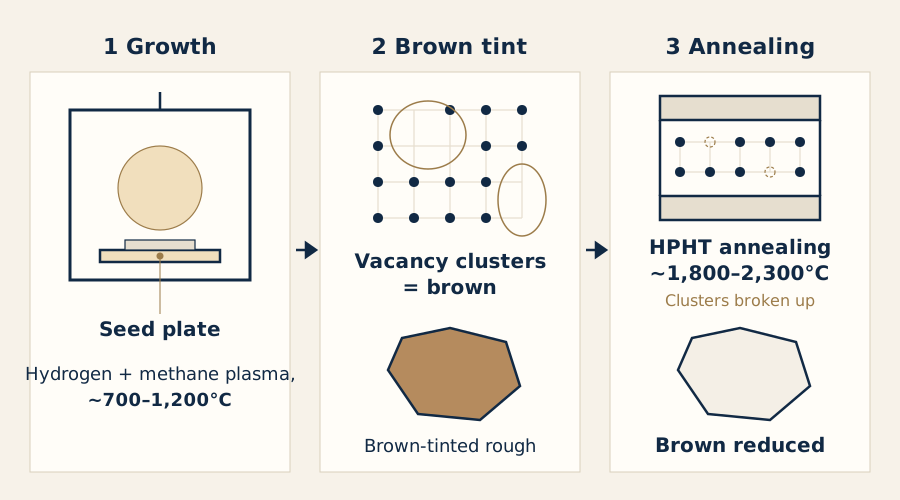
The heat gives the carbon atoms enough energy to move. Vacancy clusters break apart or rearrange into defects that absorb far less visible light, so the brown fades. A stone that came out of the reactor looking J or K with a brown cast can come out of the press grading G, F or better. The result is not always perfect: some stones keep a faint yellow from nitrogen, a faint grey, or occasionally pick up a pink tone, which is why two treated stones of the same grade can still look slightly different.
Treatment is stable in normal wear, and routine jewellery work such as resizing a ring does not reverse it, though any diamond should be protected from direct torch heat. HPHT presses are also used to grow diamonds from scratch, which can be confusing; our page on how the HPHT and CVD growth methods differ separates the two uses. Annealing also reduces strain, but it does not erase the layered growth pattern itself; see whether CVD growth striations should worry you.
How is a brown or grey tint shown on a grading report?
The colour grade on a report (D to Z, from colourless to light-tinted stones) tells you how much colour a diamond shows compared with master stones. It does not always tell you which colour. In the near-colourless range, a G with a faint brown nuance and a G with a faint yellow both simply read G. Our page on how colour grades work on lab-grown diamonds explains the scale itself.
| What the report shows | What it usually means | What to do |
|---|---|---|
| CVD growth method, 'As grown' | No evidence of post-growth treatment found | Check the grade and view the stone; as-grown D–G stones are less common |
| CVD with 'post-growth treatment' or similar | Colour was improved after growth, usually by HPHT annealing | Normal for CVD; judge the stone on how it looks |
| Colour grade only, no comment | No nuance noted by the lab, or the lab does not note nuance | Compare face-down against a known white stone |
| Lower grade (about I–K) with a hue word in comments | Visible tint the lab chose to describe, such as brown or grey | Expect warmth or greyness face-up in white metal |
| Fancy colour grade, e.g. 'Fancy Brown' | Colour is deliberate and graded as a coloured diamond | A different product, judged on depth and evenness of colour |
Wording varies between labs and changes over time. IGI, which grades most lab-grown diamonds sold in Australia, states the growth method and whether there is evidence of post-growth treatment. GIA has announced a move to broader descriptive quality terms for lab-grown diamonds rather than the full D–Z and clarity scales, so older and newer reports can look quite different. Always read the comments line, not just the headline grade.
In Australia, the Australian Consumer Law prohibits misleading or deceptive conduct. In practice that means a seller should clearly describe a stone as lab-grown or laboratory-grown, and should not hide a known treatment or a disclosed tint. If a report notes post-growth treatment, it is reasonable to expect the seller to tell you before you choose.
Related guideBrown, Grey and Blue Nuance in Colourless-Looking DiamondsNot sure which one is right?
Send us the stones you are looking at and our gemologist will tell you which to choose and why.
Can you see a brown or grey tint in a CVD diamond with the naked eye?
Face-up, in a well-cut stone, most people cannot see a faint tint in a diamond graded G or better. The facets return so much white light and flashes of colour that the body colour is masked. From about H to J, a sensitive eye may notice warmth or flatness, especially beside a whiter stone. By K and below, brown or grey is usually visible to most people.
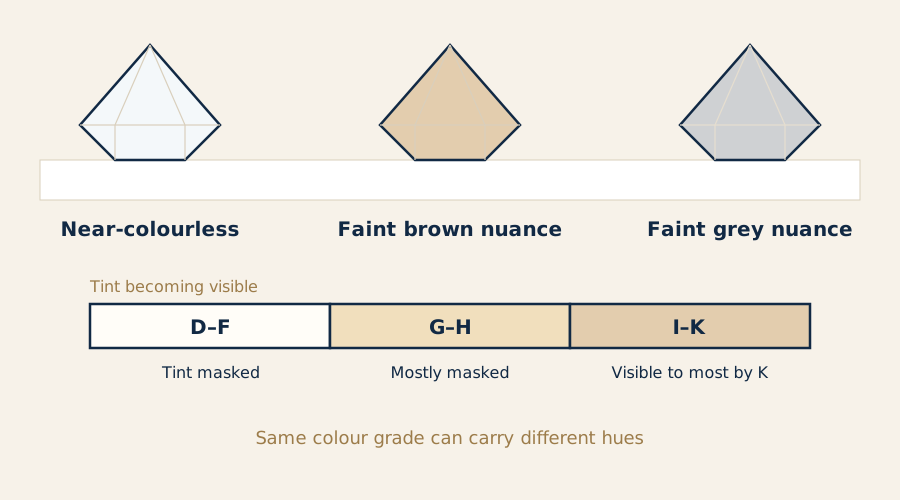
Where you look matters as much as the grade:
- Face-down on white: the easiest way to see body colour, because sparkle is removed. Labs grade this way.
- Daylight near a window: the most honest light. Shop spotlights and cool LEDs can hide warmth.
- Beside a reference stone: tint is relative. A G looks white alone and slightly warm next to a D.
- In the setting: metal colour reflects into the stone and changes what you see.
Cut quality has a big effect on grey in particular. A stone with strong contrast and good light return hides a faint grey well, while a shallow or poorly proportioned stone looks dull and makes grey more obvious; our page on cut quality in lab-grown diamonds explains what to look for. Some CVD stones also glow orange or red under strong ultraviolet light because of nitrogen-vacancy defects. That is a useful clue for labs, but it is not usually visible in daylight and does not cause a tint on its own.
How does tint in CVD compare with HPHT-grown and natural diamonds?
Each kind of diamond has its own typical colour quirks, because the growth conditions are different. This is how they line up:
| As-grown CVD | Treated CVD | HPHT-grown | Natural | |
|---|---|---|---|---|
| Most common unwanted tint | Brown | Faint grey, yellow or pink | Yellow (nitrogen) or blue (boron) | Yellow; brown in some mines |
| Main cause | Vacancy clusters and strain | Defects left after annealing | Trace nitrogen or boron | Nitrogen; plastic deformation for brown |
| Post-growth treatment common? | Not yet treated | Yes, by definition | Less common for colour | Some natural stones are HPHT-treated, must be disclosed |
| Typical diamond type | Type IIa | Type IIa | Type IIa or IIb | Mostly Type Ia |
| How you check | Report comments, face-down view | Report comments, face-down view | Report, plus blue tone in daylight | Report, nuance comments |
Type IIa means a diamond with almost no nitrogen. It is rare in nature, and CVD diamonds are usually Type IIa, which is one reason treated CVD stones can grade very white. Natural diamonds take their colour from millions of years underground: most yellow comes from nitrogen, and natural browns usually come from the crystal being squeezed and bent deep in the earth. Our full comparison of lab-grown and natural diamonds side by side covers price, value and identification.
If you are weighing up growth methods for colour alone, a well-made stone of either type can look excellent. A faint blue in some HPHT-grown versus CVD-grown stones is the main difference you might notice, whereas CVD is the type more likely to have been treated for brown.
Does the ring metal hide a brown or grey tint?
Metal reflects into the diamond from below and around the edges, so it can either mask a tint or make it more obvious.
- Yellow and rose gold: warm metal blends with faint brown, so an H–J stone with a hint of warmth can look white on the hand.
- White gold and platinum: cool metal makes brown stand out more, so most people choose G or better. A faint grey sits more naturally against white metal.
- Bezel settings: a rim of metal around the stone reflects more metal colour into it than slim claws do.
- Halo settings: a ring of very white melee (small diamonds) can make a slightly warm or grey centre look more tinted by contrast.
For custom work, it helps to choose the stone and the metal together. When a ring is designed on screen and test-fitted as a wax or resin model before casting, you can hold the actual diamond against the model and decide whether a warmer or cooler metal flatters it.
Is a CVD diamond with a brown tint worth buying?
It can be, as long as the tint is disclosed and the price reflects it. A lower-grade lab-grown stone with a faint brown or grey costs noticeably less than a whiter one of the same size, and in yellow or rose gold the difference may be hard to see. What matters is that you know what you are getting. These are broad approximate ranges for a well-cut 1 carat round, VS clarity:
| 1 ct round, VS clarity | Approximate price range (AUD) |
|---|---|
| Lab-grown, D–F, treated or as grown | about $900–$2,500 |
| Lab-grown, G–H | about $700–$1,800 |
| Lab-grown, I–K, faint brown or grey noted | about $450–$1,200 |
| Natural, G–H | about $7,000–$14,000 |
Lab-grown prices have fallen quickly in recent years and move with the market, so treat these figures as a guide only. Treatment itself does not usually change the price much among lab-grown stones, because so many CVD diamonds are treated; the colour grade and how the stone looks matter far more. Our lab-grown buying basics set out the other factors that move price, such as cut and carat.
The honest view from a store that sells both: a disclosed, attractive treated CVD stone is a perfectly sound choice, and so is an as-grown one. What is not acceptable is a tint or treatment that only shows up after the sale. Ask to see the full report and the stone in daylight before you decide.
Browse lab-grown diamonds
How do you check a CVD diamond for brown or grey tint? Step by step
- Confirm the origin. The report should state lab-grown or laboratory-grown and the growth method (CVD or HPHT).
- Read the comments line. Look for 'As grown', 'post-growth treatment' or any hue word such as brown or grey.
- Check the colour grade. For white metal aim for about G or better; in yellow or rose gold, H–J can work. Compare against a lab-grown colour grade chart if you are unsure.
- View it face-down on white. Put the stone on a white card next to a known near-colourless stone and look for warmth or a grey shadow.
- Look in daylight. Step away from shop spotlights; a window or overcast outdoor light shows true colour.
- Watch it move. A grey or overly flat look shows most as the stone tilts; strong contrast between bright and dark facets is what you want.
- Hold it against your metal. Try the stone beside the metal colour you plan to use before the setting is made.
Free consultation
Talk to a gemologist
Compare stones in person or online with Raj Sood, Graduate Gemologist (GIA), AJP (GIA).
Book a consultationShop this shape
FAQ
Common questions
Why do CVD diamonds look brown?
Fast CVD growth traps vacancy clusters (groups of missing carbon atoms) and strain in the crystal, and these absorb more blue light than red, so the stone looks brown. Nitrogen added to speed growth usually increases the brown.
Are most CVD lab-grown diamonds treated?
Many near-colourless CVD diamonds are treated after growth, usually by HPHT annealing, to remove brown. The grading report should say whether there is evidence of post-growth treatment.
Is an HPHT-treated CVD diamond still a real diamond?
Yes. Annealing changes defects in the crystal, not what it is made of, so it remains real diamond with the same hardness and refractive index. It must still be described as lab-grown.
Will the brown come back after treatment?
No. The colour change from annealing is stable in normal wear and routine jewellery work. Direct torch heat should still be kept away from any diamond during repairs.
Can a natural diamond have a brown or grey tint too?
Yes. Natural diamonds can show brown from deformation deep underground and grey from hydrogen or dark inclusions. The grading report notes the colour grade and, sometimes, the nuance.
Is grey tint worse than brown tint?
Neither is worse in durability. Faint brown usually looks warm, while faint grey can look flat; which bothers you more depends on your eye and your metal colour.

Ask a gemologist
Not sure which diamond to choose?
Raj Sood is a Graduate Gemologist (GIA) and master jeweller. Bring the stones you are considering, or send the reports, and he will tell you honestly which one is better and why.
Keep learning
Related guides
 Lab-Grown DiamondsHPHT vs CVD Lab-Grown Diamonds
 Lab-Grown DiamondsLab-Grown Diamond Colour GradesDiamond 4Cs & GradingBrown, Grey and Blue Nuance in Colourless-Looking Diamonds
 Lab-Grown DiamondsCVD Growth Striations: Should Buyers Worry?Lab-Grown DiamondsLab-Grown Diamonds GuideLab-Grown DiamondsCan I Make a Lab-Grown Diamond or Gemstone at Home?
 Lab-Grown DiamondsAre Lab-Grown Diamonds Real DiamondsLab-Grown DiamondsHow Are Lab-Grown Diamonds Manufactured?
Explore more
More guides on this topic
Education