
- Education
- Buying Knowledge & Custom Process
- Do You Need a Wax or Resin Model Before Making a Ring?
Buying knowledge & custom process
Do You Need a Wax or Resin Model Before Making a Ring?
A ring on a screen is not the same as a ring on your finger. Here is when a wax or resin model is worth asking for, what to check on it, and the Australian rules that apply once you sign off.
 Reviewed by Raj Sood, Graduate Gemologist (GIA), AJP (GIA)Master jeweller and Graduate Gemologist (GIA) · reviewed 4 November 2026
Quick answer
You don't always need one, but a wax or resin model is the safest way to check a custom ring before metal is cast. Most rings are designed in CAD, then 3D-printed. A try-on model lets you check proportions, height and fit beside a wedding band, usually for a small fee and a few extra days.
What is a wax or resin model for a ring?
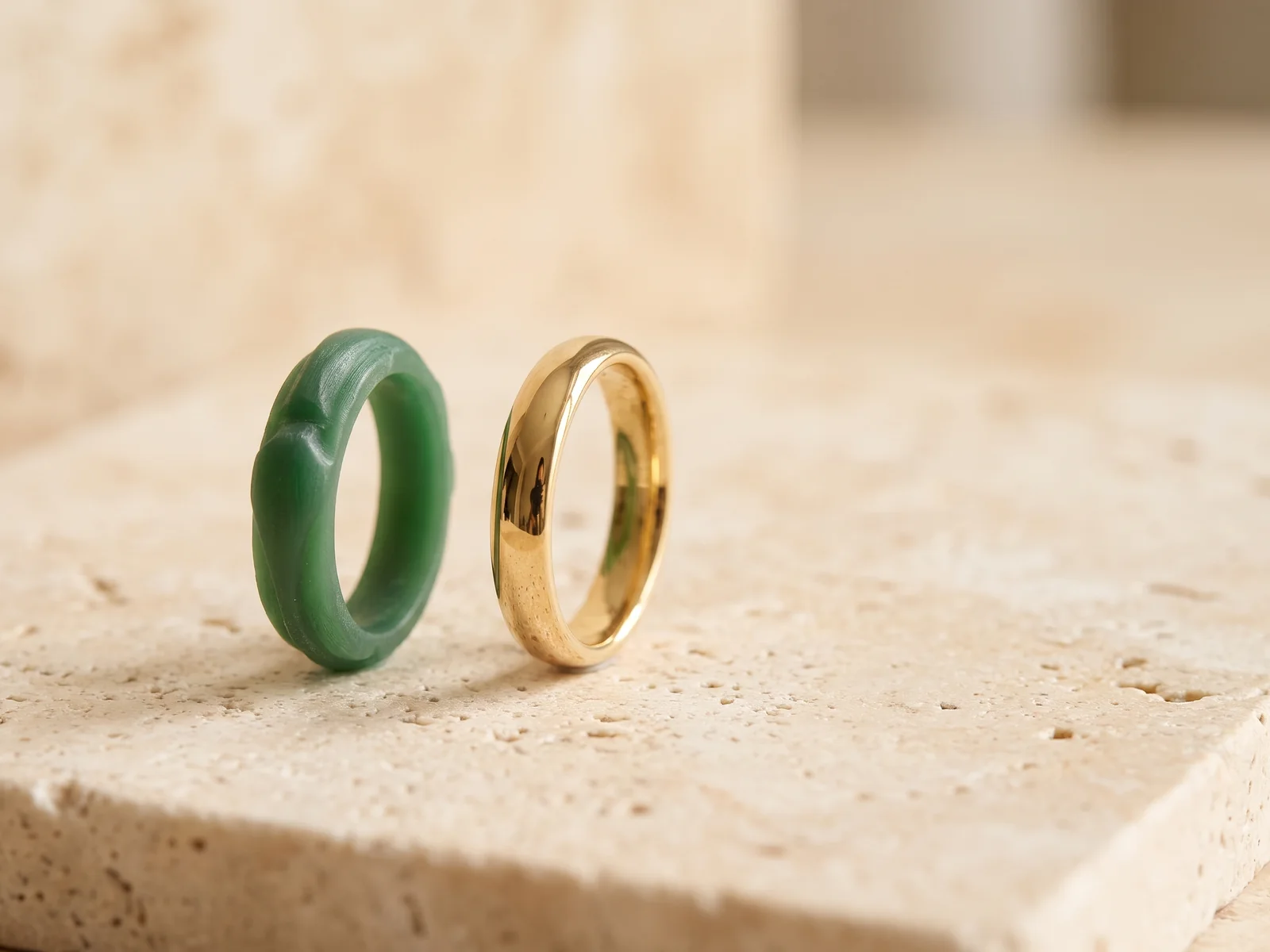
A ring model is a full-size, three-dimensional copy of your ring made before any gold or platinum is used. It is made in either wax or resin (a liquid plastic that hardens under light). You can hold it, turn it and, in most cases, slide it onto your finger. It shows the shape, height and thickness of the finished piece, but not the colour of the metal or the sparkle of the stones.
There are two quite different reasons a jeweller makes a model, and it helps to know which one you are being offered:
- Try-on model: printed in a sturdy standard resin so you can wear it and judge the design. It is never cast; it is just for you to look at.
- Casting model: printed in castable resin or castable wax, or carved by hand from jewellery wax. This is the pattern that gets turned into metal by lost-wax casting, and it is destroyed in the process.
Today most custom rings start as a CAD (computer-aided design) file, a precise 3D drawing built to fractions of a millimetre. The model is simply that file made physical. If any of these terms are new, our plain-English jewellery terms explain them, and if you are still deciding whether to go custom at all, start with custom versus ready-made rings.
Do you need a wax or resin model before making a ring?
Not always. A model is an extra check, not a compulsory step. Every cast ring passes through a wax or resin pattern at some point, but whether you personally see and approve a try-on model is a choice. The honest answer depends on how unusual the design is and how confident you are reading CAD renders (the photo-like images made from the design file).
| Situation | Model worth it? | Why |
|---|---|---|
| Simple solitaire on a proven design | Optional | Renders and a sample ring in store usually show enough |
| Tall or low setting, unusual head height | Yes | Height off the finger is hard to judge on screen |
| Halo, hidden halo or detailed gallery | Yes | Thickness and proportions look different at real size |
| Ring must sit flush with a wedding band | Strongly recommended | Gaps of 0.5 mm show on the hand, not in a render |
| Large or fancy-shaped centre stone | Yes | Checks the seat, claws and how the stone sits |
| Remodelling an heirloom or matching an old piece | Yes | Lets you compare side by side with the original |
| Exact remake of an existing ring | Usually not | The design is already proven |
If you are working through the custom process for the first time, our list of questions to ask before ordering a custom ring includes asking whether a try-on model is offered, what it costs and how many revisions are included. It also pays to settle choosing the centre diamond first, because the model is built around the exact measurements of the stone. Our complete engagement ring buying guide covers where the model fits in the bigger picture.
Fancy shapes are where a model earns its keep most often, because each outline needs its own seat and claw layout. Our overview of diamond shapes and their outlines shows why a pear, marquise or heart sits so differently from a round.
Wax or resin: what is the difference?
Both materials do the same job, but they behave differently in the printer, in your hand and in the kiln. Jewellery resin printers build a model in very thin layers, typically about 25–50 microns each (a micron is a thousandth of a millimetre), fine enough to show tiny claws and milgrain (rows of small metal beads along an edge).
| Standard resin (try-on) | Castable resin | Printed wax | Hand-carved wax | |
|---|---|---|---|---|
| How it is made | 3D-printed from CAD | 3D-printed from CAD | 3D-printed from CAD | Carved by hand with files and burrs |
| Can you wear it? | Yes, carefully | Yes, but more fragile | Briefly; soft and easily marked | Briefly; soft |
| Used for casting? | No | Yes | Yes | Yes |
| Fine detail | Very good | Very good | Excellent | Depends on the carver |
| Burns out cleanly? | Not designed to | Yes, with a longer burnout | Yes, very cleanly | Yes, very cleanly |
| Typical use | Approving the design | Most CAD-made rings | Very fine filigree and detail | Organic, sculptural and one-off designs |
Resin is stronger and holds a crisp edge, which makes it the usual choice for try-on models. Wax is softer, so it marks with a fingernail, but it melts and burns away with almost no residue, which some casters prefer for very fine work. Hand-carved wax is the older craft method: a jeweller shapes a block of wax by hand, often for flowing, natural shapes that are hard to draw in CAD.
People sometimes ask whether they can print their own model on a home 3D printer. A hobby printer can give a rough idea of shape, but jewellery printers work at a much finer resolution, and the castable materials need controlled burnout. It is a similar story to our page on what you can and can't make at home: the principle is simple, the precision is not.
How does a resin model become a finished ring?
Once you approve the design, the casting model goes through lost-wax casting, a method jewellers have used for thousands of years. The model is 'lost' because it is burnt away to leave a mould. In outline:
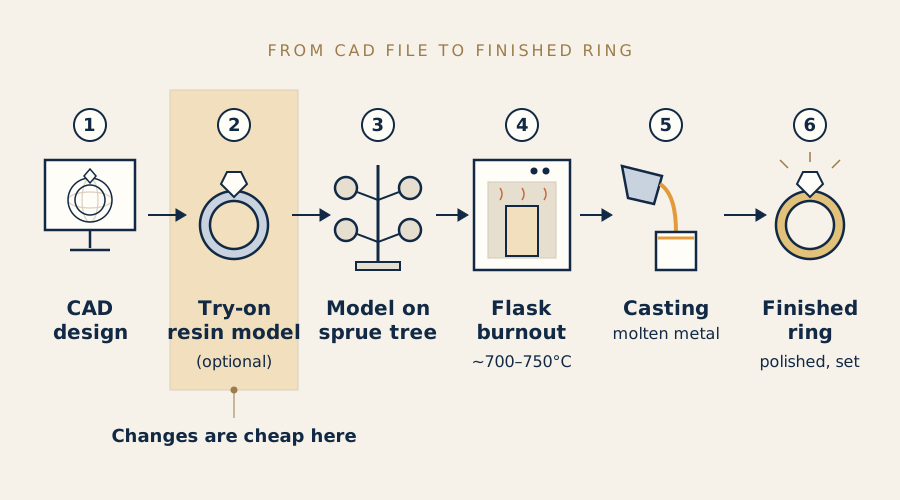
- Spruing: the model is attached by a small wax rod called a sprue to a central wax stem, often with other rings, forming a 'tree'.
- Investing: the tree goes into a steel flask filled with investment, a fine plaster-like material that sets hard around every detail.
- Burnout: the flask is heated in a kiln, typically to around 700–750°C over several hours, so the wax or resin burns away and leaves a hollow the exact shape of the ring.
- Casting: molten metal is poured or spun into the hollow. Platinum melts at about 1,770°C and needs special investment and equipment.
- Finishing: the casting is cut from the sprue, filed, sanded and polished, then the stones are set and the ring is polished again.
Metal shrinks slightly as it cools, commonly about 1–2%, and filing and polishing remove a little more. A good CAD designer builds both allowances into the file, which is why the claws on a model can look a fraction chunkier than they will on the finished ring. Our glossary entries for sprue, investment and casting go into each term in more depth.
Not sure which one is right?
Send us the stones you are looking at and our gemologist will tell you which to choose and why.
What should you check on a resin model of a ring before casting?
This is the moment to change your mind cheaply. Once metal is cast, changing the height, width or shape usually means starting again. Take your time and check each of these:
| Area | What to check | Typical figures |
|---|---|---|
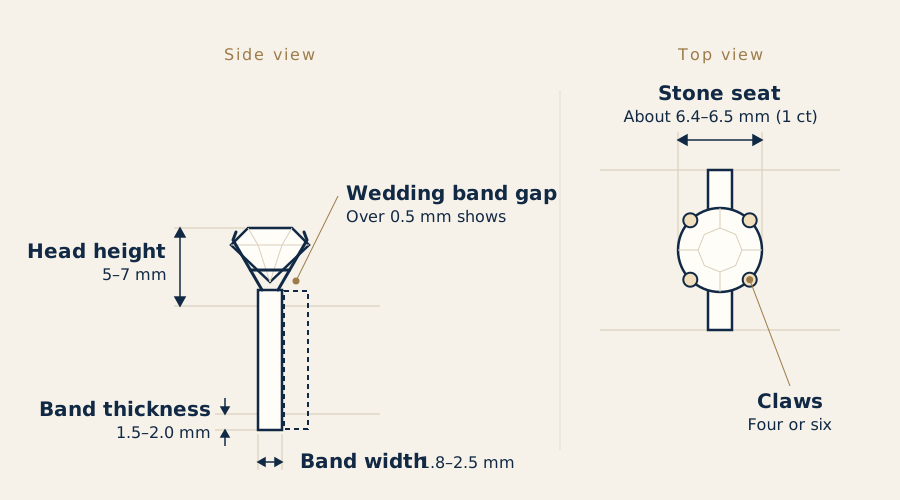
| Head height | How far the stone sits above your finger, from the side | About 5–7 mm for a 1 ct round solitaire; lower settings exist |
| Band width | Width across the top and at the base of the shank | About 1.8–2.5 mm for most engagement rings |
| Band thickness | Depth from inside to outside of the band | About 1.5–2.0 mm for everyday strength |
| Stone seat | Seat matches the stone's measured diameter | For example about 6.4–6.5 mm for a 1 ct round |
| Wedding band fit | Space under the setting so a straight or curved band sits flush | Gaps over about 0.5 mm are visible on the hand |
| Claws or bezel | Number, position and thickness | Four or six claws; V-claws on points |
| Ring size | Comfort over the knuckle and on the finger | Resin is brittle, so do not force it |
Wedding band fit is the check people most often skip. Bring your band, or a sample of the style you plan to wear, to the fitting. With fancy shapes the wide part of the stone can push a straight band away; our guide to bands that sit flush beside a heart ring shows the contoured shapes jewellers use to close that gap.
Remember what a model cannot show. Resin is usually grey, green, red or clear, so it does not show the colour of yellow, rose or white gold, and an empty seat or a placeholder stone does not show brightness. Some jewellers set a cubic zirconia (a diamond simulant, not a diamond) in the model so you can judge proportions. To compare stone sizes properly, read the millimetre measurements in our guide on how to read diamond measurements, and if the model shows the stone looks smaller than you hoped, our page on whether to put budget into size or quality helps with that trade-off. Shape matters too: see which shapes face up largest for their weight.
How much does a ring model cost and how long does it take?
Costs vary between workshops and with how complex the design is, so treat these as broad Australian ranges rather than quotes:
| Option | Approximate cost (AUD) | Extra time |
|---|---|---|
| CAD renders only | Usually included in the design fee | None beyond design |
| Try-on resin model | Often included, or about $50–$150 | About 2–5 working days |
| Each further revised model | About $0–$100 | About 2–5 working days |
| Hand-carved wax model | About $200–$800 | About 1–3 weeks |
| Silver sample cast of the design | About $150–$400 | About 1–2 weeks |
The print itself only takes a few hours; most of the extra time is cleaning, curing, posting or arranging a fitting, and any revisions. A whole custom ring commonly takes about 3–6 weeks from approved design to collection, so a model adds days, not months. If your timeline is tight, for example a proposal date or an overseas trip, tell the jeweller at the start.
The model sits alongside other decisions about the centre stone. If you are choosing a lab-grown diamond for your setting, our list of what to ask a jeweller about a lab-grown centre stone covers grading reports and disclosure.
What do Australian rules mean for a custom ring, including TRS and insurance?
Approving a model is also a practical and legal milestone. Three Australian rules are worth understanding before you sign off.
Australian Consumer Law (ACL). A ring made to your design is usually not refundable just because you change your mind, so approval of the model matters. Your automatic consumer rights still apply: the ring must be of acceptable quality, match its description and be fit for any purpose you told the jeweller about. Where goods are supplied by reference to a sample or model, the ACL also expects them to match it, so keep a copy of the approved CAD file, photos of the model and any written changes.
Tourist Refund Scheme (TRS). Visitors, and Australians travelling overseas, may be able to claim back the GST when they leave Australia. Broadly, you need to spend AUD 300 or more (GST included) with one business, buy within 60 days before departure, hold the original tax invoice and carry or wear the ring through the airport. With a custom ring, timing is the catch: plan the model, revisions and making time so the ring is finished and invoiced inside that window.
Insurance. The ring is not yours to insure until it is finished and handed over, so ask who covers it while it is being made. On collection, get a written valuation for insurance, which usually states a replacement value. Many home contents policies cap unlisted jewellery at a fairly low amount per item, so check whether you need to list the ring as a specified item or take out separate jewellery cover.
For lab-grown diamond rings, it also helps to understand resale value questions for lab-grown diamonds before you insure, because replacement value and resale value are very different numbers. Day-to-day, see our notes on caring for a lab-grown diamond once it is set.
How does the model fit into a custom ring at GemTrove?
At GemTrove, a family jewellery business founded in 2008 with roots in the trade since 1984, the model is part of the design conversation. Designs are drawn in CAD, and a try-on model can be made so you can see the ring at full size before metal is cast. Raj Sood, a Graduate Gemologist (GIA), checks the stone seat against the actual diamond or gemstone, natural or lab-grown.
Related guideShould You Choose a Custom Engagement Ring or a Ready-Made Ring?Before your appointment, it helps to have read up on budget, metal and setting choices, so you arrive knowing roughly what you want the model to show.
Explore the custom jewellery service
How do you approve a wax or resin model? Step by step
- Confirm the stone first. Get the exact millimetre measurements of the centre stone from its grading report, so the seat in the model matches.
- Review the CAD renders. Check top, side and end views, and ask for key measurements: head height, band width and band thickness.
- Ask for a try-on model if the design is tall, detailed, unusual or must sit with a wedding band.
- Wear it gently. Check comfort, height from the side and how it sits next to your wedding band or other rings.
- Write down every change and ask for a revised render or model if anything moves by more than a fraction of a millimetre.
- Approve in writing. Keep the final CAD file images and model photos with your order, then check timing for TRS and insurance before casting begins.
For a fuller pre-order list, see our full checklist of custom ring questions.
Free consultation
Talk to a gemologist
Compare stones in person or online with Raj Sood, Graduate Gemologist (GIA), AJP (GIA).
Book a consultationShop this shape
FAQ
Common questions
Is a resin model the same size as the finished ring?
A try-on model is printed at the finished size, so it shows true proportions. The casting model may be scaled slightly larger to allow for metal shrinking about 1–2% as it cools.
Can I keep the resin model?
Usually yes, if it is a try-on model, because it is never cast. A casting model is burnt away during lost-wax casting, so it cannot be kept.
Is wax or resin better for casting a ring?
Both cast well. Castable resin is stronger and holds crisp detail, while wax burns out more cleanly and suits very fine or hand-carved work; the caster usually chooses based on the design.
Can the diamond be set in the resin model?
Resin is brittle, so most jewellers avoid setting a valuable diamond in it. Some place a cubic zirconia or sit the stone loosely in the seat so you can judge proportions.
Does a ring model add a lot of time?
Usually about 2–5 working days per model, depending on revisions and how you collect it. That is small compared with the 3–6 weeks a custom ring commonly takes.
Can I return a custom ring if I approved the model?
Custom rings are generally not refundable for a change of mind under Australian Consumer Law. If the finished ring is faulty or does not match what was agreed, your automatic consumer rights still apply.

Ask a gemologist
Not sure which diamond to choose?
Raj Sood is a Graduate Gemologist (GIA) and master jeweller. Bring the stones you are considering, or send the reports, and he will tell you honestly which one is better and why.
Keep learning
Related guides
 Buying Knowledge & Custom ProcessQuestions to Ask Before Ordering a Custom Engagement Ring
 Buying Knowledge & Custom ProcessShould You Choose a Custom Engagement Ring or a Ready-Made Ring?Buying Knowledge & Custom ProcessEngagement Ring Buying Guide
 Buying Knowledge & Custom ProcessDiamond Buying Guide
 Diamond 4Cs & GradingBigger Diamond or Better Quality?
 Lab-Grown DiamondsDo Lab-Grown Diamonds Need Different Care?
 Lab-Grown DiamondsCan I Make a Lab-Grown Diamond or Gemstone at Home?
 Lab-Grown DiamondsLab-Grown Diamond Resale Value: Questions to Ask Before Buying
Explore more
More guides on this topic
Education