
- Education
- Lab-Grown Diamonds
- Can You Make a Lab-Grown Diamond at Home? What It Really Takes
Lab-Grown Diamonds
Can You Make a Lab-Grown Diamond at Home? What It Really Takes
Online videos promise you can make a lab-grown diamond at home with a microwave, a pencil or a kit. Here is what diamond growth really takes, which gemstones hobbyists can grow safely, and what to check before you buy a lab-grown stone in Australia.
 Reviewed by Raj Sood, Graduate Gemologist (GIA), AJP (GIA)Master jeweller and Graduate Gemologist (GIA) · reviewed 4 November 2026
Quick answer
No. You cannot realistically make a lab-grown diamond at home. Diamond growth needs either a press reaching about 5–6 GPa at 1,300–1,600 °C (HPHT) or a vacuum plasma reactor running methane and hydrogen for weeks (CVD), plus seed crystals and expert control. Kits and microwave hacks produce no diamond; only simple non-gem crystals are realistic at home.
Can you make a lab-grown diamond at home?
The short, honest answer is no. A lab-grown diamond is not a craft project. It is grown in specialised industrial plants using equipment that costs hundreds of thousands of dollars per machine, draws kilowatts of power around the clock and is run by engineers who control temperature, pressure and gas chemistry to within narrow limits. Nothing in a home kitchen, garage or school science kit comes close.
It helps to be clear about what a lab-grown diamond actually is. It is real diamond: pure carbon atoms locked in the same cubic crystal structure as a mined diamond, with the same hardness (10 on the Mohs scale, the scale gemmologists use to rank scratch resistance) and the same refractive index of about 2.42 (a measure of how strongly a material bends light, which drives sparkle). Our page on why lab-grown diamonds count as real diamond explains the science. The word 'lab' simply means the crystal formed in a controlled growth chamber rather than deep in the Earth.
Because the product is real diamond, the process has to recreate conditions in which carbon prefers to form diamond rather than graphite (the soft grey carbon in pencils). That is the hard part, and it is why diamond growth stays in factories. For the wider picture of how these stones are graded, priced and sold, start with our complete lab-grown diamond guide, and if any term below is new, the GemTrove jewellery glossary defines it.
How are lab-grown diamonds actually made?
There are two commercial methods. Both start with a seed crystal, a small piece of diamond that gives the new carbon atoms a pattern to copy.
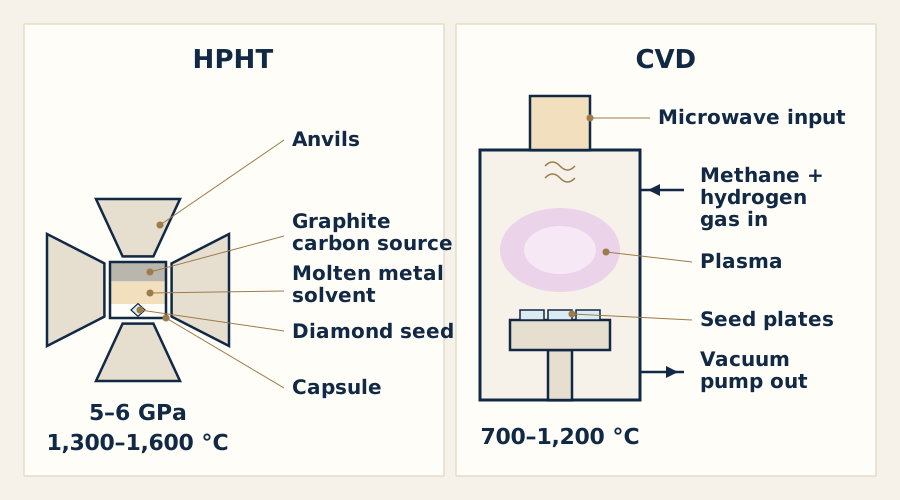
HPHT (high pressure, high temperature) copies the conditions deep in the Earth's mantle. A carbon source such as graphite, a molten metal solvent (usually iron, nickel or cobalt alloys) and tiny diamond seeds go into a capsule at the centre of a large press. Modern cubic presses squeeze the capsule from six directions with tungsten carbide anvils, reaching about 5–6 gigapascals (GPa), roughly 50,000–60,000 times normal air pressure, while heating it to about 1,300–1,600 °C. Carbon dissolves in the metal and crystallises onto the seed over days to a couple of weeks.
CVD (chemical vapour deposition) works the other way round, at low pressure. Thin diamond seed plates sit in a sealed vacuum chamber filled with a gas mix of a few percent methane in hydrogen. Microwaves of several kilowatts turn the gas into a glowing plasma (a superheated, electrically charged gas). The plasma splits the methane, and carbon atoms settle onto the seeds layer by layer at roughly 5–50 micrometres per hour, while atomic hydrogen etches away any graphite that tries to form. Growing a crystal thick enough to cut a 1 carat stone usually takes weeks. Our step-by-step look at how lab-grown diamonds are manufactured covers each stage in more depth.
| HPHT | CVD | |
|---|---|---|
| Pressure | About 5–6 GPa | Well below normal air pressure |
| Temperature | About 1,300–1,600 °C | About 700–1,200 °C at the diamond surface |
| Carbon source | Graphite dissolved in molten metal | Methane gas in hydrogen |
| Energy source | Electrical heating inside a hydraulic press | Microwave plasma, several kilowatts |
| Typical run | Days to a couple of weeks | Several weeks for a larger crystal |
| Crystal shape | Cube-octahedral (cube and octahedron faces) | Flat, tabular blocks |
| Common tell-tale features | Metallic flux inclusions, possible magnetism | Growth striations, sometimes a brown or grey tint before treatment |
Growth is only the start. Many CVD crystals come out slightly brown and are given a post-growth HPHT treatment to improve colour; see why some CVD stones show a brown or grey tint. The layered growth can also leave faint internal lines, explained in what CVD growth striations mean for buyers. Then every rough crystal is planned, sawn, cut and polished by a diamond cutter, exactly as a natural diamond would be.
Why can't you grow a lab-grown diamond at home?
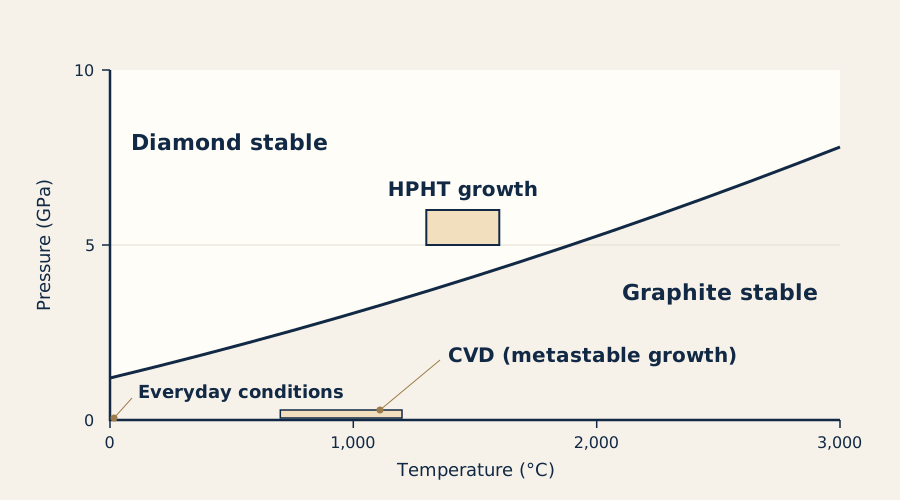
At the pressure and temperature of everyday life, graphite is the stable form of carbon. Diamond only becomes the stable form at enormous pressure, which is why natural diamonds form roughly 150 kilometres or more underground. CVD gets around this by growing diamond in a metastable state (one that lasts but is not the most stable form), but only with precise gas chemistry, a vacuum and a plasma. Either way, you need conditions no home can produce safely.
| What diamond growth needs | What a commercial grower has | What a home has |
|---|---|---|
| Sustained pressure of 5–6 GPa | Multi-tonne cubic press with carbide anvils | Workshop presses that cannot hold that pressure and heat together |
| 1,300 °C+ held steadily for days | Computer-controlled heating inside the cell | Kilns that reach temperature but not under pressure |
| Vacuum chamber with microwave plasma | Purpose-built reactor, cooling and gas control | A microwave oven, which is not a sealed vacuum system |
| High-purity hydrogen and methane | Regulated gas supply and leak monitoring | No safe way to store or meter flammable gases |
| Diamond seed plates | Cut from earlier crystals, polished flat | Not sold to the public in useful form |
| Engineering skill and time | Teams running hundreds of machines | One person, weekends |
University researchers can create diamond-forming pressure in tiny devices called diamond anvil cells, but the samples are microscopic specks used for physics experiments, not gems. Even well-funded start-ups take years to tune a CVD reactor. The barrier is not secret knowledge; it is physics, money and safety.
Do microwave, pencil and DIY diamond kits work?
Search for 'how to make a diamond at home' and you will find plenty of videos. None of them produce gem diamond. The common ones:
- Microwave plasma hacks: a grape, a match or a pencil lead in a microwave can create a brief glowing plasma. It makes no diamond, can damage the magnetron (the part that makes the microwaves), produces ozone and can start a fire.
- Pencil and battery tricks: passing current through graphite heats it until it glows or burns. Without pressure, graphite stays graphite.
- Crushing charcoal or coal: a vice or car jack is thousands of times too weak, and there is no heat.
- 'Grow your own diamond' kits: these grow salt, sugar or alum crystals, or include a cubic zirconia. They are a simulant (a material that only imitates diamond), not lab-grown diamond. See how lab-grown diamond differs from cubic zirconia.
- Memorial diamonds: companies do grow diamonds from carbon taken from cremated remains or hair, but they use industrial HPHT presses, not anything you could do yourself.
If a video shows a sparkling stone at the end, it was almost certainly bought, not grown. Treat any home 'diamond' claim with healthy scepticism until a gemmologist has tested the stone.
Not sure which one is right?
Send us the stones you are looking at and our gemologist will tell you which to choose and why.
Can you grow gemstones at home?
Diamond is out, but crystal growing as a hobby is real and rewarding, as long as you are clear about what you are making. Most lab-created gems, such as lab-created ruby, sapphire, emerald and moissanite, also need industrial temperatures or pressure vessels. A few crystals are genuinely home-friendly, and a small number of experienced hobbyists grow tiny flux crystals in kilns.
| Crystal or gem | How it is grown | Realistic at home? |
|---|---|---|
| Alum, salt, sugar | Slow evaporation from solution | Yes, safe; decorative, not gems |
| Bismuth | Melting the metal (about 271 °C) and cooling | Yes with care and ventilation; a metal, not a gem |
| Copper sulfate | Evaporation from solution | Possible, but toxic; keep away from children and pets |
| Flux-grown ruby or spinel | Dissolved in a molten flux in a programmable kiln, about 1,200–1,300 °C, for weeks | Only for experienced hobbyists; tiny crystals, toxic fluxes |
| Flame-fusion ruby and sapphire | Powder melted in an oxy-hydrogen flame above about 2,050 °C | No: explosive gases, industrial equipment |
| Hydrothermal quartz and emerald | Sealed steel autoclave at high pressure and about 350–600 °C | No: pressure vessel hazard |
| Cubic zirconia | Skull melting at about 2,750 °C | No |
| Moissanite | Silicon carbide grown at about 2,500 °C | No |
| Diamond | HPHT press or CVD plasma reactor | No |
Remember that any gem made this way, even a tiny flux ruby, is a lab-created or synthetic ruby. It has the chemistry of ruby, but it must never be described simply as 'ruby'.
Is it legal or safe to try growing gems at home in Australia?
Owning a kiln or growing alum crystals is perfectly legal. The problems start with the equipment serious gem growth needs. Hydrogen and methane are highly flammable gases, and storing and using gas cylinders is covered by state and territory work health and safety and dangerous goods rules. High-voltage microwave generators can kill. Kilns running at 1,200 °C or more usually need a dedicated circuit installed by a licensed electrician, and flux chemicals can release toxic fumes. If you are tempted to go further than a hobby kiln, speak to your state or territory work health and safety regulator first.
Selling is the other issue. Under the Australian Consumer Law, it is illegal to mislead buyers. Any stone you grew, bought as lab-grown or are unsure about must be described clearly: lab-grown or laboratory-grown for diamond, and lab-created or synthetic for coloured gems. Calling a simulant 'diamond', or leaving out that a diamond is lab-grown, is exactly the kind of description the ACCC (the national consumer regulator) watches for. Our comparison of lab-grown and natural diamonds side by side sets out the wording and differences properly.
Related guideLab-Grown Diamonds vs Natural DiamondsHow can you tell a lab-grown diamond from a simulant?
A basic handheld diamond tester measures how fast heat moves through a stone. Lab-grown diamond conducts heat like natural diamond, so it tests as diamond; cubic zirconia and glass do not. Moissanite also conducts heat well, which can fool basic thermal testers, so a combined heat-and-electrical tester or lab equipment is needed. Our guide to whether lab-grown diamonds pass a diamond tester explains what each tool can and cannot show.
Telling lab-grown from natural is a separate job. It needs spectroscopy and fluorescence imaging (machines that read how the crystal absorbs and emits light), which reveal the HPHT or CVD growth pattern. This is why an independent grading report matters. A report on a lab-grown diamond states that it is laboratory-grown, usually names the growth method, notes any post-growth treatment and records a laser inscription on the girdle (the thin outer edge). If you are weighing up look-alikes, read lab-grown diamond compared with moissanite and our broader moissanite and diamond differences.
How much does a real lab-grown diamond cost in Australia?
Part of the appeal of 'making your own' is saving money, but lab-grown diamond prices have already fallen a long way as production has scaled up. Lab-grown costs much less than natural diamond of the same size and grade, so there is little financial reason to try.
| Round brilliant, G–H colour, VS clarity | Lab-grown (approx. AUD) | Natural (approx. AUD) |
|---|---|---|
| 0.50 ct | about $400–$1,200 | about $2,000–$4,500 |
| 1.00 ct | about $800–$2,500 | about $6,000–$15,000 |
| 2.00 ct | about $1,800–$5,000 | about $20,000–$50,000 |
These are broad ranges only and move with the market. Within lab-grown, price is driven by carat, colour, clarity, cut and the grading report, not by which method grew the crystal; the real drivers of lab-grown diamond prices breaks this down. Because lab-grown stones are affordable, buyers often move up in quality, so it is worth understanding how colour grades work on lab-grown stones and what separates a well-cut lab-grown diamond. Lower prices also make multi-stone pieces practical; see lab-grown options for studs and tennis bracelets and our advice on pairing two lab-grown stones for earrings.
Browse lab-grown diamonds
How do you get a lab-grown diamond made into jewellery? Step by step
If the idea of 'making' a diamond appeals, the closest real-world version is having a lab-grown diamond set into a ring you helped design. Here is how that usually works.
- Decide on lab-grown or natural. Both are real diamond; lab-grown costs much less, natural is rarer.
- Set a budget and size. Compare millimetre measurements, not just carat weight.
- Read the grading report. Confirm it says laboratory-grown, check the growth method, any post-growth treatment and the girdle inscription.
- Check colour, clarity and cut. Ask about any brown or grey tint and look for visible striations in a 360° video.
- Design the setting. A CAD drawing, and a printed wax or resin model if needed, lets you see the ring before it is cast; see whether you need a wax or resin model first.
- Insure it. Get a written valuation and read whether to insure a lab-grown diamond.
- Look after it. Clean and check it like any diamond; our care guide for lab-grown diamond jewellery covers the routine.
Free consultation
Talk to a gemologist
Compare stones in person or online with Raj Sood, Graduate Gemologist (GIA), AJP (GIA).
Book a consultationShop this shape
FAQ
Common questions
Can you make a real diamond at home?
No. Diamond growth needs either about 5–6 GPa of pressure at 1,300–1,600 °C or a vacuum plasma reactor with methane and hydrogen, both of which require industrial equipment, expertise and serious safety controls.
Can you make a diamond in a microwave?
No. A microwave can create a brief plasma from a grape or pencil lead, but it produces no diamond and can damage the oven, release ozone and start a fire.
How much does a lab-grown diamond machine cost?
A single commercial CVD reactor or HPHT press typically costs in the hundreds of thousands of dollars, before power, gases, seed plates and cutting. Growers run many machines to make it viable.
What gemstones can I grow at home?
Safe home projects include alum, salt, sugar and bismuth crystals, which are decorative rather than gems. Experienced hobbyists sometimes grow tiny flux rubies in a kiln, but these are lab-created rubies and involve toxic chemicals.
Are DIY diamond kits real?
No. They grow salt or alum crystals or include a simulant such as cubic zirconia. Neither is lab-grown diamond.
How long does it take to grow a lab-grown diamond?
HPHT growth usually takes days to a couple of weeks, while CVD takes several weeks for a crystal large enough to cut a 1 carat stone. Cutting and polishing then add more time.
Terms in this guide

Ask a gemologist
Not sure which diamond to choose?
Raj Sood is a Graduate Gemologist (GIA) and master jeweller. Bring the stones you are considering, or send the reports, and he will tell you honestly which one is better and why.
Keep learning
Related guides
 Lab-Grown DiamondsHow Are Lab-Grown Diamonds Manufactured?
 Lab-Grown DiamondsAre Lab-Grown Diamonds Real Diamonds
 Lab-Grown DiamondsLab-Grown Diamonds vs Cubic Zirconia
 Lab-Grown DiamondsDo Lab-Grown Diamonds Test as DiamondsLab-Grown DiamondsLab-Grown Diamonds GuideLab-Grown DiamondsShould a Lab-Grown Diamond Be Insured?Lab-Grown DiamondsLab-Grown Diamond Cut QualityLab-Grown DiamondsLab-Grown Diamond Colour Grades
Explore more
More guides on this topic
Education