
- Education
- Lab-Grown Diamonds
- Can a Diamond Tester Tell Natural From Lab-Grown Diamonds?
Lab-Grown Diamonds
Can a Diamond Tester Tell Natural From Lab-Grown Diamonds?
A handheld diamond tester beeps the same for a lab-grown diamond as for a natural one. Here is why, which tools can actually tell them apart, and how a report and inscription settle the question.
 Reviewed by Raj Sood, Graduate Gemologist (GIA), AJP (GIA)Master jeweller and Graduate Gemologist (GIA) · reviewed 4 November 2026
Quick answer
No. A standard diamond tester, whether thermal or electrical, measures heat or electrical conductivity, and natural and lab-grown diamonds almost always respond the same way, so both read as diamond. Telling them apart needs a UV-based screening device or a gemmological laboratory that analyses growth patterns, fluorescence and spectra. A grading report and laser inscription confirm the origin.
Can a diamond tester tell natural from lab-grown?
Short answer: no. The handheld diamond tester you see on jewellers' benches, in pawn shops and in online listings for under about AUD $100 was designed to separate diamond from simulants (stones that imitate diamond but are a different material), such as cubic zirconia, glass and white sapphire. It does that by measuring how quickly the stone conducts heat, and on many models electricity as well.
A lab-grown diamond is the same material as a natural diamond: carbon atoms locked in the same cubic crystal structure. It conducts heat the same way, so the tester reads 'diamond' for both. If you want the chemistry behind that, our explainer on whether lab-grown diamonds are real diamonds covers it in plain terms.
That is not a fault in the tester. It is simply asking the wrong question. Whether a diamond grew more than a billion years ago deep in the earth or in a few weeks in a reactor, the difference lies in its growth history: the trace elements it took in, the pattern it grew in and how it responds to ultraviolet light. Reading that history takes different equipment, from desktop screening devices to the spectrometers used by grading laboratories.
This guide explains what each kind of tester measures, which tools can and cannot separate natural from lab-grown, how grading reports and inscriptions settle the question, and what Australian consumer law expects of sellers. For the wider background first, start with our complete guide to lab-grown diamonds.
How does a diamond tester work?
A thermal tester has a small heated metal tip. When you touch it to the table (the large flat top facet) of a stone, it measures how fast heat drains away. Diamond has the highest thermal conductivity of any natural material, roughly 2,000 W/m·K at room temperature, about five times that of copper. Heat vanishes almost instantly, the needle swings to the top and the pen beeps. Cubic zirconia and glass are close to insulators by comparison and barely register.
The weak spot of a thermal pen is moissanite (silicon carbide), which also conducts heat very well and fools it. So most testers sold today are multi-testers that add an electrical conductivity check: moissanite lets a tiny current through, while almost all diamonds are electrical insulators. Our page on how moissanite behaves on thermal and electrical testers explains that check in more detail.
| Tester type | What it measures | What it separates from diamond | Can it tell natural from lab-grown? | Approx. cost (AUD) |
|---|---|---|---|---|
| Thermal pen | Heat conductivity | Cubic zirconia, glass, most coloured stones | No | about $20–$100 |
| Electrical (moissanite) tester | Electrical conductivity | Moissanite | No; some boron-bearing lab-grown diamonds read as moissanite | about $50–$200 |
| Multi-tester | Heat and electrical conductivity | Most simulants, including moissanite | No | about $80–$400 |
| Reflectivity meter | How much light the surface reflects | Some simulants | No | about $100–$500 |
| UV screening device | Short-wave UV transmission or fluorescence | Flags type II diamonds for referral | Screens only; refers suspects to a lab | about $3,000–$30,000+ |
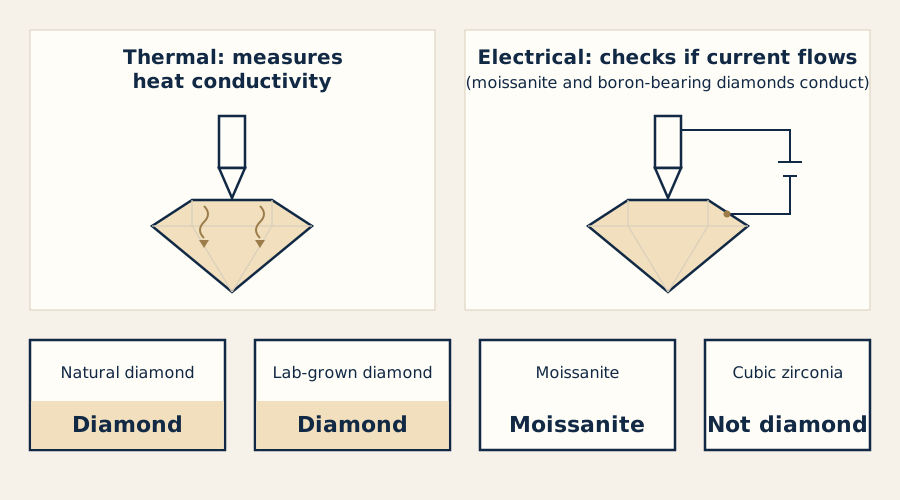
A thermal pen also needs care to give a fair reading. The stone should be clean, dry and at room temperature, the tip held at right angles to a facet, and small stones in a metal setting can read falsely if the tip touches the metal. For a fuller set of at-home and in-store checks, see our guide on how to tell if a diamond is real.
Why does a lab-grown diamond pass a diamond tester?
Because it is diamond. A lab-grown stone has the same hardness (10 on the Mohs scale), the same refractive index of about 2.42, the same density of about 3.52 g/cm3 and the same thermal conductivity as a mined one. It is grown in one of two ways: HPHT (high pressure, high temperature), which recreates mantle-like conditions in a press, or CVD (chemical vapour deposition), which builds diamond layer by layer from a carbon-rich gas. Our page on how HPHT and CVD diamonds are grown walks through both.
Natural diamonds, by contrast, crystallised roughly 150–200 km below the surface, mostly between about 1 and 3.5 billion years ago, and were carried up in volcanic kimberlite pipes. That long, messy journey leaves fingerprints, such as nitrogen clusters and crystal inclusions, that a thermal pen cannot see. Read more in the story of how natural diamonds form deep in the earth.
There is one quirk worth knowing. Some HPHT lab-grown diamonds contain traces of boron, which makes diamond conduct electricity. Many lab-grown blue diamonds are boron-coloured, and some near-colourless HPHT stones carry enough boron to matter. On a multi-tester these can trigger the 'moissanite' warning even though they pass the thermal test. Natural boron-bearing diamonds (such as natural blues) do the same, but they are very rare. So a moissanite alarm on a stone that otherwise tests as diamond is a reason for laboratory testing, not a verdict, which is also discussed in our moissanite tester guide.
You may also see cheap handheld devices advertised as 'lab diamond testers'. Treat these carefully. Where they work at all, they generally check ultraviolet response and flag a diamond as a type II stone that needs further testing. That is screening, not identification, and no handheld pen can confirm on its own that a diamond is natural.
Related guideHow to Tell if a Diamond Is RealWhat are diamond types, and why do they matter for testing?
Gemmologists sort diamonds into types by the nitrogen and boron atoms trapped in the crystal. It sounds technical, but it is the key to how screening works, because natural and lab-grown diamonds fall into the types in very different proportions.
| Diamond type | What it contains | Share of natural diamonds | In lab-grown diamonds | Typical screening result |
|---|---|---|---|---|
| Type Ia | Nitrogen in clusters (aggregated) | About 98% | Very rare | Passed as natural |
| Type Ib | Single, scattered nitrogen atoms | About 0.1% | Common in yellow HPHT stones | Referred for testing |
| Type IIa | Almost no nitrogen | About 1–2% | Most colourless CVD and HPHT stones | Referred for testing |
| Type IIb | Boron, little or no nitrogen | Well under 0.1% | Blue lab-grown and some colourless HPHT stones | Referred; conducts electricity |
Nitrogen clusters in a type Ia diamond absorb short-wave ultraviolet light, while type II diamonds let it through. That single property is what most screening devices rely on. A type Ia result means the stone can be passed as natural with high confidence, because lab-grown diamonds almost never contain aggregated nitrogen. Nitrogen only clusters over geological timescales at mantle temperatures.
Anything else is referred: set aside for laboratory testing. That includes natural type IIa diamonds, which are rare but include some famous large stones such as the Cullinan. Type IIa naturals become proportionally more common among very large stones, which ties in with how quickly natural diamonds become rarer as size goes up. A referral is not an accusation; it simply means the stone needs more than a screening device to identify.
Not sure which one is right?
Send us the stones you are looking at and our gemologist will tell you which to choose and why.
Which tools can detect a lab-grown diamond?
Separating natural from lab-grown happens in two stages: screening, which quickly passes the obvious naturals, and identification, which works out exactly what a referred stone is. Here are the tools, from simplest to most advanced:
- UV transmission screeners: desktop devices that check whether short-wave UV passes through the stone. Some, such as GIA's iD100, use spectroscopy as well. They suit loose and mounted stones and are increasingly found in jewellers' workshops.
- Automated melee screeners: machines that sort thousands of tiny diamonds (melee, usually under about 0.20 carat) and pull out lab-grown or suspect stones. Lab-grown melee mixed into natural parcels is one of the trade's main detection concerns.
- Fluorescence imaging (DiamondView): short-wave UV reveals the growth pattern inside the stone. Natural diamonds show octahedral growth zones; HPHT stones show cross-shaped cuboctahedral sectors; CVD stones show fine parallel layers or striations.
- Spectroscopy: infrared (FTIR) confirms the diamond type, and photoluminescence picks up tiny defect signals, such as the silicon-vacancy peak near 737 nm that is typical of CVD growth, or nickel-related signals in HPHT stones.
- Microscope: natural crystal inclusions such as garnet or olivine point to a natural origin, while metallic flux inclusions point to HPHT growth and dark pinpoint graphite to CVD. Many lab-grown stones are very clean, so this is often inconclusive.
- Strong magnet: some HPHT stones with metallic inclusions are faintly attracted to a neodymium magnet. It is a hint, never proof.
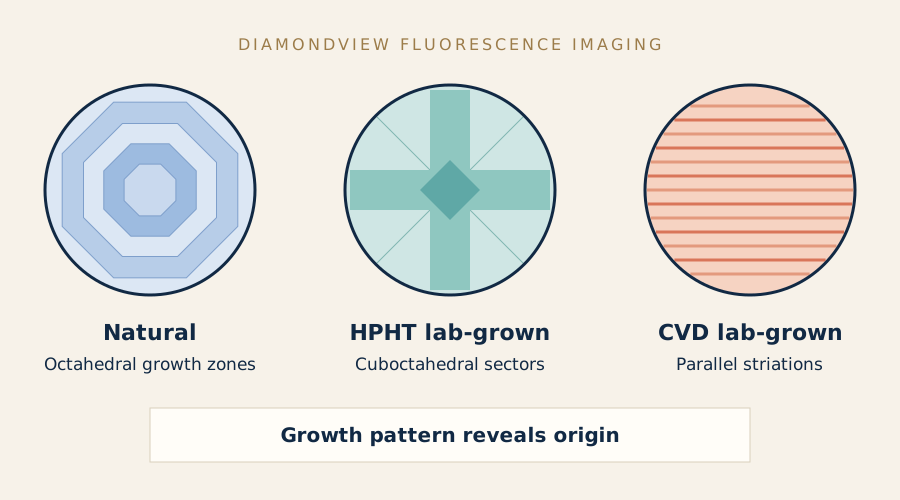
Laboratories combine several of these results before issuing a conclusion, because no single test covers every case. Our article on the step-by-step methods labs use to confirm origin goes deeper into each instrument.
You may hear that an indented natural proves a diamond is mined. An indented natural is a small patch of the original crystal surface left on or near the girdle (the narrow edge around the stone), and on a natural diamond it can show characteristic triangular growth marks. It is a useful clue, but lab-grown crystals have their own grown surfaces too, so it is not proof by itself. Our guide to indented naturals and what they reveal explains how to read them.
How do grading reports and laser inscriptions show a diamond's origin?
For a buyer, the practical answer to 'natural or lab-grown?' is the grading report from an independent laboratory such as GIA or IGI. The lab has already run the screening and identification tests above, and the report states the origin in plain words. Our comparison of how natural and lab-grown diamond reports differ shows each format in detail. What to look for:
- Report title: lab-grown reports carry a clearly different title, such as 'Laboratory-Grown Diamond Report', and often a different colour scheme from natural reports.
- Growth method: many lab-grown reports state whether the stone was grown by CVD or HPHT.
- Treatment comments: reports may note post-growth treatment, which is common in CVD diamonds to improve colour, or state 'as grown'.
- Laser inscription: a tiny inscription on the girdle, readable under 10× magnification. Lab-grown stones are typically inscribed with words such as 'LABORATORY-GROWN' or 'LAB GROWN', or a report number with an 'LG' prefix (used by IGI).
- Online check: the report number can be verified on the laboratory's website, which shows the same origin, grades and measurements.
A natural report will never mention a growth method, and it states that the stone is a natural diamond. Be aware that inscriptions can be polished off by someone determined, so a missing inscription on a stone that is supposed to have one is a reason to have it retested, not to assume either way.
What do Australian rules say about selling lab-grown diamonds?
Australia has no diamond-specific law, but the Australian Consumer Law (ACL) applies to every jewellery sale. It prohibits misleading or deceptive conduct and false or misleading representations about the type, quality or history of goods. Describing a lab-grown diamond in a way that leads a buyer to believe it is natural, or leaving out its origin when that would mislead, risks breaching the ACL. The ACCC (Australian Competition and Consumer Commission) enforces these rules.
International trade nomenclature, such as ISO 18323 and the CIBJO Diamond Book, sets out the wording the industry uses: a lab-grown diamond should be described with a clear qualifier such as 'laboratory-grown', 'laboratory-created' or 'synthetic', and terms that blur the origin should be avoided. These are industry standards rather than Australian law, but they are a sensible benchmark when a jeweller describes a stone.
For buyers, that means you are entitled to clear, written disclosure of origin, and the report and invoice should match. If a diamond sold to you as natural is later shown to be lab-grown, the ACL's consumer guarantees give you rights to a remedy. At GemTrove we sell both natural and lab-grown diamonds, and each stone's origin is stated on its grading report; a look at real report wording for each type shows what that disclosure looks like. This section is general information, not legal advice.
Does it matter whether a diamond is natural or lab-grown?
Physically and optically, not really: both are diamond, and neither a tester nor your eye can tell them apart. Where they differ is origin, rarity and price. Here they are side by side:
| Natural diamond | Lab-grown diamond | |
|---|---|---|
| Material | Crystallised carbon | Crystallised carbon |
| Hardness (Mohs) | 10 | 10 |
| Refractive index | about 2.42 | about 2.42 |
| Thermal tester reading | Diamond | Diamond |
| Typical type | Mostly type Ia | Mostly type IIa (some IIb, Ib) |
| Age or growth time | Mostly 1–3.5 billion years old | Weeks |
| Report wording | Natural diamond | Laboratory-grown, often with CVD or HPHT |
| 1 ct round, G colour, VS clarity (approx. AUD) | about $7,000–$15,000 | about $800–$2,500 |
| Resale | Well below retail | Usually very low |
Lab-grown costs much less than natural and makes larger sizes affordable. Natural diamonds are rarer and carry a geological history some people value. Neither choice is wrong, and neither should be bought on the expectation that it will rise in value. Our full natural versus lab-grown diamond comparison covers price, appearance and how each holds up over time, and our lab-grown buying basics explain grades, growth methods and treatments.
Browse lab-grown diamonds
Any unfamiliar term on this page, from girdle to photoluminescence, is also explained in our plain-English jewellery glossary.
How do you check whether a diamond is natural or lab-grown? Step by step
- Rule out simulants first. A thermal or multi-tester confirms the stone is diamond rather than cubic zirconia, glass or moissanite. It will not tell you the origin.
- Find the report. Ask for the grading report from an independent lab and read the title and comments: natural, or laboratory-grown with a growth method.
- Verify it online. Enter the report number on the laboratory's website and check the carat weight, measurements and grades match.
- Read the inscription. Use a 10× loupe to find the girdle inscription and confirm it matches the report number and origin.
- Screen if there is no report. Ask a jeweller with a UV screening device to test the stone; a type Ia result points strongly to natural.
- Send referred stones to a lab. If the stone is referred, or a tester gives a moissanite warning on a diamond, have a gemmological laboratory identify it. Our overview of what happens when a lab tests a referred diamond explains the process, and simple checks for spotting simulants help with the first step.
Free consultation
Talk to a gemologist
Compare stones in person or online with Raj Sood, Graduate Gemologist (GIA), AJP (GIA).
Book a consultationShop this shape
FAQ
Common questions
Do lab-grown diamonds pass a diamond tester?
Yes. Lab-grown diamonds are real diamond, so they conduct heat the same way and pass thermal and multi-testers. A few boron-bearing lab-grown stones can trigger a moissanite warning on electrical testers.
Can a jeweller tell if a diamond is lab-grown just by looking?
No. Natural and lab-grown diamonds look identical to the eye and under a standard loupe. A jeweller needs a UV screening device, an inscription with a matching report, or laboratory testing.
Is there a tester that detects lab-grown diamonds?
Desktop UV screening devices can pass most natural diamonds and refer the rest for testing, but they screen rather than identify. Confirming that a diamond is lab-grown needs laboratory instruments such as fluorescence imaging and spectroscopy.
Why did my diamond test as moissanite?
Electrical testers flag any stone that conducts current. Boron-bearing diamonds, including some lab-grown HPHT stones and rare natural blues, conduct electricity and can read as moissanite, so have the stone checked by a laboratory.
Do all lab-grown diamonds have a laser inscription?
Not all, but most lab-grown stones graded by major laboratories are inscribed on the girdle with their origin or report number. If a stone has no inscription and no report, a laboratory can still identify it.
Does a lab-grown diamond test differently over time?
No. A lab-grown diamond's conductivity, hardness and optical properties do not change with age or wear, so it will keep reading as diamond on a tester.

Ask a gemologist
Not sure which diamond to choose?
Raj Sood is a Graduate Gemologist (GIA) and master jeweller. Bring the stones you are considering, or send the reports, and he will tell you honestly which one is better and why.
Keep learning
Related guides
 Lab-Grown DiamondsHow Laboratories Identify Natural vs Lab-Grown Diamonds
 Certificates & ValuationsNatural vs Lab-Grown Diamond Reports
 Lab-Grown DiamondsDoes Moissanite Pass a Diamond Tester?
 Lab-Grown DiamondsHow to Tell if a Diamond Is RealLab-Grown DiamondsLab-Grown Diamonds Guide
 Lab-Grown DiamondsLab-Grown Diamonds vs Natural DiamondsDiamond 4Cs & GradingIndented Naturals in Diamonds
 Natural DiamondsHow Are Natural Diamonds Formed?
Explore more
More guides on this topic
Education