
- Education
- Diamond 4Cs & Grading
- Indented Natural in a Diamond: What It Is, How It Is Plotted and Does It Matter?
Diamond 4Cs & Grading
Indented Natural in a Diamond: What It Is, How It Is Plotted and Does It Matter?
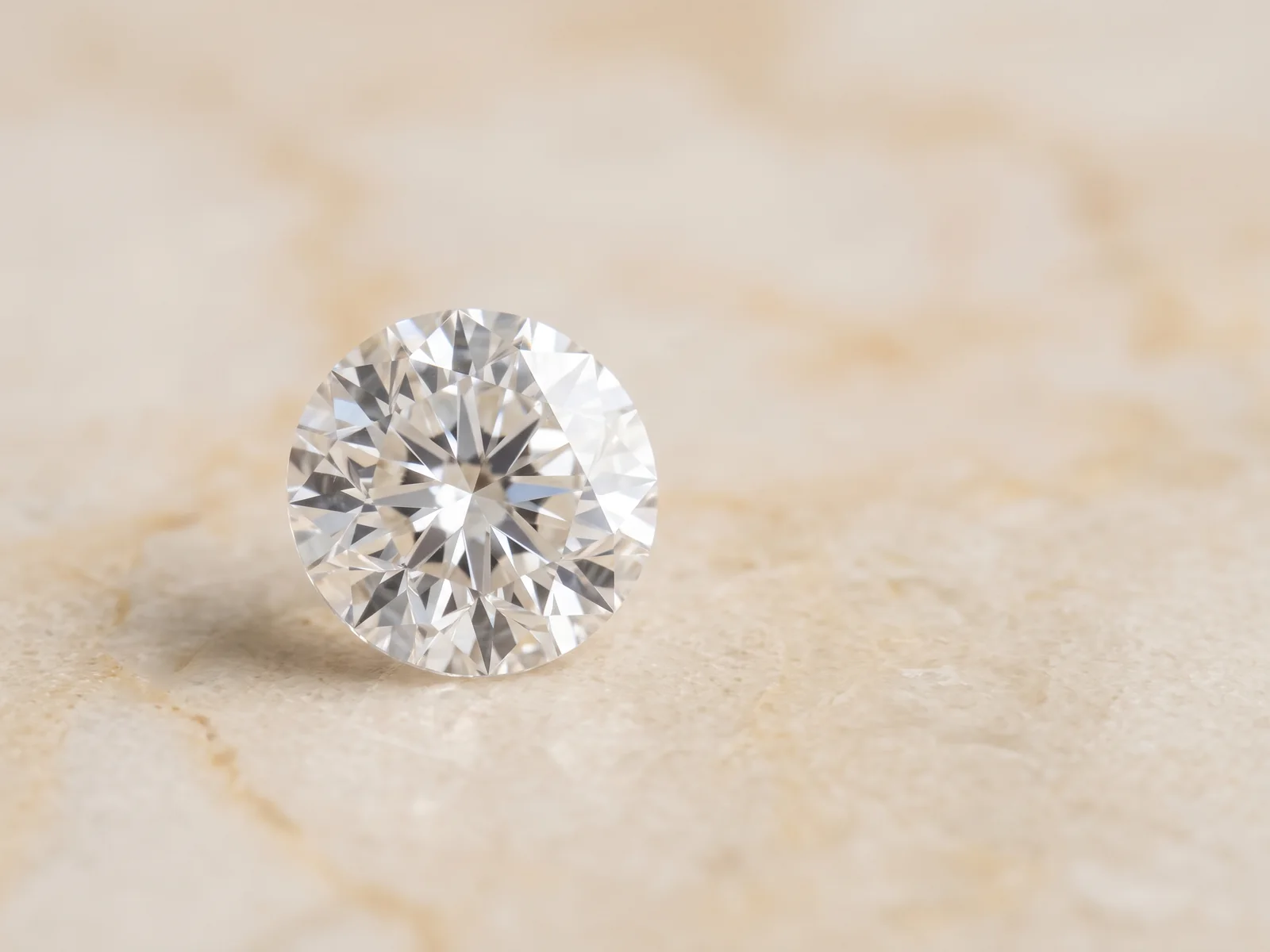
An indented natural is one of the most common features listed on a diamond report, and one of the least explained. Here is what it means for a natural diamond's clarity, durability and look, from a gemmologist's point of view.
 Reviewed by Raj Sood, Graduate Gemologist (GIA), AJP (GIA)Master jeweller and Graduate Gemologist (GIA) · reviewed 4 November 2026
Quick answer
An indented natural is a small patch of the diamond's original crystal skin that dips below the polished surface, usually at the girdle. Because it reaches into the stone, GIA treats it as an inclusion. Most are tiny, hidden by the setting, eye-clean and low risk; check its size, location and whether a feather runs from it.
What is an indented natural in a diamond?
An indented natural is a small part of a diamond's original crystal surface, the 'skin' it had as rough, that sits below the polished surface of the finished stone. Graders call any unpolished piece of original surface a natural. When that piece dips into the diamond, forming a little notch or hollow rather than lying level with the facets around it, it is recorded as an indented natural.
Most indented naturals sit on or just beside the girdle, the narrow band around the widest part of the diamond where the top (the crown) meets the bottom (the pavilion). They are usually tiny, often well under half a millimetre across, and many can only be seen under 10× magnification, the standard loupe power used for clarity grading. Clarity is the C that deals with features like this; see where it sits alongside cut, colour and carat in our guide to the clarity grade within the 4Cs.
Because an indented natural reaches into the body of the stone, GIA classes it as an inclusion (a clarity characteristic that extends inside the diamond) rather than a blemish (a surface-only feature such as a scratch, nick or polish line). That distinction changes how it is drawn on a report and how much weight it carries in the grade. If any of these terms are new, our plain-English jewellery glossary explains them, and our diamond education hub gathers every grading topic in one place.
How does an indented natural form?
Natural diamonds crystallise deep in the earth's mantle, mostly around 150–200 km down, under intense heat and pressure, and are carried towards the surface in kimberlite or lamproite eruptions. Our page on how diamonds grow deep in the mantle covers the full journey. During that journey, and over the very long time they sit in the rock, their surfaces are partly dissolved and etched. That leaves textures a polishing wheel never creates.
Rough diamonds are rarely neat octahedra (eight-sided, double-pyramid crystals). Many have dips, re-entrant edges, etched channels or uneven growth. When a cutter plans a stone, the aim is to keep as much weight as possible while still reaching good proportions. If the outline of the finished diamond runs straight through one of those hollows, the cutter has two choices: grind the whole girdle down until the hollow disappears, or leave a sliver of the original skin in place.
Leaving it can save meaningful weight, and weight matters. Larger rough is far rarer than small rough, as our page on why larger rough is rarer and worth saving weight for explains, and a diamond that finishes at 1.00 carat is priced noticeably higher than one at 0.95 carat. So an indented natural is usually a deliberate decision by the cutter, not a mistake.
Under magnification, an indented natural usually keeps its original texture. You may see:
- Trigons: tiny triangular etch pits that form on the octahedral faces of natural diamond crystals.
- Growth lines: fine parallel ridges or steps from the way the crystal built up layer by layer.
- Frosted or greyish skin: a dull, matte surface, quite different from the bright polished facets beside it.
- A shallow notch in the girdle outline: seen side-on, the girdle dips inward for a short distance.
Indented natural vs natural: how are they different from a nick or cavity?
Several small features cluster around the girdle, and reports use precise names for each. This table sets them side by side, using GIA's classification.
| Feature | What it is | Inclusion or blemish | Typical location | Usual effect on clarity |
|---|---|---|---|---|
| Natural | Patch of original skin, level with or slightly above the polished surface | Blemish | Girdle | Often none if it stays within the girdle |
| Indented natural | Original skin that dips below the polished surface | Inclusion | Girdle, sometimes reaching the crown or pavilion | Minor at the girdle; more if large or visible face-up |
| Extra facet | Small polished facet not in the cut design, often added to remove a natural or nick | Blemish | Near the girdle, usually on the pavilion | Usually minor |
| Nick | Small notch on the girdle or a facet edge, usually from wear or a knock | Blemish | Girdle, facet junctions | Minor, but a sign of wear |
| Chip | Shallow break at an edge | Inclusion | Girdle, points, culet | Can be significant |
| Cavity | Opening left where a crystal or part of a feather broke out | Inclusion | Anywhere on the surface | Can be significant |
The important difference is in the walls. An indented natural's surface is old crystal skin, so under 10× it looks frosted, etched or marked with trigons. A chip or cavity is a fresh break, with sharp, glassy, curved or stepped edges. A nick is usually small and irregular, often with a slightly bruised look. Knowing which is which tells you whether a feature is simply leftover rough or evidence that the stone has taken a knock. For the flat, level version of the same feature, see our guide to naturals left on the girdle.
Related guideNaturals on a Diamond's GirdleWhere does an indented natural show on a diamond report?
On a full grading report, the plotting diagram is a pair of line drawings of the diamond: one face-up (crown view) and one face-down (pavilion view). The grader marks each clarity characteristic in the place it sits. By convention, inclusions are drawn in red and blemishes in green, and each feature type has its own symbol, shown in the key to symbols beside the plot. Indented naturals are usually drawn right at the outer edge of the diagram, because that is where the girdle is.
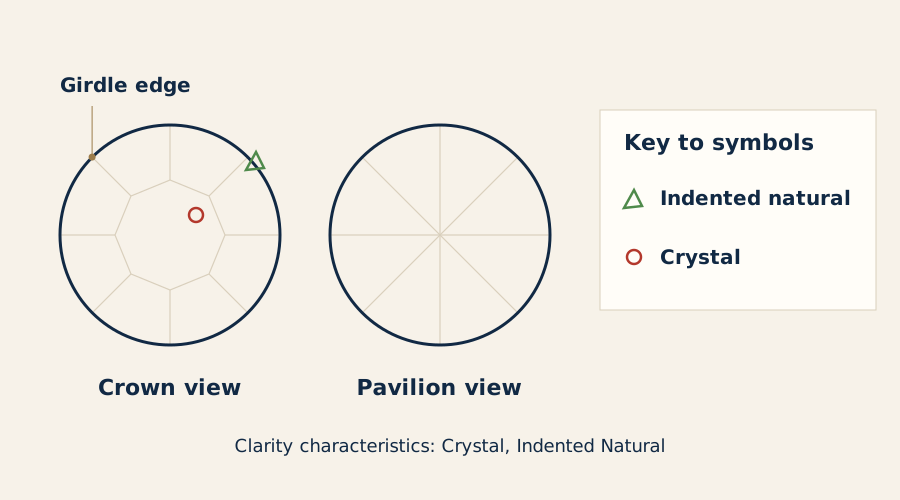
Below the plot, the report lists the clarity characteristics in words, for example 'Crystal, Feather, Indented Natural'. These are generally listed with the most significant feature first, so if 'Indented Natural' leads the list, it is likely one of the features that decided the grade. If it appears at the end, it is a minor supporting feature. Some smaller-format reports, such as GIA's Diamond Dossier, do not include a plot at all, so you only get the list, or nothing beyond the grade.
When you read the plot, check:
- Location: is the symbol on the girdle line, or does it extend inward onto the crown or pavilion?
- Which view: a mark on the crown view is more likely to be visible from above than one on the pavilion view.
- Size: symbols are approximate, not to scale, so ask for a magnified photo if the size matters to you.
- Nearby marks: a feather symbol touching or starting from the indented natural deserves a closer look.
- Comments: the comments section may note features that are not shown on the plot.
Our page on reading an IGI natural diamond report goes through each section of that lab's report line by line, and how natural and lab-grown reports differ explains what changes between the two report types.
Not sure which one is right?
Send us the stones you are looking at and our gemologist will tell you which to choose and why.
Does an indented natural affect a diamond's clarity grade?
It can, but usually only a little. Graders judge clarity on five factors: the size, number, position, nature and relief (how much a feature stands out against the diamond) of every characteristic, viewed face-up at 10×. A small indented natural tucked into the girdle is hard to find face-up, so it rarely sets the grade on its own. A larger one that reaches onto the crown is easier to see and carries more weight.
| GIA clarity grade | What 10× shows | Can an indented natural be present? |
|---|---|---|
| FL (Flawless) | No inclusions or blemishes | No; only a natural wholly within the girdle may be allowed |
| IF (Internally Flawless) | No inclusions, minor blemishes only | Generally no, since it counts as an inclusion |
| VVS1–VVS2 | Inclusions extremely to very difficult to see | Yes, if tiny and confined to the girdle |
| VS1–VS2 | Minor inclusions, difficult to somewhat easy to see | Common; may be the grade-setting feature or one of several |
| SI1–SI2 | Noticeable inclusions | Common; other features usually set the grade |
| I1–I3 | Obvious inclusions, may affect transparency or durability | Large indented naturals can contribute |
In practice, you most often see 'Indented Natural' listed on VVS and VS diamonds, where it is one of the few features present. At SI and below, crystals, feathers and clouds usually do more to set the grade, and an indented natural is simply noted alongside them.
Is an indented natural a diamond durability risk?
Diamond is 10 on the Mohs hardness scale, the hardest natural material, so it resists scratching extremely well. Hardness is not the same as toughness, though. Diamond has perfect cleavage in four directions, parallel to its octahedral faces, which means a sharp knock in the wrong spot can split or chip it. The girdle is the thinnest edge on most diamonds and the part most likely to meet a doorframe or benchtop.
A shallow indented natural with smooth, etched walls and no cracks around it is low risk. It is old crystal surface, not damage, and many diamonds wear for decades with one on the girdle. The risk rises when:
- A feather runs from it: a feather (a small internal crack) starting at the indentation is the main warning sign.
- It notches deeply into a thin girdle: the edge is even thinner at that spot and can chip more easily.
- It sits at a point or corner: the tips of pears, marquises and hearts, and the corners of princess cuts, are already the most exposed areas.
- It is left unprotected: an exposed girdle in a low-profile or tension setting takes more knocks than one covered by metal.
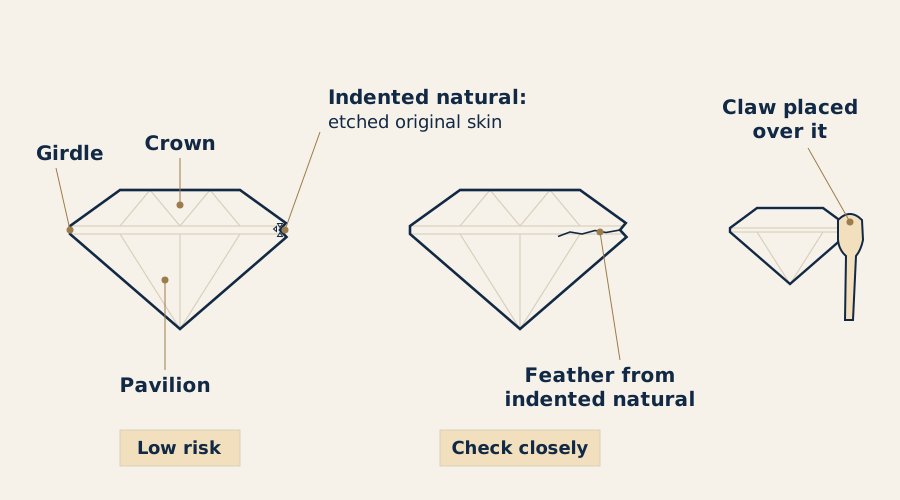
The setting does a lot of the work. A setter can place a claw directly over the indented natural, which hides it and shields that section of the girdle. A bezel (a thin rim of metal around the edge) or a halo protects the whole girdle. What the setter must avoid is bending a claw hard against a notched edge, because uneven pressure on a weak spot is exactly what causes chips during setting. Ask for the stone to be inspected under magnification before and after setting.
Is a diamond with an indented natural eye-clean?
Eye-clean means no clarity characteristic is visible to the unaided eye from a normal viewing distance of about 25–30 cm. Almost every indented natural confined to the girdle is eye-clean. The girdle is usually partly covered by claws or a bezel, and it sits edge-on to the viewer when the stone is face-up, so a feature there is hard to spot even when you know where to look.
There are exceptions. A larger indented natural that reaches onto the crown can show as a tiny notch or grey dot when the ring is seen from the side. Step cuts such as emerald and Asscher cuts, with broad open facets and less sparkle to hide features, show them more readily than brilliant cuts such as rounds, ovals and cushions. On a very small diamond, under about 0.30 carat, an indented natural is almost never noticeable.
- Face-up: look straight down at arm's length; you should not find it.
- Side-on: turn the stone and look along the girdle for a dull spot or notch.
- In the setting: check whether a claw or bezel will cover it once mounted.
Can a lab-grown diamond have an indented natural?
Strictly, 'natural' in grading refers to the original crystal surface left on a polished stone. Laboratory-grown diamonds have an as-grown surface too: CVD-grown crystals form as flat plates, and HPHT-grown crystals as blocky cube-and-octahedron shapes. A cutter can leave a remnant of that surface on a lab-grown diamond. It is seen less often, because lab-grown rough tends to be regular in shape and is usually cut to maximise appearance rather than to save every point of weight, and labs may word it differently on a lab-grown report.
A natural or indented natural is not proof that a diamond was mined. Trigons and etched skin are typical of natural crystals, but gem labs confirm origin with spectroscopy and fluorescence imaging, not with surface features. Our guides to lab-grown versus natural diamonds compared and how gem labs confirm a diamond's origin explain the methods, and we also look at whether a handheld diamond tester can tell the difference. Origin and treatment are separate questions too: some mined stones are natural diamonds that have been HPHT treated to improve their colour, and the report must say so.
The word 'natural' itself carries different meanings across jewellery. Here it means original crystal skin; elsewhere it describes origin, as in our guides to natural, synthetic and simulant gems and natural versus cultured pearls.
Browse natural and lab-grown diamonds
Is an indented natural bad? Should you buy a diamond with one?
Usually it is not a problem. A small indented natural at the girdle, with no feather running from it, does not change how the diamond looks face-up and adds little risk once it is set sensibly. It can even be a sign that the cutter kept weight rather than grinding it away. Where it matters is when it is large, sits on the crown, falls at a point or corner, or is connected to a feather.
On price, a diamond whose only notable feature is a tiny girdle indented natural is priced by its clarity grade like any other stone of that grade. Within a grade, a stone where the indented natural is the main feature, hidden at the girdle, can be a sensible choice compared with one whose grade is set by a crystal under the table. As a broad guide, a 1 ct natural round in G colour and VS2 clarity sits at roughly AUD $7,000–$14,000, and a laboratory-grown equivalent at roughly AUD $1,000–$3,000, depending on cut and the market.
Natural diamonds are best chosen for what they mean to you, not as a financial asset; our page on how natural diamond prices have moved over time puts resale in perspective. If you are still deciding between origins for a ring, natural and lab-grown stones for engagement rings compares them across every major gem.
How do you check a diamond with an indented natural? Step by step
- Read the clarity characteristics line. Note where 'Indented Natural' sits in the list; first usually means it helped set the grade.
- Find it on the plot. Check whether it stays on the girdle line or extends onto the crown or pavilion view.
- Look for a feather nearby. Any feather symbol touching the indented natural deserves a magnified look.
- Ask for a magnified photo or view it under 10×. Etched, frosted walls are original skin; glassy lines running inward are cracks.
- Check it at arm's length. Face-up and side-on, confirm the diamond is eye-clean to you.
- Plan the setting around it. On fancy shapes make sure it is not at a point; ask for a claw or bezel over it and an inspection before and after setting.
Free consultation
Talk to a gemologist
Compare stones in person or online with Raj Sood, Graduate Gemologist (GIA), AJP (GIA).
Book a consultationShop this shape
FAQ
Common questions
What does indented natural mean on a diamond report?
It means a small piece of the diamond's original crystal surface was left unpolished and dips below the finished surface, usually at the girdle. GIA classes it as an inclusion and marks it on the plot with its own symbol.
Is an indented natural bad in a diamond?
Usually not. A small indented natural at the girdle with no feather running from it is low risk and normally eye-clean; it often shows the cutter saved weight rather than grinding it away.
What is the difference between a natural and an indented natural?
A natural lies level with, or slightly above, the polished surface and is graded as a blemish. An indented natural dips into the stone, so GIA treats it as an inclusion.
Can an indented natural be polished out?
Often it can, by repolishing the girdle or adding a small facet, but the diamond loses weight and may drop below a key carat size. For a tiny girdle indented natural, it is rarely worth doing.
Can a Flawless diamond have an indented natural?
Generally no. GIA allows a natural wholly confined to the girdle in a Flawless stone, but an indented natural counts as an inclusion, so it rules out FL and IF.
Does an indented natural prove a diamond is natural, not lab-grown?
No. It is typical of natural crystals, but labs confirm origin with spectroscopy and imaging, and the grading report states whether a diamond is natural or laboratory-grown.
Terms in this guide

Ask a gemologist
Not sure which diamond to choose?
Raj Sood is a Graduate Gemologist (GIA) and master jeweller. Bring the stones you are considering, or send the reports, and he will tell you honestly which one is better and why.
Keep learning
Related guides
 Diamond 4Cs & GradingNaturals on a Diamond's GirdleDiamond 4Cs & GradingDiamond 4Cs
 Certificates & ValuationsIGI Natural Diamond Report Explained
 Natural DiamondsHow Are Natural Diamonds Formed?
 Natural DiamondsNatural Diamond Rarity by Size
 Lab-Grown DiamondsLab-Grown Diamonds vs Natural DiamondsNatural DiamondsNatural Diamond Value Over Time
 Lab-Grown DiamondsCan a Diamond Tester Tell Natural From Lab-Grown?
Explore more
More guides on this topic
Education