
- Education
- Natural Diamonds
- Natural Diamond Rarity by Size: Why Bigger Stones Are So Scarce
Natural diamonds
Natural Diamond Rarity by Size: Why Bigger Stones Are So Scarce
Natural diamond rarity by size is the reason a 2 carat stone costs far more than two 1 carat stones. Here is the geology, the numbers and the Australian story behind it, and what it means when you choose a diamond.
 Reviewed by Raj Sood, Graduate Gemologist (GIA), AJP (GIA)Master jeweller and Graduate Gemologist (GIA) · reviewed 4 November 2026
Quick answer
Natural diamonds get rarer faster than they get bigger. Most gem rough is small, and cutting keeps only about 40–50% of the crystal's weight, so a 1 carat round needs a clean 2–2.5 carat crystal. That is why a 2 carat diamond costs more than twice a 1 carat of the same grade, and 5 carat stones are scarce.
What does natural diamond rarity by size mean?
Natural diamond rarity by size describes a simple pattern: the bigger a diamond, the fewer of them the earth produces, and the number falls far faster than the size rises. A 2 carat stone is not just twice as rare as a 1 carat stone. Gem-quality crystals big enough to cut it are many times scarcer, and that shows up directly in the price per carat. If you are new to mined stones, our complete guide to natural diamonds covers the basics first.
A carat is a unit of weight, not size: 1 carat is 0.2 grams. A 1 carat round brilliant measures about 6.4–6.5 mm across. Because weight follows volume, the diameter grows slowly: a 2 carat round is only about 8.1–8.2 mm, roughly 26% wider than a 1 carat, even though it weighs twice as much. So when you step up in carat, you are paying for a much rarer crystal, not a proportionally bigger-looking stone.
This page is about natural diamonds, which formed in the earth hundreds of millions to billions of years ago. Lab-grown diamonds are real diamond too, with the same hardness (10 on the Mohs scale) and refractive index (about 2.42), but their size is set by equipment and growing time rather than geology, so the same rarity curve does not apply. If those categories still feel blurry, see the difference between natural, synthetic and simulant stones, and for any unfamiliar word, our jewellery terms explained in plain English will help.
Why are large natural diamonds so rare?
Most natural diamonds formed about 150–200 km below the surface, in the mantle beneath the oldest parts of the continents, at roughly 900–1,300 °C and enormous pressure. Many are between about 1 and 3.5 billion years old. They were carried up by rare, fast volcanic eruptions of kimberlite or lamproite (two types of deep-sourced volcanic rock), which left carrot-shaped pipes in the crust. Our page on how natural diamonds form deep in the mantle explains each stage.
A big gem diamond has to get through a long series of filters, and each one removes more large crystals than small ones:
- Growth: a crystal needs stable conditions and a steady carbon supply for a very long time to grow large. Most never do.
- The trip up: on the way to the surface, many diamonds are partly dissolved (geologists call this resorption) or cracked.
- Mining: ore is crushed to free the diamonds, and large crystals are the most likely to break. Modern mines use X-ray sorting to pull big stones out earlier.
- Quality: a large crystal must also be clean enough and white enough to be worth cutting. Inclusions (internal features) and strong brown or yellow tints rule many out.
- Cutting: roughly half the weight is ground away, so the finished stone needs a crystal about twice its size.
Diamond mines also hold very little diamond. Many economic mines recover somewhere between under 0.1 and about 1 carat per tonne of ore, and much of that is small or industrial grade. A single tonne of rock producing one large, clean gem crystal is exceptional.
There is a twist at the very top end. Research led by GIA scientists found that many of the largest, cleanest stones, including Cullinan-type diamonds, are Type IIa (almost no nitrogen) and appear to have formed much deeper, roughly 360–750 km down, with tiny metallic iron inclusions. Type IIa makes up only about 1–2% of natural diamonds; our guide to Type Ia, Ib, IIa and IIb diamonds explains what the types mean. Some brownish Type IIa stones are later heated to improve their colour, which must be disclosed; see HPHT-treated natural diamonds.
How does natural diamond rarity by size change from 0.5 to 5 carats?
In every mine, the count of crystals falls steeply as size goes up. Most natural diamonds set in jewellery are melee, small stones under about 0.20 carat used as accents and in pavé. Every step above that becomes harder to fill, especially once you add a high colour and clarity requirement.
| Cut weight | Round diameter | Rough needed (approx.) | How it shows up in the market |
|---|---|---|---|
| Under 0.20 ct (melee) | under about 3.8 mm | under 0.5 ct | The bulk of gem production; accent and pavé stones |
| 0.50 ct | about 5.1–5.2 mm | 1.0–1.25 ct | Widely available in solitaires and studs |
| 1.00 ct | about 6.4–6.5 mm | 2.0–2.5 ct | A key threshold; noticeably scarcer and priced up |
| 2.00 ct | about 8.1–8.2 mm | 4–5 ct | Rare in high colour and clarity |
| 3.00 ct | about 9.3 mm | 6–7.5 ct | Uncommon in any quality |
| 5.00 ct | about 11 mm | 10–12.5 ct | Very rare; often sold one by one |
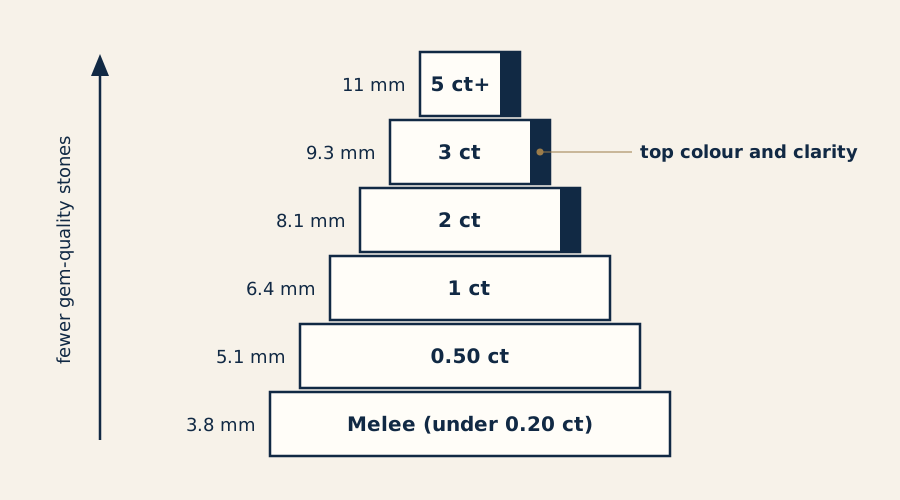
Rarity compounds. A 2 carat diamond is scarce; a 2 carat diamond that is also D–F colour and VVS clarity is a small slice of an already small group. That is why the price gap between grades widens as stones get bigger: at 0.30 carat, moving from H to E colour costs relatively little, while at 3 carats the same jump can add thousands of dollars.
You can sometimes see the cutter's fight to keep weight on the stone itself. Small unpolished patches of original crystal skin, called naturals left on the girdle, are often kept because polishing them away would drop the stone below a weight threshold. Occasionally they dip into the stone as indented naturals that dip below the surface. Both are evidence the diamond came from the earth, and on a well-cut stone they are usually invisible to the eye.
How much rough does it take to cut a 1 carat diamond?
Yield is the share of the rough crystal's weight that ends up in the polished diamond. For a round brilliant cut from a well-shaped octahedral crystal (two pyramids base to base), cutters typically keep about 40–50%. Irregular or included crystals yield less, sometimes well under a third.
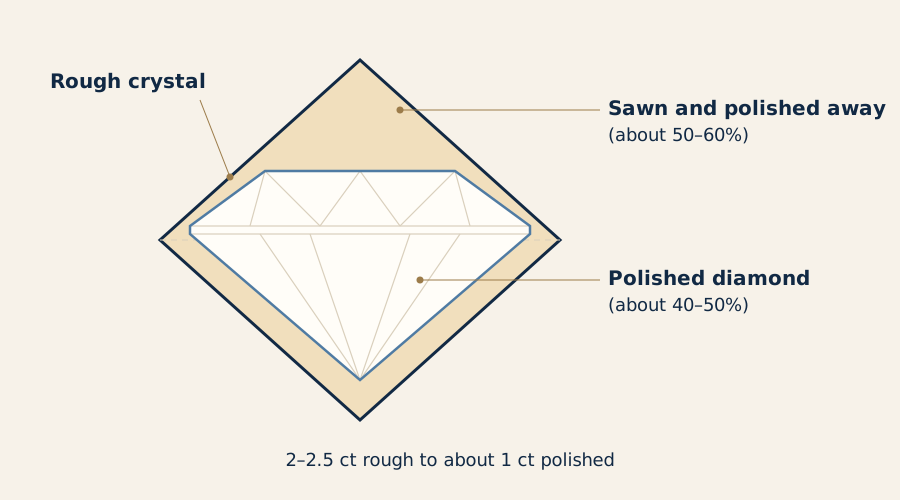
Fancy shapes such as princess, cushion, oval and pear often keep more of the crystal, because their outlines follow the rough more closely. That is one reason fancy shapes usually cost less per carat than rounds of the same grade. It also explains why a cutter planning a stone will work hard to finish at 1.01 carats rather than 0.98: the crystal is the same, but the market value is not.
The planning is now done with 3D scanners that map every inclusion inside the rough and model hundreds of possible finished stones. Even so, the cutter is always trading weight against beauty: a slightly smaller diamond with better proportions returns more light, while a heavier one with a thick girdle or deep pavilion keeps carats but looks smaller face-up.
Not sure which one is right?
Send us the stones you are looking at and our gemologist will tell you which to choose and why.
How does diamond price per carat rise with size?
Natural diamonds are priced per carat, and the per-carat rate itself climbs as stones get heavier. Trade price lists group stones into weight brackets such as 0.50–0.69, 0.70–0.89, 0.90–0.99, 1.00–1.49, 1.50–1.99, 2.00–2.99, 3.00–3.99 and 5.00–5.99 carats. Crossing into a new bracket causes a jump, and the bracket edges are called magic sizes: 0.50, 0.70, 0.90, 1.00, 1.50, 2.00, 3.00 and 5.00 carats.
| Natural round, G–H, VS, well cut | Approx. total price (AUD) | Approx. per carat (AUD) |
|---|---|---|
| 0.50 ct | $1,500–$3,500 | $3,000–$7,000 |
| 1.00 ct | $6,000–$15,000 | $6,000–$15,000 |
| 1.50 ct | $12,000–$28,000 | $8,000–$19,000 |
| 2.00 ct | $20,000–$45,000 | $10,000–$22,500 |
| 3.00 ct | $45,000–$100,000 | $15,000–$33,000 |
| 5.00 ct | $120,000–$300,000 | $24,000–$60,000 |
These are broad ranges only. Prices move with the market, with cut quality and with small differences in grade, and natural diamond prices have shifted noticeably in recent years. The pattern is what matters: per carat, a 2 carat stone usually costs well over the rate for a 1 carat, and a 5 carat several times more again. For the longer story behind those shifts, read how natural diamond prices have moved over time.
Inside a bracket the curve is much flatter. A 1.20 carat stone costs only a little more per carat than a 1.02, which is why stones just over a threshold are so common: cutters aim for the line and rarely go far past it unless the crystal allows.
What did Argyle and Australia's other mines tell us about rarity?
Australia's diamond story began on the goldfields. Diamonds were reported in New South Wales in 1851, and small alluvial workings around Copeton and Bingara in the state's north produced stones from the 1870s and 1880s. They were mostly small, and the deposits were never large.
Everything changed with Argyle in the East Kimberley of Western Australia. The AK1 pipe was found in 1979, production began in 1983, and by the time the mine closed in November 2020 it had produced more than 865 million carats of rough. At its peak it was the world's largest producer by volume. Unusually, Argyle's pipe is lamproite rather than kimberlite, and its ore was rich by global standards. Yet Argyle is the clearest lesson in rarity by size: the vast majority of its output was small and brown, and much of it was industrial or low-grade gem material.
Argyle is famous for pinks, and they show the size problem at its sharpest. Pinks were a tiny fraction of production, often quoted as less than 0.01%, and most were small. The larger ones were sold through an invitation-only annual tender, and the largest pink rough found at the mine, the 12.76 carat Argyle Pink Jubilee, came out in 2011. With the mine closed, no new Argyle pinks are being mined.
Other Australian mines tell the same story. Ellendale in the West Kimberley became known for fancy yellow diamonds before closing in 2015. The Merlin mine in the Northern Territory, worked around the turn of the century, produced Australia's largest recorded diamond, about 104.73 carats in the rough. Australia's other famous gem, the South Sea pearl from the north-west coast, has its own rarity story; see why natural pearls are so much rarer than cultured ones.
What are the largest natural diamonds ever found?
The record stones are outliers, but they show how far the size curve stretches and how seldom the far end is reached.
| Diamond | Rough weight | Found | Source |
|---|---|---|---|
| Cullinan | 3,106 ct | 1905 | Premier mine, South Africa |
| Unnamed Karowe stone | 2,492 ct | 2024 | Karowe mine, Botswana |
| Sewelô | 1,758 ct | 2019 | Karowe mine, Botswana |
| Lesedi La Rona | 1,109 ct | 2015 | Karowe mine, Botswana |
| Merlin diamond | about 104.73 ct | late 1990s | Merlin mine, Northern Territory |
| Argyle Pink Jubilee | 12.76 ct (pink) | 2011 | Argyle mine, Western Australia |
The Cullinan was cut into nine major stones and many smaller ones; the largest, Cullinan I or the Great Star of Africa, weighs about 530 carats and sits in the British royal sceptre. Lesedi La Rona produced a polished stone of about 302 carats. Notice that three of the largest finds are recent and from one mine: X-ray sorting now recovers big crystals before crushing can break them, so some giants of the past may simply have been smashed.
For perspective, global natural production runs at roughly 110–120 million carats a year, and stones over 100 carats turn up only a handful of times a year worldwide.
Does size rarity apply to lab-grown diamonds?
Not in the same way. Laboratory-grown diamonds are produced by CVD (chemical vapour deposition, growing diamond layer by layer from a carbon-rich gas) or HPHT (high pressure, high temperature, recreating mantle-like conditions in a press). Their size is limited by equipment and growing time, not by billions of years of geology, so larger stones are easy to produce and the price per carat rises much more gently.
| Natural diamond | Lab-grown diamond | |
|---|---|---|
| What limits size | Geology, survival, mining and cutting yield | Growth time and equipment |
| Supply over 3 ct | Scarce, especially in high grades | Readily available |
| Price per carat as size rises | Climbs steeply at magic sizes | Rises gently |
| Typical type | About 98% Type Ia; Type IIa about 1–2% | Most are Type IIa |
| Material | Real diamond, Mohs 10, RI about 2.42 | Real diamond, Mohs 10, RI about 2.42 |
| Report | States natural origin | Must state lab-grown origin |
The two look identical to the eye and can only be separated reliably with laboratory equipment. Our pages on how gem labs separate natural from lab-grown and whether a handheld diamond tester can tell them apart explain the methods. For the wider choice, see the full lab-grown vs natural diamond comparison, or compare natural and lab-grown options for an engagement ring across other gems too.
Browse natural diamonds by carat size
What does diamond rarity by size mean for you as a buyer?
Rarity explains price; it does not make a diamond a financial asset. A natural diamond is something you buy to wear and keep. Resale prices are usually well below what you paid at retail, and rarity alone does not change that. Choose the size you will enjoy wearing, not one you expect to grow in value.
Related guideNatural Diamond Value Over TimeWhere rarity does help you is in spending sensibly. Because the price jumps at magic sizes but face-up size changes only a little, a stone just under a threshold can look almost identical for noticeably less. A 0.90 carat round is about 6.2 mm across against about 6.4–6.5 mm for a 1.00 carat, a difference few people can see on the hand.
With larger natural stones, the paperwork matters more because more money rides on each grade. Make sure the report confirms natural origin and any treatment; our explainers on how natural and lab-grown reports differ and reading an IGI natural diamond report show exactly where to look.
How do you choose a natural diamond size? Step by step
- Set your budget first. Then see which carat bracket it reaches at the colour and clarity you want.
- Compare millimetres, not carats. Check the face-up diameter on the report; two stones of the same weight can differ by 0.2 mm or more.
- Check just below the magic sizes. Price a 0.90–0.97 ct or 1.80–1.95 ct stone against the round-number weight.
- Prioritise cut. A well-cut smaller diamond often looks brighter and as large as a poorly cut heavier one.
- Balance the grades. In bigger stones, an eye-clean VS2 or SI1 and G–H colour keep the price sensible without a visible difference.
- Confirm origin and treatment. Read the report for natural origin, any HPHT or other treatment, and the plotted inclusions.
- See it on the hand. Try two or three sizes in person before deciding; the difference is often smaller than the numbers suggest.
Free consultation
Talk to a gemologist
Compare stones in person or online with Raj Sood, Graduate Gemologist (GIA), AJP (GIA).
Book a consultationShop this shape
FAQ
Common questions
How rare is a 1 carat natural diamond?
Much rarer than a half carat, because it needs a clean rough crystal of about 2–2.5 carats. Most natural gem rough is far smaller, which is why 1 carat is a well-known price threshold.
Why does a 2 carat diamond cost more than double a 1 carat?
Because gem-quality crystals big enough for a 2 carat stone are many times scarcer, the price per carat itself is higher. You pay a higher rate on twice the weight, so the total is usually well over double.
Do rare natural diamonds go up in value?
Rarity explains their price, but it does not mean a diamond will rise in value. Resale is usually well below retail, so a natural diamond is best chosen as something to wear and keep.
Are lab-grown diamonds rare?
No. Lab-grown diamonds are real diamond but are produced in factories, so large sizes are readily available and the price per carat rises far less with size.
What is the largest diamond found in Australia?
The largest recorded Australian diamond is about 104.73 carats in the rough, from the Merlin mine in the Northern Territory. The largest pink rough from Argyle was the 12.76 carat Argyle Pink Jubilee, found in 2011.
Is a 0.90 carat diamond a sensible alternative to a 1 carat?
For many people, yes. It is only about 0.2–0.3 mm smaller in diameter, which is hard to see when worn, and it usually costs noticeably less per carat.
Terms in this guide

Ask a gemologist
Not sure which diamond to choose?
Raj Sood is a Graduate Gemologist (GIA) and master jeweller. Bring the stones you are considering, or send the reports, and he will tell you honestly which one is better and why.
Keep learning
Related guides
 Natural DiamondsHow Are Natural Diamonds Formed?
 Natural DiamondsNatural Diamond Value Over Time
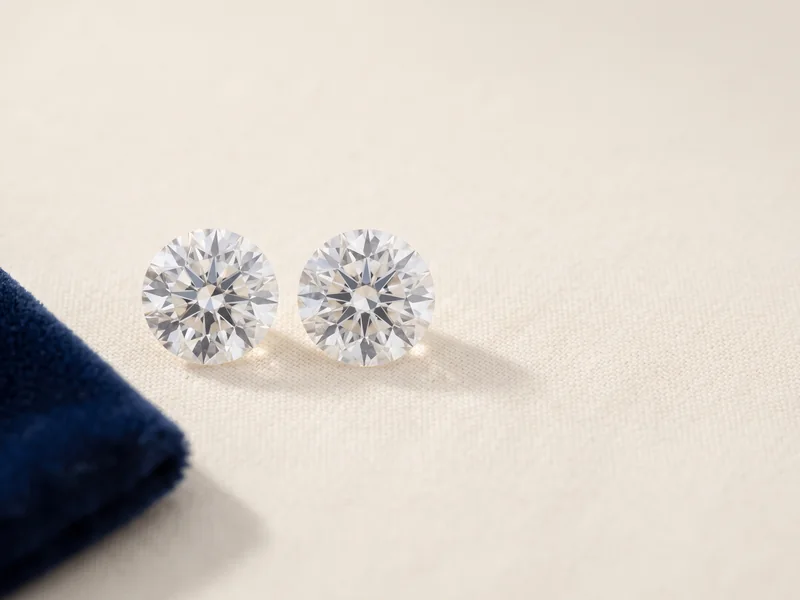 Lab-Grown DiamondsLab-Grown Diamonds vs Natural Diamonds
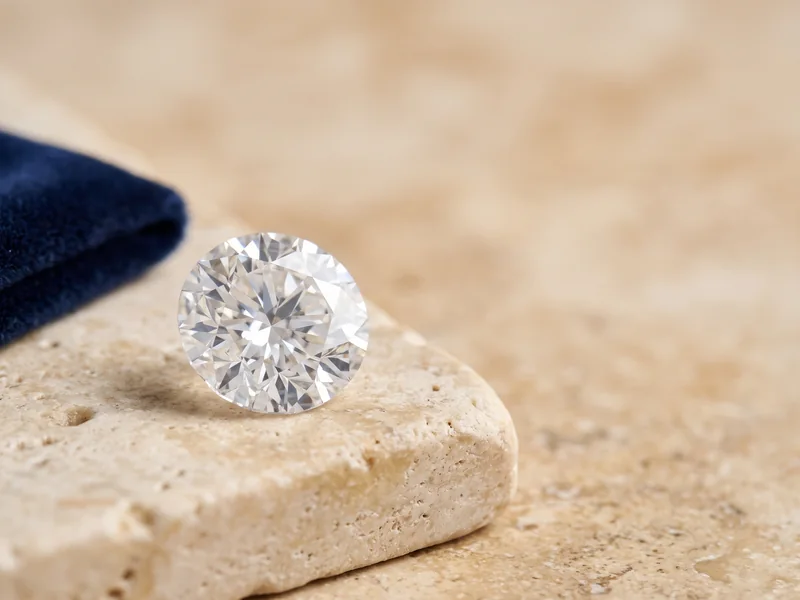 Natural DiamondsHPHT Natural Diamonds
 Diamond 4Cs & GradingIndented Naturals in Diamonds
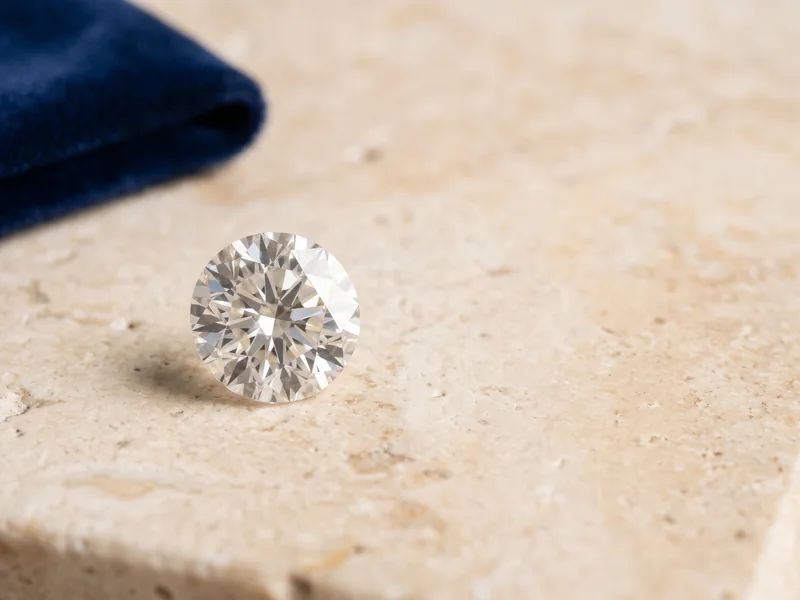 Lab-Grown DiamondsCan a Diamond Tester Tell Natural From Lab-Grown?Lab-Grown DiamondsHow Laboratories Identify Natural vs Lab-Grown Diamonds
Explore more
More guides on this topic
Education