
- Education
- Lab-Grown Diamonds
- Does Moissanite Pass a Diamond Tester? How to Tell Moissanite From Diamond
Lab-Grown Diamonds
Does Moissanite Pass a Diamond Tester? How to Tell Moissanite From Diamond
Does moissanite pass a diamond tester? Often it does, which makes it the diamond alternative most likely to fool a simple check; here is why, which tools catch it, and how a gemmologist tells the two apart.
 Reviewed by Raj Sood, Graduate Gemologist (GIA), AJP (GIA)Master jeweller and Graduate Gemologist (GIA) · reviewed 4 November 2026
Quick answer
Usually, yes. Moissanite conducts heat far better than most gems, so it passes a basic thermal diamond tester, which beeps 'diamond'. A multi-tester that also measures electrical conductivity flags most moissanite, because moissanite conducts a small current and colourless diamond does not. Under a 10× loupe, doubled facet edges confirm moissanite.
Does moissanite pass a diamond tester?
On the most common kind of tester, yes. The pen-style thermal diamond tester, found in many jewellery workshops and sold cheaply online, measures how quickly a stone draws heat away from a warmed metal tip. Diamond does this better than any other gem, and moissanite comes close enough that a basic thermal tester will usually light up 'diamond' for both. That is the main reason moissanite gets mistaken for diamond in second-hand rings, deceased estates and private online sales.
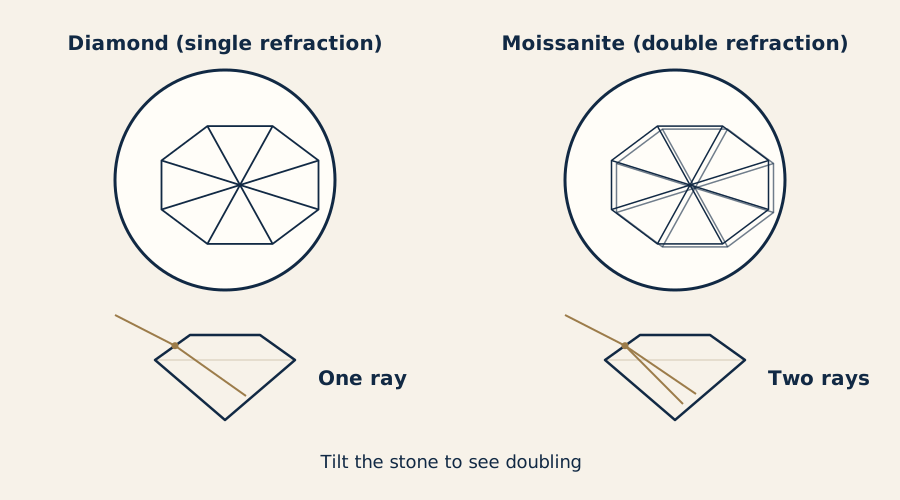
It does not pass every test, though. A multi-tester adds an electrical conductivity check, and most moissanite conducts a small current where colourless diamond does not, so the tester flags it. A 10× loupe (a jeweller's hand magnifier) shows a second giveaway: doubled facet edges caused by moissanite's double refraction. And a gemmological laboratory can identify moissanite with certainty using a refractometer, a spectrometer or both.
Moissanite is a gem in its own right, not a fake diamond, and it is sold openly as moissanite by honest sellers; our page on moissanite's story as a gemstone explains where it came from. If your real question is whether a stone you already own is diamond at all, start with our guide to checking whether a diamond is real. Any unfamiliar word here is explained in our glossary of jewellery terms.
How does a diamond tester work?
A thermal tester has a fine metal probe with a tiny heater and temperature sensor in the tip. When you press the tip against a stone, the stone pulls heat out of it. The faster the heat disappears, the higher the reading. Diamond has the highest thermal conductivity (ability to carry heat) of any natural material, several times higher than copper, so it sends the needle or lights straight to the 'diamond' zone. Most other gems draw heat away slowly and read as 'simulant' (a stone that imitates diamond).
There are five broad kinds of tester you might meet:
- Thermal tester: heat conductivity only. Cheap and quick. Separates diamond from cubic zirconia, glass, white sapphire and white topaz, but not from moissanite.
- Electrical (moissanite) tester: passes a tiny current through the stone. Moissanite usually conducts; colourless diamond does not.
- Multi-tester: combines the thermal and electrical checks in one probe and shows 'diamond', 'moissanite' or 'simulant'. This is what most jewellers now use for a first check.
- Reflectivity meter: estimates refractive index from how much light bounces off a polished facet. Moissanite reflects more than diamond, so it reads higher.
- Laboratory screening instruments: desktop or handheld devices using ultraviolet light or spectroscopy. These are designed to separate natural diamond from lab-grown diamond and simulants, and cost far more than a pen tester.
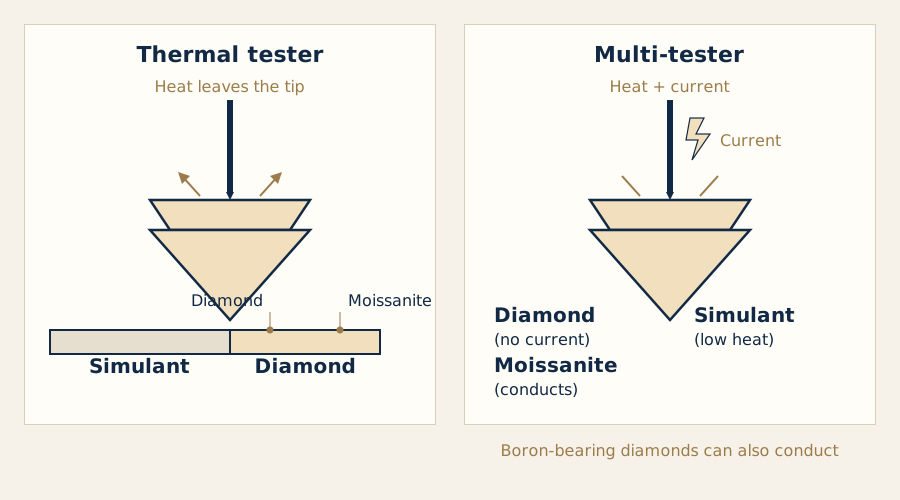
A thermal tester is still useful. It reliably separates diamond from cubic zirconia, moissanite's cheaper rival, which barely conducts heat, and from white sapphire, which conducts more than cubic zirconia but nowhere near enough to read as diamond. If you are weighing those two up as alternatives, see how white sapphire stacks up against lab-grown diamond. The problem is only that a single 'diamond' beep does not rule out moissanite.
Why does moissanite pass a diamond tester but fail a multi-tester?
Moissanite is silicon carbide (SiC), a hard crystal made of silicon and carbon atoms bonded tightly together. Like diamond, those strong, light bonds carry heat very efficiently. Diamond still conducts heat much better in absolute terms, but a pen tester is not a precise instrument: it is set with a threshold, and anything above that threshold reads as diamond. Moissanite clears it comfortably, while almost every other gem falls well short.
Electricity is where the two part ways. Colourless diamond is an electrical insulator. Silicon carbide is a semiconductor, the same family of material used in some power electronics, and gem moissanite usually carries enough current for a multi-tester to detect it. So the multi-tester runs both checks: high heat conductivity plus electrical conduction reads 'moissanite'; high heat conductivity with no conduction reads 'diamond'.
| Stone | Thermal tester | Electrical check | Multi-tester usually shows |
|---|---|---|---|
| Natural colourless diamond | Diamond | No current | Diamond |
| Lab-grown colourless diamond | Diamond | Usually no current | Diamond |
| Natural blue (type IIb) diamond | Diamond | Conducts (boron) | May show moissanite |
| Some HPHT lab-grown diamonds with trace boron | Diamond | May conduct | May show moissanite |
| Moissanite | Diamond | Usually conducts | Moissanite |
| Cubic zirconia | Simulant | No current | Simulant |
| White sapphire | Simulant | No current | Simulant |
| Glass, white topaz, crystal | Simulant | No current | Simulant |
Two cautions sit behind this table. First, the electrical check is not perfect: a few moissanites may read inconsistently, and a diamond containing boron can trigger a false 'moissanite' alarm. Second, every tester can be thrown by technique, such as a probe touching the metal setting, a cold or dirty stone, a flat battery or a stone too small for the tip. A doubtful result is a reason to look closer, not a final answer.
What is moissanite?
Moissanite is named after the French chemist Henri Moissan, who found tiny crystals of silicon carbide in rock from the Canyon Diablo meteorite crater in Arizona in the 1890s and at first thought they were diamond. Natural moissanite does exist, but only as microscopic grains, far too small to cut. Every moissanite you see in jewellery is lab-created, grown in a furnace at very high temperatures from silicon carbide, then cut and polished like any other gem. Gem-quality lab-created moissanite reached the jewellery market in the late 1990s.
Because it is grown, moissanite is a synthetic gem, and in Australia it should be described as lab-created or synthetic moissanite. It belongs to the same broad world as other lab-created gems such as sapphire, ruby and emerald, though unlike those it has no gem-sized natural twin. Growing it takes industrial equipment and furnace temperatures well above 2,000 °C, which is one reason growing a gemstone at home isn't practical.
Early moissanite often had a noticeable yellow or greenish tint. Modern colourless moissanite is much whiter, and makers now sell it in grades that borrow diamond-style letters. Those grades are usually set by the maker or seller rather than an independent lab, so read our guide to how moissanite colour and clarity are graded before comparing two stones on paper.
Not sure which one is right?
Send us the stones you are looking at and our gemologist will tell you which to choose and why.
How does moissanite compare with diamond for hardness, sparkle and price?
Moissanite and diamond look alike across a room, but almost every measurable property is different. That is good news for identification, because each difference is a possible test.
| Property | Moissanite | Lab-grown diamond | Natural diamond | Cubic zirconia |
|---|---|---|---|---|
| Material | Silicon carbide (SiC) | Carbon (C) | Carbon (C) | Zirconium oxide (ZrO2) |
| Origin | Lab-created | Laboratory-grown | Mined | Lab-created |
| Mohs hardness | 9.25 | 10 | 10 | 8–8.5 |
| Refractive index | 2.65–2.69 | 2.42 | 2.42 | about 2.15–2.18 |
| Dispersion (fire) | 0.104 | 0.044 | 0.044 | about 0.06 |
| Refraction | Double | Single | Single | Single |
| Specific gravity | about 3.22 | 3.52 | 3.52 | about 5.6–6.0 |
| Thermal tester | Reads diamond | Reads diamond | Reads diamond | Reads simulant |
| Electrical check | Usually conducts | Usually none | None (except type IIb) | None |
Hardness: at 9.25 on the Mohs scale, moissanite is harder than every common gem except diamond, so it handles daily wear well and keeps a crisp polish. Diamond, at 10, is still harder, and its facet edges stay sharper over decades of wear.
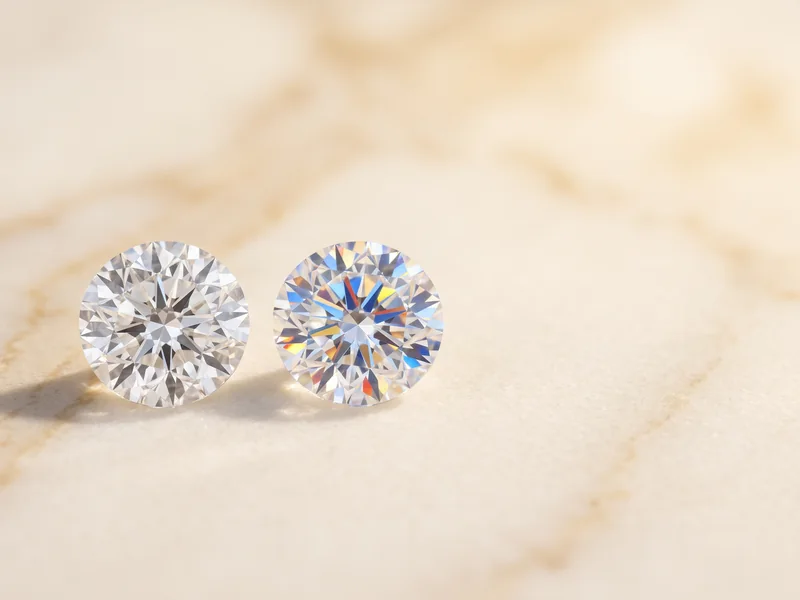
Sparkle: moissanite's higher refractive index (how strongly it bends light) makes it very bright, and its dispersion (how much it splits white light into colours) is more than double diamond's. In sunlight that shows as strong rainbow flashes, sometimes called a 'disco ball' look. Diamond shows a more balanced mix of white brilliance and coloured fire. Neither is better; they are simply different, and experienced eyes often pick moissanite from the extra colour alone. Our full moissanite vs diamond comparison covers looks and wear in more depth, and the side-by-side of lab-grown diamond against moissanite is useful if you are choosing between two lower-cost options.
Related guideMoissanite vs DiamondHow can you tell moissanite from a diamond without a tester?
A gemmologist rarely relies on a beep alone. These are the checks that separate moissanite from diamond, roughly in order of how conclusive they are:
- Double refraction under a loupe: moissanite is doubly refractive, so light entering it splits into two rays. Looking through the stone at an angle with a 10× loupe, the back facet edges appear doubled, like a slightly out-of-focus photo. Diamond is singly refractive and never shows this. This is the most useful home-and-counter check.
- Needle-like inclusions: moissanite often contains fine, straight, white needles or tubes running parallel to each other. Diamond inclusions look different: crystals, feathers and pinpoints, or in lab-grown diamond, dark metallic specks or fine graining.
- Fire: strong, constant rainbow flashes, especially in a larger stone or under a single light, point towards moissanite.
- Weight for size: moissanite is a lighter material than diamond (specific gravity about 3.22 against 3.52). A 6.5 mm round diamond weighs about 1.00 carat; a 6.5 mm moissanite weighs about 0.88 carat.
- Colour tint: some moissanite shows a faint grey, green or yellow cast, most noticeable in larger stones and under fluorescent lighting.
- Ultraviolet light: a UV torch can help but is not conclusive. Many natural diamonds glow blue under long-wave UV, while moissanite is usually inert or weak, yet plenty of diamonds are inert too.
The 'fog test' (breathing on the stone to see how quickly it clears) is often suggested online, but it is unreliable here: moissanite sheds heat quickly too, and a greasy diamond can fog for longer than a clean moissanite. Inclusions are a better clue, and it helps to know what inclusions usually look like in lab-grown diamonds, since a lab-grown diamond is the other stone most often confused with moissanite in modern jewellery.
Can a diamond tester tell moissanite from lab-grown diamond?
A multi-tester can usually separate moissanite from lab-grown diamond, because most colourless lab-grown diamonds do not conduct electricity. What no standard thermal or multi-tester can do is separate lab-grown diamond from natural diamond. They are the same material, carbon in a cubic crystal, with the same hardness, refractive index and heat conductivity, so both read 'diamond'. We explain this fully in why a standard tester can't separate natural from lab-grown.
Lab-grown diamond is real diamond, grown in a laboratory rather than mined. Moissanite is a different mineral altogether. The two are often mentioned together because both cost much less than natural diamond, but a lab-grown diamond will pass every diamond test, while moissanite is identified as soon as the right test is used.
The tricky case runs the other way. Diamonds containing boron conduct electricity. Naturally, that is the rare blue type IIb diamond; in the lab, some stones grown by the high-pressure method can pick up traces of boron. Those diamonds can make a multi-tester show 'moissanite' even though they are genuine diamond. Diamond types are based on their trace elements, and our page on type IIa diamonds and why so many lab-grown stones are this pure type explains the system. For how growth method affects what ends up in the crystal, see the HPHT and CVD growth methods compared.
If a ring matters to you, the dependable answer is a grading or identification report from an independent laboratory such as GIA or IGI. A report states whether a stone is natural diamond, laboratory-grown diamond or synthetic moissanite, and many diamonds carry a laser-inscribed report number on the girdle that you can check under magnification. Our complete lab-grown diamond guide covers reports and inscriptions in more detail.
How much does moissanite cost in Australia compared with diamond?
Price is one of the clearest differences, and one reason a moissanite passed off as diamond is a serious problem for the buyer. These are broad, approximate AUD ranges for a loose round stone with a face-up size of about 6.5 mm, the size of a 1 carat round diamond:
| About 6.5 mm round (1 ct diamond size) | Approximate price range (AUD) |
|---|---|
| Moissanite (colourless grade) | about $300–$1,000 |
| Lab-grown diamond, G–H, VS | about $800–$2,500 |
| Natural diamond, G–H, VS | about $7,000–$15,000 |
| Cubic zirconia | under $100 |
Prices move with the market, the cut quality and the exact grades, so treat these as a rough guide only. Testers themselves are inexpensive: a basic thermal pen is often around $20–$80 and a multi-tester around $50–$300, while laboratory screening instruments cost thousands.
Under Australian Consumer Law, a seller must not describe a stone in a misleading way, so moissanite should be sold as moissanite, and lab-grown diamond must be clearly disclosed as lab-grown. Our page on the ACCC's guidance on lab-grown and simulant wording sets out which terms are acceptable. If a 'diamond' is priced like moissanite and comes without a report, it is worth having it checked before you pay.
Browse lab-grown diamonds
How do you test a stone for moissanite? Step by step
- Clean and warm the stone. Wipe it with a lint-free cloth and let it sit at room temperature for a few minutes; a cold or greasy stone can give a false reading.
- Run a thermal test. Hold the probe at right angles to the table facet, without touching the metal setting. If it reads 'simulant', the stone is not diamond or moissanite.
- Run the electrical check. On a multi-tester, a 'moissanite' result means the stone conducts. Repeat two or three times on different facets.
- Look for doubling with a 10× loupe. Tilt the stone and view the back facet edges through a side crown facet. Doubled edges confirm moissanite.
- Check inclusions and fire. Parallel white needles and strong rainbow flashes support a moissanite result.
- Compare weight and size. If the stone is loose, measure it in millimetres and weigh it; a 6.5 mm round moissanite weighs about 0.88 carat, where a diamond of that size weighs about 1.00 carat.
- Get a lab report for anything important. If results disagree, or the stone is a blue or high-value diamond, send it to an independent laboratory for identification.
Free consultation
Talk to a gemologist
Compare stones in person or online with Raj Sood, Graduate Gemologist (GIA), AJP (GIA).
Book a consultationShop this shape
FAQ
Common questions
Will moissanite test as diamond?
On a basic thermal tester, usually yes, because moissanite conducts heat far better than most gems. On a multi-tester with an electrical check, most moissanite reads as moissanite.
Can a jeweller tell moissanite from diamond?
Yes. A jeweller or gemmologist can use a multi-tester, look for doubled facet edges under a 10× loupe and check the inclusions, and a laboratory can identify it with certainty.
Does lab-grown diamond pass a diamond tester?
Yes. Lab-grown diamond is real diamond, so it passes both thermal and electrical tests like natural diamond. A standard tester cannot tell lab-grown from natural; that needs laboratory screening or a grading report.
Why did my diamond test as moissanite?
A diamond containing boron, such as a natural blue type IIb diamond or some HPHT lab-grown diamonds, can conduct electricity and trigger the moissanite alarm. Poor technique, such as the probe touching metal, can also cause odd readings, so confirm with a loupe or a lab.
Is moissanite a fake diamond?
No. Moissanite is a separate lab-created gem, silicon carbide, with its own properties. It only becomes a problem when it is sold or described as diamond.
Does cubic zirconia pass a diamond tester?
No. Cubic zirconia conducts heat poorly, so even a basic thermal tester reads it as a simulant. It is also softer than moissanite, at 8–8.5 on the Mohs scale.

Ask a gemologist
Not sure which diamond to choose?
Raj Sood is a Graduate Gemologist (GIA) and master jeweller. Bring the stones you are considering, or send the reports, and he will tell you honestly which one is better and why.
Keep learning
Related guides
 Lab-Grown DiamondsMoissanite vs DiamondLab-Grown DiamondsLab-Grown Diamond vs Moissanite
 Lab-Grown DiamondsCan a Diamond Tester Tell Natural From Lab-Grown?
 Lab-Grown DiamondsHow to Tell if a Diamond Is RealLab-Grown DiamondsLab-Grown Diamonds GuideLab-Grown DiamondsMoissanite vs Cubic Zirconia
 Lab-Grown DiamondsMoissanite Colour and Clarity GradesGemstonesMoissanite as a Gemstone
Explore more
More guides on this topic
Education