
- Education
- Wedding Bands & Eternity
- Do You Need a Spacer Band Between Rings? When It Helps and When It Doesn't
Wedding Bands & Eternity
Do You Need a Spacer Band Between Rings? When It Helps and When It Doesn't
A spacer band can stop two rings wearing each other down, or it can add width and cost you never needed. Here is how to tell which, shape by shape, with widths, metals and approximate Australian prices.
 Reviewed by Raj Sood, Graduate Gemologist (GIA), AJP (GIA)Master jeweller and Graduate Gemologist (GIA) · reviewed 4 November 2026
Quick answer
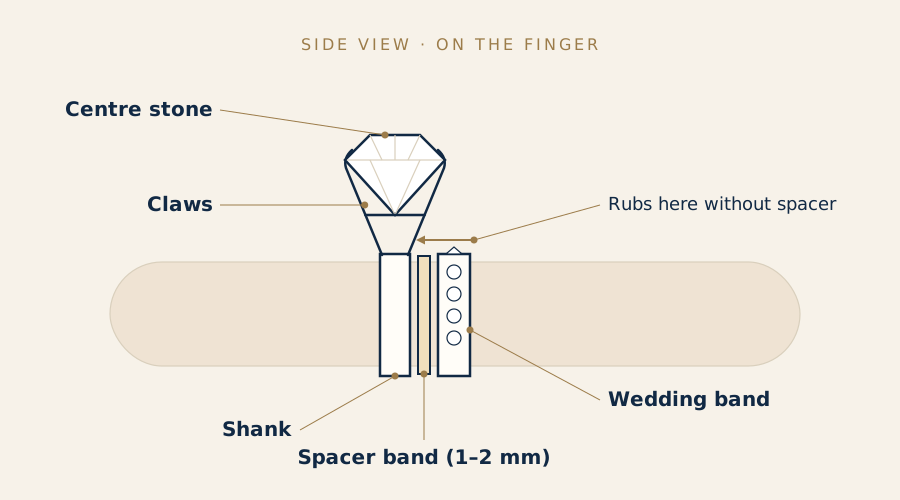
Not always. A spacer band is a thin plain band, usually 1–2 mm wide, worn between an engagement ring and wedding band. You need one when the setting leaves an awkward gap, when diamonds or claws rub against each other, or when a softer gemstone needs protecting. A low-set ring with a flush band rarely needs one.
What is a spacer band?
A spacer band is a thin, usually plain ring worn between two other rings, most often between an engagement ring and a wedding band. Typical spacers are 1.0–2.0 mm wide and about 1.2–1.8 mm thick, so they add very little bulk to the finger. You may also see them called stacker bands, guard bands or simply thin bands. The names overlap, and our plain-English jewellery glossary sorts out the differences if you come across them on a quote.
A spacer does one of three jobs. It separates two rings so their stones or claws do not touch. It fills a visual gap under a raised setting. Or it changes the look of a stack, for example a fine yellow gold line between two platinum rings. It is not the same as a ring guard (sometimes called an enhancer), which is a pair of bands joined by a curve or V that wraps around the engagement ring from both sides.
Most spacers have a court profile (rounded on the inside and outside) or a slim flat profile, because both sit comfortably against neighbouring rings without digging in. Our page on court, flat and D-shape band profiles shows what each looks like in cross-section and how it feels on the hand.
Why do people wear a spacer band between rings?
The main reason is wear. Diamond sits at 10 on the Mohs hardness scale. Every ring metal is far softer: gold and platinum alloys sit at roughly 2.5–4.5. When a diamond-set band rubs against an engagement ring every day, the diamonds behave like a fine file on the metal beside them. Over months it is invisible; over years it adds up.
- Claw wear: the claws (small metal prongs) holding a centre stone are often only about 0.6–1.0 mm thick at the tip. A pavé or channel-set band rubbing against them can thin them noticeably within a few years. Our guide to the signs your claws need retipping shows what that wear looks like.
- Diamond against diamond: diamond is hard but also brittle along its cleavage planes. Two diamonds knocking together can chip a girdle (the thin outer edge of a stone), especially on pointed or cornered shapes.
- Softer gemstones: emerald (7.5–8), morganite (7.5–8), tanzanite (6–7) and opal (5.5–6.5) can all be scratched by a diamond band sitting against them.
- Metal on metal: two plain bands also polish each other slowly. This is usually harmless and mostly cosmetic.
- Spinning: engagement rings with a heavy head tend to roll to one side. A band on each side, or a spacer plus band, helps hold them upright.
- Looks: a fine line of plain metal can stop two detailed rings from visually blurring into one.
Because the wear problem comes mostly from diamonds, it matters far more when your wedding band is set with stones than when it is plain. Our comparison of plain versus diamond wedding bands looks at the same question from the band's side.
Do you need a spacer band, or is it optional?
Plenty of people never need one. If your engagement ring sits low and your wedding band slides right up against it with no gap and no stones touching, a spacer only adds width. You are more likely to benefit from a spacer band if:
- Your wedding band is diamond-set and would sit directly against the engagement ring's claws or stones.
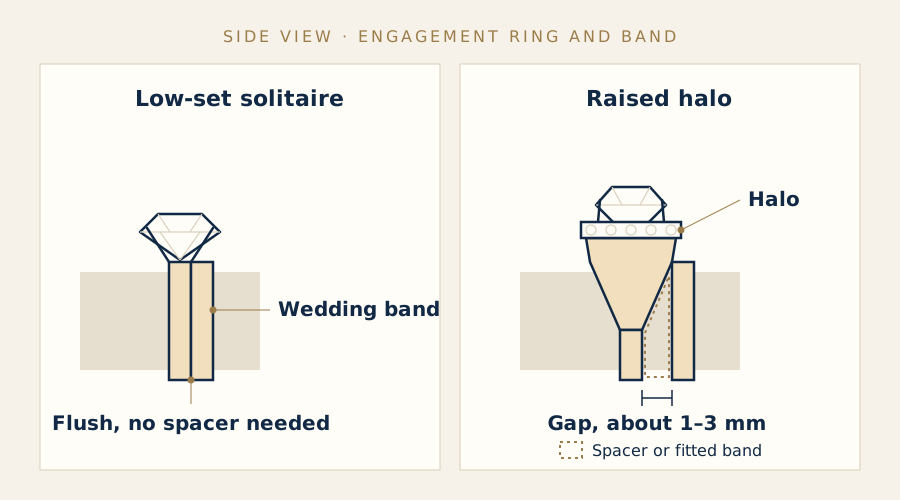
- Your engagement ring has a raised head, cathedral shoulders or a halo, leaving a gap underneath that you do not like the look of.
- The centre stone is a softer gemstone such as opal, emerald or morganite.
- Your engagement ring keeps spinning and you do not want a wider wedding band.
- You want to wear two diamond bands, such as a wedding band and an eternity ring, either side of the engagement ring.
A gap on its own is not a fault. Some people like a small sliver of skin between rings; others want a seamless line. Before deciding, look at the rings together on your own hand, and read our guide to how much gap is normal between an engagement ring and band, which sets out typical gaps in millimetres for different settings.
Related guideFitted Wedding Bands Explained | Custom Curved BandsWhich engagement ring shapes need a spacer band?
Whether a spacer helps depends less on the diamond shape itself and more on how it is set: how high the head sits, whether the shoulders slope and whether anything overhangs the shank (the band part of the ring). Here is how the common styles usually behave.
| Engagement ring style | Typical issue | Spacer band? | Common alternative |
|---|---|---|---|
| Round solitaire, low-set | Band usually sits flush | Rarely needed | Straight band |
| Round on high cathedral or basket | Visible gap under the head | Optional, for looks | Fitted or contoured band |
| Oval, pear or marquise | Points can catch a straight band | Useful with a diamond band | Curved or notched band |
| Princess | Sharp corners rub the band | Useful, protects corners | Low setting plus straight band |
| Emerald or Asscher | Wide, flat stone; often low | Rarely needed | Straight band |
| Halo | Halo often overhangs the shank | Sometimes, to fill the gap | Fitted band shaped to the halo |
| Three-stone | Wide side stones overhang | Often useful | Curved or fitted band |
| Bezel | Smooth rim, usually flush | Rarely needed | Straight band |
| Vintage cluster or toi et moi | Irregular outline, uneven gap | Case by case | Custom fitted band |
Princess cuts deserve a special mention because their four corners are the thinnest, most exposed part of the stone. A plain spacer between a princess and a diamond band takes the knocks instead of the corners; our page on bands that sit well beside a princess cut goes through the options. For halos and three-stone rings, a spacer often only half-solves the gap, and contoured and fitted bands that follow the setting are usually the neater answer.
Pointed and elongated shapes need the most thought. A pear's tip or a marquise's two points can sit over the band and rub with every movement, so a plain spacer gives that point a softer neighbour than a row of diamonds. Our guide to pear cut diamonds and their fragile tip explains why the point is the weak spot, while oval diamonds, which have no points at all are usually easier to pair with a straight band. Hearts combine a point with wide lobes, and our page on wedding bands that suit a heart shaped centre stone shows when a spacer or a curved band works better.
Not sure which one is right?
Send us the stones you are looking at and our gemologist will tell you which to choose and why.
Spacer band vs fitted band vs ring guard: which suits you?
A spacer is one of several ways to make two rings live together. Each has a trade-off between comfort, looks, flexibility and cost.
| Option | How it works | Pros | Cons |
|---|---|---|---|
| Spacer band | Thin plain band between the two rings | Cheap, flexible, protects claws | Adds 1–2 mm of width; another ring to wear |
| Straight band with a gap | Band sits wherever it falls | Simplest; nothing extra | Gap shows; rings may still touch |
| Fitted or contoured band | Band is curved or shaped to hug the setting | Flush, seamless look | Only matches one engagement ring |
| Notched band | Small cut-out lets the setting sit into the band | Flush while staying mostly straight | Notch can look obvious off the hand |
| Ring guard or enhancer | Two bands joined, wrapping the engagement ring | Holds the ring upright, protects both sides | Wide, heavier, more metal |
| Soldered set | Rings permanently joined | Never spin or rub | Cannot wear rings separately; resizing is trickier |
Band shape matters too. Tapered bands that narrow towards the centre stone leave more room under a raised head, so you may not need a spacer at all. Textured styles such as twisted band designs can work as a decorative spacer themselves, adding a line of detail between two plainer rings.
How wide should a spacer band be, and what metal?
Width is a balance between strength and bulk. Thinner looks more delicate but bends more easily, particularly in softer alloys.
| Width | Look | Durability notes |
|---|---|---|
| 1.0 mm | Barely there, a fine line | Can bend out of round with hard wear; better in platinum or a harder alloy |
| 1.5 mm | Clean, the most common choice | Good balance for daily wear |
| 2.0 mm | Clearly visible line | Sturdy; adds noticeable width to the stack |
| 2.5 mm+ | Reads as a band in its own right | Consider whether you need a spacer or a second band |
Thickness (the depth from finger to outer surface) matters as much as width. A spacer around 1.4–1.8 mm thick holds its shape far better than a very thin 1.0 mm one, which can go oval over time.
- Match the metal: where possible, use the same metal and alloy as the engagement ring. Two different alloys rubbing together means the softer one wears faster.
- Platinum: heavy and durable; it scratches to a soft satin look but loses very little metal.
- 18ct white gold: usually rhodium plated, which wears off where rings rub. Expect replating every year or two on a heavily worn stack.
- 9ct gold: harder and less costly, but slightly different in colour from 18ct, which can show side by side.
- Contrast: a yellow or rose gold spacer between two white rings is a deliberate design choice and works well.
Comfort follows the same rules as any band: a court or comfort-fit inside lets the stack slide over the knuckle more easily. The principles in our guide to men's wedding band widths and metals apply here too, since men who stack a band with a signet or second ring face the same width questions.
What are the downsides of a spacer band?
A spacer is not automatically an improvement. The main drawbacks:
- Extra width: a 2.0 mm engagement shank plus a 1.5 mm spacer plus a 2.5 mm band makes a 6 mm stack. Above about 6 mm, many people find they need to go up roughly half a size so the rings slide on comfortably.
- Thin spacers deform: a 1.0 mm spacer in a soft alloy can bend or twist, especially if you lift heavy things or garden in your rings.
- It wears too: the spacer takes the rubbing, so it will need polishing or eventually replacing. That is the point, but it is still a cost.
- More to clean: three rings trap more soap and moisturiser than two.
- It does not fix a poor fit: if the band and engagement ring do not suit each other in shape, a spacer only hides part of the problem.
If you are unsure about any of the setting terms here, such as shank, gallery or head, our definitions of ring terms like shank and gallery are a quick reference.
How much does a spacer band cost in Australia?
Spacers use little metal, so they are among the least costly bands you can buy. Price depends mostly on the metal, the width and whether stones are set in it.
| Spacer band (about 1.5 mm) | Approximate price range (AUD) |
|---|---|
| 9ct gold, plain | about $250–$500 |
| 18ct gold, plain | about $450–$900 |
| Platinum, plain | about $600–$1,200 |
| Fine diamond-set, lab-grown diamonds | about $600–$1,500 |
| Fine diamond-set, natural diamonds | about $800–$2,000 |
These are broad ranges only; metal prices move and finished widths vary. A diamond-set spacer partly defeats the purpose if its job is to protect claws, so most people choose plain metal. Lab-grown diamonds are real diamond grown in a laboratory and cost much less than natural; either works in a decorative spacer. For the wider picture on budgets and metals, see our complete wedding ring buying guide, and for how stones change the price, the cost difference between plain and diamond bands is set out side by side.
Create your spacer band or wedding band
How do you decide on a spacer band? Step by step
- Wear the rings together. Put the engagement ring and wedding band on in the order you will wear them.
- Check for contact. Make a fist and flex your fingers. Note whether claws, stones or points touch the band.
- Look at the gap. Decide whether any gap under the setting bothers you; measuring the gap under your setting helps you compare options.
- Consider the band first. A tapered, curved or fitted band may solve the problem without a third ring.
- Choose width and metal. If a spacer is the answer, start at about 1.5 mm in the same metal and alloy as your engagement ring.
- Check the total stack width. Add up all three widths; above about 6 mm, try a half size larger before you commit.
- Plan the upkeep. Have claws checked every 6–12 months and the spacer polished when you see wear.
Free consultation
Talk to a gemologist
Compare stones in person or online with Raj Sood, Graduate Gemologist (GIA), AJP (GIA).
Book a consultationShop this shape
FAQ
Common questions
What is a spacer band for?
A spacer band sits between two rings to stop their stones or claws rubbing, to fill a gap under a raised setting, or simply to change the look of the stack. It is usually a plain band 1–2 mm wide.
Do I need a spacer band between my engagement ring and wedding band?
Only if the rings rub, leave a gap you dislike, or one of them holds a softer gemstone. A low-set engagement ring with a plain band that sits flush usually needs nothing extra.
What is the difference between a ring guard and a spacer band?
A spacer is a single thin band worn on one side of the engagement ring. A ring guard is two bands joined together that wrap around the engagement ring from both sides, holding it upright.
How wide should a spacer band be?
Around 1.5 mm suits most stacks. 1.0 mm looks finer but can bend in softer alloys, while 2.0 mm and wider starts to read as a band of its own.
Will two rings rubbing together damage them?
Two plain bands mostly polish each other slowly and harmlessly. A diamond-set band rubbing against claws or another diamond can thin claws and chip stone edges over time, which is where a spacer helps.
Should a spacer band be the same metal as my rings?
Usually, yes. Matching the metal and alloy keeps the colour consistent and the wear even, though a contrasting gold spacer can be a deliberate design choice.
Terms in this guide

Ask a gemologist
Not sure which diamond to choose?
Raj Sood is a Graduate Gemologist (GIA) and master jeweller. Bring the stones you are considering, or send the reports, and he will tell you honestly which one is better and why.
Keep learning
Related guides
 Wedding Bands & EternityHow Much Gap Should There Be Between an Engagement Ring and Wedding Band?
 Wedding Bands & EternityFitted Wedding Bands Explained | Custom Curved Bands
 Wedding Bands & EternityWedding Band Profiles ExplainedWedding Bands & EternityWedding Ring Buying Guide
 Wedding Bands & EternityMen’s Wedding Band Guide
 Engagement Rings & SettingsTapered Bands
 Wedding Bands & EternityBest Wedding Band for Princess Engagement Rings
 Engagement Rings & SettingsTwisted Bands
Explore more
More guides on this topic
Education