
- Education
- Engagement Rings & Settings
- Twisted Engagement Ring Guide: Twisted Shank Styles, Security and Band Fit
Engagement Rings & Settings
Twisted Engagement Ring Guide: Twisted Shank Styles, Security and Band Fit
A twisted engagement ring adds movement to a simple solitaire, but the strands, gaps and curves change how it wears, how it is resized and which wedding band will sit beside it. Here is what to check before you choose one.
 Reviewed by Raj Sood, Graduate Gemologist (GIA), AJP (GIA)Master jeweller and Graduate Gemologist (GIA) · reviewed 4 November 2026
Quick answer
A twisted engagement ring has a band made of two or more strands that wrap around each other, often meeting at the centre stone. It suits round, oval and cushion diamonds most easily. Choose strands at least about 1.5 mm thick, expect harder resizing and pavé upkeep, and plan a curved or fitted wedding band beside it.
What is a twisted engagement ring?
A twisted engagement ring has a band, or shank (the part of the ring that circles the finger), made from two or more strands of metal that wrap around one another. Some twist all the way round like a rope. Others stay plain and straight underneath and only twist through the shoulders, where the band rises to meet the head (the part that holds the centre stone). Either way the effect is movement: light runs along the curves, and the band looks finer and more detailed than a plain band of the same width.
Twisted and rope-pattern bands appear in a great deal of antique jewellery, and the crossover design, where two ends of the band pass each other around a stone, has been popular for well over a century. Today most twisted shank rings are designed in CAD (computer-aided design) and cast, which lets the jeweller control the thickness of every strand, something that matters a lot for how the ring wears over twenty or thirty years.
The twist is one of many band styles you can pair with a solitaire, halo or three-stone head. To see where it sits among claws, bezels, halos and the rest, start with every engagement ring setting style compared. Any ring term in this guide you have not met before is defined in our jewellery glossary of ring terms.
What types of twisted shank ring are there?
'Twisted' covers several quite different designs. The type you choose decides how busy the ring looks, how easy it is to resize and how much cleaning it needs.
| Style | What it looks like | Resizing | Upkeep |
|---|---|---|---|
| Full rope twist | Two or three strands twisted together around the whole band | Hard; the cut breaks the pattern | Grooves the full way round collect dirt |
| Twisted shoulders (half twist) | Twist only across the top; plain band under the finger | Usually straightforward | Moderate; gaps only near the head |
| Infinity or crossover twist | Strands cross in a figure-eight shape either side of the centre stone | Usually straightforward if the base is plain | Moderate |
| Pavé twist | One strand set with small diamonds, the other polished metal | Possible with care; stones near the cut may need resetting | Pavé needs regular checks |
| Double pavé twist | Both strands set with small diamonds | Hard if pavé runs far down the band | Highest; more stones, more beads to check |
| Vine or open twist | Strands separate and curl around the head, leaving open space | Usually straightforward | Open loops can catch on knitwear |
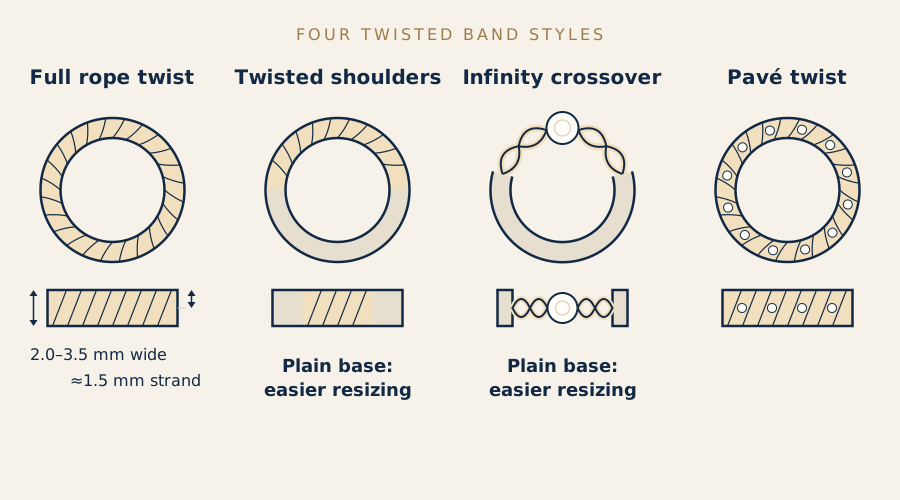
A twist can also be combined with other band profiles. Some designs twist within tapered bands that narrow towards the centre stone, so the strands get finer as they reach the head and the diamond looks larger. Others use reverse taper bands, which widen near the head, giving the twist more presence and a sturdier base for a bigger stone.
How is a twisted band made?
Most modern twisted bands start as a CAD model. The designer draws each strand as a separate curve, sets its thickness and the gap between strands, then checks the model from every angle before anything is made. The model is 3D printed in wax or resin and cast in metal using lost-wax casting: the print is surrounded by plaster-like investment, burnt out, and molten gold or platinum is poured into the hollow it leaves. The rough casting is then cleaned, polished into the grooves and set with stones.
The traditional alternative is handmade: two round wires are twisted together, flattened slightly and soldered to a plain base and head. A handmade twist has a softer, slightly irregular look; a CAD twist is more even and lets you set pavé precisely along the curve. Both are sound if the strands are thick enough.
When you compare twisted rings, these are the measurements that matter:
- Strand thickness: about 1.5 mm or more in each direction for everyday wear. Thinner strands look delicate but bend and wear through sooner.
- Overall width: most twisted bands sit between about 2.0 and 3.5 mm across, measured where the strands are widest.
- Gap between strands: a small, even gap looks crisp; a very tight gap is hard to polish and clean.
- Pavé size: small diamonds on a twisted strand are usually about 0.8–1.3 mm. Our guide to how big pavé and band diamonds should be explains the trade-off between sparkle and security.
- Base thickness: the part under the finger takes the most wear, so it should be solid and at least as thick as the strands.
Is a twisted engagement ring secure for everyday wear?
Yes, a well-made twisted engagement ring is fine to wear every day. The twist itself is not the weak point. The risks sit in a few specific places, and knowing them helps you judge a design before it is made.
- The junction: where the strands join the plain base or the head. This is where stress concentrates if the ring is squeezed, for example gripping a barbell or a steering wheel.
- Thin strand edges: a strand under about 1.2 mm can bend out of shape and wears thin faster on the palm side.
- Pavé on a curve: stones set along a twisting strand sit at changing angles, so some of the tiny holding beads are more exposed to knocks than they would be on a flat band.
- Open loops: vine and open twists can snag on knitwear, hair and gloves, which slowly lifts claws and beads.
Width helps. A twist with an overall width of 2.2 mm or more gives each strand enough metal to stay strong, especially with pavé. Under 2 mm, a two-strand twist means each strand is very fine. To picture the difference on a hand, see band widths from 1.8 to 4 mm side by side.
Resizing is the other practical issue. If the bottom of the band is plain, a jeweller can usually cut and resize it by about one to two sizes without touching the twist. If the twist runs all the way round, a resize breaks the pattern, and the jeweller may need to rebuild a section or remake the band. Get sized carefully before the ring is made, ideally on a warm day and a cool day.
Not sure which one is right?
Send us the stones you are looking at and our gemologist will tell you which to choose and why.
Which diamond shapes and sizes suit a twisted band?
Almost any centre stone can sit on a twist, but some shapes follow its curves more naturally. Curved outlines echo the twist; sharp-cornered shapes create contrast, which some people love and others find busy.
| Centre stone shape | How it looks on a twist | Watch for |
|---|---|---|
| Round | Classic and balanced; the most common pairing | Nothing special |
| Oval | The twist flows into the long sides | Twist direction should line up with the stone's length |
| Cushion | Soft corners blend with the curves | A deep cushion may need a taller head |
| Pear | Strands can sweep towards the point for a sense of movement | V-claw to protect the point |
| Princess or emerald | Straight lines against curves; a bolder contrast | Claws on corners; check the twist doesn't crowd them |
| Marquise | Dramatic, almost leaf-like with a vine twist | Two points to protect |
Size matters too. Under about 0.50 carat, a busy double pavé twist can draw the eye away from the centre stone, so a plain or single-pavé twist usually suits small stones better. Between about 1 and 2 carats the proportions tend to look balanced. From about 3 carats, the shank needs more metal, so aim for a wider or reverse-tapered twist. For help matching width to your stone and finger, read choosing a band width for your hand.
The centre stone can be natural or lab-grown diamond; both are diamond, 10 on the Mohs scale of hardness, and both suit a twist. Sapphire (9 on the Mohs scale), natural or lab-created, is also durable enough for daily wear. Softer gems such as morganite (about 7.5–8) are fine in a protective head but will show wear sooner than diamond.
Which metal suits a twisted shank ring?
The twist exposes more metal surface than a plain band, and its high points take the knocks. That changes how each metal ages.
| Metal | How it behaves in a twist | Upkeep |
|---|---|---|
| Platinum 950 | Dense and naturally white; it moves rather than wears away, so high points develop a soft satin look | Polish every few years; no plating |
| 18ct white gold | Harder surface; holds crisp edges between strands | Rhodium plating every 12–18 months or so, as the high points wear first |
| 18ct yellow gold | Warm and rich; scratches blend into the curves | Occasional polish |
| 18ct rose gold | Copper in the alloy makes it slightly harder | Occasional polish |
| 9ct or 14ct gold | Lower gold content and lower price; generally harder but can tarnish more over time | Occasional polish |
Many people mix metals in a twist: one yellow gold strand wound around a white gold strand, or a platinum head on a rose gold twist. Two-tone twists are made by casting the strands separately and joining them, so the join should be checked at each service. For a fuller look at how each alloy wears, see how platinum and gold alloys wear in a band.
Which wedding band fits a twisted engagement ring?
This is the question that surprises most people later. Because a twisted band curves and often rises towards the head, a straight wedding band can leave a visible gap or rub against the strands. There are four common answers:
- Straight band: works when the twist stays flat and the head sits high enough for the band to slide underneath.
- Matching twist: a second twisted band in the same direction, so the two nest together. Twists in opposite directions rarely sit flush.
- Fitted or curved band: made to follow the outline of the engagement ring exactly, closing the gap.
- Spacer band: a fine plain band between the two rings that stops the twist and pavé rubbing.
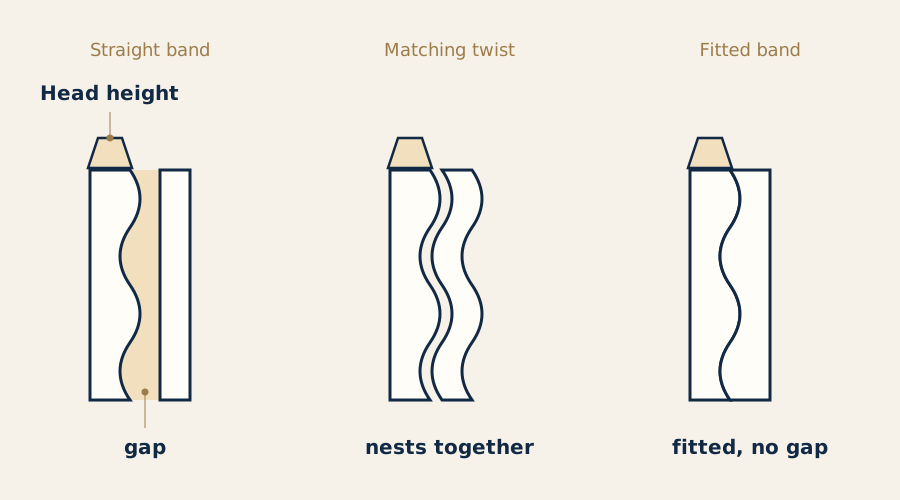
Head height decides a lot. If the stone sits high, a straight band can tuck under it; if it sits low, the band has to curve. Our page on how setting height affects wedding band fit explains the measurements, and wedding bands for low-profile rings covers the low-set designs where a twist is hardest to match.
Related guideFitted Wedding Bands Explained | Custom Curved BandsIf you already know a gap will bother you, plan both rings together. A jeweller can design custom fitted and curved wedding bands in CAD from the engagement ring file, so the two lock together. Other options are a fine plain band and whether a spacer band is worth adding. If you are working the other way round, see designing an engagement ring around a band you already own. And if your partner's band is part of the picture, read whether couples' wedding bands should match; a twist pattern can be echoed on a wider plain band without copying it.
How does a twisted band wear over the years, and how do you look after it?
From the repair bench, twisted rings that come back after ten or fifteen years tend to show the same patterns. None of them is a reason to avoid the style, but they tell you what to watch.
- Thinning underneath: the palm side wears fastest on any ring. On a full rope twist this thins the grooves until the strands look flatter.
- Worn high points: the tops of the curves lose their crisp edge first, and on white gold the slightly warmer, off-white colour of the gold alloy shows through where the rhodium wears.
- Lost pavé: beads on the outer curve flatten over time and a small diamond can work loose, usually after a knock.
- Bent strands: a squeeze can push one strand out of line or open a gap at the junction.
- Hairline cracks: occasionally at the join between strands and head, which can be repaired with a laser welder if caught early.
Cleaning is straightforward. Soak the ring in warm water with a drop of mild dishwashing liquid for 10–15 minutes, then work a soft toothbrush into the grooves and around the pavé, rinse and pat dry. Lotion and soap collect in the gaps of a twist faster than on a plain band and dull the centre stone from underneath. Avoid home ultrasonic cleaners on pavé twists, as the vibration can loosen small stones in worn settings. Our wedding band maintenance checklist sets out what to check at home and what a jeweller should check every 6–12 months.
How does a twisted engagement ring compare with other band styles?
| Twisted | Plain round | Tapered | Knife-edge | |
|---|---|---|---|---|
| Look | Movement, texture, vintage or organic | Simple and classic | Draws the eye to the centre stone | Fine central ridge that catches light |
| Typical width | 2.0–3.5 mm | 1.8–3.0 mm | Narrows to about 1.5–2.0 mm at the head | 1.8–2.5 mm |
| Resizing | Easy to hard, depending on the twist | Easy | Easy | Easy |
| Cleaning | Grooves need a brush | Easy | Easy | Easy |
| Straight wedding band | Often leaves a gap | Sits flush | Usually sits flush | Usually sits flush |
| Wear over time | High points and grooves wear | Even wear | Thin point at head can wear | Ridge softens over time |
If you like the way a twist catches light but want a simpler shape to live with, the closest alternative is a ridged profile: compare knife-edge bands with a sharp central ridge. If you love the twist but worry about the gap, a twisted-shoulder design with a plain base gives you most of the look with easier resizing and fit.
Price follows the metal, the weight of metal and how much pavé is set. As a broad guide only, a twisted engagement ring setting without the centre stone is about AUD $1,500–$3,500 in 18ct gold and about $2,500–$5,000 in platinum, with pavé adding roughly $500–$2,000 depending on how many stones are set. A full rope twist takes more work to model, polish and finish than a plain band of the same width, so it usually costs a little more. The centre stone is priced separately; natural and lab-grown diamonds of the same grade look the same, and lab-grown costs much less.
Design a twisted band: create your ring or browse ring settings
How do you choose a twisted engagement ring? Step by step
- Pick the twist type. Full rope, twisted shoulders, infinity crossover, pavé or vine. Decide how much texture you want to see every day.
- Check the measurements. Ask for the overall width (about 2.0–3.5 mm) and the thickness of each strand (about 1.5 mm or more).
- Match the stone. Round, oval and cushion follow the curves; pear and marquise need the twist to flow towards their points.
- Choose the metal. Platinum for no plating, 18ct white gold if you are happy to re-plate, yellow or rose gold for warmth.
- Plan resizing. If your size may change, choose a design with a plain base under the finger.
- Plan the wedding band now. Decide between a straight, matching, fitted or spacer band before the engagement ring is made.
- Review the CAD render. Check the strand junctions, gaps and head height from the side as well as from above.
- Book regular checks. Have the pavé, claws and junctions inspected every 6–12 months.
Free consultation
Talk to a gemologist
Compare stones in person or online with Raj Sood, Graduate Gemologist (GIA), AJP (GIA).
Book a consultationShop this shape
FAQ
Common questions
Are twisted engagement rings durable?
Yes, if each strand is thick enough, about 1.5 mm or more, and the base under the finger is solid. The places to watch are the strand junctions and any pavé set along the curves.
Can a twisted shank ring be resized?
Usually, if the bottom of the band is plain; most can go up or down about one to two sizes. If the twist runs all the way round, resizing breaks the pattern and a section may need to be rebuilt.
What wedding band goes with a twisted engagement ring?
A matching twist in the same direction, a custom fitted curved band, or a straight band if the head sits high enough. A thin spacer band is another option if you want to stop the rings rubbing.
Do twisted bands collect dirt?
More than plain bands, because soap and lotion settle in the grooves between strands. A soak in warm soapy water and a soft toothbrush once a week keeps the twist and the centre stone bright.
What diamond shape looks good on a twisted band?
Round, oval and cushion shapes follow the curves most naturally. Pear, marquise, princess and emerald cuts also work, but the twist direction and claws need more planning.
Is a twisted engagement ring more expensive than a plain band?
Usually a little, because a full twist takes longer to make and polish, and pavé adds to the cost. A twisted-shoulder design with a plain base sits closer to the price of a plain band.

Ask a gemologist
Not sure which diamond to choose?
Raj Sood is a Graduate Gemologist (GIA) and master jeweller. Bring the stones you are considering, or send the reports, and he will tell you honestly which one is better and why.
Keep learning
Related guides
 Wedding Bands & EternityFitted Wedding Bands Explained | Custom Curved Bands
 Engagement Rings & SettingsSetting Height and Wedding Band FitWedding Bands & EternityWedding Band Maintenance ChecklistEngagement Rings & SettingsTapered BandsEngagement Rings & SettingsWhat Engagement Ring Band Width Should You Choose?
 Engagement Rings & SettingsReverse Taper BandsEngagement Rings & SettingsKnife-Edge Bands
Explore more
More guides on this topic
Education