
- Education
- Engagement Rings & Settings
- Tapered Band Engagement Rings: How They're Built, Wear and Fit
Engagement Rings & Settings
Tapered Band Engagement Rings: How They're Built, Wear and Fit
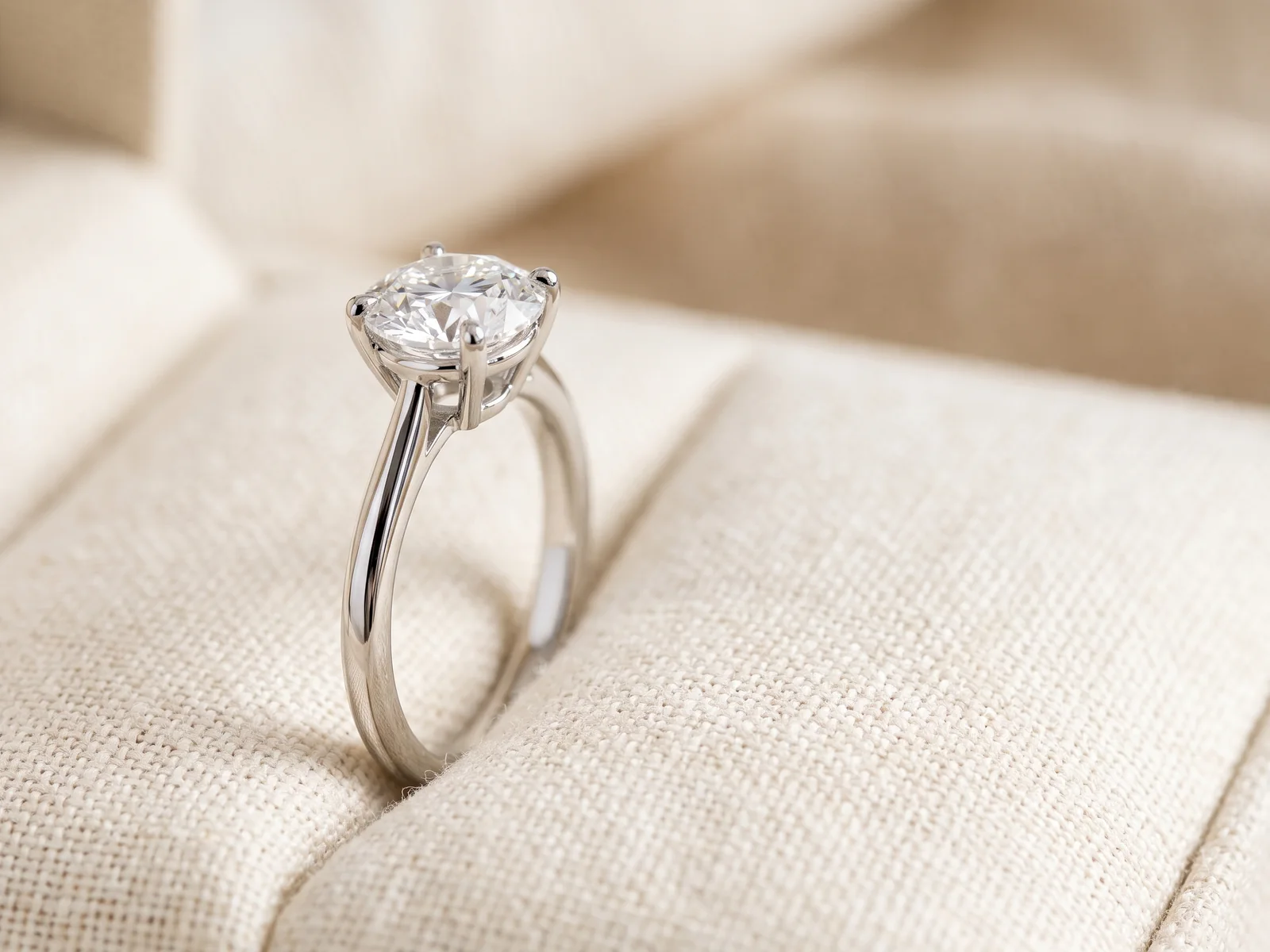
A tapered band is one of the simplest ways to make a centre stone look larger, but how far it narrows decides how well it wears. Here is how a tapered band is built, what suits it and how it sits beside a wedding band.
 Reviewed by Raj Sood, Graduate Gemologist (GIA), AJP (GIA)Master jeweller and Graduate Gemologist (GIA) · reviewed 4 November 2026
Quick answer
A tapered band is an engagement ring shank that narrows as it rises towards the centre stone, typically from about 2.5–3 mm at the back to about 1.5–2 mm under the head. The slim shoulders make the diamond look larger and suit most shapes, but need enough metal depth, around 1.5 mm, to stay strong.
What is a tapered band?
A tapered band is a ring shank (the part of the ring that goes around your finger) that gets gradually narrower as it climbs towards the centre stone. It is wider at the base, where the ring sits against your palm, and slimmer at the shoulders, the two sections either side of the head (the claws or bezel that hold the stone).
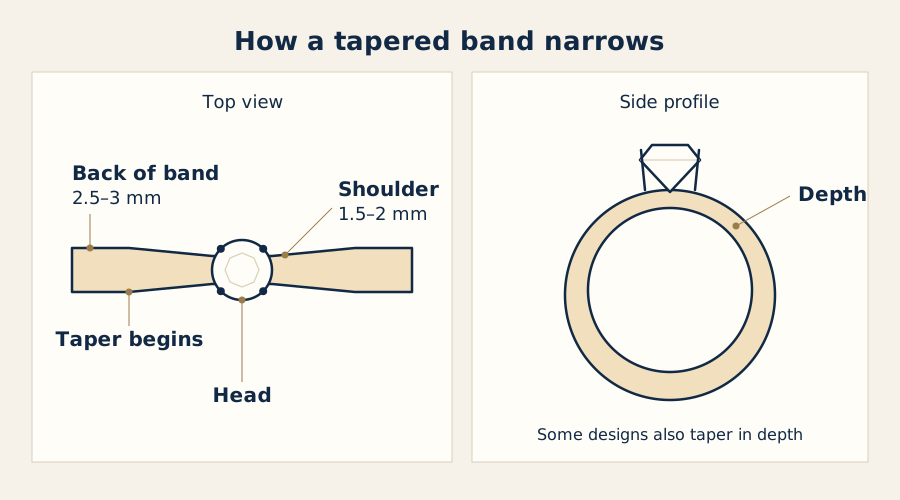
On a typical tapered band engagement ring, the back of the band measures about 2.5–3 mm wide and the shoulders narrow to about 1.5–2 mm right where they meet the head. Some designs taper only in width; others also taper in depth, so the band looks finer from the side too. The taper usually begins about a third of the way up from the base, though designers move that point to change the look.
The tapered band is one of many shank styles covered in our guide to engagement ring setting styles. Its opposite is the reverse taper band, which widens towards the stone. If any term on this page is new to you, it is explained in our plain-English jewellery glossary.
How is a tapered band made?
Most tapered bands today start as a CAD model (computer-aided design). The designer sets the width and depth at the base, the point where the taper starts and the width at the shoulder, then checks the ring from every angle before anything is made. Small changes matter: a shoulder of 1.6 mm and one of 2.0 mm look very different on the hand, even though the difference is less than half a millimetre.
The model is then 3D printed in wax or resin and cast in metal, usually 18ct gold or platinum. After casting, a jeweller cleans up the shank, refines the curve of the taper by hand, fits the head and sets the stone. A good taper is smooth and even on both sides, with no step or flat spot where the narrowing begins.
Metal choice changes how a slim taper behaves. Platinum is dense (about 21 g/cm³) and tends to push aside rather than lose metal when it is scratched, so a fine shoulder holds its shape well over many years. 18ct gold is lighter and a little more prone to wearing thin, though harder alloys such as 18ct white gold generally hold a fine taper better than softer yellow gold. Our page on choosing a metal for wedding bands compares the options in detail, and the same reasoning applies to an engagement ring shank.
How does a tapered band change the look of a ring?
A tapered band works by contrast. Because the metal is slimmest right beside the stone, the centre diamond looks a little larger and more prominent than it would on a straight band of the same width. The narrowing lines also lead the eye inwards, a bit like the lines of a road meeting at the horizon. On a finer hand, the slim shoulders keep the ring delicate while the wider base keeps it comfortable and strong.
Here is how a tapered band compares with the other common shank styles:
| Style | Shape of the shank | Look | Strength at the shoulders | Wedding band fit |
|---|---|---|---|---|
| Tapered | Narrows towards the stone | Stone looks larger, delicate shoulders | Good if 1.5 mm+ deep; thinnest near the head | Small V-gap beside a straight band |
| Straight | Same width all round | Classic, balanced | Even strength all round | Sits flush if the head allows |
| Reverse taper | Widens towards the stone | Bold, solid shoulders | Strongest near the head | Can leave a gap at the back |
| Knife-edge | Ridge along the top | Fine, crisp line of light | Good; extra depth from the ridge | Usually sits flush |
| Twisted | Two or more strands wound together | Textured, romantic | Depends on strand thickness | Gaps between strands; may need a fitted band |
If you like a slim line but want the strength of extra depth, look at knife-edge bands and their peaked profile. For texture and movement, twisted and intertwined bands are the other popular choice. For a stronger look, the reverse taper is the mirror image of the style on this page.
Related guideReverse Taper BandsIs a tapered band secure enough for everyday wear?
Yes, provided the narrowest part has enough metal. The risk with any tapered shank ring is that the slimmest section sits right where the ring takes knocks and where the head is joined. If the shoulders are cut too fine, they can bend, crack where they meet the head, or wear thin over the years, which can loosen the claws holding the stone.
Width is what you see from above; depth (the thickness from the outside of the band to the inside, against your finger) is what gives strength. A tapered band that is 1.6 mm wide but 1.8 mm deep is far sturdier than one that is 1.6 mm wide and 1.2 mm deep. As a general guide:
| Width at the shoulder | Suggested minimum depth | How it wears |
|---|---|---|
| Under 1.5 mm | 1.7 mm or more | Very fine; best for careful wearers and smaller stones |
| 1.5–1.8 mm | 1.5–1.7 mm | A common balance of delicate and durable |
| 1.8–2.2 mm | 1.5 mm | Sturdy for daily wear and heavier centre stones |
| Back of band 2.5–3 mm | 1.5–1.8 mm | Comfortable, and leaves room for resizing |
From the repair bench, the problems we see in older tapered rings follow a pattern: shoulders worn thin on the palm side from years of gripping, small cracks at the join between a very fine shank and a heavy head, and bands bent out of round from lifting or knocks. All of these are much less likely when the band was made with adequate depth from the start. Our article on how to choose an engagement ring band width covers the trade-offs between look and strength, and the side-by-side band widths from 1.8 to 4 mm show what each size looks like on the hand.
Not sure which one is right?
Send us the stones you are looking at and our gemologist will tell you which to choose and why.
Which diamond shapes and stones suit a tapered band?
A tapered band suits almost every centre stone, which is part of its long popularity. It works especially well where you want the stone to look as large as possible for its carat weight.
- Round brilliant: the classic pairing. A taper to about 1.6–1.8 mm under a 1 carat round (about 6.4 mm across) makes the stone look generous without looking top-heavy.
- Oval, pear and marquise: elongated shapes look even longer and slimmer when the shoulders narrow towards them.
- Cushion and princess: the fine shoulders soften square outlines; make sure the head is strong enough to protect the corners.
- Emerald and other step cuts: work well, though some people prefer a straight band to echo the clean lines of the stone.
- Three-stone rings: a taper towards the side stones keeps the cluster in proportion. Our guide to baguette and tapered baguette side stones explains how tapered baguettes echo a tapered shank.
The main exception is a very large or very heavy centre stone, roughly 2.5 carats and up, or a tall head. A very fine taper under a big stone can look unbalanced and puts more strain on the shoulders. Here a gentler taper, stopping at about 2 mm, or a reverse taper usually wears better. Coloured gems follow the same rules: hard stones such as sapphire and ruby (9 on the Mohs hardness scale) suit any taper, while softer stones benefit from a protective head rather than a finer band.
Can a tapered band have diamonds in it?
Yes. A tapered pavé band has small diamonds set along the shoulders, usually in a single row. Pavé (from the French for paved) means small stones set close together and held by tiny beads or claws of metal. Because the band narrows, the stones are often graduated: perhaps 1.5 mm near the back of the visible section, stepping down to about 1.1–1.3 mm near the head, so the row stays even with the edges of the metal.
Setting stones into a narrowing band takes care. Each stone needs a seat cut into the metal, and every seat removes some strength, so a tapered pavé band should be slightly deeper than a plain one. Keep the pavé to the top half of the ring, too: stones on the palm side take most of the wear and are the ones most often lost. The same principles of stone size and metal support appear in our guide on how big the diamonds in a band should be.
How does a tapered band sit with a wedding band?
This is the question to ask before you finalise a tapered band engagement ring. Because the shoulders narrow, a straight wedding band placed beside it touches at the back but leaves a small V-shaped gap near the head. Some people like this gap, as it lets each ring be seen on its own. Others want the two rings to sit flush.
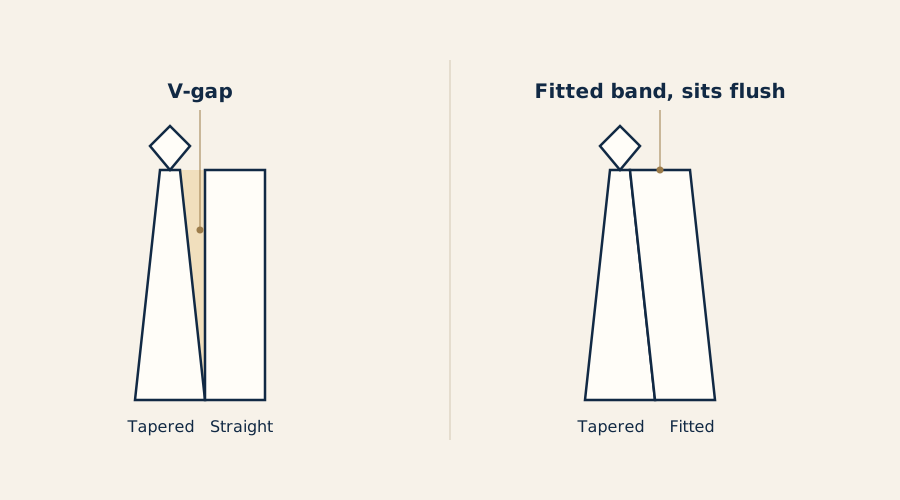
How the rings sit also depends on the head. If the stone sits low and its gallery (the metal under the stone) reaches down to the finger, a straight band may not sit close at all. Our guides to how setting height affects wedding band fit and wedding bands for low-set engagement rings go through each situation. Ways to close the gap include:
- A fitted band: a wedding band shaped to follow the taper and the head. See how custom curved and fitted bands are made.
- A matching tapered band: a wedding band with the same taper, so the two rings mirror each other.
- A spacer: a thin band worn between rings to stop rubbing; our page on whether a spacer band is worth it explains when it helps.
- Designing both rings at once: often the simplest route. Read the case for designing both rings together.
If you already own a wedding band, perhaps an heirloom, the tapered engagement ring can be shaped to suit it. Our article on building an engagement ring around a band you already have covers the details.
How does a tapered band wear over the years, and can it be resized?
A well-made tapered band ages much like any other ring, but the wear shows first at the thinnest points. Over 10–20 years of daily wear, the palm side of a gold band can lose a noticeable fraction of a millimetre, and rings worn alongside a wedding band can rub flat spots into each other. Platinum wears more slowly in thickness but develops a soft, slightly matte patina that many people like.
- Every 6–12 months: have the claws and any pavé checked under magnification.
- Every few years: ask a jeweller to measure the shoulder and palm-side depth; a worn shank can be rebuilt by adding a new section of metal.
- At home: soak in warm water with a drop of dishwashing liquid and brush gently with a soft toothbrush, especially under the head where the taper meets it.
- Take it off for gym work, heavy lifting and gardening, which are the most common causes of bent shanks.
Tapered band resizing is usually straightforward, because sizing is done at the back of the ring where the band is widest and plain. A jeweller cuts the shank and adds or removes metal there, keeping the taper untouched. Large changes, roughly more than two sizes, can shift where the taper begins and may alter its proportions; pavé that runs far down the band also makes resizing harder. Our ring and band maintenance checklist lists what to check and when.
How do you choose a tapered band? Step by step
- Pick the centre stone first. Its shape, size and height decide how far the band can taper.
- Set the shoulder width. About 1.5–2 mm under the head suits most stones; go towards 2 mm for stones over about 2 carats.
- Ask for the depth. Aim for about 1.5 mm or more at the narrowest point, more if the shoulders carry pavé.
- Choose the metal. Platinum or a hard white gold if you want a very fine taper to hold its shape.
- Plan the wedding band. Decide whether you want a V-gap, a fitted band or a matching tapered band before the ring is made.
- Check the CAD render. Look at the ring from the top and the side, and compare it with finished photos of similar rings.
Tapered bands are available in natural and lab-grown diamond settings alike; the shank style makes no difference to the stone you choose. Approximate prices for a plain tapered solitaire setting in 18ct gold sit around AUD 1,200–3,000 before the centre stone, with platinum and pavé shoulders costing more. These are broad ranges only and depend on metal weight and design.
Explore ring settings and create your own ring
Free consultation
Talk to a gemologist
Compare stones in person or online with Raj Sood, Graduate Gemologist (GIA), AJP (GIA).
Book a consultationShop this shape
FAQ
Common questions
What is the difference between a tapered and a reverse taper band?
A tapered band narrows as it approaches the centre stone, making the stone look larger. A reverse taper band widens towards the stone, giving bolder, stronger shoulders.
Does a tapered band make a diamond look bigger?
Yes, slightly. The slim shoulders beside the stone create contrast, so the centre diamond looks more prominent than it would on a straight band of the same width.
Will a straight wedding band sit flush with a tapered engagement ring?
It will touch at the back but usually leaves a small V-shaped gap near the stone. If you want no gap, choose a fitted band or a matching tapered band.
Is a tapered band strong enough for daily wear?
Yes, if the narrowest section has enough metal, ideally about 1.5 mm deep or more. Very fine shoulders under a large stone are the ones that bend or wear thin.
Can a tapered band be resized?
Usually yes, because the jeweller works at the wide plain back of the ring. Changes of more than about two sizes, or pavé running far down the band, can make resizing more complex.
What width should a tapered band be?
Most tapered bands are about 2.5–3 mm at the back and about 1.5–2 mm under the centre stone. Heavier stones suit the wider end of that range.
Terms in this guide

Ask a gemologist
Not sure which diamond to choose?
Raj Sood is a Graduate Gemologist (GIA) and master jeweller. Bring the stones you are considering, or send the reports, and he will tell you honestly which one is better and why.
Keep learning
Related guides
 Engagement Rings & SettingsReverse Taper BandsEngagement Rings & SettingsEngagement Ring Setting Styles Guide
 Engagement Rings & SettingsSetting Height and Wedding Band Fit
 Wedding Bands & EternityFitted Wedding Bands Explained | Custom Curved Bands
 Engagement Rings & SettingsTwisted BandsEngagement Rings & SettingsWhat Engagement Ring Band Width Should You Choose?Engagement Rings & SettingsKnife-Edge BandsEngagement Rings & SettingsEngagement Ring Band Widths: 1.8 to 4 mm
Explore more
More guides on this topic
Education