
- Education
- Lab-Grown Diamonds
- Lab-Grown Diamond Melee in Pavé and Halo Settings: A Complete Guide
Lab-Grown Diamonds
Lab-Grown Diamond Melee in Pavé and Halo Settings: A Complete Guide
Most of the sparkle in a pavé band or halo ring comes from dozens of tiny stones, and today many of them are lab-grown diamond melee. Here is how to judge those small stones, how they should be described, and what they mean for durability and price.
 Reviewed by Raj Sood, Graduate Gemologist (GIA), AJP (GIA)Master jeweller and Graduate Gemologist (GIA) · reviewed 4 November 2026
Quick answer
Lab-grown diamond melee means the tiny laboratory-grown diamonds, usually under 0.20 carat and 0.8–3.5 mm across, set in pavé bands and halos. It is real diamond (Mohs 10), costs much less than natural melee, and should be colourless (about D–G) and eye-clean. Any piece using it must be clearly described as lab-grown.
What is lab-grown diamond melee?
Melee (pronounced mel-ay) is the trade word for small diamonds, usually anything under about 0.20 carat each. Lab-grown diamond melee is exactly that: small diamonds grown in a laboratory rather than mined. They are the stones in pavé bands, halos, the shoulders of solitaires, eternity rings, and the small diamonds in earrings and bracelets. A typical ring with a sparkling band or halo holds somewhere between 10 and 60 of them.
Lab-grown melee is real diamond: carbon atoms locked in the same cubic crystal structure, 10 on the Mohs hardness scale, with a refractive index of about 2.42. Our page on whether lab-grown diamonds are real diamond explains the chemistry, and the complete guide to lab-grown diamonds covers the wider picture. What differs from natural melee is origin, price and the way it has to be described when it is sold.
Most lab-grown melee is grown by HPHT (high pressure, high temperature), a method that can produce many small crystals in one press run. Larger lab-grown centre stones are more often grown by CVD (chemical vapour deposition), which builds diamond layer by layer on a thin seed plate. For a plain-English walk through both, see how HPHT and CVD diamonds are grown.
What sizes does diamond melee come in?
Melee is bought and quoted by millimetre diameter, not by individual carat weight, because the stones are too small to weigh and grade one by one in everyday trade. Jewellers order calibrated sizes so every stone fits a drilled seat in the metal. The table below shows typical round brilliant melee sizes and where each is used.
| Diameter | Approx. weight each | Stones per carat | Common use |
|---|---|---|---|
| 0.8 mm | about 0.003 ct | about 300+ | Micro-pavé on fine bands and edges |
| 1.0 mm | about 0.005 ct | about 200 | Micro-pavé, double halos |
| 1.3 mm | about 0.01 ct | about 100 | Halos around a 1 ct centre, pavé shoulders |
| 1.5 mm | about 0.015 ct | about 65 | Pavé bands, halos on larger centres |
| 1.8 mm | about 0.025 ct | about 40 | Wider pavé bands, eternity rings |
| 2.0 mm | about 0.03 ct | about 30 | Eternity rings, tennis bracelets |
| 2.5 mm | about 0.06 ct | about 16 | Channel bands, earring clusters |
| 3.0 mm | about 0.10 ct | about 10 | Side stones, stud earrings |
| 3.5 mm | about 0.16 ct | about 6 | Larger side stones, the top end of melee |
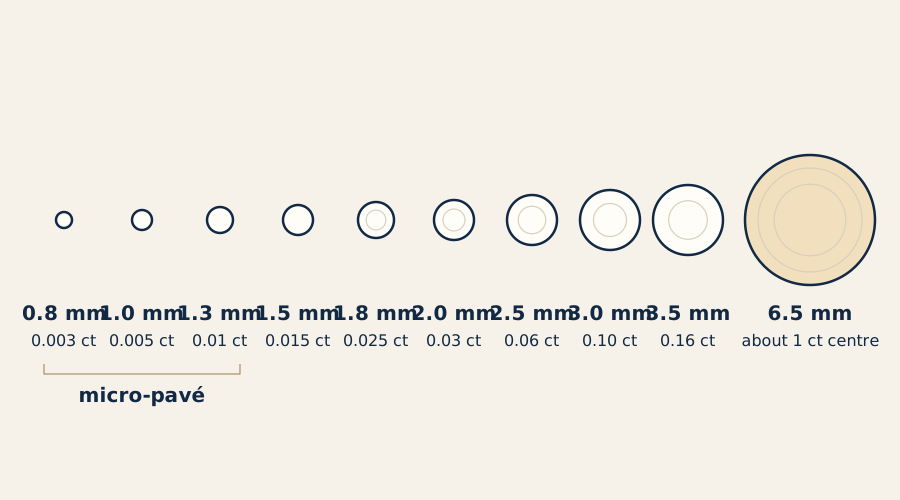
Weights are approximate for well-proportioned round brilliants; a deeper stone weighs a little more for its diameter. On a ring description you will usually see a total carat weight (written ctw or tcw), the combined weight of all the small stones, for example 0.25 ctw. In the trade, natural melee is also sorted with sieves (metal plates with numbered round holes), so you may hear sizes quoted as sieve numbers. Any term here that is new to you is also explained in our jewellery glossary.
Single cut or full cut: which melee suits pavé?
Melee comes in two main faceting styles. A single cut has 17 facets (8 on the crown, 8 on the pavilion and a table), sometimes 18 with a culet. A full cut is a miniature round brilliant with 57 or 58 facets. Single cuts give fewer, larger flashes of light with a slightly old-fashioned look, closer in spirit to the older round cuts that came before the modern brilliant; full cuts give finer, busier sparkle that matches a modern brilliant centre stone.
- Under about 1.0 mm: single cuts are common because cutting 57 facets on a stone this small is slow and costly. Some full cut lab-grown melee is available down to about 0.8–1.0 mm.
- 1.0–1.3 mm: either style; full cut is usual in modern halos.
- Above about 1.3 mm: full cut is standard for pavé, halos and eternity rings.
Cut quality matters in small stones too. Poorly proportioned melee looks grey or glassy even if its colour grade is high, and in a halo one dull stone breaks the ring of light. Because lab-grown melee is cut in very large volumes, quality varies between suppliers, exactly as it does with natural melee. Our guide to how cut quality affects lab-grown sparkle covers proportions in more detail.
Melee also comes in calibrated fancy shapes such as princess, baguette and tapered baguette, used in channel and side-stone designs. Our comparison of straight and tapered baguette side stones explains how those two step cuts differ, and the overview of every diamond shape shows how each outline looks at larger sizes.
What colour and clarity should lab-grown diamond melee be?
Melee is sold in grade ranges rather than single grades, for example F–G colour, VS–SI clarity. Lab-grown melee is widely available in the colourless range, roughly D–G, which is one reason it has become so popular for halos. A good working target for a ring:
- Colour: about D–G in white gold or platinum; G–H is usually fine in yellow or rose gold.
- Clarity: VS to SI. At 1.3 mm a small SI inclusion is practically invisible, so paying for VVS in melee rarely changes what you see.
- Consistency: every stone should look the same colour. A single warm or grey stone in a halo is easy to spot.
- Cast: some HPHT lab-grown melee can show a faint blue or grey tint, and some CVD material is treated after growth to remove brown. Ask that the parcel be checked under daylight-equivalent light.
The colour of the melee changes how the centre stone looks. Very white melee around a warmer centre, say a natural H or I, makes the centre look more yellow by contrast. The usual advice is to keep the melee within one or two colour grades of the centre, or slightly warmer than a very white centre. Our explanation of lab-grown colour grades and how they are assigned shows what each letter looks like.
Small diamonds hold their brightness because they are diamond: they do not scratch, cloud or lose polish with normal wear. That is the practical difference from simulants, and it is why the comparison of lab-grown diamond and cubic zirconia in pavé matters for rings worn every day.
Not sure which one is right?
Send us the stones you are looking at and our gemologist will tell you which to choose and why.
How are pavé and halo settings made with lab-grown melee?
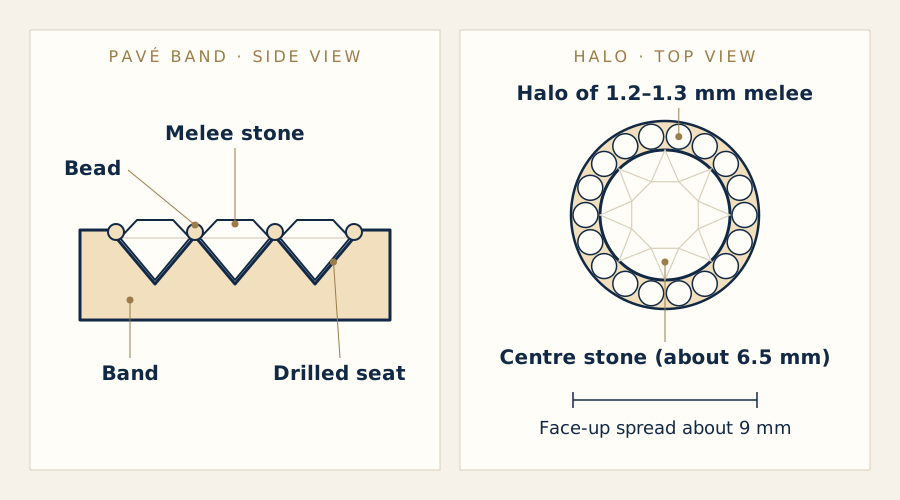
In a pavé setting (from the French for paved), the jeweller drills a row of seats into the metal, sets each melee stone level, then uses a graver to raise tiny beads of metal over the edge of each stone to hold it. Micro-pavé uses stones of about 1.3 mm or smaller and is set under a microscope. The metal between the stones is kept thin, so the band looks almost entirely diamond from the top.
A halo is a ring of melee around the centre stone, usually bead-set or set in fine claws. Around a 1 ct round centre (about 6.4–6.5 mm), a single halo of 1.2–1.3 mm stones typically takes about 16–20 stones and adds about 0.15–0.20 ctw. It increases the face-up spread to roughly 9 mm, so the centre looks noticeably larger, and the halo also protects the centre's girdle from knocks. Judging the centre is still the first job; see our notes on judging cut in a lab-grown centre stone before choosing a halo around it.
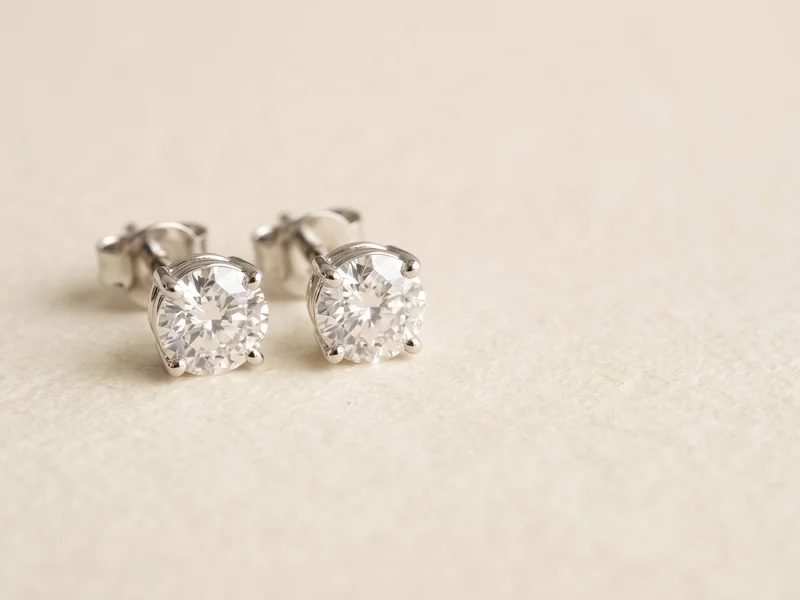
The same melee sizes and setting methods appear outside rings. Tennis bracelets usually use 2.0–3.0 mm stones in individual claws, and halo studs use 1.0–1.5 mm melee around a larger centre; we cover these in lab-grown diamonds in earrings and tennis bracelets.
Related guideLab-Grown Diamonds for Earrings and Tennis BraceletsCan a natural centre stone have a lab-grown halo?
Yes, and it is a common choice: a natural centre diamond with a lab-grown diamond halo or pavé band. The setting looks the same as an all-natural ring, the centre keeps its natural origin, and the small stones cost much less. The reverse also exists, a lab-grown centre with natural melee, though it is less common because natural melee is the more expensive part.
What matters is the description. Under the Australian Consumer Law, businesses must not engage in misleading or deceptive conduct or make false representations about the composition or origin of goods. In practice that means a mixed piece should be described stone by stone, for example: 1.00 ct natural diamond centre; 0.20 ctw lab-grown diamond halo. A description that says only diamond ring, when the melee is lab-grown, leaves the buyer with the wrong impression. If you are buying, ask for the composition in writing on your receipt or valuation.
Natural and lab-grown diamonds differ in origin and in price, not in hardness or how they look in a ring. Our page on the differences between lab-grown and natural diamonds sets out those differences honestly, so you can decide which matters to you for the centre and which for the small stones.
How can you tell lab-grown melee from natural melee?
Not by eye, and not with a basic diamond tester. Thermal and electrical-conductivity testers confirm that a stone is diamond, and lab-grown diamond is diamond, so it passes; our page explaining why lab-grown diamonds pass a diamond tester covers this. Telling the two origins apart needs a laboratory approach.
- Screening devices: most natural diamonds (roughly 98%) are type Ia, meaning they contain clustered nitrogen. Most lab-grown diamonds are type IIa or IIb. Screening instruments look for this difference using short-wave ultraviolet light and pass natural type Ia stones, while referring others for further testing.
- Fluorescence imaging: lab instruments show growth patterns under deep ultraviolet. HPHT diamonds often show a cross-shaped (cuboctahedral) pattern; CVD diamonds show layered growth striations.
- Inclusions and magnetism: HPHT melee can contain tiny metallic inclusions from the metal solvent used in growth, and some stones are weakly attracted to a strong magnet.
- Phosphorescence: some HPHT lab-grown diamonds glow for a few seconds after a UV lamp is switched off.
These clues come straight from the growth process, which is why it helps to understand the growth methods that leave tell-tale signs. Melee is rarely sent for individual reports, so for a set ring you rely on the seller's disclosure. Laboratories including GIA have offered melee screening services because undisclosed lab-grown melee mixed into natural parcels has been an industry concern, and many jewellers now screen their natural melee before setting it.
How much does lab-grown diamond melee cost in Australia?
Lab-grown melee costs much less than natural melee per carat. But melee is only one part of a pavé or halo ring's price: metal, design and the labour of setting every stone add up, and setting labour is the same whether the stone is lab-grown or natural. So switching the melee from natural to lab-grown lowers the ring's price, but not in proportion to the difference in stone cost.
| Lab-grown diamond melee | Natural diamond melee | Moissanite | Cubic zirconia | |
|---|---|---|---|---|
| What it is | Diamond, laboratory-grown | Diamond, mined | Silicon carbide, lab-created | Zirconium oxide, a simulant |
| Mohs hardness | 10 | 10 | 9.25 | 8–8.5 |
| Refractive index | about 2.42 | about 2.42 | about 2.65–2.69 | about 2.15 |
| Look after years of wear | Unchanged | Unchanged | Unchanged; more rainbow fire | Scratches and clouds over time |
| Approx. cost of 0.25 ctw (stones only, AUD) | about $75–$250 | about $250–$900 | about $40–$150 | under $20 |
These are broad stone-only ranges and move with the market, the size of the melee (smaller full cuts cost more to cut per carat) and the grade. As a rough picture, a pavé band with about 0.30 ctw of melee might differ by a few hundred dollars between lab-grown and natural stones, while the setting labour and metal stay the same. For how the price gap plays out on centre stones, see our natural versus lab-grown price comparison, and for the wider buying basics read our lab-grown diamond buying overview.
Browse lab-grown diamonds
Is a lab-grown pavé setting durable enough for everyday wear?
The stones themselves are as tough as any diamond. The weak point of every pavé or halo ring is the metal holding the stones, not the stones. Beads are tiny, often under 0.3 mm, and they wear down with knocks, gym equipment, gardening and years of rubbing against a neighbouring ring. When a bead wears flat, the stone can work loose and fall out.
- Check-ups: have pavé and halo rings checked every 6–12 months, more often if worn for manual work.
- Cleaning: warm water, mild detergent and a soft toothbrush. Ultrasonic cleaners can loosen worn pavé, so ask before using one.
- Resizing: a half-way pavé band can usually be resized one or two sizes; full eternity pavé usually cannot without remaking.
- Metal: platinum beads wear more slowly and tend to move rather than lose metal; 18 ct gold is common and holds well with regular checks.
Replacing a lost lab-grown melee stone is generally inexpensive because the stone costs little; the cost is mostly the jeweller's time to match and set it. Simulant pavé is a different story, because the stones themselves dull, which is covered in our comparison of lab-grown diamond versus cubic zirconia.
How do you check a pavé or halo ring before you buy? Step by step
- Get the composition in writing. The description should state the centre stone's origin and the melee's origin separately, for example lab-grown diamond halo, 0.18 ctw.
- Ask for the melee grades. Expect a range such as F–G, VS–SI, and the cut style (full cut or single cut).
- Compare colour to the centre. Look at the ring in daylight against white card; the halo should not make the centre look yellow. Our guide to matching colour letters between centre and halo helps here.
- Check the setting under a loupe. Even rows, stones level, round beads over every stone and no rough metal that could catch.
- Count and measure. Ask how many stones and what diameter; for a 1 ct round, a halo of about 1.2–1.3 mm stones is typical.
- Plan the upkeep. Ask about resizing limits, check-up intervals and what replacing a lost stone involves.
Free consultation
Talk to a gemologist
Compare stones in person or online with Raj Sood, Graduate Gemologist (GIA), AJP (GIA).
Book a consultationShop this shape
FAQ
Common questions
What is melee in diamonds?
Melee is the trade term for small diamonds, usually under about 0.20 carat each, used in pavé, halos, eternity rings and side stones. They are sold in parcels by millimetre size and grade range rather than individually.
Are lab-grown melee diamonds real diamonds?
Yes. Lab-grown melee is diamond, with the same hardness (Mohs 10) and refractive index (about 2.42) as natural diamond. It differs only in being grown in a laboratory, and it must be described as lab-grown.
Can you mix a natural centre stone with lab-grown melee?
Yes, it is a common and sensible combination. The ring should be described clearly, for example a natural diamond centre with a lab-grown diamond halo, so you know exactly what you are buying.
Does lab-grown melee come with a grading report?
Individual melee stones almost never have their own reports because they are so small. They are graded in parcels by colour and clarity range, and your receipt or valuation should list the total carat weight, grades and origin.
Will the stones in a lab-grown pavé band fall out?
Any pavé stone can come loose if the metal beads holding it wear down, whether the diamond is lab-grown or natural. Checking the setting every 6–12 months catches worn beads before a stone is lost.
Is lab-grown melee cheaper than natural melee?
Yes, lab-grown melee costs much less per carat than natural melee. The whole ring is not cheaper in the same proportion, because metal and the labour of setting each stone cost the same either way.

Ask a gemologist
Not sure which diamond to choose?
Raj Sood is a Graduate Gemologist (GIA) and master jeweller. Bring the stones you are considering, or send the reports, and he will tell you honestly which one is better and why.
Keep learning
Related guides
 Lab-Grown DiamondsLab-Grown Diamond Colour Grades
 Lab-Grown DiamondsDo Lab-Grown Diamonds Test as Diamonds
 Lab-Grown DiamondsLab-Grown Diamonds vs Natural Diamonds
 Lab-Grown DiamondsAre Lab-Grown Diamonds Real DiamondsLab-Grown DiamondsHow Are Lab-Grown Diamonds Manufactured?Lab-Grown DiamondsLab-Grown Diamond Cut Quality
 Lab-Grown DiamondsLab-Grown Diamonds for Earrings and Tennis Bracelets
Explore more
More guides on this topic
Education