
- Education
- Diamond Shapes
- Baguette vs Tapered Baguette Diamonds: Side-by-Side Comparison
Diamond shapes
Baguette vs Tapered Baguette Diamonds: Side-by-Side Comparison
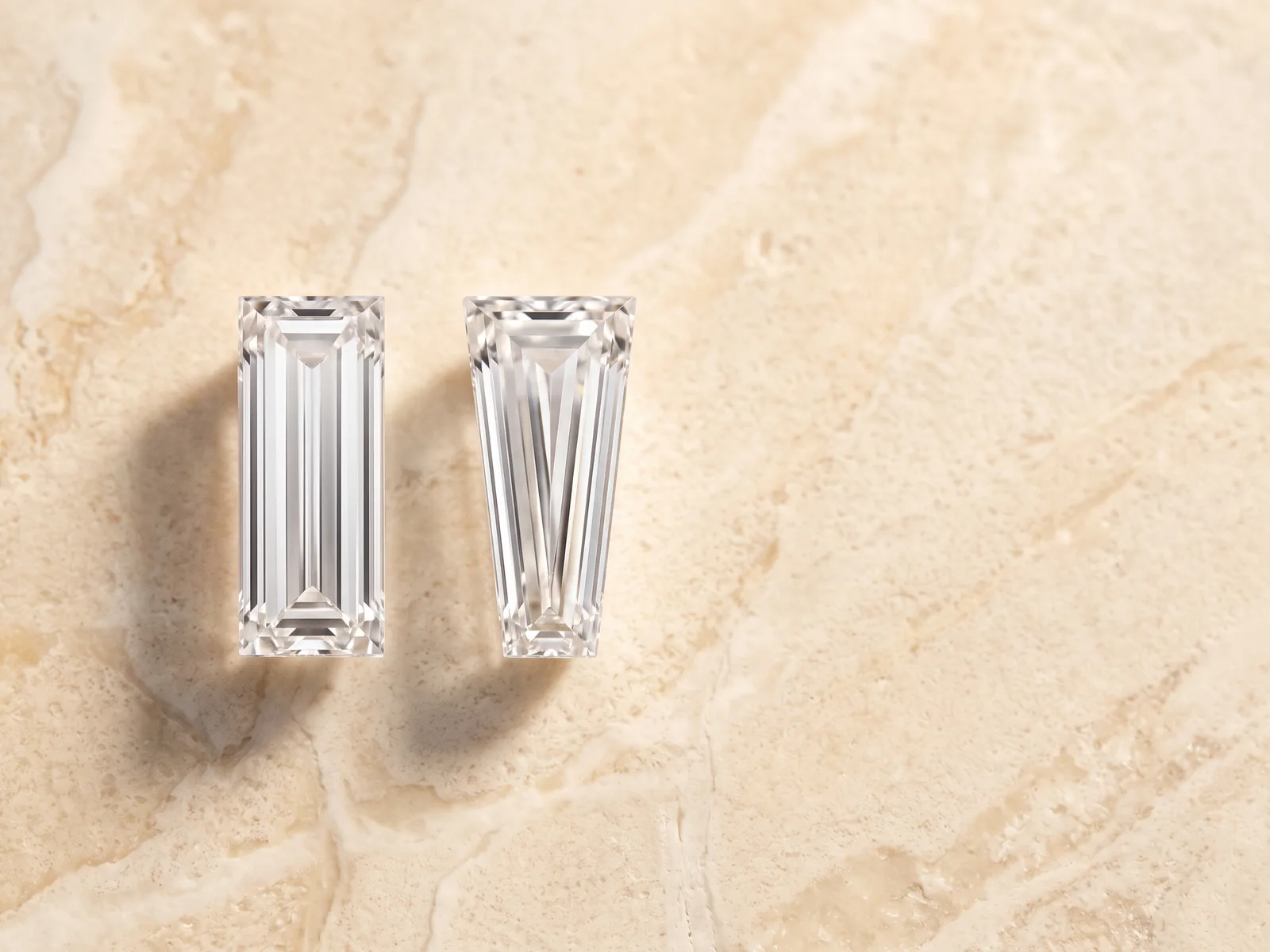
Baguette vs tapered baguette is one of the most common side stone decisions in a ring, and the choice changes how the whole design reads. The difference is often a millimetre or less at one end, but it decides whether a ring looks straight and architectural or flows towards its centre stone.
 Reviewed by Raj Sood, Graduate Gemologist (GIA), AJP (GIA)Master jeweller and Graduate Gemologist (GIA) · reviewed 4 November 2026
Quick answer
A straight baguette is a long rectangle with parallel sides; a tapered baguette narrows towards one end, like a slim trapezoid. Both are step cuts with similar sparkle and face-up size per carat. Straight baguettes suit channel-set bands and emerald cuts; tapered baguettes suit side stones that point towards a round, oval or pear centre.
What is the difference between a baguette vs tapered baguette?
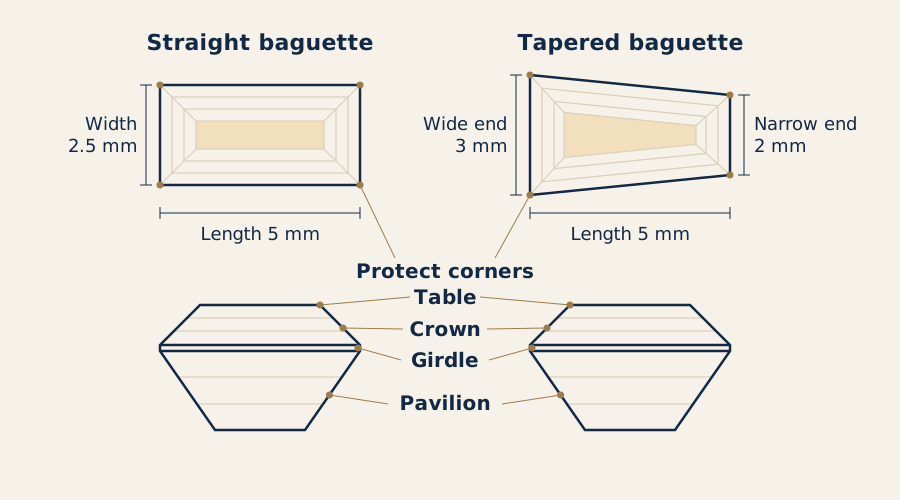
A baguette is a small, long, rectangular diamond with straight parallel sides and square corners. The name is French for a long loaf of bread. A tapered baguette has the same long, step-cut look, but its two long sides angle inwards so one end is narrower than the other. Seen from above, it is a slim trapezoid (a four-sided shape with only two parallel sides). Our main guide to baguette cut diamonds covers the straight version in full; this page puts the two side by side.
Both are almost always used as accents rather than centre stones. You will see them either side of a centre diamond, lined up in a band, or framing a larger stone in a pendant or earrings. They belong to a wider group of shapes cut mainly to sit beside other stones, set out in our guide to trapezoid, half moon, bullet and other side stone cuts.
| Straight baguette | Tapered baguette | |
|---|---|---|
| Outline | Rectangle, parallel sides | Trapezoid, one end narrower |
| Facet style | Step cut, about 14 facets | Step cut, about 14 facets |
| Typical sizes | 3 × 1.5 mm to 6 × 3 mm | 4 × 2 × 1.5 mm to 6 × 3 × 2 mm |
| Look on the hand | Straight lines, geometric, Art Deco | Flows towards the centre stone |
| Sparkle | Broad flashes, mirror-like | Broad flashes, mirror-like |
| Matching | Can be matched in rows | Must be cut and matched in mirror pairs |
| Usual use | Channel bands, emerald and Asscher three-stones | Side stones beside round, oval, pear, heart |
| Price per carat | Lower | Usually a little higher |
Sizes for tapered baguettes are usually written as three numbers: length, wide end and narrow end. A 5 × 3 × 2 mm tapered baguette is 5 mm long, 3 mm across at the wide end and 2 mm at the narrow end. If any of these terms are new, our plain-English jewellery glossary explains them.
How are baguettes cut, and why do they sparkle differently?
Both baguette styles are step cuts. Instead of the many small triangular facets of a round brilliant, a step cut has a large flat table (the top facet) surrounded by long, narrow facets that run parallel to the edges like the steps of a staircase. A typical baguette has about 14 facets in total: the table, a row of steps on the crown (the top part) and a couple more rows on the pavilion (the bottom part). Our page on emerald, Asscher, baguette, carré and other step cuts shows the whole family.
Diamond has a refractive index of about 2.42, which bends light strongly. In a brilliant cut, that light is broken into lots of small, quick sparkles. In a step cut, the long facets return light as fewer, broader flashes, often described as a hall-of-mirrors effect: bright and dark panels that switch on and off as the ring moves. It is a cooler, calmer look. For the full explanation of the two faceting systems, see how step cuts and brilliant cuts handle light.
In sparkle, straight and tapered baguettes behave almost the same. The one difference is that the steps of a tapered baguette also converge towards the narrow end, so the flashes can look slightly more concentrated there. If the cutter has not kept the steps even, you may notice the narrow end looking darker or glassier than the wide end, which is worth checking on a video.
The baguette took off in the 1920s and 1930s, when Art Deco jewellery favoured straight lines and geometric settings. It was a sharp break from the softer, older looks such as the domed rose cut and the chunky early brilliants described in our comparison of the round brilliant and the Old European cut.
How do straight and tapered baguettes look on the hand?
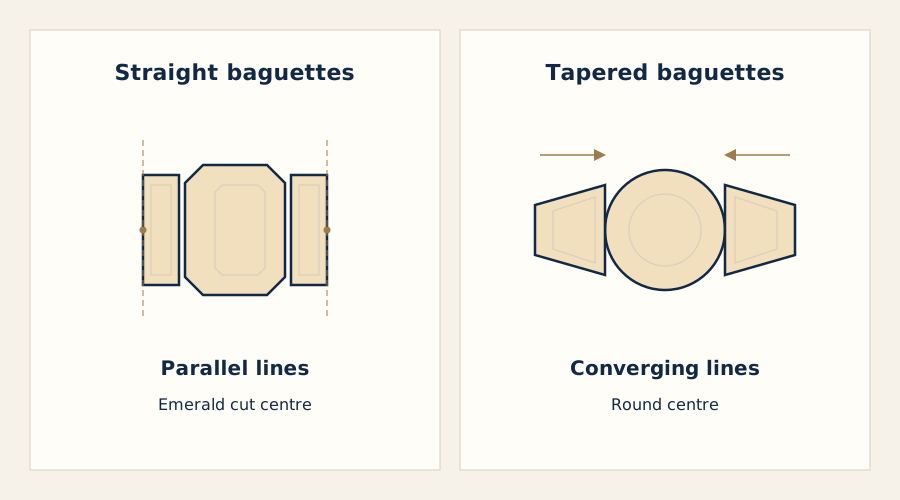
This is where the two really differ. Straight baguettes make parallel lines. Lined up in a channel-set band, they read as one continuous strip of light. Set either side of an emerald cut or Asscher, they continue the stone's straight edges, so the whole ring looks like a single geometric design.
Tapered baguettes make converging lines. Set with the wide end against the centre stone and the narrow end pointing away, they act like arrows that lead the eye back to the middle. That shape also softens the step from a large centre stone to a thin band, which is why tapered baguette side stones are a classic pairing with bands that narrow towards the shoulders.
- Straight baguettes look: architectural, crisp, a little vintage, and wider across the finger because the stones do not narrow.
- Tapered baguettes look: graceful and focused, drawing attention to the centre stone rather than spreading it sideways.
- On shorter fingers: tapered baguettes keep the ring from looking too broad; straight baguettes can make a three-stone feel wide.
- On long fingers: either works, and straight baguettes can add welcome width.
Hand shape is a personal call rather than a rule, but our guide to diamond shapes for small hands and long fingers goes through how outline and proportion change the look on different hands.
Which looks bigger per carat: baguette or tapered baguette?
For the same length and the same average width, the two face up at very nearly the same size. A 5 × 3 × 2 mm tapered baguette has an average width of 2.5 mm, so it covers roughly the same area as a 5 × 2.5 mm straight baguette and weighs about the same. What changes the face-up size most is the depth: a deep, chunky baguette hides weight underneath, while a shallower one spreads it across the top.
| Size (length × width) | Approximate weight each | Tapered equivalent |
|---|---|---|
| 3 × 1.5 mm | about 0.03–0.05 ct | 3 × 2 × 1 mm |
| 4 × 2 mm | about 0.08–0.11 ct | 4 × 2.5 × 1.5 mm |
| 5 × 2.5 mm | about 0.15–0.20 ct | 5 × 3 × 2 mm |
| 6 × 3 mm | about 0.25–0.35 ct | 6 × 3.5 × 2.5 mm |
These are typical figures for baguettes cut to a depth of around 60–70% of their width; individual stones vary. Step cuts often face up a little smaller than brilliant-cut fancy shapes of similar outline and weight, because they are usually cut deeper and carry more weight below the girdle (the outer edge). Our comparison of how each diamond shape faces up per carat puts the numbers side by side.
For side stones, the more useful measurement is the size relative to the centre stone. As a rough guide, side baguettes whose wide end is about half the centre stone's width, where they meet, look balanced. For a 1 carat round of about 6.4 mm, a pair of tapered baguettes around 5 × 3 × 2 mm (roughly 0.30 ct the pair) is a common choice.
Not sure which one is right?
Send us the stones you are looking at and our gemologist will tell you which to choose and why.
What colour and clarity should baguette side stones be?
Step cuts are honest. Their large table and long, open steps work like windows, so inclusions (internal features) and body colour are easier to see than in a brilliant of the same grade. Our guide to which diamond shapes hide colour and inclusions explains why brilliants are more forgiving.
- Clarity: aim for VS2 or better so the stones look clean in their long windows. Small SI stones can work if each one is checked individually.
- Colour: match the centre stone, or sit no more than one or two grades below it. A G centre with G–H baguettes looks even; an I baguette beside a D–E centre can look slightly warm.
- Consistency: matching colour and clarity across all the side stones matters more than chasing a top grade, because the eye compares stones that sit next to each other.
Very small baguettes, under about 0.15 ct each, are often sold in matched parcels without individual grading reports, and the grades are given as a range such as G–H, VS. Larger side stones and pairs above that size may come with a report from GIA or IGI. Either way, ask what the colour and clarity range is and whether the stones are natural or lab-grown.
Are baguette diamonds durable enough for everyday wear?
Diamond is 10 on the Mohs hardness scale, so it resists scratching better than anything else you will wear. Hardness is not the same as toughness, though. Diamond can chip along its cleavage planes if a thin edge takes a sharp knock, and both baguette styles have exposed corners.
- Straight baguettes have four square corners. Square corners are the weak spot of any step cut, so they need to be covered by metal.
- Tapered baguettes have the same corners plus a narrow end, which is the thinnest part of the stone. Small tapered baguettes, around 1–1.5 mm at the narrow end, are the most delicate.
- Channel settings, where the stones sit between two walls of metal, cover the long edges and corners and suit everyday wear.
- Claw settings need a claw on each corner, or V-claws at the ends, and are more exposed on a hand that works hard.
In practice, both styles are fine for daily wear when the corners are protected. Have the setting checked about once a year, especially on rings worn for sport, gardening or manual work.
Which centre stones and settings suit each style?
Match the side stone to the lines of the centre stone. Straight edges like straight baguettes; curves and points like tapered ones.
| Centre stone | Straight baguettes | Tapered baguettes |
|---|---|---|
| Emerald cut | Very natural match | Works, slightly softer look |
| Asscher or princess | Natural match | Works |
| Round brilliant | Can look wide | Classic three-stone pairing |
| Oval | Works | Natural match |
| Pear or heart | Less common | Natural match, follows the outline |
| Marquise or moval | Less common | Works well along the length |
Elongated centre stones with curved sides, like those compared in our marquise vs moval comparison, usually sit more comfortably beside tapered baguettes, because the narrowing stones echo the stone's own taper. For geometric designs, there are other step-cut side stones too, such as the six-sided calf's head cut, and the shape family overview in our guide to every diamond shape shows how they fit together.
Related guideTrilliant vs Pear Side StonesIf you prefer a softer, more sparkly side stone, brilliant-cut options are compared in trilliant and pear side stones, point by point. A trilliant gives more scintillation than any baguette, but loses the clean step-cut lines.
Baguette vs tapered baguette: which costs more?
Tapered baguettes usually cost a little more per carat than straight baguettes of the same grade. More of the rough crystal is cut away to form the taper, and pairs have to be matched in outline, colour and clarity, which takes time. Straight baguettes are easier to cut in calibrated sizes and to match in long rows for bands.
| Example (G–H, VS) | Natural (approx. AUD) | Lab-grown (approx. AUD) |
|---|---|---|
| Pair of straight baguettes, about 0.30 ct total | about $600–$1,500 | about $150–$450 |
| Pair of tapered baguettes, about 0.30 ct total | about $700–$1,800 | about $180–$550 |
| Channel band, about 0.50 ct of straight baguettes (stones only) | about $1,000–$2,500 | about $250–$700 |
These are broad ranges only, for the stones alone, not the setting or labour. Prices move with the market and with the exact grades. Lab-grown baguette diamonds are real diamond, grown in a laboratory rather than mined, with the same hardness and refractive index; they cost much less than natural stones. Natural baguettes are mined and rarer. Both should be disclosed clearly, and if your centre stone is natural you may want natural side stones to match, though mixing is a personal choice. For price patterns across all shapes, see the price differences between diamond shapes.
Browse baguette diamonds: natural and lab-grown
How do you choose between straight and tapered baguettes? Step by step
- Start with the centre stone. Straight edges (emerald, Asscher, princess) lean towards straight baguettes; curves and points (round, oval, pear, heart) lean towards tapered.
- Decide on the look. Straight for geometric and Art Deco; tapered for a ring that flows towards the centre.
- Check the proportions. Side stones whose wide end is about half the centre stone's width where they meet usually look balanced.
- Match colour and clarity. VS2 or better, and within one or two colour grades of the centre stone.
- Check the pair. For tapered baguettes, confirm both stones have the same length, wide end and narrow end in millimetres.
- Plan the setting. Make sure every corner, and the narrow end of a tapered baguette, is covered by a channel, bezel or claw.
- Confirm natural or lab-grown. Ask for the origin and grade range of every stone in writing.
Free consultation
Talk to a gemologist
Compare stones in person or online with Raj Sood, Graduate Gemologist (GIA), AJP (GIA).
Book a consultationFAQ
Common questions
What is the difference between a baguette and a tapered baguette?
A straight baguette is a rectangle with parallel sides. A tapered baguette narrows towards one end, forming a slim trapezoid. Both are step cuts with about 14 facets.
Do tapered baguettes sparkle more than straight baguettes?
No, their sparkle is almost identical. Both give broad, mirror-like flashes rather than the small, busy sparkle of a brilliant cut.
Are tapered baguettes more expensive?
Usually a little, per carat. More rough is cut away to form the taper, and pairs must be matched closely in size, colour and clarity.
What size tapered baguettes suit a 1 carat round?
A pair around 5 × 3 × 2 mm, roughly 0.30 carat together, is a common choice. The right size depends on the centre stone's width and the band.
Are baguette diamonds durable?
Yes, if the corners are protected. Diamond is 10 on the Mohs scale, but square corners and the narrow end of a tapered baguette can chip, so channel or bezel settings are popular.
Can you get lab-grown baguette diamonds?
Yes. Lab-grown baguettes are real diamond, widely available in both straight and tapered styles, and cost much less than natural baguettes.

Ask a gemologist
Not sure which diamond to choose?
Raj Sood is a Graduate Gemologist (GIA) and master jeweller. Bring the stones you are considering, or send the reports, and he will tell you honestly which one is better and why.
Keep learning
Related guides
 Diamond ShapesBaguette Cut Diamonds
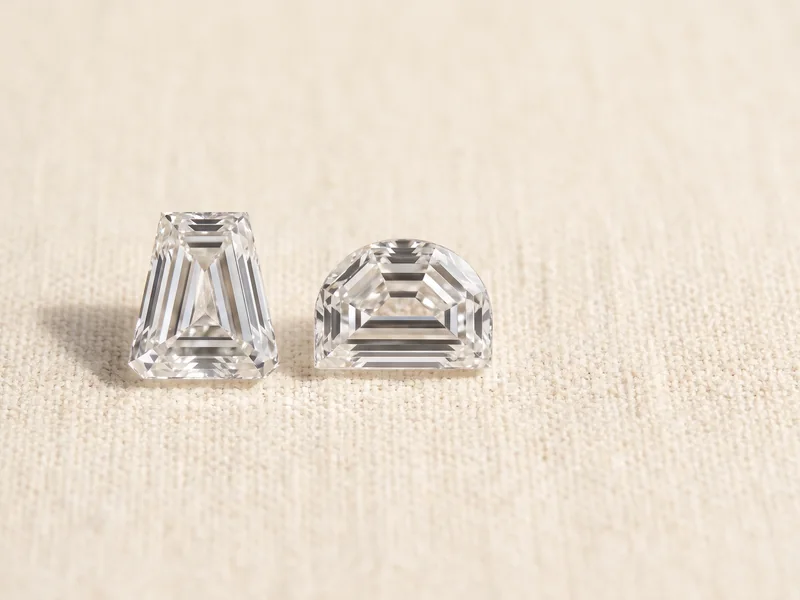 Diamond ShapesSide Stone Diamond Cuts: Trapezoid, Half Moon, Bullet, Baguette, TrilliantDiamond ShapesStep Cut Diamonds: Emerald, Asscher, Baguette, Carré and More
 Engagement Rings & SettingsTapered BandsDiamond ShapesUnderstanding Diamond Shapes
 Diamond ShapesDiamond Shapes That Hide Colour and Inclusions
 Diamond ShapesStep Cuts vs Brilliant Cuts Explained
 Diamond ShapesWhich Diamond Shape Looks Biggest per Carat
Explore more
More guides on this topic
Education