
- Education
- Lab-Grown Diamonds
- Lab-Grown Diamond Earrings and Tennis Bracelets: A Practical Guide
Lab-Grown Diamonds
Lab-Grown Diamond Earrings and Tennis Bracelets: A Practical Guide
Lab-grown diamond earrings and tennis bracelets are where laboratory-grown stones make the most sense, because these pieces need several diamonds that look alike. Here is what to check, from matching a pair of studs to reading the report and the wording a jeweller should use.
 Reviewed by Raj Sood, Graduate Gemologist (GIA), AJP (GIA)Master jeweller and Graduate Gemologist (GIA) · reviewed 4 November 2026
Quick answer
Lab-grown diamond earrings and tennis bracelets use real diamond grown in a laboratory, so they look and wear the same as natural but cost much less. For studs, match two stones within one colour grade and about 0.1 mm in diameter. For a bracelet, check total carat weight, stone quality range, setting type and a secure double-locking clasp.
What are lab-grown diamond earrings and tennis bracelets?
Lab-grown diamond earrings and tennis bracelets are set with diamonds grown in a laboratory rather than mined. The stones are pure carbon crystallised in the same cubic structure as natural diamond, with the same hardness (10 on the Mohs scale), the same refractive index (about 2.42, which controls how strongly light bends and sparkles) and the same density (about 3.52). Standard thermal diamond testers read them as diamond. Our explainer on whether lab-grown diamonds are real diamonds covers the science in full.
There are two growth methods. CVD (chemical vapour deposition) builds diamond layer by layer from a carbon-rich gas onto a thin diamond seed plate. HPHT (high pressure, high temperature) recreates the crushing heat and pressure deep in the earth inside a large press. Both produce real diamond; they can leave slightly different clues that a laboratory uses to identify the stone. See how CVD and HPHT diamonds are grown for the step-by-step process.
Earrings and bracelets are a special case. A solitaire ring has one centre stone to judge. A pair of studs needs two stones that look like twins, and a tennis bracelet (a flexible line of individually set diamonds that runs all the way around the wrist) can hold about 35 to 90 stones that should all look the same. That is where lab-grown production, which can turn out many similar stones, changes the buying decision. For the wider picture, start with our complete introduction to lab-grown diamonds, and look up any unfamiliar word in the GemTrove jewellery glossary.
Is lab-grown a good choice for earrings and bracelets?
For multi-stone pieces, the price gap between natural and lab-grown multiplies. A natural matched pair costs more than two single stones, because the cutter or dealer has to hunt for a twin. A natural tennis bracelet needs dozens of stones of consistent colour and clarity, which takes time to gather. Lab-grown stones are produced in quantity, so matching is easier and the cost per carat is much lower. Our page on the factors behind lab-grown diamond prices explains why prices have fallen over recent years.
| Lab-grown | Natural | |
|---|---|---|
| What it is | Real diamond grown in a laboratory | Real diamond formed in the earth over millions of years |
| Hardness and sparkle | Mohs 10, RI about 2.42 | Mohs 10, RI about 2.42 |
| Matching a pair | Easier; similar stones are more available | Harder; matched pairs carry a premium |
| Tennis bracelet cost | Much lower, even at 5 ctw and up | Rises steeply with total carat weight |
| Reports on small stones | Small bracelet stones are rarely graded individually | Same; usually a range for the whole piece |
| Resale | Low and uncertain | Usually well below what you paid at retail |
| Rarity | Not rare; supply keeps growing | Finite supply |
Neither type should be bought as a financial asset. Lab-grown prices have dropped and resale is limited. Natural diamonds keep more of their value but usually sell back for well below retail too. Buy the one you will enjoy wearing. Our side-by-side page on how lab-grown and natural diamonds differ goes further into origin, grading and value.
What size lab-grown diamond earrings should you choose?
Stud earrings are usually sold by total carat weight (ctw), meaning the combined weight of both stones. A "1 carat" pair is two stones of about 0.50 ct each, not two 1 ct stones. Always ask for the weight and millimetre size of each stone.
| Pair (ctw) | Each stone | Approximate diameter of each round |
|---|---|---|
| 0.50 ctw | 0.25 ct | about 4.1 mm |
| 1.00 ctw | 0.50 ct | about 5.1 mm |
| 1.50 ctw | 0.75 ct | about 5.8 mm |
| 2.00 ctw | 1.00 ct | about 6.4 mm |
| 3.00 ctw | 1.50 ct | about 7.3 mm |
| 4.00 ctw | 2.00 ct | about 8.1 mm |
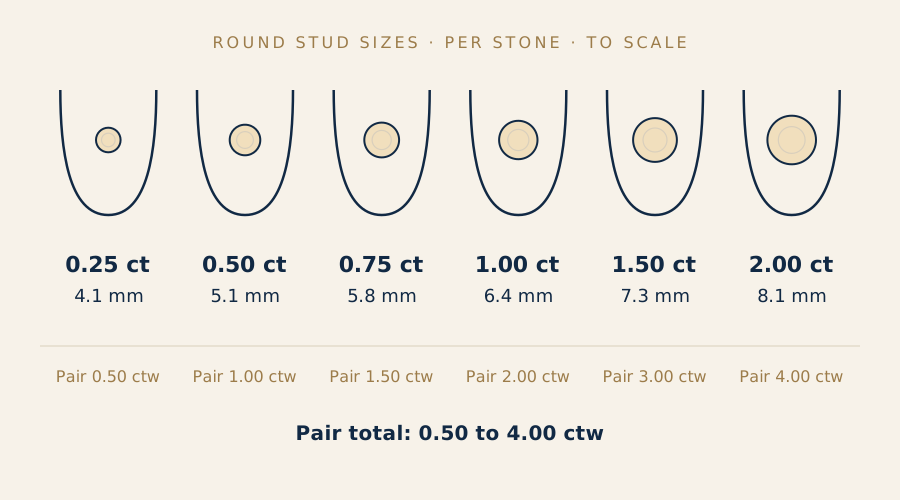
These diameters assume a well-proportioned round brilliant. A stone cut too deep carries extra weight underneath and looks smaller from the front, which matters more in earrings because people see them face-on. Our notes on judging cut quality in lab-grown stones explain why some lab-grown diamonds are cut for weight rather than light return.
Lab-grown has made very large studs affordable, and pairs of 1.5 ct or 2 ct each are now common requests. At that size the same checks as a big solitaire apply, so our guide to choosing a 3 carat lab-grown stone is worth reading. Practically, studs over about 1 ct each are heavier on the lobe, so screw backs or a larger friction back help keep them upright and secure.
- Four-claw basket: the classic stud; shows the most diamond and lets light in.
- Three-claw martini: a cone-shaped setting that sits the stone closer to the lobe.
- Bezel: a rim of metal around the edge; very secure, a little less sparkle, suits active wear.
- Halo: small stones around the centre make a modest stud look larger.
How do you match two lab-grown diamonds for earrings?
A matched pair is two stones that look the same at normal viewing distance. Because earrings sit about 15 cm apart, slight differences in colour are hard to see, but differences in size and brightness are easy to notice in photos and in the mirror. Check these points:
- Diameter: within about 0.1 mm of each other. This matters more than identical carat weight.
- Colour: the same grade, or no more than one grade apart (for example G and H).
- Clarity: both eye-clean (no inclusions visible without magnification); the exact grades can differ.
- Cut: the same cut grade, with similar depth and table percentages so they face up at the same brightness.
- Fluorescence: the same or similar, so they look alike under sunlight or UV-rich lighting.
- Growth method: ideally the same. CVD and HPHT stones can carry slightly different tints, such as a faint brown or a faint blue-grey.
Our step-by-step guide to pairing lab-grown stones for studs includes example report numbers side by side. Fluorescence is worth a second look, because some lab-grown stones glow under UV or show a brief afterglow; see how fluorescence shows up in lab-grown diamonds.
Not sure which one is right?
Send us the stones you are looking at and our gemologist will tell you which to choose and why.
What should you check in a lab-grown diamond tennis bracelet?
A tennis bracelet's total carat weight comes from the size of each stone multiplied by how many fit around the wrist. A common length for women's bracelets is about 17–18 cm, though the right length is your wrist measurement plus about 1–1.5 cm so it moves without sliding over the hand.
| Each stone (round) | Approximate weight each | Stones in an 18 cm bracelet | Approximate total |
|---|---|---|---|
| 1.7 mm | 0.02 ct | about 75–85 | about 1.5–1.7 ctw |
| 2.0 mm | 0.03 ct | about 65–72 | about 2–2.2 ctw |
| 2.5 mm | 0.06 ct | about 55–60 | about 3.3–3.6 ctw |
| 3.0 mm | 0.10 ct | about 48–52 | about 5 ctw |
| 4.0 mm | 0.25 ct | about 36–40 | about 9–10 ctw |
Counts vary with the link design, claw thickness and spacing, so treat these as a guide. Stones under about 0.20 ct are usually called melee (small diamonds used in groups). With lab-grown, larger 3–4 mm stones become affordable, which gives a bolder line of sparkle.
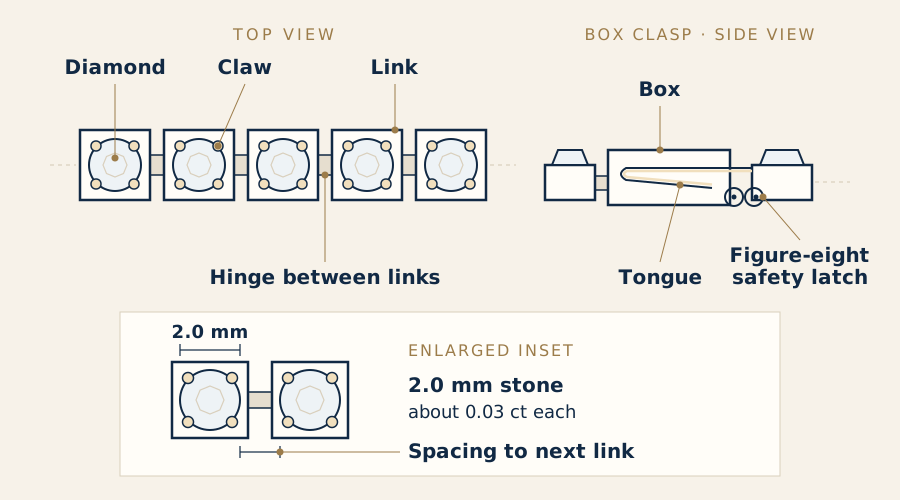
- Setting style: four-claw links show the most diamond; three-claw and bezel links are smoother against clothing; channel settings hold stones between two rails.
- Flex: lay it flat and curl it gently. Every link should move freely, with no stiff spots or gaps.
- Consistency: look along the full length under daylight. No stone should look noticeably greyer, yellower or duller than its neighbours.
- Clasp: a box clasp (a tongue that clicks into a box) plus at least one safety latch, such as a figure-eight catch on the side.
- Metal weight: a bracelet holds a lot of metal, often around 8–20 g, so the metal choice affects price almost as much as the diamonds.
What should a lab-grown diamond report say?
For studs, each stone (or the pair) should come with a report from an independent laboratory such as IGI or GIA. A lab-grown report should state clearly that the diamond is laboratory-grown, and usually notes the growth method (CVD or HPHT) and whether the stone was treated after growth to improve its colour. Many lab-grown stones are also laser inscribed on the girdle (the thin outer edge) with the report number and a lab-grown marker, which you can read under a loupe.
- Origin wording: "Laboratory-Grown Diamond" or similar, front and centre.
- Growth method: CVD or HPHT, where the lab states it.
- Post-growth treatment: for example a note that colour was improved after growth.
- Measurements: the millimetre diameter and depth, which you need for matching.
- Grades: colour, clarity and, for rounds, a cut grade on IGI reports. GIA has moved lab-grown reports to a simpler descriptive quality system, so check the current version.
Tennis bracelets work differently. The small stones are almost never graded one by one, so expect a single document or invoice that states the total carat weight, the colour and clarity range (for example F–G, VS) and that all stones are lab-grown. Ask how the stones were screened. Testers that check heat or electrical conductivity confirm diamond but cannot tell lab-grown from natural; that needs specialist screening equipment, as explained in what diamond testers can and cannot tell you. Our list of questions worth asking a jeweller before you buy includes the report and screening questions to raise.
What wording must Australian jewellers use for lab-grown diamonds?
Australia does not have a diamond-specific naming law. Instead, the Australian Consumer Law bans misleading or deceptive conduct and false or misleading claims about goods, and the ACCC (Australian Competition and Consumer Commission) enforces it. In practice, a lab-grown diamond must be described so a buyer cannot mistake it for a natural one: on the tag, in the listing, on the invoice and in conversation.
| Clear wording | Wording that can mislead |
|---|---|
| Lab-grown diamond / laboratory-grown diamond | "Diamond" with no qualifier, for a lab-grown stone |
| Laboratory-created diamond | Vague brand names that hide the origin |
| Lab-grown diamond tennis bracelet, 3 ctw | "Real diamond bracelet" with no mention of lab-grown |
| Lab-created moissanite / cubic zirconia (simulants) | Calling a simulant a "diamond" of any kind |
| Specific, checkable facts about origin | Unsupported "eco" or "sustainable" claims |
It is accurate to call a lab-grown diamond a real diamond, as long as the lab-grown origin is stated alongside. What is not accurate is to call it "fake", or to suggest a natural diamond is an investment. The ACCC has also published guidance on environmental claims, so broad green claims about any diamond need evidence.
Diamond simulants are a different thing altogether: they only imitate diamond. Moissanite (silicon carbide, Mohs 9.25, RI about 2.65) shows more rainbow fire, and cubic zirconia (Mohs about 8–8.5, RI about 2.15) scratches and clouds over time. Compare them in lab-grown diamond against moissanite and lab-grown diamonds compared with cubic zirconia.
How much do lab-grown diamond earrings and tennis bracelets cost?
Prices depend on total carat weight, colour, clarity, cut, the metal and how much metal the piece uses. The ranges below are broad guides for well-made pieces in Australia, with lab-grown stones around F–H colour and VS–SI clarity.
| Piece | Lab-grown (approx. AUD) | Natural, similar grades (approx. AUD) |
|---|---|---|
| Studs, 0.50 ctw, 18ct gold | about $400–$1,000 | about $1,200–$3,000 |
| Studs, 1.00 ctw, 18ct gold | about $700–$1,800 | about $3,000–$7,000 |
| Studs, 2.00 ctw, 18ct gold | about $1,500–$3,500 | about $9,000–$20,000 |
| Tennis bracelet, 2 ctw, 18ct gold | about $2,500–$6,000 | about $5,000–$12,000 |
| Tennis bracelet, 5 ctw, 18ct gold | about $4,000–$9,000 | about $12,000–$30,000 |
Two things often surprise people. First, in a lab-grown tennis bracelet the gold can make up a large share of the price, so the same diamonds cost noticeably more in 18ct than in 9ct or 14ct. Second, lab-grown prices have been falling, so a quote from last year may already be out of date. Whether you shop on screen or at a counter, our page on online versus showroom buying for lab-grown sets out what each does well, especially for checking a pair side by side.
Earrings are easy to lose and bracelets can snag, so think about cover. Our guide on insuring lab-grown jewellery explains why the insured value should match the replacement cost rather than the original price.
Browse lab-grown diamonds for earrings and bracelets
Do lab-grown earrings and tennis bracelets need special care?
The diamonds need exactly the same care as natural diamonds: warm water, a drop of mild detergent and a soft brush. The settings are what need attention. Stud claws and earring backs loosen over time; tennis bracelet hinges, claws and clasps wear with every movement of the wrist.
- Check stud backs every few weeks and replace any that slide on too easily.
- Take a tennis bracelet off for gym sessions, gardening and sport, where claws can catch.
- Listen for a rattle: a loose stone in a bracelet link often clicks before it falls out.
- Have the clasp and claws checked by a jeweller about once a year.
- Store each piece separately; diamond scratches other diamonds and softer gems.
More detail on cleaning, ultrasonic cleaners and storage is in caring for lab-grown diamond jewellery.
How do you choose lab-grown earrings or a tennis bracelet? Step by step
- Set the size. For studs, pick a millimetre diameter from the size table; for a bracelet, pick a stone size and length that suit your wrist.
- Confirm the wording. The tag, listing and invoice should say lab-grown or laboratory-grown diamond.
- Read the reports. For studs, check each stone's colour, clarity, cut, measurements and growth method; for bracelets, get the colour and clarity range and total carat weight in writing.
- Check the match. Studs within about 0.1 mm and one colour grade; bracelet stones even along the full length in daylight.
- Test the hardware. Secure earring backs; a bracelet that flexes smoothly, with a box clasp and safety latch.
- Choose the metal. Weigh up 9ct, 14ct, 18ct gold or platinum, remembering that bracelet metal weight affects price.
- Plan for the long term. Arrange insurance at replacement value and book a yearly check of claws and clasp.
Free consultation
Talk to a gemologist
Compare stones in person or online with Raj Sood, Graduate Gemologist (GIA), AJP (GIA).
Book a consultationShop this shape
FAQ
Common questions
Are lab-grown diamond earrings real diamonds?
Yes. Lab-grown diamonds are real diamond, with the same hardness, refractive index and chemistry as natural. The only difference is that they were grown in a laboratory, and they must always be sold as lab-grown.
What does 1 carat total weight mean for stud earrings?
It is the combined weight of both stones, so a 1 ctw pair is two stones of about 0.50 ct each, roughly 5.1 mm across. Always ask for the weight and diameter of each stone.
How many diamonds are in a tennis bracelet?
Usually between about 35 and 90, depending on stone size and length. An 18 cm bracelet of 2 mm stones holds roughly 65–72 diamonds, while 4 mm stones bring it down to about 36–40.
Do lab-grown tennis bracelets come with a grading report?
Rarely for each stone, because the stones are small. Expect a document stating the total carat weight, the colour and clarity range and that all stones are lab-grown.
Can you tell lab-grown and natural diamond earrings apart by eye?
No. Even trained gemmologists need specialist laboratory equipment to confirm whether a diamond is lab-grown or natural.
Is a lab-grown tennis bracelet worth it?
For many people, yes, because a bracelet needs dozens of matched stones and lab-grown costs much less than natural at the same total weight. Bear in mind that resale value for lab-grown is low, so buy it to wear, not as a store of value.

Ask a gemologist
Not sure which diamond to choose?
Raj Sood is a Graduate Gemologist (GIA) and master jeweller. Bring the stones you are considering, or send the reports, and he will tell you honestly which one is better and why.
Keep learning
Related guides
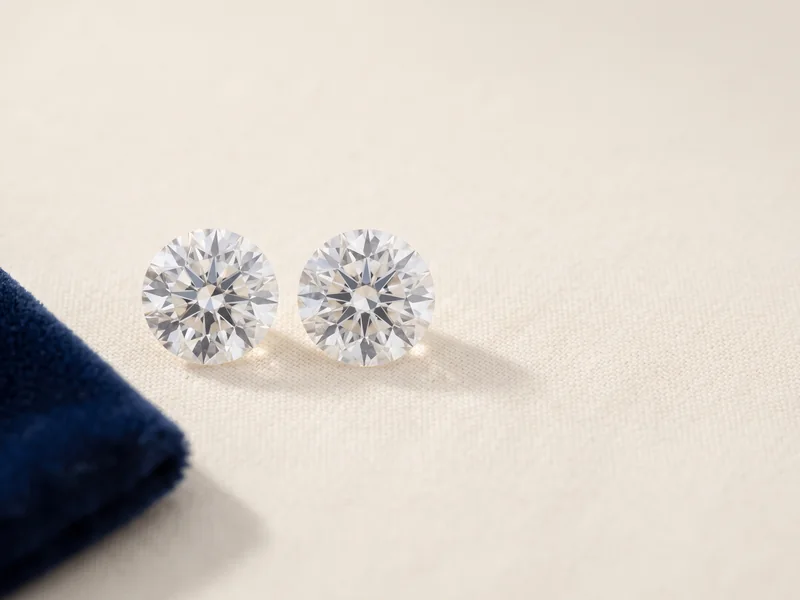
 Lab-Grown DiamondsMatching Two Lab-Grown Diamonds for Earrings
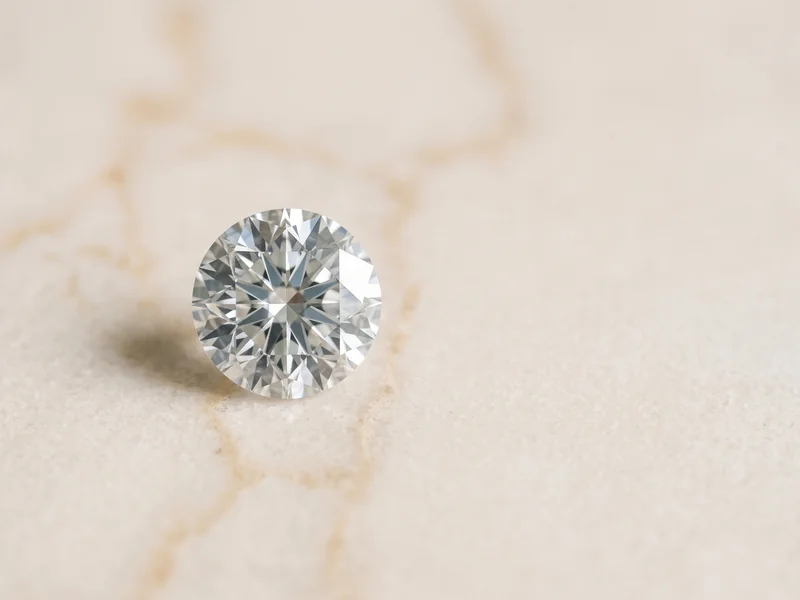
 Lab-Grown DiamondsLab-Grown Diamonds vs Natural Diamonds
 Lab-Grown DiamondsQuestions to Ask a Jeweller Before Buying a Lab-Grown DiamondLab-Grown DiamondsLab-Grown Diamonds Guide
 Lab-Grown DiamondsShould a Lab-Grown Diamond Be Insured?Lab-Grown DiamondsHow Are Lab-Grown Diamonds Manufactured?
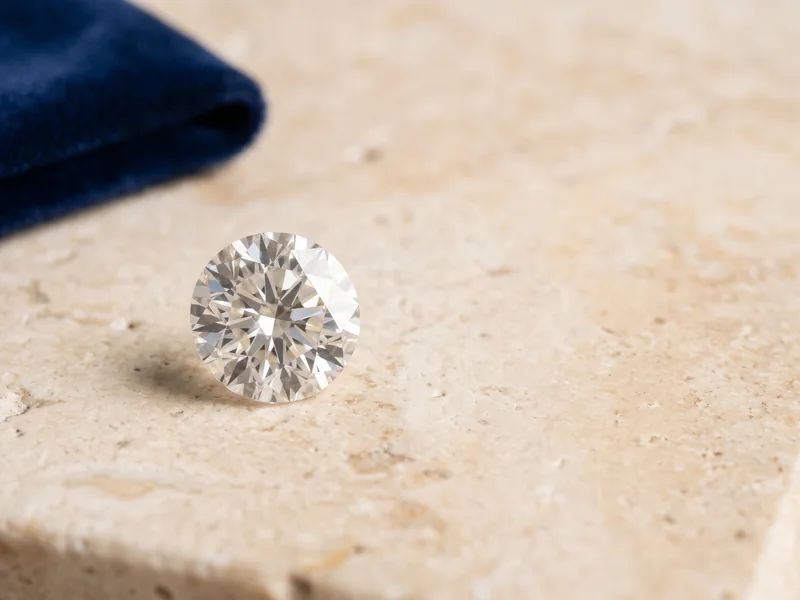 Lab-Grown DiamondsAre Lab-Grown Diamonds Real Diamonds
 Lab-Grown DiamondsLab-Grown Diamond Cut Quality
Explore more
More guides on this topic
Education