
- Education
- Lab-Grown Diamonds
- Matching Lab-Grown Diamonds for Earrings: How to Pair Two Stones
Lab-Grown Diamonds
Matching Lab-Grown Diamonds for Earrings: How to Pair Two Stones
Earrings are the one place two diamonds are seen side by side, so small differences in size, colour and sparkle show. Here is how a gemmologist matches two lab-grown diamonds, with the numbers to check on each report.
 Reviewed by Raj Sood, Graduate Gemologist (GIA), AJP (GIA)Master jeweller and Graduate Gemologist (GIA) · reviewed 4 November 2026
Quick answer
Matching lab-grown diamonds for earrings means pairing two stones that look the same on the ear, not ones with identical certificates. Aim for face-up diameters within about 0.1 mm, colour within one grade, clarity both eye-clean, the same cut grade and similar fluorescence. Check depth and table within about 1–2%, then compare both grading reports.
What does matching lab-grown diamonds for earrings actually mean?
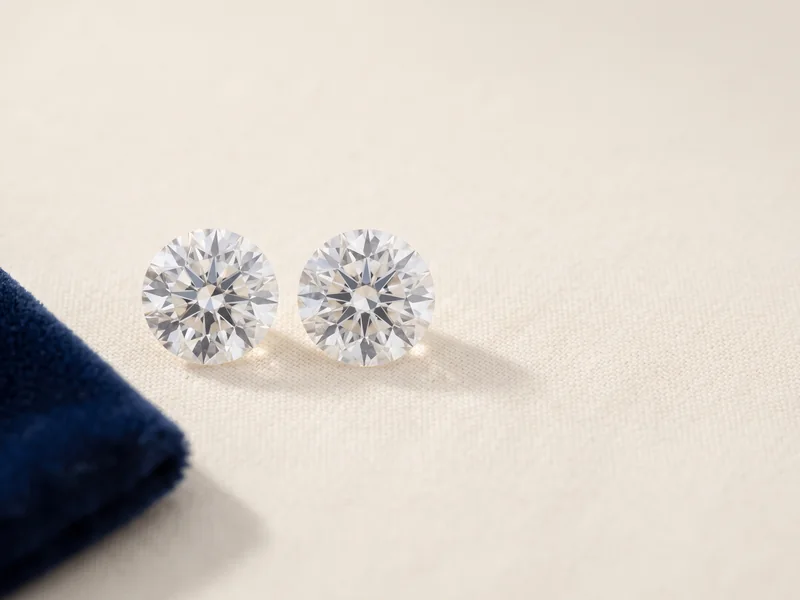
A pair of earrings is the one piece of jewellery where people see both stones at once, a few centimetres apart and usually at the same moment. That is why matching lab-grown diamonds for earrings is a different skill from choosing a single centre stone. The goal is not two identical certificates. It is two diamonds that look the same size, the same colour and the same brightness when they sit either side of the face.
Lab-grown diamonds are real diamond: the same carbon crystal, 10 on the Mohs scale, with a refractive index of about 2.42. They are grown in a laboratory rather than mined. If that is new to you, start with our complete guide to lab-grown diamonds or the plain answer on whether lab-grown diamonds are real diamonds. Because growers produce many stones of similar size and quality, finding a close pair is usually easier with lab-grown than with natural diamonds, where two similar stones may come from different mines and different cutters.
Growth method matters a little for matching. Most lab-grown diamonds are made by CVD (chemical vapour deposition, where carbon builds up layer by layer from a gas) or HPHT (high pressure, high temperature, which recreates conditions deep in the earth). The two methods can leave slightly different body tints and fluorescence, covered below; our article on how CVD and HPHT diamonds are grown explains the process. Any unfamiliar term is defined in the GemTrove jewellery glossary.
How closely should two diamonds match for stud earrings?
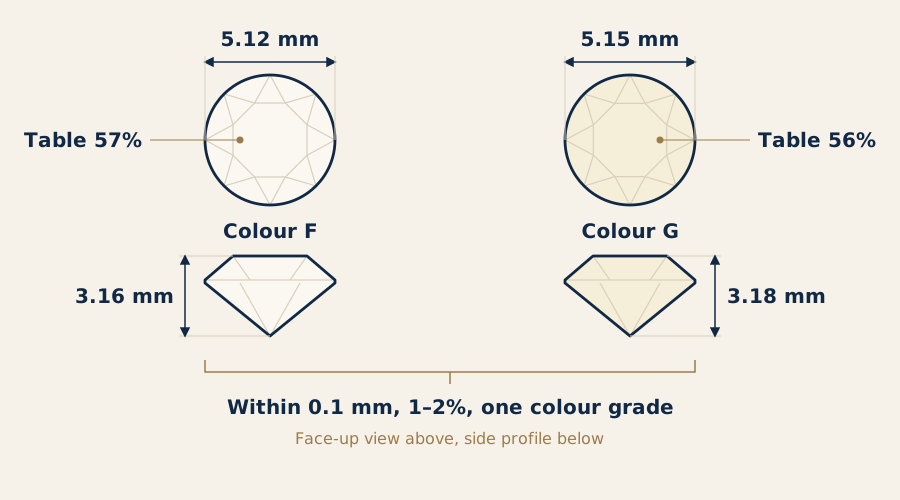
Your eye judges a pair mainly by size and brightness, then by colour. Small differences in clarity are almost invisible on the ear, as long as both stones are eye-clean. These are the tolerances a gemmologist typically works to for a pair of round brilliant studs:
| What to compare | Aim for | Why it matters |
|---|---|---|
| Face-up diameter | Within about 0.05–0.1 mm | Size is the first difference people notice |
| Carat weight | Within about 0.02–0.05 ct | A guide only; diameter matters more than weight |
| Colour | Same grade or one apart (e.g. F and G) | Two grades apart can show as one warmer stone |
| Clarity | Both eye-clean; grades can differ (e.g. VS1 and VS2) | Inclusions are rarely visible at ear distance |
| Cut grade | The same grade on both reports | Cut controls brightness and sparkle |
| Depth % | Within about 1–2% | Different depths spread the weight differently |
| Table % | Within about 1–2% | Changes the balance of brightness and fire |
| Fluorescence | Same strength, ideally None or Faint | Strong fluorescence can look different in sunlight |
| Growth method | Ideally the same (both CVD or both HPHT) | Body tint and fluorescence can differ by method |
Notice that carat weight is not the main target. Two 0.50 ct rounds can measure 5.0 mm and 5.25 mm across if one is cut deep and the other shallow, and a quarter of a millimetre is visible when the stones sit side by side. That is why we match on the millimetre measurements printed on the report (minimum diameter, maximum diameter and depth) rather than on weight. Our page on cut proportions for lab-grown stones shows how depth and table change the face-up size.
Also check that each stone is round in itself. A report gives two diameters, for example 5.12–5.15 × 3.16 mm. A gap of more than about 1% between them means the stone is slightly out of round. That matters less in a single ring than in a pair, where one stone can look a touch oval next to its partner.
What size lab-grown diamond studs should you choose?
Earrings are usually described by total carat weight (ct tw), the weight of both stones added together. A pair described as 1 ct tw is two stones of about 0.50 ct each, not two 1 ct stones. Typical face-up diameters for well-cut round brilliants:
| Total weight (pair) | Each stone | Typical diameter each |
|---|---|---|
| 0.50 ct tw | 0.25 ct | about 4.0–4.1 mm |
| 1.00 ct tw | 0.50 ct | about 5.0–5.2 mm |
| 1.50 ct tw | 0.75 ct | about 5.7–5.9 mm |
| 2.00 ct tw | 1.00 ct | about 6.3–6.5 mm |
| 3.00 ct tw | 1.50 ct | about 7.2–7.4 mm |
| 4.00 ct tw | 2.00 ct | about 7.9–8.2 mm |
For everyday wear, many people settle between 1 and 2 ct tw: noticeable without being heavy on the lobe. Above about 1 ct per stone, weight and the earring back become important (see settings below). Our guide to lab-grown diamonds in studs and tennis bracelets looks at sizes for other styles too, including drops, hoops and halos.
Size also changes how strict the match needs to be. At 4 mm, a 0.1 mm difference is very hard to see. At 7–8 mm the same difference is still small, but colour and brightness differences become easier to spot because there is simply more diamond to look at.
Do colour and fluorescence need to match exactly in a pair?
Colour is graded on the D-to-Z scale, where D is completely colourless and each letter further down shows a little more warmth. Most lab-grown studs are sold in the D–H range, because colourless lab-grown stones are readily available. Within one grade, two stones are practically indistinguishable on the ear. Two grades apart, say E and G, one can look slightly warmer when you see them together on a white card, although in the ear the difference is small. Three grades apart is usually a visible mismatch. Our page on how lab-grown colour grades work explains the scale in more detail.
Lab-grown diamonds can also carry a faint tint that a letter grade does not fully describe. CVD stones can show a very slight brown or grey cast (often reduced by treatment after growth), while some HPHT stones lean very slightly blue or grey. Two G-colour stones from different methods may therefore not look exactly alike. Looking at both stones together, face-down on a white grading tray and then face-up, is the only reliable check.
Fluorescence is a glow some diamonds give off under ultraviolet light, including the UV in sunlight. In natural diamonds it is usually blue; in lab-grown diamonds it can be blue, green, orange or other colours depending on the growth method, and some HPHT stones also show phosphorescence, a glow that lingers after the UV is switched off. Indoors it rarely shows. Outdoors, a pair where one stone has strong fluorescence and the other none can look different. Read about fluorescence in laboratory-grown diamonds for the detail.
- Safest match: both None or both Faint.
- Usually fine: Faint paired with None, at the same or neighbouring colour grades.
- Avoid pairing: Strong or Very Strong with None, especially for earrings you will wear outdoors.
Not sure which one is right?
Send us the stones you are looking at and our gemologist will tell you which to choose and why.
Why is cut the most important thing to match in a pair?
Cut decides how much light a diamond returns to your eye. In a pair, a difference in cut shows as one stone looking brighter or livelier than the other, and that is far more noticeable than a clarity grade. For round brilliants, labs such as IGI and GIA give a cut grade (Ideal, Excellent, Very Good, Good and so on). Pick two stones with the same cut grade, then compare the proportions: a depth of about 59–62.5% and a table of about 54–58% is a common range for an Excellent or Ideal round. Our article explaining what separates an Excellent cut from a Very Good goes through the angles behind those grades.
Polish and symmetry count too. Two stones that both read Excellent for cut, polish and symmetry (often called triple excellent, or 3EX) are the easiest to pair. If the reports list crown and pavilion angles, stones within about half a degree of each other tend to show a similar sparkle pattern.
For clarity, the test is simply whether each stone is eye-clean, meaning you cannot see inclusions (internal features) without magnification. At ear distance, VS2 and many SI1 stones look clean, and a pair can be VS1 and VS2 without anyone ever knowing. The exception is a dark inclusion under the table of a larger stone: at 1 ct per stone and above, look at photos of both stones rather than relying on the grade alone.
Related guideLab-Grown Diamonds for Earrings and Tennis BraceletsWhat should you check on the two grading reports?
Ask for an independent grading report for each stone. Most lab-grown diamonds sold in Australia are graded by IGI (International Gemological Institute); some carry GIA reports, which for lab-grown diamonds have moved to a simpler, more descriptive format. Ideally both stones in a pair are graded by the same laboratory, because grading practice varies slightly between labs and a G from one lab may not be quite the same as a G from another. Some labs also issue a single matched pair report covering both stones.
- Report number and laser inscription: most lab-grown diamonds have the report number, and often 'LG' or 'Laboratory-Grown', laser-inscribed on the girdle (the thin outer edge). It is too small to see by eye, but a jeweller can show you under magnification.
- Origin statement: the report should clearly say laboratory-grown and often names the growth method (CVD or HPHT).
- Post-growth treatment: some reports note whether colour was improved after growth. Pair stones with the same description where you can.
- Measurements: minimum and maximum diameter and depth, in millimetres, to two decimal places.
- Proportions: depth %, table %, crown and pavilion angles and girdle thickness.
- Grades: colour, clarity, cut, polish, symmetry and fluorescence.
Under the Australian Consumer Law, a seller must not mislead you about what you are buying, so a lab-grown diamond should be described as lab-grown, laboratory-grown or synthetic on the label, the invoice and the report. Pairing one natural and one lab-grown diamond without telling you would be misleading. A standard thermal diamond tester will not settle the question, because it reads both natural and lab-grown as diamond; our page on why a diamond tester reads lab-grown as diamond explains the screening equipment labs use instead. A simulant such as cubic zirconia (refractive index about 2.15–2.18, Mohs 8–8.5) is a different material altogether: see how lab-grown diamond differs from cubic zirconia.
Matching the growth method is a useful extra rather than a rule. Two CVD stones from the same producer often share a very similar tint, which is one reason dealers like to source both stones of a pair from the same growth process and, where possible, the same grower.
How do you match fancy shapes like ovals, pears and princess cuts?
Round studs are the simplest to pair. Fancy shapes add one more measurement: the length-to-width ratio, the length divided by the width. For a pair of ovals, pears, marquise or emerald cuts, keep the ratios within about 0.03–0.05 of each other, for example 1.38 and 1.41 for ovals. Beyond that, one stone looks visibly slimmer than the other.
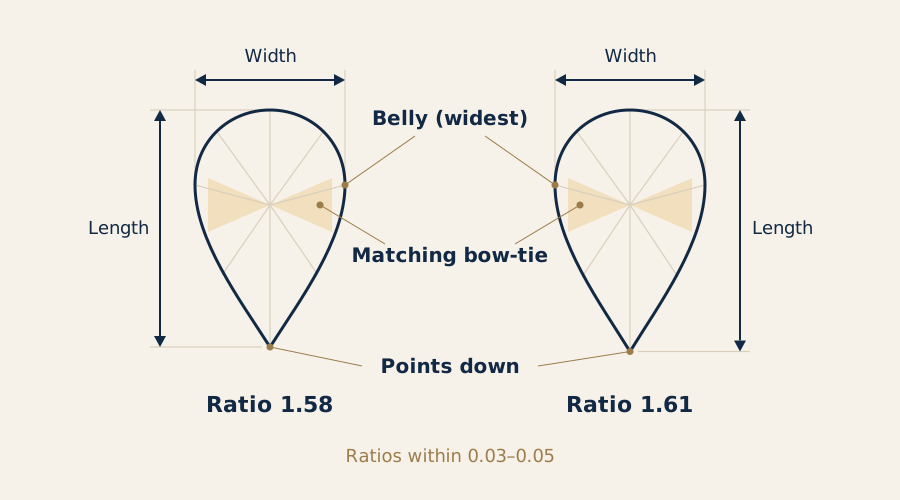
- Pears and marquise: matched as mirror images where possible, with the points facing the same way when worn (usually down) and the bellies, the widest parts, the same width.
- Ovals and pears: compare the bow-tie, a darker band across the middle. Two stones with bow-ties of different darkness look mismatched even when the grades agree.
- Princess and emerald cuts: check the corners are equally sharp or equally cut, and, for emerald cuts, that the step facets form a similar pattern.
- Colour in fancy shapes: elongated shapes show body colour at their ends, so keep colour to the same grade where you can.
Because most reports give fancy shapes no overall cut grade, judge them by eye or by 360° video. Our notes on symmetry and outline in fancy lab-grown cuts cover what to look for.
How much do matching lab-grown diamonds for earrings cost in Australia?
Lab-grown prices have fallen a long way in recent years, so a well-matched lab-grown pair is within reach of many budgets. Natural pairs cost much more, and finding two closely matched natural stones takes longer. The ranges below are approximate, for loose round brilliants in F–G colour, VS clarity and Excellent cut, before the earring setting:
| Pair (total weight) | Lab-grown pair (AUD) | Natural pair (AUD) |
|---|---|---|
| 0.50 ct tw (2 × 0.25 ct) | about $300–$900 | about $1,500–$3,500 |
| 1.00 ct tw (2 × 0.50 ct) | about $500–$1,800 | about $4,000–$9,000 |
| 2.00 ct tw (2 × 1.00 ct) | about $1,200–$3,500 | about $18,000–$35,000 |
| Finding a close match | Easier; many similar stones available | Harder; pairs can take time to source |
| Disclosure | Must be described as lab-grown | Natural; any treatment must be disclosed |
Two pairs with identical grades can still be priced differently because of proportions, fluorescence, measurements and how closely the stones match; this page on why two stones with identical 4Cs can be priced differently explains the factors. If you are still weighing up the material, our side-by-side lab-grown vs natural comparison covers value, rarity and resale honestly. Neither type should be bought as an investment: lab-grown diamonds have little resale value, and natural diamonds usually resell well below their retail price.
One practical point in favour of lab-grown pairs: if you lose one earring, a close replacement is usually easy to find from the measurements on your report. Keep both reports somewhere safe.
Browse lab-grown diamonds for matching pairs
Which earring setting suits a matched pair of lab-grown diamonds?
The setting can hide or exaggerate small differences. A good mount holds both stones at the same height and angle, so they face forward on the ear rather than tilting.
- Four-claw: shows the most diamond and makes a round look very slightly square; the classic stud.
- Six-claw: keeps a round looking round and adds security, with a little more metal on show.
- Martini: a cone-shaped basket that sits the stone closer to the lobe, useful above about 0.75 ct per stone.
- Bezel: a rim of metal around the edge, very secure for active wear; it also disguises a small difference in diameter.
- Halo: a ring of small diamonds around each stone, which makes the pair look larger and softens a small size gap.
For stones of about 0.75 ct each and above, screw-back posts or larger locking backs help keep the earring upright and secure. Heavier studs can droop forward on a standard butterfly back, which makes even a perfect pair look uneven.
How do you match two lab-grown diamonds for earrings? Step by step
- Set the size in millimetres. Choose the diameter you want and look for stones within about 0.1 mm of each other, not just the same carat weight.
- Match the cut. Same cut, polish and symmetry grades, with depth and table within about 1–2%.
- Keep colour within one grade. The same grade where possible, especially for larger stones or fancy shapes.
- Confirm both are eye-clean. Clarity grades can differ slightly; check photos for dark inclusions under the table.
- Compare fluorescence and growth method. Both None or Faint, and ideally the same method and treatment status.
- Read both reports side by side. Same lab, origin clearly stated as laboratory-grown, inscriptions matching the report numbers.
- View them together. Table-down on white, then face-up at arm's length, indoors and in daylight.
- Choose the setting and backs. Match the claw style and height, and use screw-backs or locking backs for larger stones.
If any term on either report is unclear, our plain-English definitions of grading terms will help, and our lab-grown buying basics cover the rest of the decision.
Free consultation
Talk to a gemologist
Compare stones in person or online with Raj Sood, Graduate Gemologist (GIA), AJP (GIA).
Book a consultationShop this shape
FAQ
Common questions
Do matching diamond earrings need the same carat weight?
No. Diameter matters more than weight, so aim for face-up diameters within about 0.1 mm. Weights a few hundredths of a carat apart are normal in a well-matched pair.
Can lab-grown diamond studs be different colour grades?
Yes, within one grade, such as F and G, they look the same on the ear. Two or more grades apart can show as one warmer stone, especially in larger sizes.
Can you match a lab-grown diamond with a natural diamond?
They can look alike, but it is rarely done, and the pair must be clearly described as containing one lab-grown and one natural stone. Most people match like with like, which keeps the reports and value consistent.
What does 1 ct tw mean on diamond earrings?
It means 1 carat total weight across both earrings, so each stone is about 0.50 ct and roughly 5.0–5.2 mm across.
Can I replace one lost lab-grown diamond earring?
Usually, yes. Take the report for the remaining stone and look for a replacement from the same lab with the same grades and a diameter within about 0.1 mm.
Do lab-grown diamond earrings look different from natural ones?
No. Lab-grown and natural diamonds look the same to the eye, and only laboratory equipment can reliably tell them apart, which is why the grading report and clear disclosure matter.

Ask a gemologist
Not sure which diamond to choose?
Raj Sood is a Graduate Gemologist (GIA) and master jeweller. Bring the stones you are considering, or send the reports, and he will tell you honestly which one is better and why.
Keep learning
Related guides
 Lab-Grown DiamondsLab-Grown Diamonds for Earrings and Tennis Bracelets
 Lab-Grown DiamondsLab-Grown Diamond Colour Grades
 Lab-Grown DiamondsLab-Grown Diamond Fluorescence Explained
 Lab-Grown DiamondsLab-Grown Diamond Cut QualityLab-Grown DiamondsLab-Grown Diamonds GuideLab-Grown DiamondsHow Are Lab-Grown Diamonds Manufactured?Lab-Grown DiamondsAre Lab-Grown Diamonds Real Diamonds
 Lab-Grown DiamondsLab-Grown Diamonds vs Natural Diamonds
Explore more
More guides on this topic
Education