
- Education
- Lab-Grown Diamonds
- Lab-Grown Diamond Fluorescence Explained: Grades, HPHT vs CVD and Reports
Lab-Grown Diamonds
Lab-Grown Diamond Fluorescence Explained: Grades, HPHT vs CVD and Reports
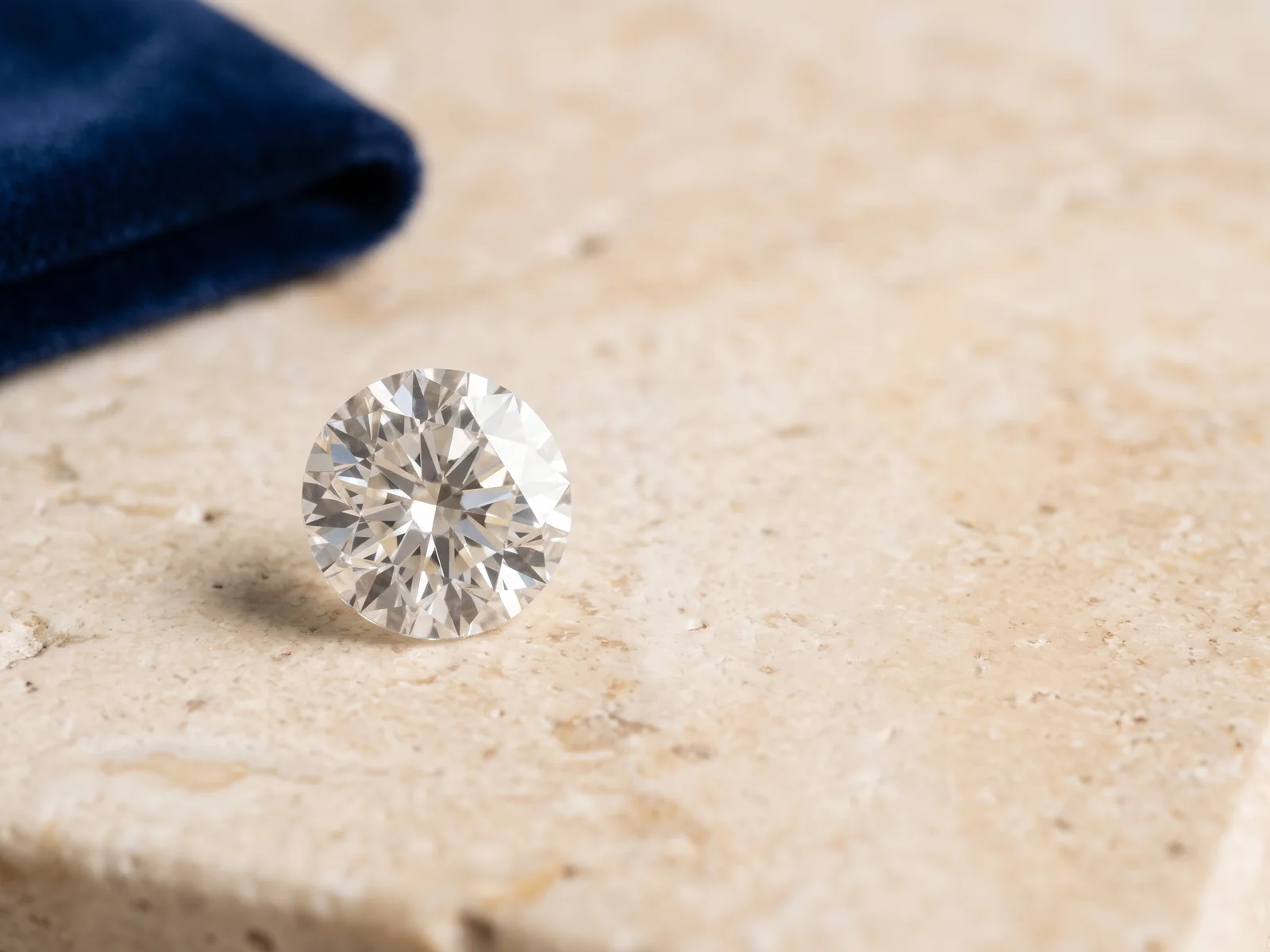
Fluorescence is one of the least understood lines on a diamond report, and it behaves differently in lab-grown stones. Here is what lab-grown diamond fluorescence is, why it happens and when it actually matters.
 Reviewed by Raj Sood, Graduate Gemologist (GIA), AJP (GIA)Master jeweller and Graduate Gemologist (GIA) · reviewed 4 November 2026
Quick answer
Lab-grown diamond fluorescence is a glow some lab-grown diamonds give off under ultraviolet light. Most show None or Faint on a grading report, which tests under longwave UV. HPHT stones may glow blue-green under shortwave UV and briefly afterglow; CVD stones may glow orange. In normal light it rarely changes appearance, so judge cut and colour first.
What is lab-grown diamond fluorescence?
Fluorescence is visible light a material gives off while it is being hit by ultraviolet (UV) light. UV is invisible to us, but some atoms and defects inside a crystal absorb that energy and release it straight away as a colour we can see, usually blue in natural diamonds. Turn the UV off and the glow stops. For a broader look at the effect in rubies, sapphires and other stones, see what fluorescence means across all gemstones.
Lab-grown diamonds are real diamond: the same carbon crystal, 10 on the Mohs hardness scale, with the same refractive index of about 2.42. Our page on why lab-grown diamonds are real diamond explains the chemistry. What differs is the tiny amount of trace elements and structural defects, and those are exactly what control fluorescence. That is why a lab-grown diamond and a natural diamond of the same colour and clarity can react quite differently under a UV lamp.
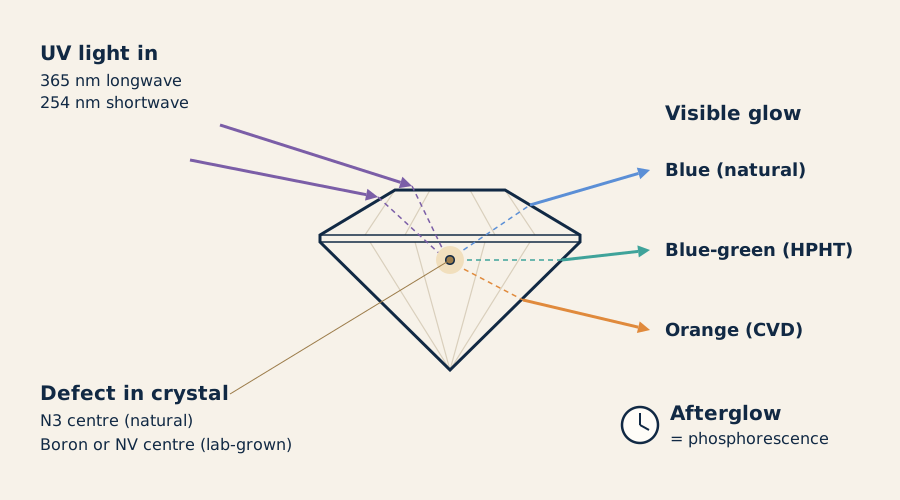
Two kinds of UV matter here. Longwave UV (about 365 nanometres, the 'black light' at a nightclub) is what grading labs use for the fluorescence line on a report. Shortwave UV (about 254 nm) is used mostly by gem labs and testing machines, because many lab-grown diamonds respond to it more strongly than to longwave. If you are new to lab-grown stones in general, start with our complete lab-grown diamonds guide, and keep the plain-English jewellery glossary open for any term you meet for the first time.
Why is lab-grown diamond fluorescence different from natural?
Almost all natural diamonds formed deep in the earth with nitrogen trapped in the crystal. Over millions of years that nitrogen clumped into groups. One particular group of three nitrogen atoms around a vacancy, called the N3 centre, is the main cause of the blue glow in natural diamonds. GIA has reported that roughly a quarter to a third of natural diamonds show some fluorescence, mostly blue, with only a small share graded Strong or Very Strong.
Lab-grown diamonds grow in weeks, not millions of years, and growers work hard to keep nitrogen out because nitrogen makes a diamond look yellow. Most colourless lab-grown diamonds are Type IIa, a category with almost no nitrogen. With no time for nitrogen to cluster and very little nitrogen to begin with, the N3 centre that makes natural diamonds glow blue is usually missing. So most colourless lab-grown diamonds show None or Faint under longwave UV.
Instead, the glow in a lab-grown diamond comes from other defects created by the growing method: boron and certain nitrogen-related centres in HPHT stones, and nitrogen-vacancy centres in CVD stones. Our page on how lab-grown diamonds are made by HPHT and CVD covers the two methods in detail. The short version is that the method leaves a fingerprint, and fluorescence is part of it.
Does HPHT or CVD growth change the fluorescence?
Yes. HPHT (high pressure, high temperature) copies the squeezing heat of the earth's mantle in a press. CVD (chemical vapour deposition) builds diamond up layer by layer from a carbon-rich gas. They leave different defects, so they tend to glow differently. These are typical patterns, not rules, and individual stones vary.
| Natural diamond | HPHT lab-grown | CVD lab-grown | |
|---|---|---|---|
| Usual longwave result | None to Strong, usually blue | Usually None or Faint | Usually None to Faint, sometimes orange |
| Shortwave UV | Usually weaker than longwave | Often stronger: blue to greenish-blue | Often orange to reddish, or weak blue after treatment |
| Afterglow (phosphorescence) | Uncommon in colourless stones | Common, blue to greenish-blue | Uncommon |
| Main cause | Nitrogen N3 centres | Boron and nitrogen-related centres | Nitrogen-vacancy centres |
| Growth pattern under lab imaging | Irregular, octahedral zones | Cross-shaped cuboctahedral zones | Fine parallel layers (striations) |
HPHT diamond fluorescence is the most distinctive. Many colourless HPHT stones are inert, or nearly so, to the longwave lamp, then glow blue to greenish-blue under shortwave and keep glowing for seconds after the lamp switches off. That afterglow is covered in its own section below.
CVD diamond fluorescence is often orange or reddish under shortwave, because nitrogen-vacancy centres emit orange-red light. Many CVD diamonds also receive a post-growth heat treatment to improve colour, which can weaken or change that glow. Reports from IGI, the lab that grades most lab-grown diamonds sold in Australia, usually state the growth method and whether the stone is 'as grown' or has had post-growth treatment. That treatment also affects the colour grade, which is explained in our page on post-growth treatment and colour grading.
How is fluorescence graded on a lab-grown diamond report?
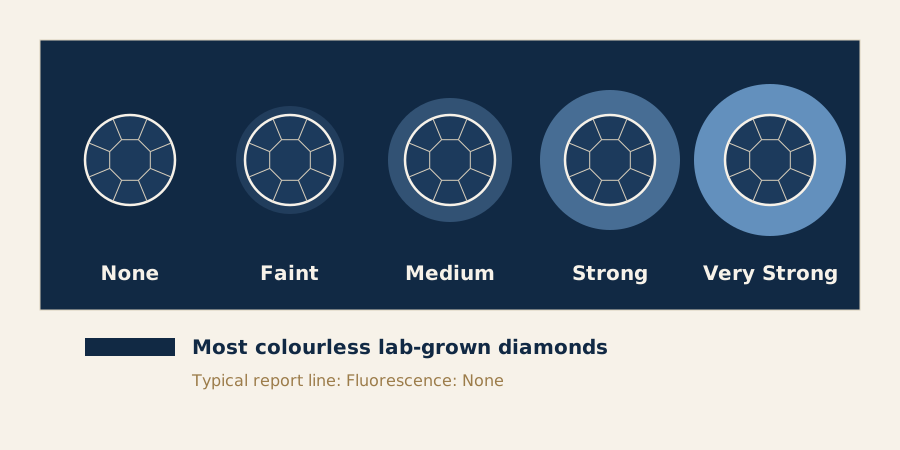
Labs grade fluorescence by placing the diamond table-down under a longwave UV lamp (about 365 nm) in a darkened box and comparing its glow with master stones of known strength. The grade describes strength. If the glow is a colour other than blue, many reports add it, for example 'Faint Yellow' or 'Medium Orange'. Shortwave reactions and afterglow are not usually printed on a consumer report.
| Report grade | What you would see under a UV torch | In normal daylight |
|---|---|---|
| None | No visible glow | No effect |
| Faint | A very slight glow, easy to miss | No visible effect |
| Medium | A clear but soft glow | Very rarely visible |
| Strong | An obvious glow | Occasionally visible as a slight tint or softness |
| Very Strong | A bright glow, like a small lamp | Can look slightly hazy or milky in strong sun; check in person |
On an IGI lab-grown report you will typically find fluorescence listed just below polish and symmetry, with the growth method and any treatment noted in the comments. A typical line reads 'Fluorescence: None', and that is by far the most common result for colourless lab-grown stones. The five steps are the same ones used for natural diamonds, which we explain with photos in the five fluorescence strengths from None to Very Strong. The grade is applied the same way whatever the shape, from rounds to the fancy shapes in our guide to all 34 diamond cuts.
Not sure which one is right?
Send us the stones you are looking at and our gemologist will tell you which to choose and why.
Is fluorescence bad in a lab-grown diamond?
Usually not, and in most lab-grown stones the question never comes up, because the grade is None or Faint. Fluorescence only shows when there is enough UV around: direct sunlight, a nightclub black light or a UV nail lamp. Indoor lighting has very little UV, so in an office or at a restaurant table a diamond graded Medium looks the same as one graded None.
In natural diamonds, the trade has long debated two effects. Strong blue fluorescence can make a slightly warm stone, around I to K colour, look a touch whiter in daylight, because blue cancels some yellow. At the other end, a small number of Very Strong stones can look slightly hazy or 'oily' in bright sun. A GIA study published in 1997 found that most observers could not tell fluorescence was there at all in normal viewing, and that its effect on appearance was small.
With lab-grown diamonds the same logic applies, with a few differences:
- None or Faint: no practical effect. This covers most colourless lab-grown stones.
- Medium: almost never visible. Not a reason to reject an otherwise well-cut stone.
- Strong or Very Strong: uncommon in lab-grown. View the stone in daylight next to a window and look for any softness or tint before deciding.
- Non-blue colours: an orange or yellow glow will not whiten the stone the way blue can. In strong sunlight it may add a faint warmth, so check it in person.
What changes how a diamond looks far more than fluorescence is cut. A poorly proportioned stone leaks light whatever its fluorescence grade, so look first at cut quality, which drives sparkle far more. Colour is next: see how the D-to-Z colour scale applies to lab-grown stones.
Why do some lab-grown diamonds keep glowing after the UV light is off?
That afterglow is phosphorescence. Fluorescence stops the instant the UV stops; phosphorescence carries on, because some of the absorbed energy is stored briefly and released slowly. Lab-grown diamond phosphorescence is most often seen in HPHT stones, usually as a blue to greenish-blue glow after shortwave UV that can last from a few seconds to a minute or more.
It is linked to small amounts of boron and other defects from the HPHT process. It does nothing to the stone's look in daylight, its hardness or its durability, and you will usually only notice it in the dark straight after a strong UV source, most often a shortwave lamp. Some people enjoy it. Natural colourless diamonds rarely phosphoresce noticeably, although some natural blue diamonds, which also contain boron, famously glow red after UV. Other gems show afterglow too, which we cover in glow and afterglow in coloured gemstones.
Because phosphorescence is uncommon in natural colourless diamonds, gem labs treat it as a useful clue to growth origin, which leads to the next question.
Can fluorescence tell a lab-grown diamond from a natural one?
Fluorescence is a strong clue, but not proof on its own. Gem labs and screening machines compare the longwave and shortwave reactions, look for afterglow and photograph the growth pattern with a deep shortwave imaging instrument such as the DiamondView. A stone that is inert to longwave but bright under shortwave, or that phosphoresces blue, is flagged for further testing. Spectroscopy then confirms whether it is natural or lab-grown. The growth patterns it reveals are the ones left by the HPHT press and the CVD reactor.
A UV torch at home cannot do this reliably. Some natural diamonds show no fluorescence, and some lab-grown diamonds show Faint blue. Standard handheld thermal testers also cannot separate them, because lab-grown diamond conducts heat the same way as natural diamond, since the two share an identical crystal structure. Our guide on whether lab-grown diamonds pass a diamond tester explains which tools can and cannot tell the difference.
Fluorescence also will not reliably spot a simulant. Cubic zirconia (CZ) is a different material altogether, about 8 to 8.5 on the Mohs scale with a refractive index of about 2.15, and it can fluoresce in various colours or not at all. If your worry is whether a stone is diamond or a look-alike, read how lab-grown diamond differs from cubic zirconia.
Under the Australian Consumer Law, a seller must not mislead you about what a stone is. A lab-grown diamond should always be described as lab-grown or laboratory-grown, and the grading report should state its origin. Laser inscriptions on the girdle (the thin outer edge) of most lab-grown stones also carry the report number and often the words 'lab-grown'.
Does fluorescence change the price of a lab-grown diamond in Australia?
For natural diamonds, it can. Strong or Very Strong blue fluorescence in the higher colours (D to H) usually carries a modest discount, roughly a few per cent up to around 15%, because some buyers avoid it. In the lower colours (I to K) the discount is smaller, and occasionally strong blue is preferred.
For lab-grown diamonds, the effect on price is small. Most stones are graded None, supply is plentiful, and price is driven mainly by carat, cut, colour and clarity. Lab-grown diamonds cost much less than natural diamonds of the same grades. Of those factors, the one most worth paying for is light performance, explained in how cut grades work on lab-grown reports.
| 1 ct round, G colour, VS2, Excellent cut | Approximate price range (AUD) |
|---|---|
| Natural, fluorescence None | about $9,000–$15,000 |
| Natural, Strong blue fluorescence | about $8,000–$14,000 |
| Lab-grown, fluorescence None | about $900–$2,500 |
| Lab-grown, Faint or Medium | about the same as None |
These are broad ranges only, and lab-grown prices in particular have been falling. Use them to understand the pattern, not as a quote. For the other factors that set a lab-grown price, see lab-grown prices and buying basics. Shape moves the price far more than fluorescence does; our page on how price per carat varies by diamond shape sets out the pattern.
Browse lab-grown diamonds
How to check fluorescence before you choose a lab-grown diamond
- Read the report. Find the fluorescence line and note the strength, and the colour if one is given.
- Check the origin details. Confirm the report says lab-grown, which method (HPHT or CVD) and whether there was post-growth treatment.
- Put fluorescence in its place. None, Faint or Medium: move on to cut, colour and clarity. Strong or Very Strong: plan to view the stone in person.
- Look in daylight. Hold the stone by a window, ideally next to one graded None, and look for any haze or tint.
- Try a UV torch if you are curious. It shows the glow and any afterglow, but it is not a test of origin.
- Match the inscription. Check the girdle inscription number matches the report number.
- Keep the report. It records fluorescence and origin for insurance, resale and any future repairs.
If you want to see what each strength looks like before comparing stones, our page with examples of every fluorescence grade is a useful companion to this checklist. For how a jeweller confirms origin beyond the report, see the screening tools jewellers use on diamonds.
Free consultation
Talk to a gemologist
Compare stones in person or online with Raj Sood, Graduate Gemologist (GIA), AJP (GIA).
Book a consultationShop this shape
FAQ
Common questions
Do lab-grown diamonds fluoresce?
Some do, but most colourless lab-grown diamonds show None or Faint under the longwave UV used for grading. HPHT stones often glow blue-green under shortwave UV, and CVD stones may glow orange.
What does a lab-grown diamond look like under UV light?
Under a longwave UV torch, most look dark or show only a faint glow. Under shortwave UV in a lab, many HPHT stones glow blue to greenish-blue and may keep glowing for a short time after the lamp is off.
Is fluorescence bad in a lab-grown diamond?
Generally no. None and Faint have no visible effect in normal light, and Medium almost never does. Strong or Very Strong is uncommon in lab-grown stones and is worth checking in daylight for any haze.
Why does my lab-grown diamond glow in the dark after a nightclub?
That is phosphorescence, an afterglow most common in HPHT lab-grown diamonds. It is harmless and does not affect the stone's appearance, hardness or durability.
Can I tell if a diamond is lab-grown with a UV torch?
Not reliably. Fluorescence patterns are a clue that gem labs use alongside spectroscopy and growth imaging, but a home UV torch cannot confirm origin. Rely on the grading report and girdle inscription.
Does fluorescence affect the price of a lab-grown diamond?
Only slightly, if at all. Price is driven mainly by carat, cut, colour and clarity, whereas in natural diamonds strong blue fluorescence can bring a modest discount in the higher colours.
Terms in this guide

Ask a gemologist
Not sure which diamond to choose?
Raj Sood is a Graduate Gemologist (GIA) and master jeweller. Bring the stones you are considering, or send the reports, and he will tell you honestly which one is better and why.
Keep learning
Related guides
 Diamond 4Cs & GradingFluorescence
 Diamond 4Cs & GradingDiamond Fluorescence Strengths: None to Very StrongLab-Grown DiamondsHow Are Lab-Grown Diamonds Manufactured?
 Lab-Grown DiamondsDo Lab-Grown Diamonds Test as DiamondsLab-Grown DiamondsLab-Grown Diamonds Guide
 Lab-Grown DiamondsAre Lab-Grown Diamonds Real DiamondsLab-Grown DiamondsLab-Grown Diamond Cut QualityLab-Grown DiamondsLab-Grown Diamond Colour Grades
Explore more
More guides on this topic
Education