
- Education
- Wedding Bands & Eternity
- Can a Full Eternity Ring Be Resized? Options, Limits and Costs
Wedding Bands & Eternity
Can a Full Eternity Ring Be Resized? Options, Limits and Costs
Can a full eternity ring be resized? It is one of the most common questions we hear at the counter, and the honest answer depends on the setting, the stones and how far out the size is.
 Reviewed by Raj Sood, Graduate Gemologist (GIA), AJP (GIA)Master jeweller and Graduate Gemologist (GIA) · reviewed 4 November 2026
Quick answer
Usually only a little. A full eternity ring has stones all the way around, so there is no plain metal to cut and rejoin. A jeweller may stretch or compress it about a quarter to half a size, or fit sizing beads to make it smaller. Bigger changes mean removing or adding stones, or remaking the ring.
Can a full eternity ring be resized?
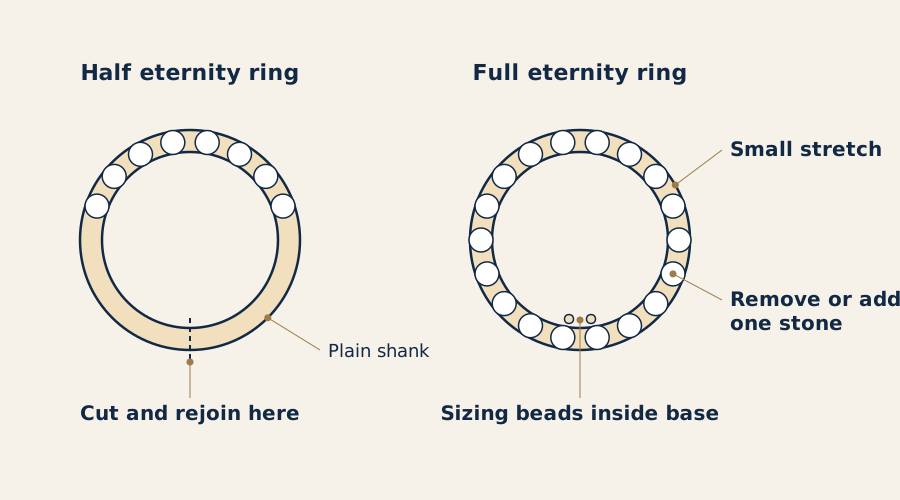
A full eternity ring is a band set with matching stones all the way around, with no plain section of metal at the back. A half eternity ring has stones across the top only, usually about half to two-thirds of the way around, with a plain shank (the band of metal under the finger) underneath. That difference decides almost everything about resizing. Our guide to eternity and anniversary rings explains the styles in more detail.
So, can a full eternity ring be resized? Yes, but only within tight limits. On an ordinary ring a jeweller cuts the plain shank at the base, removes or adds a small piece of metal, solders it closed and polishes the join. On a full eternity ring there is nowhere to make that cut without going through a stone setting. The realistic options are:
- Stretch or compress the band slightly, usually about a quarter to half a size, then check and tighten every stone.
- Fit sizing beads (two small metal balls inside the band) to make a ring that is slightly too big sit more snugly.
- Remove a stone and rejoin the band to make it smaller, or add a stone and setting to make it larger. Each stone changes the size by roughly one and a half to two sizes.
- Remake the ring in the correct size, sometimes reusing the original stones.
Which of these is safe depends on how the stones are set, what they are, the metal and how far out the size is. Any term you have not met before is explained in our plain-English jewellery glossary.
Why are full eternity rings so hard to resize?
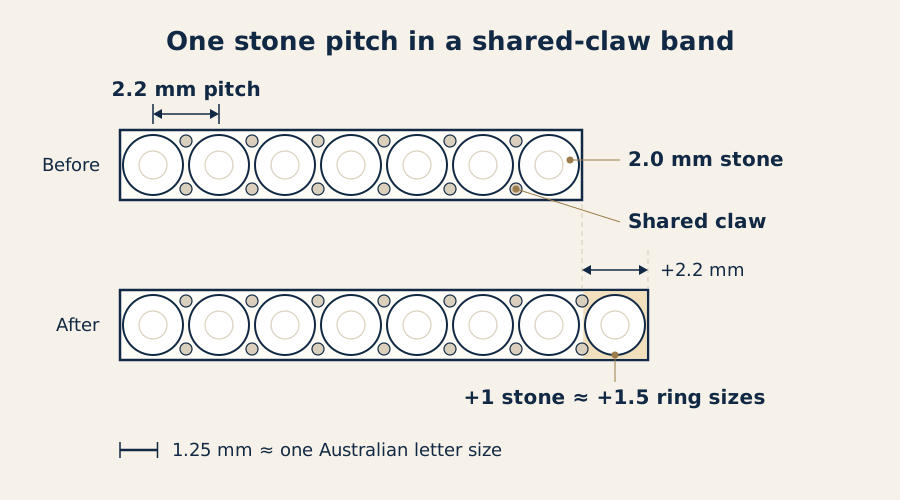
Resizing works by changing the length of the metal that goes around your finger. An Australian ring size is a letter (with half sizes in between), and each full letter is roughly 1.25 mm of inside circumference, or about 0.4 mm of inside diameter. Going up one size on a plain band means adding a strip of metal about 1.25 mm long. That is easy in a plain shank. In a full eternity ring, every millimetre of the circumference is holding a stone.
Three things make it difficult:
- Settings are made to fit stones exactly. Claws, channels and collets (small metal cups) are cut to hold each stone at a set diameter. Stretching the band pulls them open; compressing it squeezes them shut. Either can loosen or crack a stone.
- Stone spacing must stay even. The stones sit edge to edge. Change the circumference and the gaps change too, which is easy to see on a row of matching diamonds.
- Heat is close to the stones. Soldering a join needs heat, and in a full eternity ring the join is always beside a stone. Some gems cannot take that heat at all, so they must come out first.
These are the same factors any jeweller weighs on any ring, but a full eternity ring hits all of them at once. Our page on what decides whether any ring can be resized covers the general rules, including width, thickness and metal type.
Can a full eternity ring be resized if it is claw set or channel set?
The setting style matters more than anything else. Some styles tolerate a small adjustment and a stone being added or removed; others do not tolerate any change at all.
| Setting | How the stones are held | Resizing flexibility |
|---|---|---|
| Shared-claw (U-cut or fishtail) | Each claw holds the edges of two neighbouring stones | Small stretch possible, then every claw re-tightened; a stone can usually be removed or added |
| Individual four-claw baskets | Each stone sits in its own little basket of claws, joined side by side | Fairly good: a basket can be taken out or a new one added |
| Channel | Stones held between two continuous metal walls | Very limited: stretching opens the channel and stones loosen |
| Bezel or rubover | Each stone sits in a metal collet with a rim pressed over its edge | Very limited: collets can be added or removed, but cannot be stretched |
| Bar set | Stones held between thin metal bars across the band | Limited: a bar section can sometimes be removed, little stretch |
| Pavé or grain-set | Several rows of tiny stones held by beads of metal | Little or none: usually a remake |
Shared-claw and individual-claw settings are the most adaptable because each stone is held at points rather than along its whole edge. After any adjustment the jeweller re-tightens the claws around each stone. Channel and bezel settings are the most secure for everyday wear, with no claws to catch on clothing, but that continuous metal grip is exactly what stops them being stretched. Baguettes and other rectangular stones are usually channel set, so a baguette eternity ring is one of the hardest to resize; our page on how baguette and tapered baguette stones differ explains why they are set that way.
Stone size matters too. Small stones, around 1.5–2.0 mm, are easier to space evenly after a change, while large stones of 3 mm and up make every gap more noticeable. Our chart of pointer sizes for eternity ring stones shows what each diameter looks like on the hand.
What are the options if your full eternity ring is too small or too big?
Here is how each method compares. The size change figures are typical, not promises; your jeweller should inspect the ring under magnification first.
| Method | Makes it | Typical change | Main risk |
|---|---|---|---|
| Sizing beads | Smaller (fit only) | About ½–1 size tighter feel | Slight bump inside the band |
| Stretching | Bigger | About ¼–½ size | Loose stones, thinner metal |
| Compressing | Smaller | About ¼–½ size | Stones pushed together, chips |
| Remove one stone and rejoin | Smaller | About 1.5–2 sizes per stone | Uneven gap at the join |
| Add a stone and setting | Bigger | About 1.5–2 sizes per stone | Matching the new stone's colour and size |
| Remake | Either | Any size | Cost and time |
If it is a little too big, sizing beads are usually the gentlest fix. Two small balls of metal are soldered or laser-welded inside the base of the band, so the ring cannot spin or slide over the knuckle. They work best where there is a solid gallery (the metal underneath the stones) to attach them to. A removable ring guard is a temporary option while you decide.
If it is a little too small, a small stretch on a sturdy claw-set band may be possible, but many careful jewellers decline to stretch a stone-set band at all, because the metal thins and each stone needs checking afterwards. A quarter of a size is a common limit. For more, the jeweller adds a stone and setting, or remakes the ring.
If it is a lot out, more than about one size, the realistic choice is between adding or removing stones and a remake. Our guide to the general limits on stretching and sizing rings explains why big stretches are avoided on any band.
Not sure which one is right?
Send us the stones you are looking at and our gemologist will tell you which to choose and why.
How many stones does it take to change a full eternity ring size?
This is the part most people do not expect. You cannot add half a stone, so a full eternity ring can only change size in steps of one stone, plus a little adjustment in the spacing. Each stone takes up its own diameter plus a sliver of metal for the claws. A 2.0 mm stone in a shared-claw setting uses about 2.2 mm of the circumference, which works out to around one and a half ring sizes. A 3.0 mm stone uses about 3.2 mm, roughly two sizes.
| Australian size | Inside circumference (approx.) | 2.0 mm stones (approx.) | 3.0 mm stones (approx.) |
|---|---|---|---|
| J | 49.3 mm | 25 | 18 |
| L | 51.9 mm | 26 | 19 |
| N | 54.4 mm | 28 | 20 |
| P | 57.0 mm | 29 | 21 |
| R | 59.5 mm | 30 | 22 |
These counts are rough guides for a shared-claw band; channel and bezel rings differ, and every maker spaces stones slightly differently. The pattern is the useful part: going from L to N on a 2 mm band needs one or two more stones, not a small strip of metal. To see how stone diameter relates to carat weight (a 2.0 mm round is about 0.03 carat, a 3.0 mm round about 0.10 carat), see our guide to how stone diameter converts to carat weight.
Fancy shapes make the steps bigger still. An eternity ring of ovals set east-west or north-south uses more circumference per stone than rounds of the same weight, so one stone can mean two or more sizes. Our page on oval diamond shapes and proportions shows how long a typical oval is for its weight.
Adding a stone also means matching it. With natural diamonds, finding one of exactly the same diameter, colour and clarity is possible for small common sizes but harder for larger or coloured stones. Lab-grown diamonds and lab-created sapphires are usually easier to match, because stones of matching size and colour are easier to source. Removing a stone is simpler, and the stone can be kept for a future repair.
Do the metal and gemstones affect resizing a full eternity ring?
Yes. The metal decides how the join is made and how it holds up; the stones decide how much heat they can be near.
- Platinum (usually 95% pure in Australia) is dense and tough. It holds claws well and joins cleanly by laser welding or high-temperature soldering, but it needs specialist tools.
- 18 carat gold is soft enough to adjust slightly and solders well. White gold is usually rhodium plated, so the whole ring needs replating after the work.
- 9 carat and 14 carat gold are harder and springier, so they resist stretching and are more likely to crack if forced.
- Laser welding puts a tiny, controlled spot of heat exactly where it is needed, which is often the safest way to join metal near stones.
Diamond, natural or lab-grown, is 10 on the Mohs hardness scale and handles moderate heat, but a torch flame can still burn its surface or worsen an internal feather (a small crack). Sapphire and ruby (Mohs 9) are fairly heat tolerant, though glass-filled rubies are not. Emerald (7.5–8, often oil treated), tanzanite (6–7), opal (5.5–6.5) and pearls cannot take heat at all. With those, the nearby stones come out before any soldering and are reset afterwards, which adds time and cost.
After any resizing the ring is refinished. A high polish finish hides the join completely once it is buffed. A brushed or satin finish has to be recreated with the grain running the same way as the rest of the band, which a good bench jeweller can match.
How much does it cost to resize a full eternity ring in Australia?
Prices depend on the metal, the setting, the stones and how many need checking or resetting. These are broad Australian ranges only, as a starting point for a quote.
| Job | Approximate price range (AUD) |
|---|---|
| Sizing beads | about $60–$150 |
| Small stretch plus checking and tightening stones | about $80–$200 |
| Remove one stone and rejoin | about $200–$500 |
| Add a stone and setting | about $300–$900, plus the stone |
| Remake in the correct size | from about $1,200 for a simple lab-grown diamond band to several thousand for natural diamonds or platinum |
Rhodium replating of white gold, resetting heat-sensitive gems and replacing worn claws are often charged on top. Remaking can sound expensive, but on a ring that is two or more sizes out it is often the only option that leaves even spacing and full-strength settings. A remake also lets you change the design, for example to a three-quarter eternity ring with a short plain section at the back that can be resized in future.
At GemTrove, Raj Sood, Graduate Gemologist (GIA), looks at the settings and stones under magnification before recommending any method, so you know the risks before the work starts. When a ring is remade:
Eternity rings, custom bands and jewellery repairs
If you are still choosing a ring, our full wedding ring buying guide covers metals, widths and profiles alongside sizing.
How do you get the size right before buying a full eternity ring?
Because the options afterwards are limited, sizing carefully first matters more than with any other ring. Fingers change through the day and the year: they swell in Melbourne's summer heat, after exercise and in the evening, and shrink in the cold.
- Get sized late in the day. Your finger is at its largest then, so the ring will not end up too tight.
- Use a sizer the same width as the band. A wide band (4 mm and over) feels tighter than a narrow one, often by about half a size.
- Check over the knuckle. The ring should slide on with slight resistance and come off with a gentle twist.
- Size more than once. Try on two different days, ideally one warm and one cool, and go with the larger result if they differ.
- Allow for the profile. A comfort-fit band (rounded inside) can feel up to a quarter size looser than a flat-inside band.
- Think about the future. If pregnancy, weight change or arthritis could change your finger size, consider a three-quarter or half eternity design instead.
If the eternity ring will sit beside an engagement ring, size them together and check they sit comfortably side by side. The same pairing thinking applies to unusual centre stones, as in our guide to bands that sit beside a toi et moi ring and our notes on bands that pair with a heart engagement ring.
Is a half eternity ring easier to resize than a full eternity ring?
Yes, much easier. A half eternity ring has a plain shank at the back, so it can be resized like any plain band, usually two or three sizes up or down, without touching the stones. A three-quarter eternity ring has a shorter plain section and usually allows one to two sizes. Our half versus full eternity comparison weighs up sparkle, comfort and wear as well as sizing.
Related guideHalf Eternity vs Full Eternity RingsA full eternity ring still has real advantages: it looks the same from every angle and never spins to show a plain back. The trade-off is simply that it is a commitment to one size. Stones on the underside also take more knocks against benches and handrails, so a full eternity ring benefits from a check of its claws every year or two.
If you are deciding what to mark a milestone with, our explainer on the difference between an anniversary ring and an eternity ring may help you choose between the two before thinking about size.
Free consultation
Talk to a gemologist
Compare stones in person or online with Raj Sood, Graduate Gemologist (GIA), AJP (GIA).
Book a consultationFAQ
Common questions
Can you stretch a full eternity ring?
Sometimes, but only about a quarter to half a size on a sturdy claw-set band, and every stone must be checked and tightened afterwards. Channel, bezel and pavé eternity rings generally should not be stretched.
What can I do if my full eternity ring is too big?
Sizing beads inside the band, or a removable ring guard, can make a slightly loose ring sit securely. If it is more than about a size too big, a jeweller can remove a stone and rejoin the band, or remake it.
What can I do if my full eternity ring is too small?
A very small stretch may be possible. Otherwise a jeweller adds a matching stone and setting, which makes it about one and a half to two sizes larger, or remakes the ring in the correct size.
How much does it cost to resize an eternity ring in Australia?
As a rough guide, sizing beads cost about $60–$150 and adding or removing a stone about $200–$900 plus any new stone. A remake costs more, depending on the metal and stones.
Is a half eternity ring easier to resize?
Yes. A half eternity ring has a plain section at the back that can be cut and rejoined, so it can usually be resized two or three sizes without disturbing the stones.
Can a lab-grown diamond eternity ring be resized?
The same limits apply, because resizing depends on the setting rather than whether the diamonds are natural or lab-grown. Lab-grown diamonds can be easier to match if a stone needs adding.

Ask a gemologist
Not sure which diamond to choose?
Raj Sood is a Graduate Gemologist (GIA) and master jeweller. Bring the stones you are considering, or send the reports, and he will tell you honestly which one is better and why.
Keep learning
Related guides
 Wedding Bands & EternityHalf Eternity vs Full Eternity Rings
 Care, Repairs & RemodellingRing Resizing: What Determines Whether a Ring Can Be Resized?
 Wedding Bands & EternityEternity Ring Stone Sizes (Pointer Guide)Wedding Bands & EternityEternity Rings & Anniversary RingsWedding Bands & EternityWedding Ring Buying Guide
 Wedding Bands & EternityAnniversary Ring vs Eternity Ring
 Wedding Bands & EternityBest Wedding Band for Toi et Moi Rings
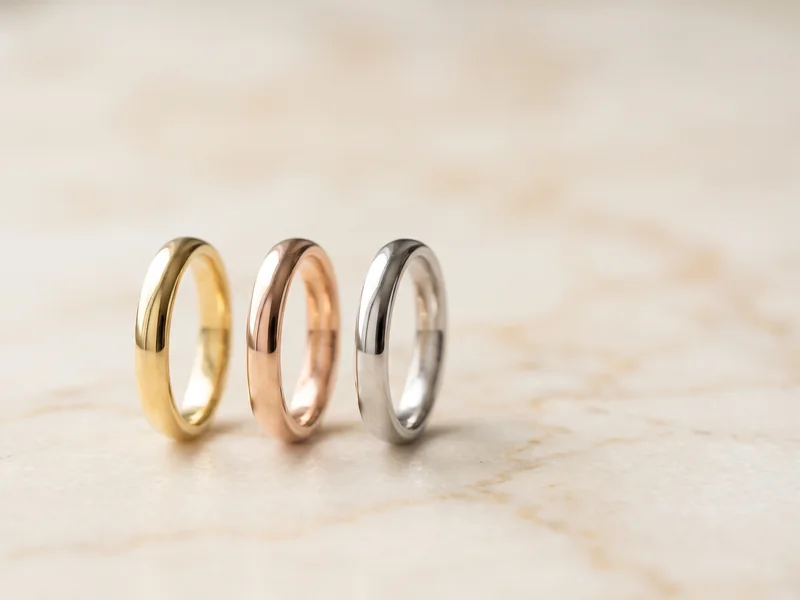 Wedding Bands & EternityHigh Polish Ring Finish
Explore more
More guides on this topic
Education