
- Education
- Wedding Bands & Eternity
- Should Couples' Wedding Bands Match? A Guide to Matching Wedding Bands
Wedding Bands & Eternity
Should Couples' Wedding Bands Match? A Guide to Matching Wedding Bands
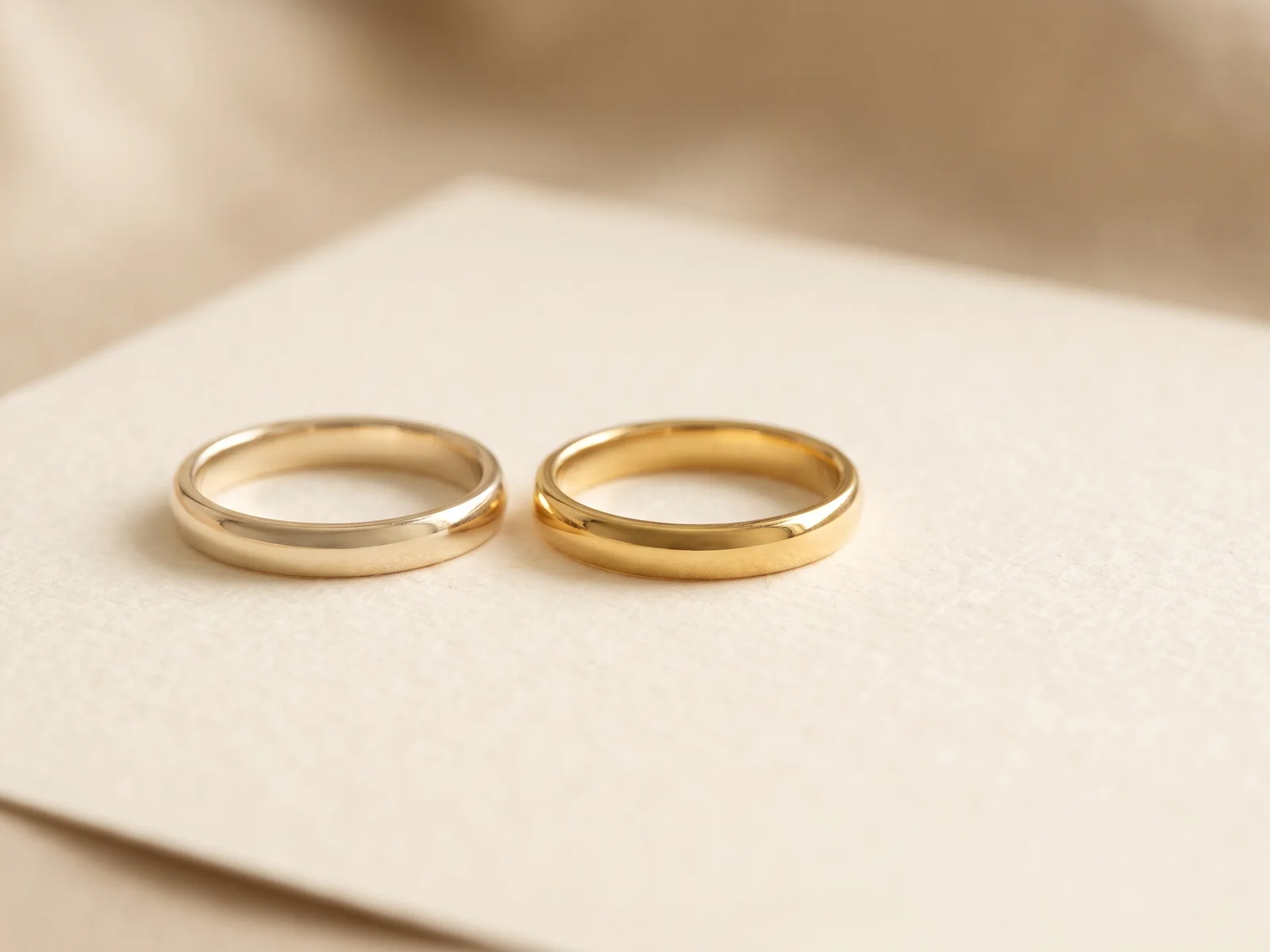
Matching wedding bands are a choice, not a rule. Here is how couples decide whether to match exactly, coordinate one detail or go their own way, and the metal, width, profile and finish choices that make two different rings still feel like a pair.
 Reviewed by Raj Sood, Graduate Gemologist (GIA), AJP (GIA)Master jeweller and Graduate Gemologist (GIA) · reviewed 4 November 2026
Quick answer
No, couples' wedding bands don't have to match. Many choose matching wedding bands in the same metal and finish, but widths usually differ (often about 2–3 mm and 4–6 mm), and plenty of couples coordinate one detail instead. Choose each band to suit the wearer's hand, work and engagement ring first, then link them through metal, finish or engraving.
Do couples need matching wedding bands?
No. There is no legal, religious or etiquette rule in Australia that says two partners' wedding bands must match. Matching is a tradition that became popular in the mid-twentieth century, when double-ring ceremonies (where both partners receive a ring) became the norm. Before that, in many families only one partner wore a ring at all.
Today couples split roughly three ways: some want identical or near-identical rings, some want rings that clearly belong together without being copies, and some choose completely different rings and let the wedding itself be the link. All three are perfectly normal. The question worth asking is not do wedding rings have to match, but what each of you will be happy wearing every day for decades.
A quick note on words. A wedding band usually means a simple, even-width ring, while wedding ring is the broader term for whatever ring you exchange. Our page on the difference between a wedding ring and a wedding band explains where the two overlap. If you are starting from scratch, our complete wedding ring buying guide covers sizing, metals and timing, and any term you have not met before is in our plain-English jewellery glossary.
What are the four ways to approach matching wedding bands?
Almost every couple lands on one of four approaches. Thinking of them this way makes the decision much easier, because you are choosing how closely to match, not simply yes or no.
| Approach | What it means | Typical example | Suits couples who |
|---|---|---|---|
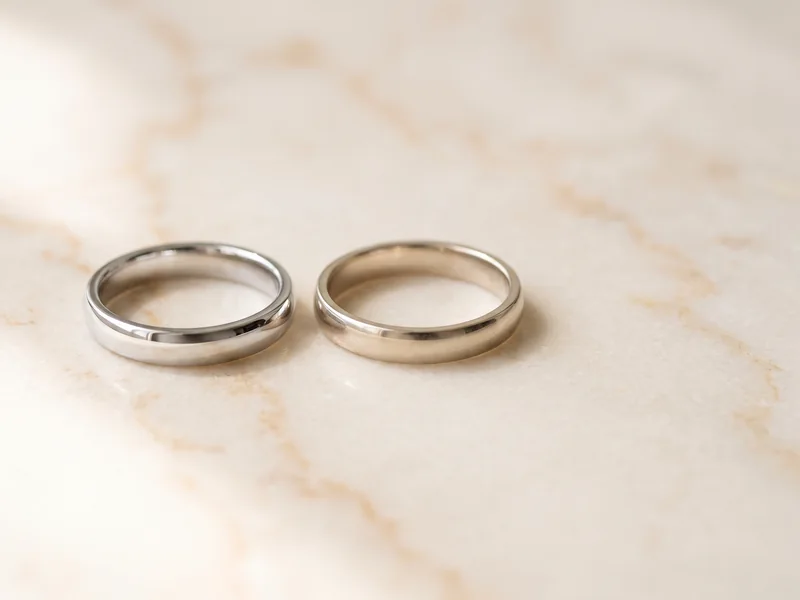
| Identical | Same metal, profile, finish and width | Two 4 mm platinum court bands | Have similar hand sizes and want a true pair |
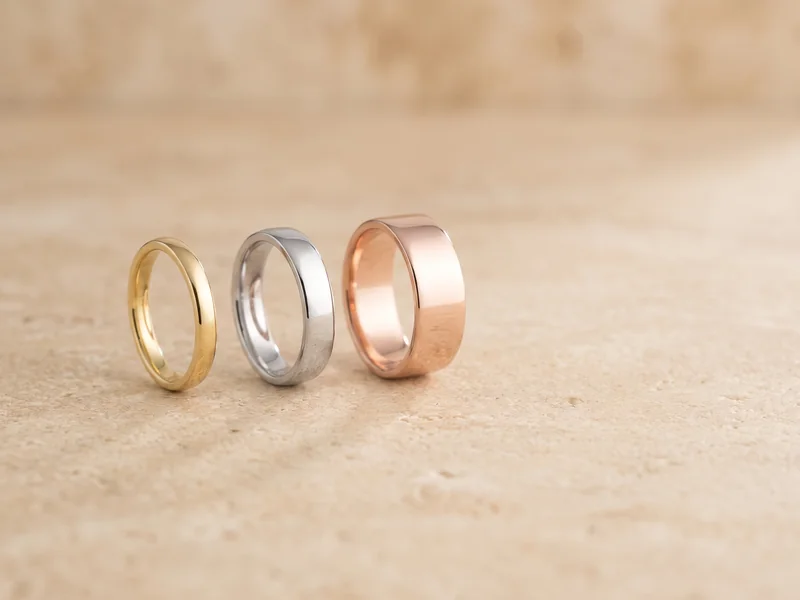
| Matched set | Same metal, profile and finish; different widths | 2.5 mm and 5 mm 18ct yellow gold D-shape bands | Want an obvious pair that suits each hand |
| Coordinated | Share one or two details only | Same brushed finish, one in white gold, one in yellow | Have different tastes but want a visible link |
| Independent | Chosen separately, no shared detail | A diamond band and a black tungsten carbide band | Value personal style over symbolism |
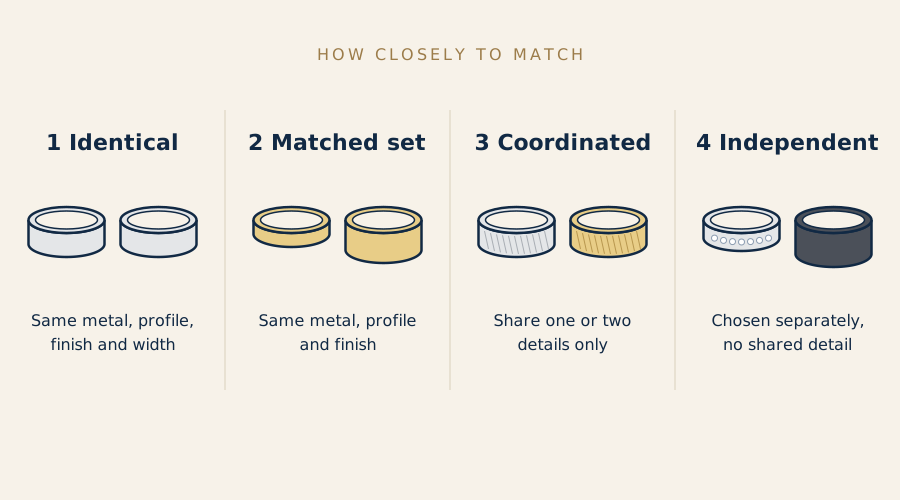
The matched set is the most common choice we see for his and hers wedding bands, and for same-sex couples too. Keeping the metal, cross-section and finish the same while adjusting the width means each band is in proportion to the hand wearing it. A 6 mm band can overwhelm a slim finger, and a 2 mm band can look like a thread on a large one.
Coordinated pairs work well when one partner wants diamonds and the other does not. Our comparison of plain versus diamond-set bands covers the practical differences, from wear to resizing, before you decide whether both rings need sparkle.
Should you choose the same metal for both bands?
Metal is the strongest visual link between two rings, so same metal wedding bands read as a pair even when every other detail differs. But colour is only half of it. Metals wear differently, and if one of you is hard on your hands, the right alloy matters more than matching.
| Metal | Purity | Hardness and wear | Resizable? | Notes |
|---|---|---|---|---|
| Platinum 950 | 95% platinum | About 4–4.5 on the Mohs scale; scratches move metal rather than remove it | Yes | Heavy and naturally white; develops a soft satin patina |
| 18ct gold | 75% gold | About 2.5–3 Mohs; durable alloy, scratches show on polished finishes | Yes | Yellow, white or rose; white gold is usually rhodium plated |
| 9ct gold | 37.5% gold | Slightly harder alloy, but more prone to tarnish | Yes | Lower cost; colour can differ a little from 18ct |
| Palladium 950 | 95% palladium | Similar hardness to platinum alloys; light | Yes, with a skilled jeweller | Naturally white, lighter on the hand |
| Titanium | Commercially pure or alloy | About 6 Mohs; very light | Very limited | Popular in men's bands; hard to alter |
| Tungsten carbide | Carbide composite | About 8.5–9 Mohs; very scratch resistant but brittle | No | Can crack if dropped on tile; cannot be cut off easily in an emergency |
The Mohs scale measures scratch resistance from 1 (talc) to 10 (diamond). A higher number does not mean a tougher ring: tungsten carbide resists scratches but can shatter, while gold and platinum bend and can be repaired.
Two details catch couples out. First, white gold is usually coated with rhodium (a bright white metal of the platinum family), which wears back over time, often every one to two years for a daily-worn band. If one band is platinum and the other white gold, they will look almost identical when new and slightly different once the rhodium wears. Second, yellow gold varies in shade between alloys and makers, so if you want a perfect colour match, have both bands made in the same alloy at the same time.
For the partner wearing the plainer, wider band, our guide to men's wedding band metals and styles goes deeper into titanium, tungsten carbide and the heavier precious metals.
What matching wedding band width and profile should each of you choose?
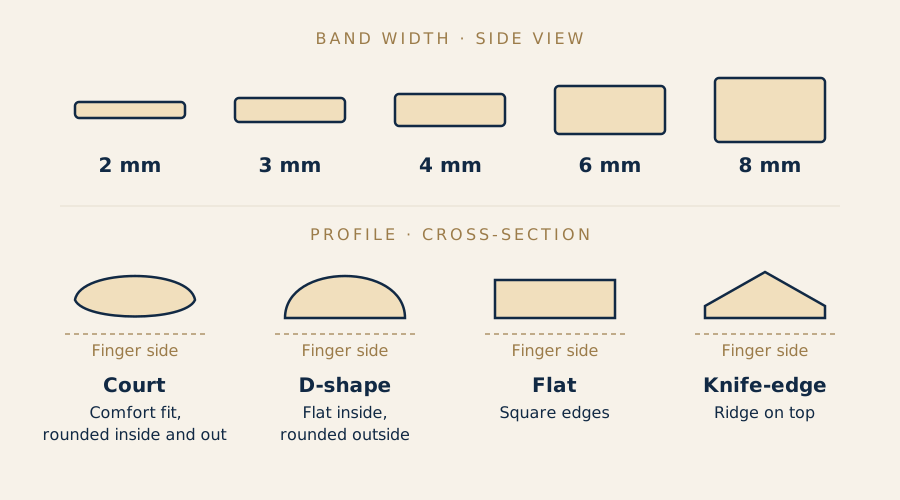
Width is where most matched sets deliberately differ. A band worn next to an engagement ring is usually kept narrow so the pair does not crowd the finger, while a band worn on its own can be wider. These are starting points, not rules:
| Band role | Common width | Why |
|---|---|---|
| Beside a solitaire engagement ring | 2–3 mm | Balances the engagement ring's band and centre stone |
| Worn alone, slimmer fingers | 3–4 mm | Visible without dominating the hand |
| Worn alone, larger fingers | 5–6 mm | Keeps proportion on a wider finger |
| Statement band | 7–8 mm and up | Bold look; usually needs a half size larger |
The profile is the shape of the band's cross-section, and it affects how a ring looks and feels far more than people expect. Sharing a profile is one of the neatest ways to link two bands of different widths. The main options are covered in our page on court, D-shape, flat and knife-edge profiles:
- Court (comfort fit): rounded inside and out, slides over the knuckle easily. The usual choice for wider bands.
- D-shape: flat inside, rounded outside. Classic, slightly slimmer feel.
- Flat: straight sides and a flat top. Modern and architectural.
- Knife-edge: two sloping faces meeting in a ridge. Looks finer than its width.
Wide bands fit tighter than narrow ones of the same size, because more of the finger is covered. For bands of about 6 mm or more, many people go up roughly half a size. Australia uses letter ring sizes (the same system as the UK), so get both partners sized in the width you will actually wear. If the wider band is for a male partner, our notes on how wide a men's band usually sits help with proportions.
Not sure which one is right?
Send us the stones you are looking at and our gemologist will tell you which to choose and why.
Can matching wedding bands have different finishes or diamonds?
Yes, and this is where coordinated pairs get interesting. The finish is the surface texture of the metal, and a shared finish links two rings almost as strongly as a shared metal.
- High polish: mirror-bright; shows fine scratches within weeks but can be re-polished.
- Brushed or satin: fine parallel lines; hides everyday marks well and is popular for men's bands.
- Sandblasted or matte: soft, frosted look; very forgiving, but wears towards polish on the high points.
- Hammered: small facets beaten into the surface; hides wear and looks handmade.
- Milgrain: a row of tiny metal beads along the edge; an easy shared detail on two different bands.
Diamonds are the other common difference. A popular pairing is a slim diamond band for one partner and a plain band in the same metal for the other, sometimes with a single flush-set diamond (a stone sunk into the metal so it sits level with the surface) in the plain band as a link. Small stones are typical in bands; anything from about 0.01 to 0.10 carat per stone is common, depending on band width. Our page on diamond sizes that suit a wedding band gives the mm-to-carat figures.
If diamonds are lab-grown in one band and natural in the other, that is fine too; both are real diamond and look the same to the eye. Just make sure you know which is which, and that the colour grades are close so the stones look consistent when the hands are side by side.
Engraving is the quietest way to match. Many couples with mismatched wedding bands engrave the same date, coordinates or a split phrase inside both rings, so the link is there even if no one else can see it.
How does the engagement ring change the choice?
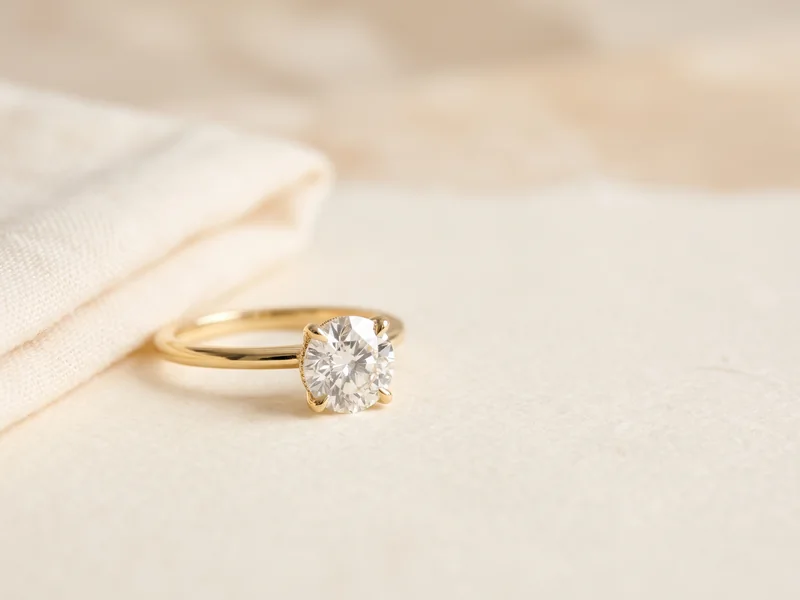
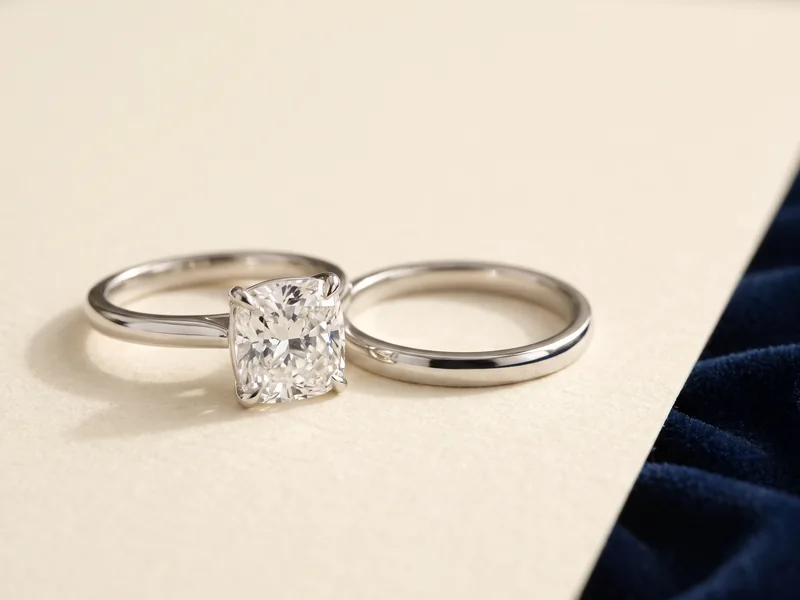
For the partner who wears an engagement ring, the wedding band has two jobs: pair with the engagement ring and pair with the other partner's band. When those pull in different directions, the engagement ring should usually win, because those two rings sit touching every day.
That means checking a few things before you settle on a matched set. Does the band need to be curved or notched to sit against a low-set stone? Our guide to curved and fitted bands shows how contoured bands work. Do you want the rings flush, or with a small space between them? See how much gap to leave between engagement ring and band. For a step-by-step method, start with pairing a band with your engagement ring.
Shape matters too. A square stone with corners, for example, needs different clearance from a round: our page on bands that sit neatly beside a princess cut covers that case. Once the engagement-side band is settled, the partner's band can be matched to it in metal, profile or finish.
Related guideFitted Wedding Bands Explained | Custom Curved BandsHow do work and lifestyle affect your wedding bands?
Two people rarely use their hands the same way. A nurse washing hands thirty times a shift, an electrician, a chef and an office worker all put very different stress on a ring. This is the most practical reason couples choose not to match exactly.
- Trades and manual work: a brushed or hammered finish hides marks; platinum or 18ct gold can be repaired, while tungsten carbide cannot. Metal rings conduct electricity, so electricians often remove them or wear a silicone band at work.
- Healthcare and food handling: a smooth, low, plain band with no stones is easier to keep clean and less likely to tear gloves.
- Sport and gym: a court profile is more comfortable when gripping; some people swap to a silicone band for training.
- Allergies: some white gold alloys contain nickel, which irritates some skin. Platinum and palladium are usually well tolerated.
Think about the future as well. Fingers change size with age, pregnancy, weight and climate, and Melbourne summers make many people's fingers swell a little. Gold and platinum bands can generally be resized by a size or two; titanium is very hard to alter and tungsten carbide cannot be resized at all. A fully diamond-set eternity band is also difficult to resize. The same thinking applies to engagement rings, as our guide to planning rings for future resizing explains.
How much do matching wedding bands cost in Australia?
Price follows metal, weight and width. A wider band uses more metal, so in a matched set the wider band usually costs noticeably more than the narrow one, even in the same alloy. These are broad ranges for plain bands and move with metal prices:
| Metal | Narrow band, about 2–3 mm (AUD) | Wider band, about 5–6 mm (AUD) |
|---|---|---|
| 9ct gold | about $400–$900 | about $700–$1,600 |
| 18ct gold | about $900–$2,000 | about $1,600–$3,800 |
| Platinum 950 | about $1,200–$2,600 | about $2,200–$4,800 |
| Titanium or tungsten carbide | about $150–$500 | about $200–$700 |
Adding diamonds raises the price according to the number and size of stones and how they are set. Our page on the cost difference between plain and diamond bands gives typical ranges, and the factors that drive wedding ring prices section covers weight, finish and custom work.
Custom matching wedding bands, designed together and made as a pair, let you control the exact alloy, profile, finish and engraving so the two rings genuinely belong together.
Create your wedding bands as a pair
How to choose wedding bands as a couple: step by step
- Decide your approach. Identical, matched set, coordinated or independent. Agree on this before looking at individual rings.
- Settle the engagement-side band first. Check fit against the engagement ring, including any curve or gap needed.
- Choose the metal. Consider colour, wear, allergies and whether you will want to resize later.
- Pick widths for each hand. Try on several widths; about 2–3 mm beside an engagement ring and 4–6 mm for a band worn alone are common starting points.
- Agree on a profile and finish. Sharing one or both is the simplest way to link two different widths.
- Get sized properly. Size both partners in the actual width, at a normal temperature, ideally later in the day.
- Add the personal link. Engraving, a flush-set stone or milgrain edges tie the pair together.
- Allow time. Custom bands often take about 3–6 weeks, so order well before the wedding.
Free consultation
Talk to a gemologist
Compare stones in person or online with Raj Sood, Graduate Gemologist (GIA), AJP (GIA).
Book a consultationShop this shape
FAQ
Common questions
Do wedding rings have to match?
No. There is no rule that couples' wedding rings must match. Many couples choose a matched set in the same metal, while others coordinate one detail or choose entirely different rings.
Is it bad luck to have mismatched wedding bands?
No. That is a superstition with no basis. Mismatched wedding bands are common, especially when partners have very different hand sizes, jobs or tastes.
Should his and hers wedding bands be the same width?
Usually not. A band beside an engagement ring is often about 2–3 mm, while a band worn alone is often about 4–6 mm, so each suits its hand while still matching in metal and profile.
Can we mix white gold and platinum in matching bands?
Yes. They look almost identical when new, but rhodium-plated white gold can slowly show a warmer tone as the plating wears, so plan to have it re-plated periodically.
What is the easiest way to make different bands look like a pair?
Share the metal colour and finish. A matching engraving inside both rings is another simple link that works with any design.
How long do custom matching wedding bands take?
Often about 3–6 weeks from design approval, depending on complexity and diamonds. Allow extra time for sizing and any engraving.

Ask a gemologist
Not sure which diamond to choose?
Raj Sood is a Graduate Gemologist (GIA) and master jeweller. Bring the stones you are considering, or send the reports, and he will tell you honestly which one is better and why.
Keep learning
Related guides
 Wedding Bands & EternityHow to Match a Wedding Band to an Engagement Ring
 Wedding Bands & EternityMen’s Wedding Band Guide
 Wedding Bands & EternityWedding Band Profiles Explained
 Wedding Bands & EternityPlain vs Diamond Wedding BandsWedding Bands & EternityWedding Ring Buying Guide
 Wedding Bands & EternityWedding Ring vs Wedding Band
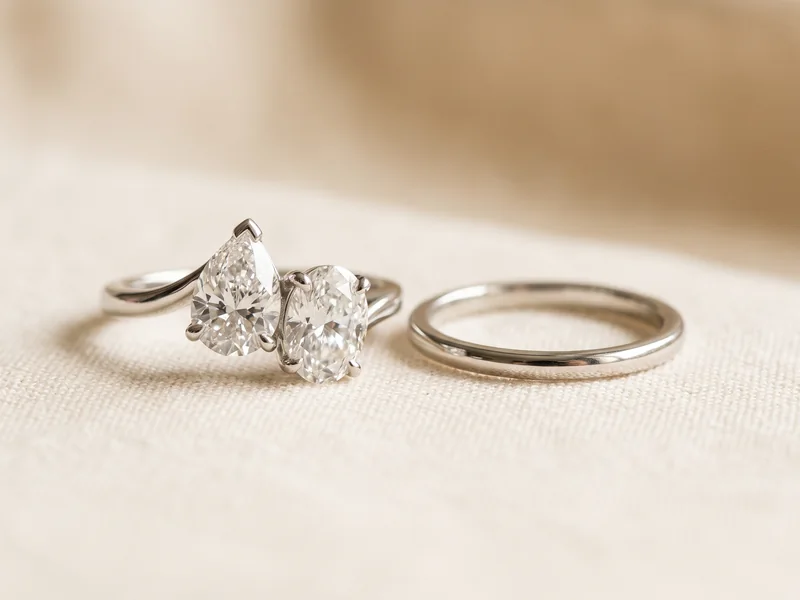 Wedding Bands & EternityHow Big Should Diamonds Be in a Wedding Band?
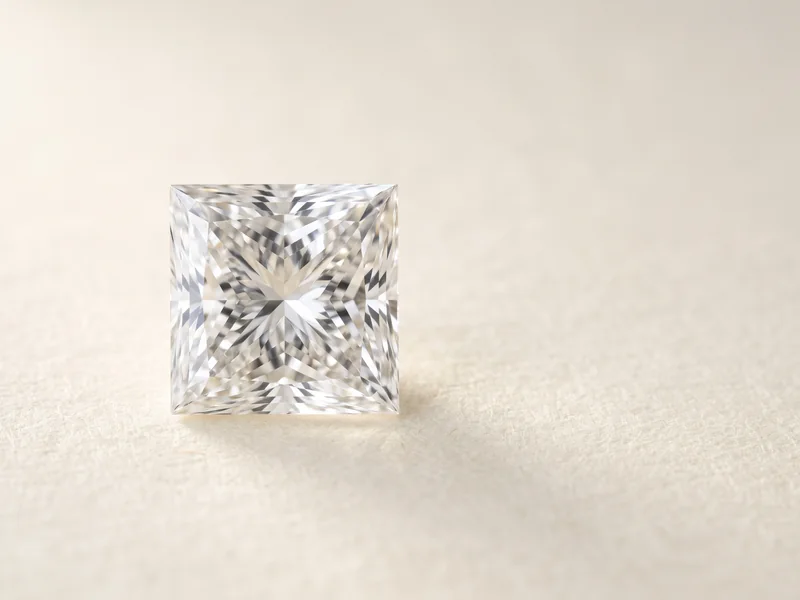 Wedding Bands & EternityBest Wedding Band for Princess Engagement Rings
Explore more
More guides on this topic
Education