
- Education
- Wedding Bands & Eternity
- Wedding Band Diamond Size: How Big Should Diamonds Be in a Wedding Band?
Wedding Bands & Eternity
Wedding Band Diamond Size: How Big Should Diamonds Be in a Wedding Band?
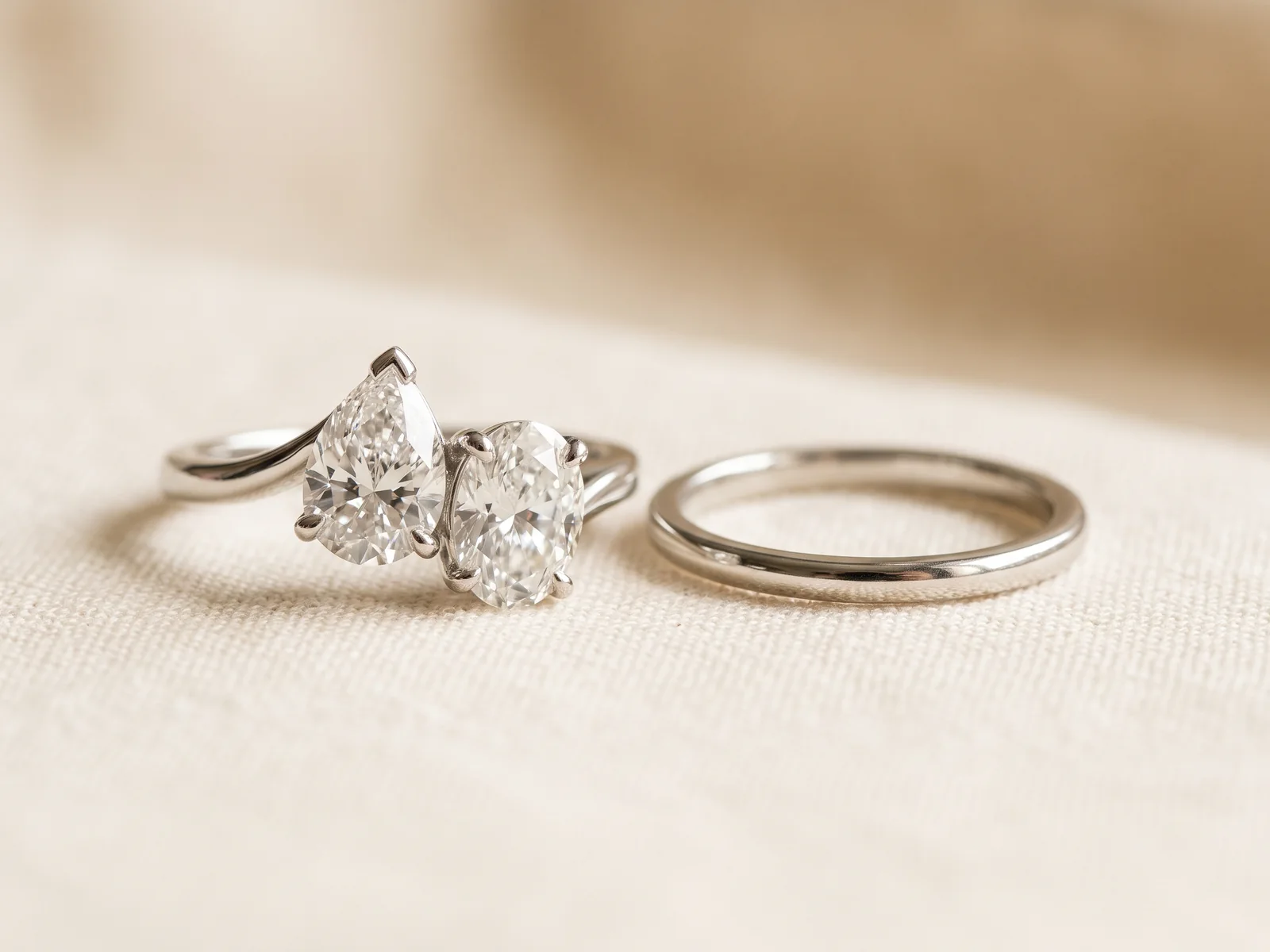
Getting the wedding band diamond size right is what makes a bridal set look planned rather than pieced together. Here are the real millimetre and carat figures, matched to band widths, settings and every engagement ring shape.
 Reviewed by Raj Sood, Graduate Gemologist (GIA), AJP (GIA)Master jeweller and Graduate Gemologist (GIA) · reviewed 4 November 2026
Quick answer
Most diamond wedding bands use stones of about 1.5–2.5 mm (roughly 0.015–0.06 carat each), on a band 2–3 mm wide. Go smaller, 1.0–1.8 mm, beside a delicate engagement ring; 2.5–3.5 mm for a bolder eternity look. The right wedding band diamond size keeps the band visually lighter than your centre stone and level with its setting.
What is the usual wedding band diamond size?
Most diamond wedding bands in Australia are set with round brilliant diamonds between about 1.5 mm and 2.5 mm across. In the trade these are called melee (said 'mel-ay'), the word jewellers use for small diamonds, usually anything under about 0.20 carat. A 2 mm round weighs roughly 0.03 carat, or 3 points (one point is one hundredth of a carat), so even a band full of them often adds up to less than a carat in total.
When people ask how big the diamonds in a wedding band should be, they usually mean the size of each stone, not the total weight. A band described as '0.50 ct' might hold eight 2.5 mm diamonds or fifty 1.3 mm diamonds, and the two look completely different on the hand. That is why jewellers talk in millimetres first and carats second. Here is how the common sizes read when worn:
- Under 1.3 mm (micro-pavé): a fine line of glitter. It reads as texture rather than as separate stones.
- 1.3–1.8 mm: delicate. The most common choice beside a solitaire on a fine band.
- 1.8–2.5 mm: the classic eternity look. Each diamond is visible from normal talking distance.
- 2.5–3.5 mm: bold. The band becomes a statement piece that can be worn on its own.
- Over 3.5 mm: uncommon beside an engagement ring; more typical of a stand-alone eternity or anniversary ring.
If you are still deciding whether you want stones at all, start with our comparison of plain metal and diamond-set wedding bands. For the bigger decisions around metal, width and budget, see the complete wedding ring buying guide. Whether you call it a ring or a band, the sizing logic here is identical; our explainer on the difference between a wedding ring and a wedding band covers the naming.
How do millimetres convert to carats for small diamonds?
Carat is a weight (one carat is 0.2 grams), and weight grows much faster than width. Because a diamond is a three-dimensional shape, doubling the diameter multiplies the weight by roughly eight. A 3 mm round weighs about 0.10 carat, close to seven times a 1.5 mm round at about 0.015 carat, even though it is only twice as wide. The table shows approximate figures for well-cut round brilliants, plus how many fit around a full eternity band in Australian ring size N.
| Round diameter | Approx. weight each | Points | Full eternity, size N (stones) | Approx. total weight |
|---|---|---|---|---|
| 1.0 mm | 0.005 ct | 0.5 pt | micro-pavé only | — |
| 1.3 mm | 0.01 ct | 1 pt | about 38–42 | about 0.40 ct |
| 1.5 mm | 0.015 ct | 1.5 pt | about 33–36 | about 0.50 ct |
| 1.8 mm | 0.023 ct | 2.3 pt | about 28–31 | about 0.70 ct |
| 2.0 mm | 0.03 ct | 3 pt | about 25–28 | about 0.80 ct |
| 2.5 mm | 0.06 ct | 6 pt | about 21–23 | about 1.30 ct |
| 3.0 mm | 0.10 ct | 10 pt | about 18–20 | about 1.90 ct |
| 3.5 mm | 0.16 ct | 16 pt | about 15–17 | about 2.50 ct |
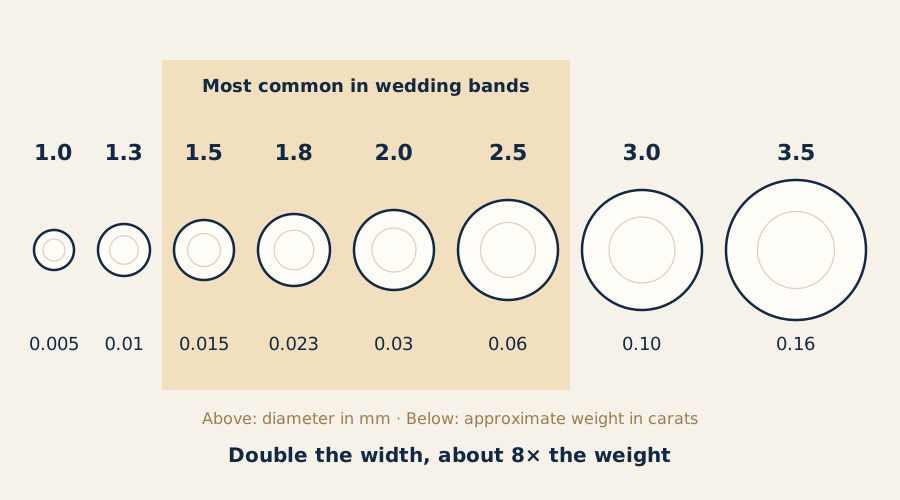
A half eternity band, with diamonds across the top only, usually carries about 40–50% of the full eternity figure: roughly 11–14 stones at 2 mm. Larger ring sizes need more stones, so the total carat weight of the same design rises as the size goes up. When you compare bands online, check the stone diameter and the stone count, not only the total carat weight. Any term here you have not met before, from pavilion to girdle, is in our plain-English jewellery glossary.
How wide should a diamond wedding band be?
The diamonds have to sit inside the band with enough metal around them to hold them safely. As a working rule, the band is about 0.3–0.8 mm wider than the stones, depending on the setting. Shared claws can let a stone sit almost the full width of the band, while a channel needs a wall of metal on each side, typically around 0.3–0.4 mm.
| Band width | Typical stone size | How it reads |
|---|---|---|
| 1.6–1.8 mm | 1.0–1.3 mm | Very fine; suits a slim solitaire |
| 2.0 mm | 1.3–1.7 mm | Fine; the most common width beside a solitaire |
| 2.5 mm | 1.8–2.2 mm | Classic eternity band |
| 3.0 mm | 2.2–2.7 mm | Bold; stones clearly visible |
| 3.5–4.0 mm | 2.7–3.3 mm | Statement band, often worn alone |
| 5–7 mm (men's, flush set) | 1.5–3.0 mm | Single stones or a row set into a wide band |
Height matters as much as width. A well-cut round diamond is about 60% as deep as it is wide, so a 2.5 mm stone is roughly 1.5 mm from table (the flat top facet) to culet (the bottom point). The band needs to be tall enough, usually about 2.0–2.4 mm for that stone, that the pavilion (the pointed underside) never touches your finger. Bigger stones mean a taller band, and a taller band changes how it sits beside your engagement ring. The shape of the band in cross-section also affects comfort and look; our guide to band profiles such as flat, court and knife-edge explains each one.
A simple visual guide: keep the wedding band within about 0.5 mm of the width of your engagement ring's band (its shank). A 3 mm diamond band beside a 1.8 mm engagement shank looks heavy; a 1.6 mm band beside a 3 mm shank can look like an afterthought.
How do you match wedding band diamond size to your engagement ring?
There are three relationships to get right: the band against the shank, the band diamonds against any shoulder stones (small diamonds down the sides of the engagement ring), and the band diamonds against the centre stone.
- Continue the shoulder line. If your engagement ring has 1.3 mm pavé shoulders, band diamonds of 1.3–1.5 mm carry the same line across both rings. Jumping to 2.5 mm looks like two unrelated rings.
- Stay under the centre. As a guide, most balanced sets keep band diamonds at no more than about a third of the centre stone's width. Beside a 1 carat round of about 6.4 mm, that is roughly 2 mm or less; beside a 0.50 carat round of about 5.1 mm, around 1.7 mm.
- Match the height. Band diamonds that sit higher than the shoulder stones make the set look stepped, and the band takes every knock first.
- Match colour. Small diamonds show little colour on their own, but next to a very white centre, warm band stones can look yellow. Aim to keep them within one or two colour grades of the centre.
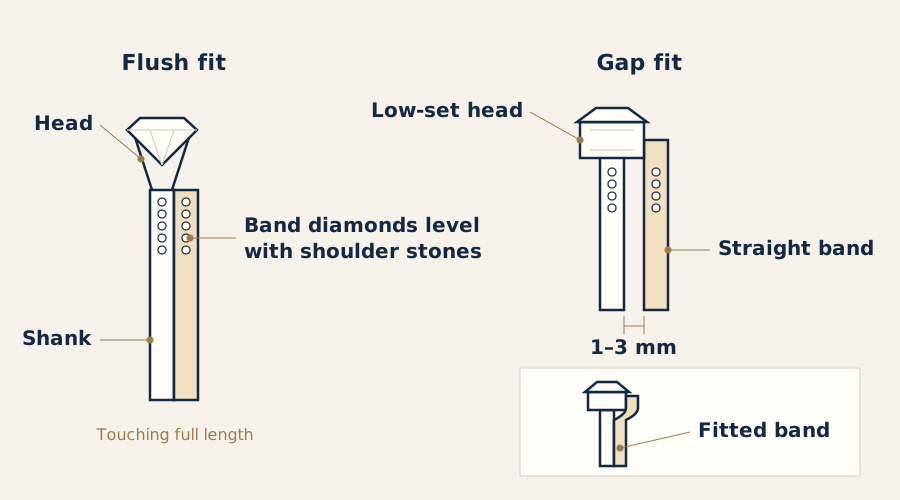
The side view is where most sets succeed or fail. If the engagement ring's setting sits low, the head (the part holding the centre stone) can touch a straight band and leave a gap of 1–3 mm between the rings. Some people like that gap; others want the two rings touching along their full length. Our guide on how much gap is normal between an engagement ring and band covers the options. Where a straight band will not sit flush, a notched or curved band shaped around the setting solves it, and the diamonds in a curved band are often a size smaller so they follow the contour neatly.
For the full process of choosing metal, width and profile together, see matching a wedding band to your engagement ring step by step. If the engagement ring is not made yet, it is worth reading about designing both rings at the same time, because the setting height can be planned so a diamond band sits flush without any curve.
Related guideHow Much Gap Should There Be Between an Engagement Ring and Wedding Band?Not sure which one is right?
Send us the stones you are looking at and our gemologist will tell you which to choose and why.
What size band diamonds suit each engagement ring shape?
Most pairing advice stops at round solitaires. The shape of your centre stone changes how much room there is beside it, and which band diamonds look like they belong. These figures assume a centre of about 1 carat; scale down slightly for smaller centres and up for larger ones.
| Centre shape (about 1 ct) | Approx. centre size | Band diamonds often chosen | What to watch |
|---|---|---|---|
| Round | 6.4 mm | 1.8–2.2 mm rounds | The easiest pairing; a straight band usually sits flush if the head is high enough |
| Oval | 7.7 × 5.7 mm | 1.5–2.2 mm rounds | Set north-south, it rarely overhangs; set east-west, check the side profile |
| Princess | 5.5 × 5.5 mm | 1.8–2.2 mm rounds or 1.5–2.0 mm princess in a channel | Square corners can catch; channel-set squares echo the straight lines |
| Emerald | 7.0 × 5.0 mm | 2.5 × 1.5 mm baguettes or 1.5–2.0 mm rounds | Step-cut band stones suit the step-cut centre |
| Cushion | 5.8 × 5.5 mm | 1.8–2.2 mm rounds | Often has a halo; match the halo stones |
| Pear | 8.5 × 5.5 mm | 1.3–1.8 mm rounds | The point often overhangs; a curved or V band follows it |
| Marquise | 10.0 × 5.0 mm | 1.3–1.8 mm rounds | Two points; a chevron or contour band avoids a gap |
| Heart | 6.8 × 6.3 mm | 1.5–2.0 mm rounds | Wide lobes; a contoured band sits closest |
| Any shape with a halo | Halo stones about 1.0–1.5 mm | Within about 0.2 mm of the halo stones | Matching halo and band stones makes one continuous field of sparkle |
Princess cuts are the shape people most often get wrong, because the corners sit close to the band and a large round-diamond band can look fussy against its clean lines. Our guide to bands that suit a princess cut goes through channel, claw and plain options. For pears and marquises, the smaller 1.3–1.8 mm range is usually chosen because those stones go into a contour band that follows a pear or marquise point, and smaller diamonds curve around a tight bend more cleanly.
Which band setting suits which diamond size?
The setting style and the stone size work together. Some settings only suit tiny stones, while others need a decent stone to look right.
| Setting | Usual stone size | Strengths | Watch for |
|---|---|---|---|
| Micro-pavé | 0.8–1.3 mm | Fine, even sparkle on a slim band | Tiny metal beads wear; needs regular checks |
| Pavé (bead or grain set) | 1.2–2.0 mm | Lots of sparkle, little metal showing | Beads wear down over years of wear |
| Shared claw | 1.5–3.5 mm | Most light in, stones look larger | Claws can catch on knits and wear thin |
| Channel | 1.5–3.0 mm; also princess and baguettes | Smooth sides, stones well protected | Slightly less light; harder to resize |
| Bezel or half-bezel | 2.0–3.5 mm | Very secure | More metal, stones look a little smaller |
| Flush (gypsy) | 1.5–3.0 mm | Nothing to catch; suits wide and men's bands | Needs thick metal; less sparkle |
Diamond is 10 on the Mohs hardness scale and has a refractive index of about 2.42, so the stones themselves resist scratching and sparkle well even at 1.5 mm. The weak point in a diamond band is almost always the metal holding the stones, not the diamonds. Claws and beads thin with wear, and a stone can work loose long before it would ever be damaged. Platinum claws tend to bend rather than snap and wear slowly, while many jewellers prefer 18ct gold to 9ct for fine settings, as 9ct can be more brittle in thin claws. Smaller stones mean smaller claws and beads, which is why micro-pavé bands need checking more often than a channel or flush-set band.
Are bigger diamonds in a wedding band less practical for everyday wear?
Bigger stones sit higher above the metal and have larger claws, so they take more knocks. If you work with your hands, garden, lift weights or wear gloves often, smaller stones (1.3–1.8 mm) in a channel or flush setting are the practical choice. If your hands have an easier time, 2–3 mm claw-set stones wear perfectly well with a check-up every year or so. Our guide on how your lifestyle should shape ring design applies just as much to the band.
- Full eternity bands have diamonds all the way around. They usually can only be resized by about half a size, if at all, so your size needs to be right the first time.
- Half or three-quarter eternity bands leave plain metal underneath, which can be cut and resized, and the palm side is spared from wear.
- Bigger stones on the palm side of a full eternity band can press on neighbouring fingers and tend to collect knocks.
- Finger size changes with heat, pregnancy and age, so leaving room to resize is sensible.
If you expect your finger size to change, read about planning rings for future resizing before choosing a full eternity. And if you want words inside the band, a solid half eternity leaves a clean inner surface; our ideas on wedding ring engraving that still reads well in decades suit almost any band width over 2 mm.
How big should diamonds be in a men's wedding band?
Men's bands are usually wider, about 5–8 mm, and the diamonds are mostly flush set, sunk into the metal so nothing sticks up. Common layouts are a single flush-set diamond of 2–3 mm (about 0.03–0.10 carat), three stones of 1.5–2.5 mm across the top, or a channel row of 1.5–2.0 mm stones. The thicker metal that a flush setting needs suits a wide band anyway. Avoid going above about 3 mm in a flush setting unless the band is at least 2.5 mm thick, as the stone needs depth to sit in. Our guide to men's wedding bands covers widths, profiles and metals in more detail.
How much does a diamond wedding band cost in Australia, natural or lab-grown?
Small diamonds are usually sold and set in matched parcels graded to a range, such as F–G colour and VS–SI clarity, rather than with an individual report for each stone. At 1.5–2.5 mm, clarity differences are very hard to see, so VS to SI is the common choice. Colour matters more when the band sits beside a very white centre.
Bands are made with natural diamonds or with lab-grown diamonds, which are real diamond grown in a laboratory rather than mined. Lab-grown diamonds cost much less than natural, but in small sizes the metal and the hours of setting work make up a larger share of the price, so the gap between the two is smaller than it is for a 1 carat centre stone. Whichever you choose, your paperwork should state clearly whether the band diamonds are natural or lab-grown, including when they are paired with a centre of the other type.
| 18ct white gold band, size N | Natural diamonds (approx. AUD) | Lab-grown diamonds (approx. AUD) |
|---|---|---|
| Half eternity, 1.5 mm stones (about 0.20 ct) | $1,500–$2,800 | $1,200–$2,200 |
| Half eternity, 2.0 mm stones (about 0.40 ct) | $2,000–$3,800 | $1,500–$2,800 |
| Full eternity, 2.0 mm stones (about 0.80 ct) | $3,000–$6,000 | $2,000–$3,800 |
| Full eternity, 2.5 mm stones (about 1.30 ct) | $4,500–$9,000 | $2,500–$4,500 |
These are broad ranges only. Platinum usually costs more than 18ct gold, larger ring sizes need more stones and metal, and gold prices move. If you are budgeting for both rings, our section on budgeting for an engagement ring and band together walks through where the money goes.
Create your eternity ring or wedding band
How do you choose the diamond size for your wedding band? Step by step
- Measure your engagement ring. Note the shank width, the size of any shoulder or halo stones, and the centre stone's measurements in millimetres.
- Set a ceiling. Keep band diamonds to no more than about a third of the centre stone's width, and close to the shoulder stones if you have them.
- Pick the band width. Aim within about 0.5 mm of the engagement shank, then allow 0.3–0.8 mm of metal around the stones for the setting.
- Choose the setting for your life. Claw or pavé for the most sparkle; channel or flush for hands-on work.
- Check the side view. Make sure the band sits flush or with a gap you are happy with, and consider a fitted band if the head sits low; see our notes on checking the gap between the two rings.
- Decide full or partial eternity. Choose half or three-quarter if your finger size may change.
- Confirm the stones. Ask for the stone diameter, count, colour and clarity range, and whether the diamonds are natural or lab-grown.
Free consultation
Talk to a gemologist
Compare stones in person or online with Raj Sood, Graduate Gemologist (GIA), AJP (GIA).
Book a consultationShop this shape
FAQ
Common questions
What size diamonds are in most wedding bands?
Most diamond wedding bands use round diamonds of about 1.5–2.5 mm, roughly 0.015–0.06 carat each. Micro-pavé bands go below 1.3 mm, and statement eternity bands go up to 3–3.5 mm.
Is a 2 mm diamond wedding band too big?
Not usually. A 2 mm stone suits a band about 2.5 mm wide and sits comfortably beside most centre stones of 0.75 carat and up. Beside a very fine solitaire under half a carat, 1.3–1.7 mm often looks more balanced.
How many carats is a diamond eternity band?
It depends on stone size and ring size. In size N, a full eternity of 1.5 mm stones totals about 0.50 carat, 2 mm stones about 0.80 carat and 2.5 mm stones about 1.30 carat; a half eternity is roughly 40–50% of that.
Should my wedding band diamonds match my engagement ring?
They should be close in size to any shoulder stones and within one or two colour grades of the centre. They do not need to be the same shape, but similar cutting styles, such as baguettes beside an emerald cut, look more planned.
Can you resize a diamond wedding band?
A half or three-quarter eternity band can usually be resized through the plain metal underneath. A full eternity band generally can only move about half a size, if at all, because there is no plain section to cut.
Are lab-grown diamonds suitable for a wedding band?
Yes. Lab-grown diamonds are real diamond with the same hardness and sparkle, and they cost less than natural, though the saving is smaller in tiny sizes because setting labour is a large part of the price. The band's paperwork should state that the diamonds are lab-grown.

Ask a gemologist
Not sure which diamond to choose?
Raj Sood is a Graduate Gemologist (GIA) and master jeweller. Bring the stones you are considering, or send the reports, and he will tell you honestly which one is better and why.
Keep learning
Related guides
 Wedding Bands & EternityHow to Match a Wedding Band to an Engagement RingWedding Bands & EternityHow Much Gap Should There Be Between an Engagement Ring and Wedding Band?
 Wedding Bands & EternityFitted Wedding Bands Explained | Custom Curved Bands
 Wedding Bands & EternityPlain vs Diamond Wedding BandsWedding Bands & EternityWedding Ring Buying Guide
 Wedding Bands & EternityWedding Ring vs Wedding Band
 Wedding Bands & EternityMen’s Wedding Band Guide
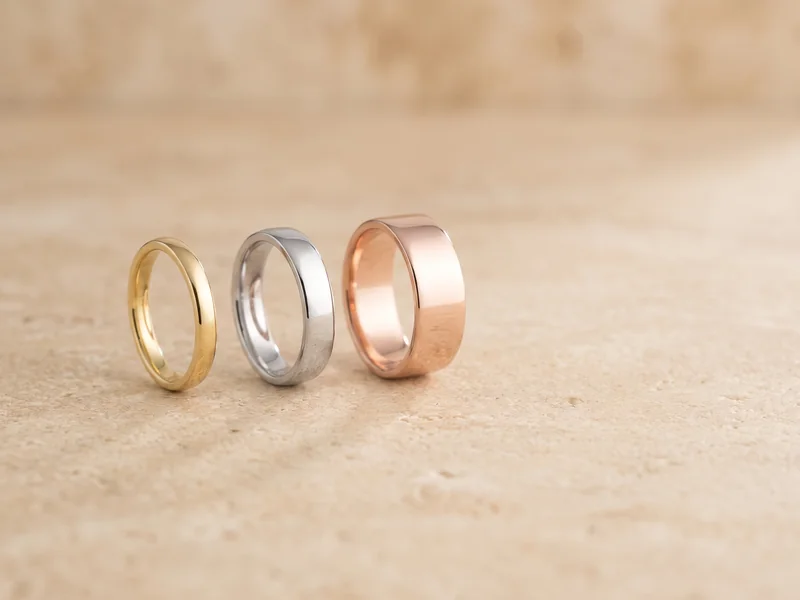 Wedding Bands & EternityWedding Band Profiles Explained
Explore more
More guides on this topic
Education