
- Education
- Diamond 4Cs & Grading
- VS1 vs VS2 Diamond: Can You See the Difference?
Diamond 4Cs & Grading
VS1 vs VS2 Diamond: Can You See the Difference?
VS1 and VS2 sit side by side on the clarity scale, and the price gap between them can pay for a better colour or a slightly bigger stone. Here is how to tell when the step up to VS1 actually changes what you see.
 Reviewed by Raj Sood, Graduate Gemologist (GIA), AJP (GIA)Master jeweller and Graduate Gemologist (GIA) · reviewed 4 November 2026
Quick answer
The difference between a VS1 vs VS2 diamond is visible only under magnification. Both are Very Slightly Included: a VS1's inclusions are harder to find at 10x, a VS2's slightly easier. In round diamonds under about 2 carats both are normally eye-clean, so VS2 usually gives the same look for less; VS1 suits large or step-cut stones.
VS1 vs VS2 diamond clarity: what is the difference?
Clarity describes how free a diamond is from inclusions (tiny features inside the stone, such as crystals or small cracks) and blemishes (marks on the surface). It is one of the four grading factors, alongside colour, cut and carat; our page on how clarity fits into the 4Cs explains how they work together.
VS stands for Very Slightly Included. GIA, the Gemological Institute of America, describes both VS grades the same way: inclusions are seen with effort under 10x magnification and can be called minor. The 1 and 2 simply split that band in two. In a VS1, the inclusions take more effort to find. In a VS2, a trained grader finds them a little more readily, because they are slightly larger, more numerous, darker or better placed to be seen.
| VS1 | VS2 | |
|---|---|---|
| Position on GIA scale | 5th of 11 grades | 6th of 11 grades |
| Seen at 10x | With effort, often only from certain angles | With effort, but found more quickly |
| Seen with the naked eye | Almost never | Rarely; most often in large or step-cut stones |
| Typical grade-setting inclusion | A small crystal, pinpoint or short feather near the edge | A slightly larger crystal, small cloud or feather, sometimes under the table |
| Price | A modest step above VS2 | The usual value point for an eye-clean stone |
| Most sensible for | Emerald and asscher cuts, 3 ct and above | Round and most fancy shapes up to about 2 ct |
The key point is that the grade is a judgement about magnified appearance. It does not measure durability, sparkle or brightness. Two diamonds a grade apart can look identical on the hand, and a well-placed VS2 can face up cleaner than a poorly placed VS1. If any of the grading words are new to you, our jewellery glossary of grading terms defines them in plain English.
Where do VS1 and VS2 sit on the diamond clarity scale?
GIA's scale has 11 grades in six groups. Most other labs, including IGI, use the same names. Clarity is graded by a trained grader with a 10x loupe (a small magnifying lens) or microscope, looking at the diamond face-up and from the side.
| Grade | Name | What a grader sees at 10x |
|---|---|---|
| FL | Flawless | No inclusions or blemishes |
| IF | Internally Flawless | No inclusions; only minor surface blemishes |
| VVS1 / VVS2 | Very Very Slightly Included | Inclusions extremely difficult to very difficult to see |
| VS1 / VS2 | Very Slightly Included | Minor inclusions, seen with effort |
| SI1 / SI2 | Slightly Included | Inclusions noticeable at 10x; sometimes visible to the eye in SI2 |
| I1 / I2 / I3 | Included | Obvious inclusions that may affect transparency, brilliance or durability |
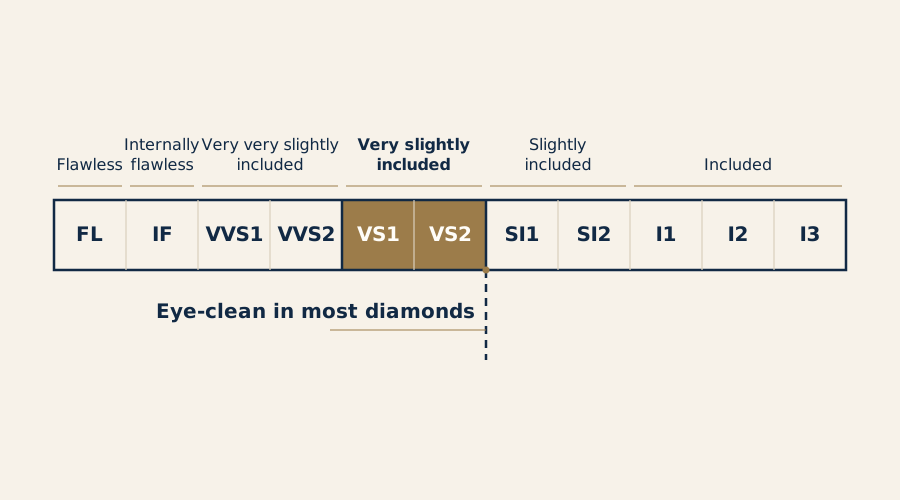
VS sits just above the line where most people begin to see inclusions without help. That is why the two VS grades come up so often in Australian ring shopping: they are the lowest grades where you can expect an eye-clean stone almost every time. For the full picture at each grade, see our VS1 clarity guide, or browse the full diamond education library for the other grades and factors.
Can you see the difference between a VS1 vs VS2 diamond?
With the naked eye, in normal light, at a normal viewing distance of about 25–30 cm: almost never. A diamond is called eye-clean when you cannot see any inclusion that way, face-up. Nearly all VS1 diamonds are eye-clean, and the large majority of VS2 diamonds are too, especially round brilliants.
Under a 10x loupe, a grader can usually tell the two apart, but even then it takes a minute. In a VS1 you may need to tilt the stone and search the edges. In a VS2 the grade-setting inclusion (the main one that decides the grade) is often easier to find, sometimes sitting under the table, the large flat facet on top.
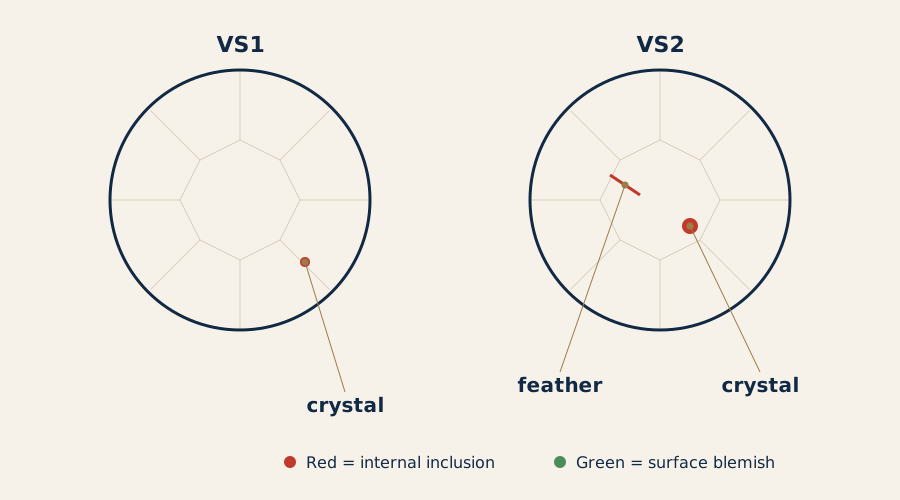
Five things decide how visible an inclusion is, and why two stones with the same grade can look different:
- Size: bigger inclusions are easier to see. In a 3 ct stone, a VS2 inclusion is physically larger than the same grade in a 0.50 ct stone.
- Number: one tiny crystal versus a scatter of pinpoints.
- Position: under the table is most visible; near the girdle (the outer edge) it is easy to hide under a claw.
- Nature: what type of inclusion it is, such as a crystal, feather or cloud.
- Relief: how much it contrasts with the diamond. A dark crystal stands out; a white or colourless one blends into the sparkle.
Our page on the VS2 clarity grade in detail shows how each of these plays out across real stones.
What inclusions do VS1 and VS2 diamonds usually have?
VS diamonds carry the same kinds of inclusions you find in any diamond, just smaller and fainter. The plotting diagram on a GIA report, a map of the stone with each inclusion marked in red (internal) or green (surface), tells you what is there and where.
| Inclusion | What it is | Concern at VS level |
|---|---|---|
| Crystal | A tiny mineral grain trapped as the diamond formed, sometimes another diamond | Low if colourless; a dark crystal under the table is the one to check |
| Pinpoint | A crystal so small it looks like a dot at 10x | Very low |
| Cloud | A cluster of pinpoints that can look hazy | Low; large clouds can soften brightness, rare at VS |
| Feather | A small internal crack | Low at VS, but avoid one that reaches the surface at the girdle or a corner |
| Needle | A long, thin crystal | Low |
| Twinning wisp | Pinpoints and clouds along a growth plane | Low |
| Indented natural | A trace of the original crystal surface dipping into the stone at the girdle | Very low; usually hidden by the setting |
Some features are not natural inclusions at all. A laser drill hole is a treatment: a fine tunnel burned into the stone to reach a dark inclusion and bleach or dissolve it. It must be disclosed, and GIA plots it on the report. Our guide to laser drill holes and what they mean for clarity explains how to spot one. Surface marks such as pits and extra facets and polishing burn marks and lizard skin are blemishes; at VS they rarely affect the grade, but they are worth understanding when you read a report.
If the report's key to symbols uses a term you have not met, our definitions of feather, cloud and crystal cover each one.
Not sure which one is right?
Send us the stones you are looking at and our gemologist will tell you which to choose and why.
Is VS2 eye-clean in every shape and size?
Not always. Facet pattern and size change how well a diamond hides its inclusions. Brilliant cuts (round, oval, pear, cushion, radiant, princess) break light into many small flashes, which disguises small features. Step cuts (emerald and asscher) have long, parallel facets and a large open table, which works like a window into the stone. Our overview of how each diamond shape handles light and the guide to all 34 diamond cuts and their facet styles show which shapes fall into each group.
| Shape and size | VS2 | VS1 |
|---|---|---|
| Round, under 2 ct | Eye-clean almost every time | Eye-clean; usually no visible benefit |
| Oval, pear, cushion, under 2 ct | Usually eye-clean; check the table area | Eye-clean |
| Round or fancy brilliant, 2–3 ct | Usually eye-clean; check each stone | Eye-clean |
| Emerald or asscher, any size | Check carefully; some show an inclusion | Safer choice |
| Any shape, 3 ct and above | Check each stone closely | Safer choice |
Elongated brilliants hide inclusions well, which is one reason a VS2 is a common choice in oval diamonds for engagement rings. For very large stones, where a VS2 inclusion can be big enough to catch the eye, our page on clarity choices in 6 to 10 carat diamonds goes further. The setting matters too: an inclusion near the girdle can sit under a claw, while a bezel (a metal rim around the stone) covers the whole edge.
How much more does a VS1 diamond cost than VS2 in Australia?
Clarity has a smaller effect on price than carat weight, colour or cut. For natural diamonds, the step from VS2 to VS1 is real but modest, and it grows in dollar terms as stones get larger. For lab-grown diamonds, the gap in dollars is small because the whole price is lower.
| Round, G colour, excellent cut | VS2 (approx. AUD) | VS1 (approx. AUD) |
|---|---|---|
| 1 ct natural | about $7,000–$12,000 | about $7,500–$13,000 |
| 2 ct natural | about $25,000–$40,000 | about $28,000–$45,000 |
| 1 ct lab-grown | about $800–$1,800 | about $900–$2,000 |
| 2 ct lab-grown | about $1,800–$4,000 | about $2,000–$4,500 |
These are broad ranges only; prices move with the market and with each stone's exact grades, report and cut quality. What they show is the pattern: on a natural 1 ct round the VS1 premium is often a few hundred to around a thousand dollars, which could instead buy a colour grade higher or a slightly larger stone. Shape moves the price too, as our price per carat comparison across shapes sets out. If size matters to you, see ways to make a diamond look bigger for the money, and for the trade-offs across all four factors, read about weighing colour, cut and carat against clarity.
Browse VS1 and VS2 diamonds: natural and lab-grown
Does VS1 vs VS2 matter for lab-grown diamonds?
Lab-grown diamonds are real diamond, grown in a laboratory rather than mined, with the same hardness (10 on the Mohs scale) and refractive index (about 2.42) as natural diamond. Most lab-grown diamonds sold in Australia are graded by IGI on the same clarity scale, so VS1 and VS2 mean the same thing to the eye.
The inclusions differ a little. Diamonds grown by HPHT (high pressure, high temperature) can contain small metallic flux inclusions left from the growth process, which may look dark. Diamonds grown by CVD (chemical vapour deposition) can show dark pinpoints of non-diamond carbon or faint growth lines. At VS level these are small, but a dark inclusion under the table is worth a second look.
Because the price step between lab-grown VS2 and VS1 is often only a hundred or two dollars, many people simply choose VS1 or higher in lab-grown. In natural diamonds the larger dollar gap makes the decision more worth thinking through.
When is VS1 worth it over VS2?
VS1 is the smart pick when it lowers a real risk of seeing something. VS2 is the smart pick when that risk is already close to zero. In practice:
- Choose VS1 for emerald and asscher cuts, for stones over about 3 ct, for a bezel-free setting where the whole stone is on show, or when you would simply feel better knowing the inclusions are harder to find.
- Choose VS2 for round brilliants and most fancy brilliants under about 2 ct, where the facets hide small inclusions and the saving can go towards cut, colour or size.
- Either works in a halo or a multi-stone design, where the eye moves across many stones at once.
- Check closely either way if the grade-setting inclusion is a dark crystal under the table or a feather reaching the surface.
Read more on when a VS1 earns its price and on choosing an eye-clean VS2 before you shortlist stones.
Related guideVS2 Clarity DiamondsHow do you choose between VS1 and VS2? Step by step
- Start with shape and size. Round or fancy brilliant under 2 ct: VS2 is a sound starting point. Step cut or 3 ct and above: start at VS1.
- Read the report. Confirm the clarity grade, the lab, and whether the diamond is natural or lab-grown, and note any treatment such as laser drilling.
- Find the grade-setting inclusion. It is usually listed first under clarity characteristics. Check its type and where it sits on the plotting diagram.
- Check its position. Near the girdle is easy to hide; under the table is the area to look at most closely.
- Watch a magnified video or view the stone in person. Look face-up at a normal distance first, then under magnification.
- Compare the price step. Put the VS1 premium next to what it would buy in colour, cut or size, and decide which you would notice more.
For the other grading factors you will weigh alongside clarity, see more grading guides from GemTrove.
Free consultation
Talk to a gemologist
Compare stones in person or online with Raj Sood, Graduate Gemologist (GIA), AJP (GIA).
Book a consultationFAQ
Common questions
Is VS1 better than VS2?
VS1 is one grade higher, meaning its inclusions are harder to find under 10x magnification. To the naked eye the two usually look the same, so VS1 is not necessarily the better choice for your money.
Is a VS2 diamond eye-clean?
Most are, especially round brilliants under about 2 carats. Step cuts like emerald and asscher, and stones over about 3 carats, are more likely to show a VS2 inclusion, so check those individually.
Should I choose VS1 or VS2 for an engagement ring?
For a round or fancy brilliant under 2 carats, VS2 usually looks identical and costs less. For an emerald cut, an asscher cut or a large centre stone, VS1 is the safer choice.
How much more does VS1 cost than VS2?
For a natural 1 carat round the step is often a few hundred to about a thousand dollars in AUD, and more in larger sizes. For lab-grown diamonds the dollar gap is usually small.
Do lab-grown diamonds use the same VS1 and VS2 grades?
Yes. Labs such as IGI grade lab-grown diamonds on the same clarity scale, though the inclusions can differ, such as metallic flux in HPHT stones or dark pinpoints in CVD stones.
Does clarity affect a diamond's sparkle?
At VS level, no. Inclusions this small do not noticeably affect brightness or fire; cut quality controls sparkle far more than clarity does.

Ask a gemologist
Not sure which diamond to choose?
Raj Sood is a Graduate Gemologist (GIA) and master jeweller. Bring the stones you are considering, or send the reports, and he will tell you honestly which one is better and why.
Keep learning
Related guides
 Diamond 4Cs & GradingVS1 Clarity Diamonds
 Diamond 4Cs & GradingVS2 Clarity DiamondsDiamond 4Cs & GradingDiamond 4Cs
 Diamond 4Cs & GradingLaser Drill Holes in Diamonds
 Diamond 4Cs & Grading6 to 10 Carat Diamonds
 Diamond 4Cs & GradingHow to Make a Diamond Look BiggerDiamond 4Cs & GradingPits and Extra Facets on DiamondsDiamond 4Cs & GradingBurn Marks and Lizard Skin on Diamonds
Explore more
More guides on this topic
Education