
- Education
- Diamond 4Cs & Grading
- How to Make a Diamond Look Bigger: Sizes, Shapes and Settings
Diamond 4Cs & Grading
How to Make a Diamond Look Bigger: Sizes, Shapes and Settings
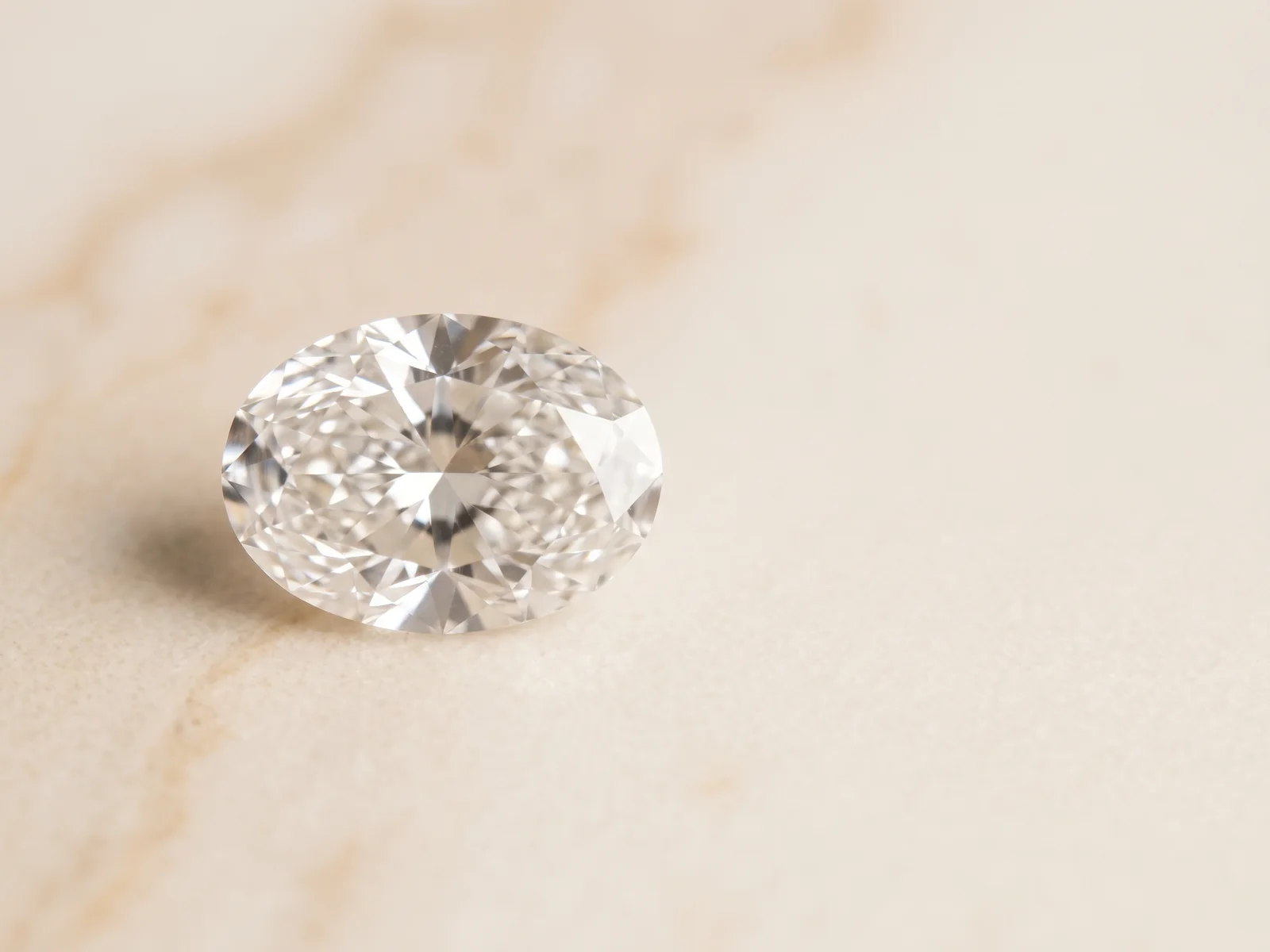
Carat is weight, not size, so two diamonds of the same carat can look surprisingly different on the hand. Here is how to make a diamond look bigger using shape, cut, setting and band, with real millimetre sizes for every shape.
 Reviewed by Raj Sood, Graduate Gemologist (GIA), AJP (GIA)Master jeweller and Graduate Gemologist (GIA) · reviewed 4 November 2026
Quick answer
To make a diamond look bigger, choose an elongated shape such as an oval, pear or marquise, a well-cut stone that is not too deep, a halo or thin white-metal bezel, fine claws and a slim band. Buying just under 1 carat, such as 0.90 ct, costs less with almost no visible size loss.
Is carat weight the same as diamond size?
No. A carat is a unit of weight: 1 carat (ct) is 0.2 grams, divided into 100 points, so a 0.75 ct diamond is often called a '75-pointer'. Carat is one of the four Cs of diamond grading, and it tells you how heavy a stone is, not how wide it looks from above. What you actually see on the hand is the face-up size, also called spread: the outline of the stone measured in millimetres across the top.
That gap between weight and size is the whole reason this guide exists. A diamond's weight can sit where you see it, across the top, or where you don't: in a deep pavilion (the cone-shaped underside) or a thick girdle (the narrow band around the widest edge). Our guide to why stones of the same carat can look different sizes shows real examples side by side.
Watch the labels too. ct on its own normally means the weight of one stone. ctw (carat total weight), or TDW (total diamond weight), which you will see on many Australian price tags, adds up every diamond in the piece. A '1 ct TDW' halo ring might hold a 0.50 ct centre and 0.50 ct of small diamonds around it, so the centre is far smaller than a 1 ct solitaire. Always ask for the centre stone's own weight and measurements.
| Term | What it means | Example |
|---|---|---|
| ct (carat) | Weight of a single diamond; 1 ct = 0.2 g | A 1.00 ct round solitaire |
| Points | Hundredths of a carat | 0.30 ct = 30 points |
| ctw / TDW | Total weight of every diamond in the piece | 0.50 ct centre + 0.50 ct halo = 1.00 ctw |
| Face-up size (spread) | Width and length you see from above, in mm | A 1 ct round at about 6.4–6.5 mm |
| Measurements | Length × width × depth on the grading report | 6.45 × 6.48 × 3.98 mm |
How big is a diamond in mm at each carat weight?
The figures below are typical face-up sizes for well-proportioned stones. Individual diamonds vary by a few tenths of a millimetre either way, so treat them as a guide and always check the measurements printed on the grading report. Carat is only one input; it works alongside the other three of carat, cut, colour and clarity, and the cut has the biggest say in how large a given weight looks.
| Carat weight | Round (diameter) | Oval (about 1.40 ratio) | Princess (square) |
|---|---|---|---|
| 0.25 ct | about 4.1 mm | about 4.9 × 3.5 mm | about 3.5 mm |
| 0.50 ct | about 5.1 mm | about 6.1 × 4.4 mm | about 4.4 mm |
| 0.75 ct | about 5.8 mm | about 7.0 × 5.1 mm | about 5.0 mm |
| 1.00 ct | about 6.4–6.5 mm | about 7.7 × 5.6 mm | about 5.5 mm |
| 1.50 ct | about 7.3–7.4 mm | about 8.8 × 6.4 mm | about 6.3 mm |
| 2.00 ct | about 8.1–8.2 mm | about 9.7 × 7.1 mm | about 6.9 mm |
| 3.00 ct | about 9.3 mm | about 11.1 × 8.1 mm | about 7.9 mm |
Notice that doubling the weight from 1 to 2 carats adds only about 1.7 mm to a round's diameter. A diamond is three-dimensional, so its width grows with the cube root of its weight: to look twice as wide, a stone would need to weigh roughly eight times as much. That is why small changes in shape, depth and setting can matter as much as a jump in carat.
Which diamond shapes look biggest per carat?
Elongated shapes spread their weight along a longer outline, so they cover more of the finger and read as larger. Square and deep-cut shapes keep more weight underneath, so they look smaller for the same carat. The length-to-width ratio (length divided by width) tells you how stretched a shape is.
| Shape | Typical ratio | Approx. size at 1 ct | Face-up impression vs a round |
|---|---|---|---|
| Round | 1.00 | 6.4 × 6.4 mm | The baseline |
| Marquise | 1.85–2.10 | 10.0 × 5.0 mm | Looks largest; the longest outline |
| Pear | 1.50–1.70 | 8.5 × 5.5 mm | Looks noticeably larger |
| Oval | 1.35–1.50 | 7.7 × 5.6 mm | Looks larger, especially lengthways |
| Emerald | 1.40–1.50 | 7.0 × 5.0 mm | Similar area; less sparkle can make it read smaller |
| Radiant (elongated) | 1.20–1.35 | 6.6 × 5.2 mm | Similar to slightly smaller |
| Heart | 0.90–1.10 | 6.8 wide × 6.3 mm long | Similar; wide across the lobes |
| Cushion | 1.00–1.10 | 5.8 × 5.6 mm | Looks smaller; often cut deep |
| Asscher | 1.00–1.05 | 5.5 × 5.5 mm | Looks smaller; deep step cut |
| Princess | 1.00–1.05 | 5.5 × 5.5 mm | Looks smallest; weight held in the corners and pavilion |
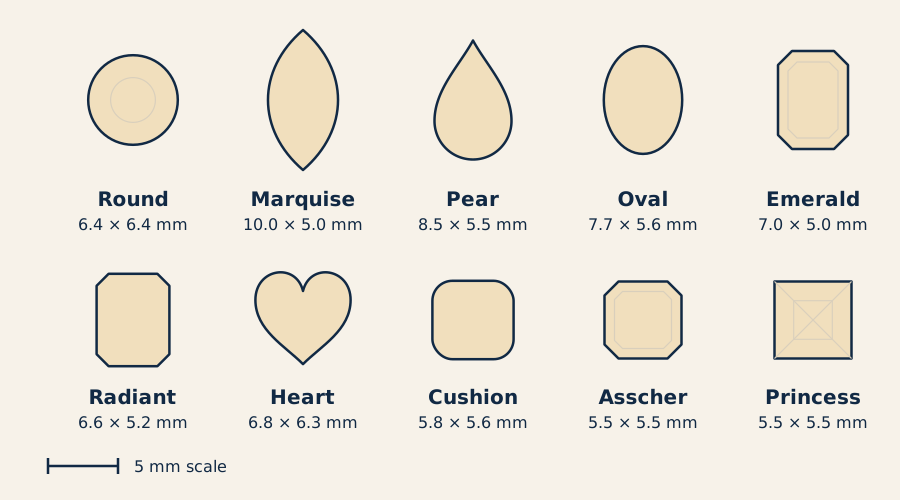
A princess looks small partly because it holds extra weight in its corners and deep pavilion: its corner-to-corner diagonal is longer, but its edge-to-edge width is only about 5.5 mm at 1 ct. An oval, by comparison, is about 7.7 mm long, and most people read size from the longest dimension. Our ranking of shapes by face-up size per carat goes through each one with measured examples. One caution: ovals, pears and marquises can show a dark bow-tie across the middle, so look at a video before you choose one purely for size.
How does cut and depth change how big a diamond looks?
Depth percentage is the stone's total depth divided by its width. For a round brilliant, most well-cut stones sit around 59–62.5%. A deeper stone carries extra weight underneath, which you pay for in carats but never see face-up.
| Depth % (1.00 ct round) | Approx. diameter | What you see |
|---|---|---|
| About 58% | about 6.6 mm | More spread, but risk of light leaking out and a grey 'fisheye' ring |
| 59–62.5% | about 6.4–6.5 mm | Balanced spread and brightness |
| About 64% | about 6.35 mm | Slightly smaller; can look darker in the centre |
| 66% or more | about 6.3 mm or less | Noticeably smaller for the weight; weight hidden in the pavilion |
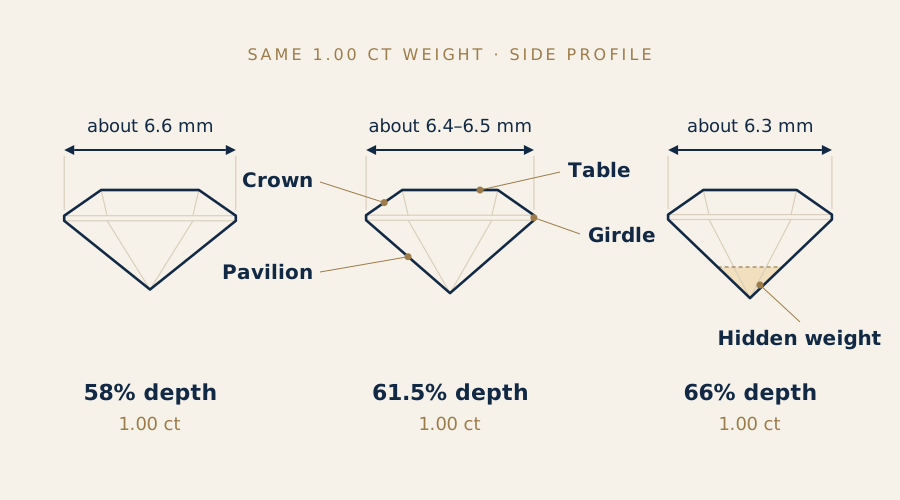
Going too shallow is not the answer either. Below about 58–59% depth, light can pass straight through the pavilion instead of bouncing back, and the stone looks glassy or shows the reflection of its own girdle. Our guide to shallow rounds and the trade-off between spread and sparkle explains where the line sits.
Brightness matters as much as millimetres. A well-cut diamond returns more light, and a bright stone reads as larger than a dull one of the same width. For rounds, a GIA cut grade of Excellent is a sound starting point. Check the girdle as well: a very thick girdle adds weight around the edge without adding spread. Cutters sometimes leave small naturals on the girdle to keep weight, which is harmless when tiny but tells you the cutter was saving carats.
Clarity does not change size, but transparency affects how lively a stone looks. Heavy whitish internal graining can make a diamond look slightly hazy and flat, while most small features, such as fine etch channels, make no visible difference at eye-clean grades.
Not sure which one is right?
Send us the stones you are looking at and our gemologist will tell you which to choose and why.
How to make a diamond look bigger with the setting
The setting can add more visual size than any other choice, because it changes what the eye reads as 'the diamond'. The main options:
- Halo: a ring of small diamonds around the centre stone. A 1 ct round (about 6.5 mm) with a halo of small stones reads close to 9 mm across from a distance, though up close you can still see where the centre ends.
- Thin white-metal bezel: a slim rim of white gold or platinum around the stone blends with the diamond's edge and can add around half a millimetre of visual width each side.
- Fine claws: slim claws cover less of the outline. Six claws make a round look rounder; four claws show more of the stone. For fancy shapes, claws on the corners or points protect them without hiding the edges.
- Cluster or illusion settings: several small diamonds or bright metal facets grouped to look like one larger stone. They suit smaller budgets, but check the ctw figure.
- Pavé or split shank: small diamonds along the band, or a band that splits near the head, widen the overall sparkle around the centre.
- East-west setting: an oval or emerald turned sideways covers more of the finger's width.
Each setting has trade-offs in security, cleaning and how it sits beside a wedding band. Our comparison of settings that add visual size goes through them with photos and measurements.
Related guideSettings That Make a Diamond Look BiggerDoes the band width and metal colour make a diamond look bigger?
Yes, both do, and both cost very little to get right. The band works by contrast: next to a slim band of about 1.8–2.2 mm, a centre stone looks larger than it does on a 3 mm or wider band. A tapered band, which narrows towards the stone, does the same thing while keeping the back of the ring strong enough for daily wear.
Metal colour changes how the edge of the stone reads. White gold and platinum claws blend into the diamond's outline, so the stone and its setting merge into one bright shape. Yellow and rose gold claws draw a warm line around the edge, which defines the outline but can make the white area look slightly smaller. A common approach is a white-metal head on a yellow or rose gold band. Metal also shifts how the diamond's colour looks, as our guide to how the metal changes a diamond's apparent colour explains.
Stacking matters too. A slim pavé wedding band beside the engagement ring adds a line of sparkle that makes the whole set look fuller, while a heavy plain band can make the centre look smaller by comparison.
How big will a diamond look on my finger?
The same stone looks bigger on a slimmer finger, because it covers more of the width. Australian ring sizes use letters, and each step is roughly 0.4 mm in inside diameter. The table gives a rough sense of how much of the finger a round centre stone covers.
| Ring size (AU) | Approx. inside diameter | 1 ct round (6.5 mm) covers about | 1.5 ct round (7.4 mm) covers about |
|---|---|---|---|
| J | 15.3 mm | 42% of the width | 48% of the width |
| L | 16.1 mm | 40% | 46% |
| N | 16.9 mm | 38% | 44% |
| P | 17.7 mm | 37% | 42% |
| R | 18.5 mm | 35% | 40% |
Finger length plays a part as well. On long, slim fingers, elongated shapes look in proportion; on shorter fingers, an oval or pear can make the finger look longer, while a large round can look wider. Nail length, other rings and how far away people stand all change the impression, which is why trying the stone on, or a ring with a similar outline, tells you more than any chart.
Is a 0.90 carat diamond worth it over 1 carat?
Often, yes. Prices tend to step up at round-number weights such as 0.50, 0.70, 0.90, 1.00, 1.50 and 2.00 carats, sometimes called magic sizes. Because width grows with the cube root of weight, a 0.90 ct round is only about 0.2 mm narrower than a 1.00 ct (about 6.2 mm against 6.45 mm), a difference that is very hard to see on the hand. The same logic applies to 1.40 against 1.50 ct, or 1.90 against 2.00 ct.
The catch is that you will not have the round number on the certificate, and for some people that matters. Decide which matters more to you: the figure on paper or the look on the finger. Our guide to choosing between a bigger diamond and better quality works through real budgets.
Colour and clarity can free up money for size as well. An eye-clean SI1 looks the same as a VS1 to most people, and in yellow or rose gold an H or I colour can look as white as a higher grade. Our explainer on what actually sets a diamond's price shows how each factor moves the cost.
Do lab-grown diamonds look bigger than natural diamonds?
No. A laboratory-grown diamond is real diamond: the same carbon crystal, the same density (about 3.52 g/cm³) and the same refractive index (about 2.42). A 1 ct lab-grown round with the same proportions as a 1 ct natural round is the same size and looks the same. Lab-grown diamonds are made in specialised CVD reactors or HPHT presses, not anything you could run in a kitchen; our guide on whether you could grow one at home explains why.
The practical difference is price. Lab-grown diamonds cost much less than natural diamonds of the same grade, so the same budget buys a larger stone. Natural diamonds are rarer and formed deep in the Earth, most of them 1 to 3.5 billion years ago, which is part of what makes natural diamond unique among gems. Both should come with an independent grading report showing exact measurements, so you can compare face-up size directly.
Browse natural and lab-grown diamonds by measurement
How to make a diamond look bigger: step by step
- Choose the shape first. If face-up size is your priority, look at oval, pear and marquise before round, and be aware that princess, cushion and Asscher read smaller per carat.
- Read the measurements, not just the carat. Compare length and width in millimetres on the report; for rounds, aim for a depth of about 59–62.5% and avoid very thick girdles.
- Check brightness on video. A loose-stone tweezer video shows light return, bow-ties and any dark centre better than a still photo.
- Consider a weight just under the step. A 0.90 or 1.40 ct can look almost identical to the round number and costs less.
- Plan the setting. A halo, thin white-metal bezel or fine claws on a slim or tapered band adds visual size; compare halo, bezel and claw options side by side.
- Keep it clean. Skin oil and hand cream dull the surface. Soak in warm water with a drop of mild detergent and brush gently with a soft toothbrush; a clean stone looks brighter and larger.
- Check the jargon. If a listing uses an unfamiliar term, look it up in our jewellery glossary before you compare.
Free consultation
Talk to a gemologist
Compare stones in person or online with Raj Sood, Graduate Gemologist (GIA), AJP (GIA).
Book a consultationShop this shape
FAQ
Common questions
How big is a 1 carat diamond in mm?
A well-cut 1 carat round brilliant is about 6.4–6.5 mm across. A 1 carat oval is about 7.7 × 5.6 mm, a pear about 8.5 × 5.5 mm and a princess about 5.5 mm square.
Does a halo make a diamond look bigger?
Yes. A halo of small diamonds around a 1 ct round makes the head read close to 9 mm across from a distance. Up close you can still see the centre stone's edge, so it adds presence rather than disguising the real size.
Which diamond shape looks the biggest?
The marquise usually looks largest for its weight, at about 10 × 5 mm per carat, followed by the pear and oval. Princess, Asscher and cushion shapes tend to look smallest per carat.
What is the difference between ct and ctw?
ct is the weight of a single diamond, while ctw (carat total weight), also written TDW, is the combined weight of every diamond in the piece. A 1 ctw ring can have a centre stone well under 1 carat.
Does a thin band make a diamond look bigger?
Yes. Next to a band of about 1.8–2.2 mm the centre stone looks larger than on a 3 mm or wider band. A tapered band gives the same effect while keeping the back of the ring strong.
Do lab-grown diamonds look bigger than natural ones?
Not at the same carat and proportions; they are the same material and the same size. Because lab-grown diamonds cost much less, the same budget usually buys a larger lab-grown stone.

Ask a gemologist
Not sure which diamond to choose?
Raj Sood is a Graduate Gemologist (GIA) and master jeweller. Bring the stones you are considering, or send the reports, and he will tell you honestly which one is better and why.
Keep learning
Related guides
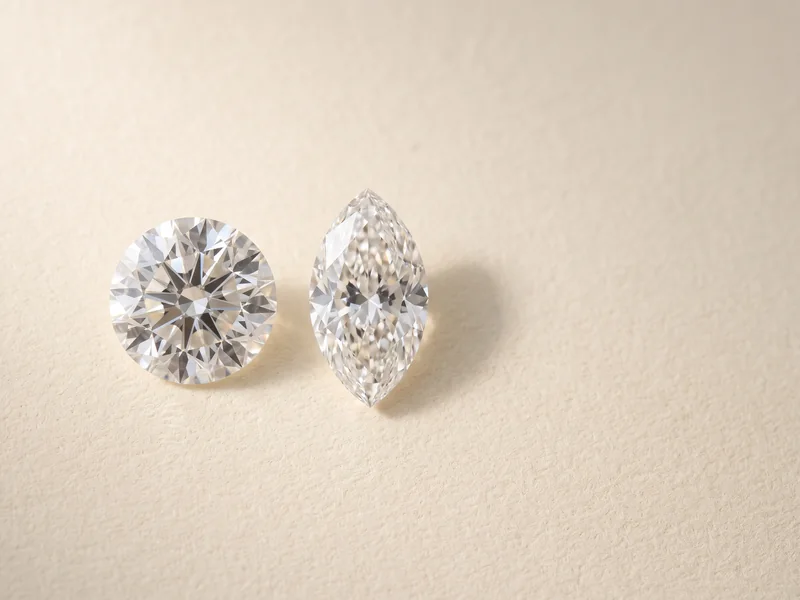 Diamond ShapesWhich Diamond Shape Looks Biggest per Carat
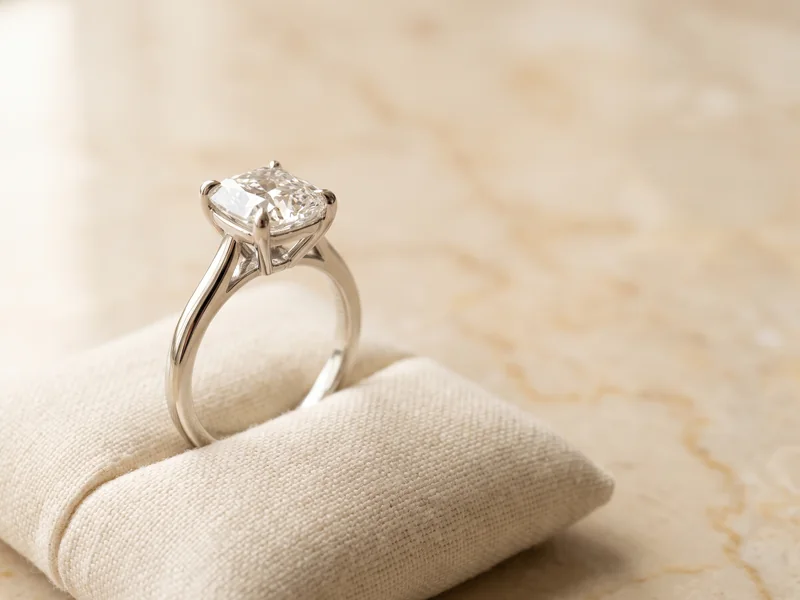 Engagement Rings & SettingsSettings That Make a Diamond Look Bigger
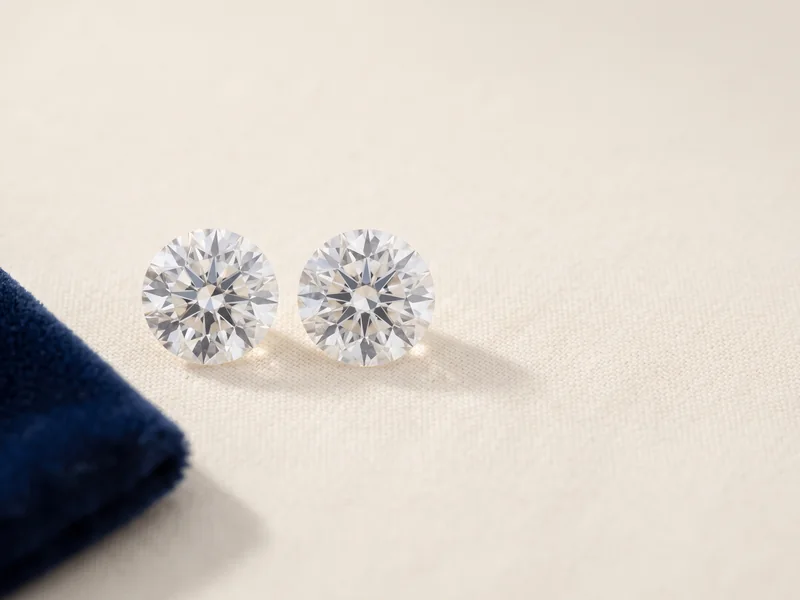 Diamond Anatomy & LightWhy Same-Carat Diamonds Can Look DifferentDiamond 4Cs & GradingBigger Diamond or Better Quality?Diamond 4Cs & GradingDiamond 4Cs
 Natural DiamondsWhat Makes a Diamond Special?
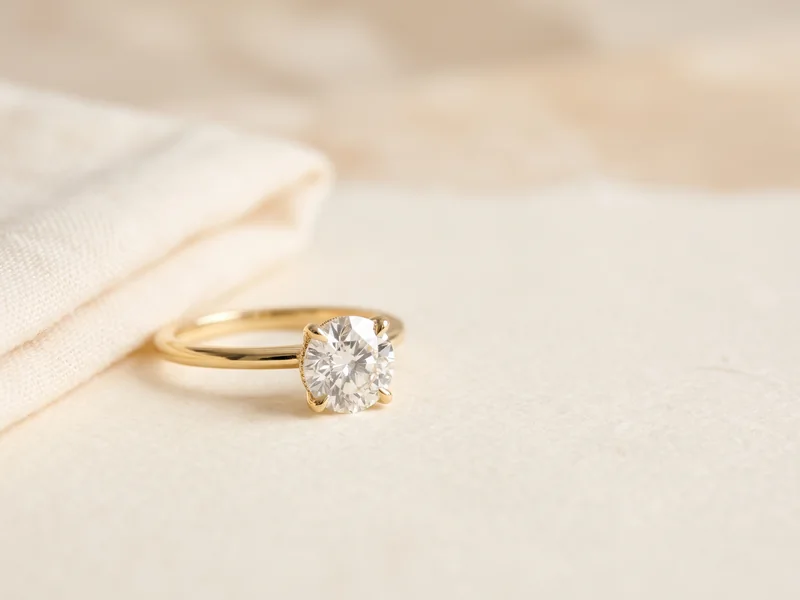 Diamond 4Cs & GradingHow Ring Metal Changes the Way Diamond Colour Looks
 Lab-Grown DiamondsCan I Make a Lab-Grown Diamond or Gemstone at Home?
Explore more
More guides on this topic
Education