
- Education
- Diamond 4Cs & Grading
- Pits and Extra Facets on Diamonds: What They Are and Whether They Matter
Diamond 4Cs & Grading
Pits and Extra Facets on Diamonds: What They Are and Whether They Matter
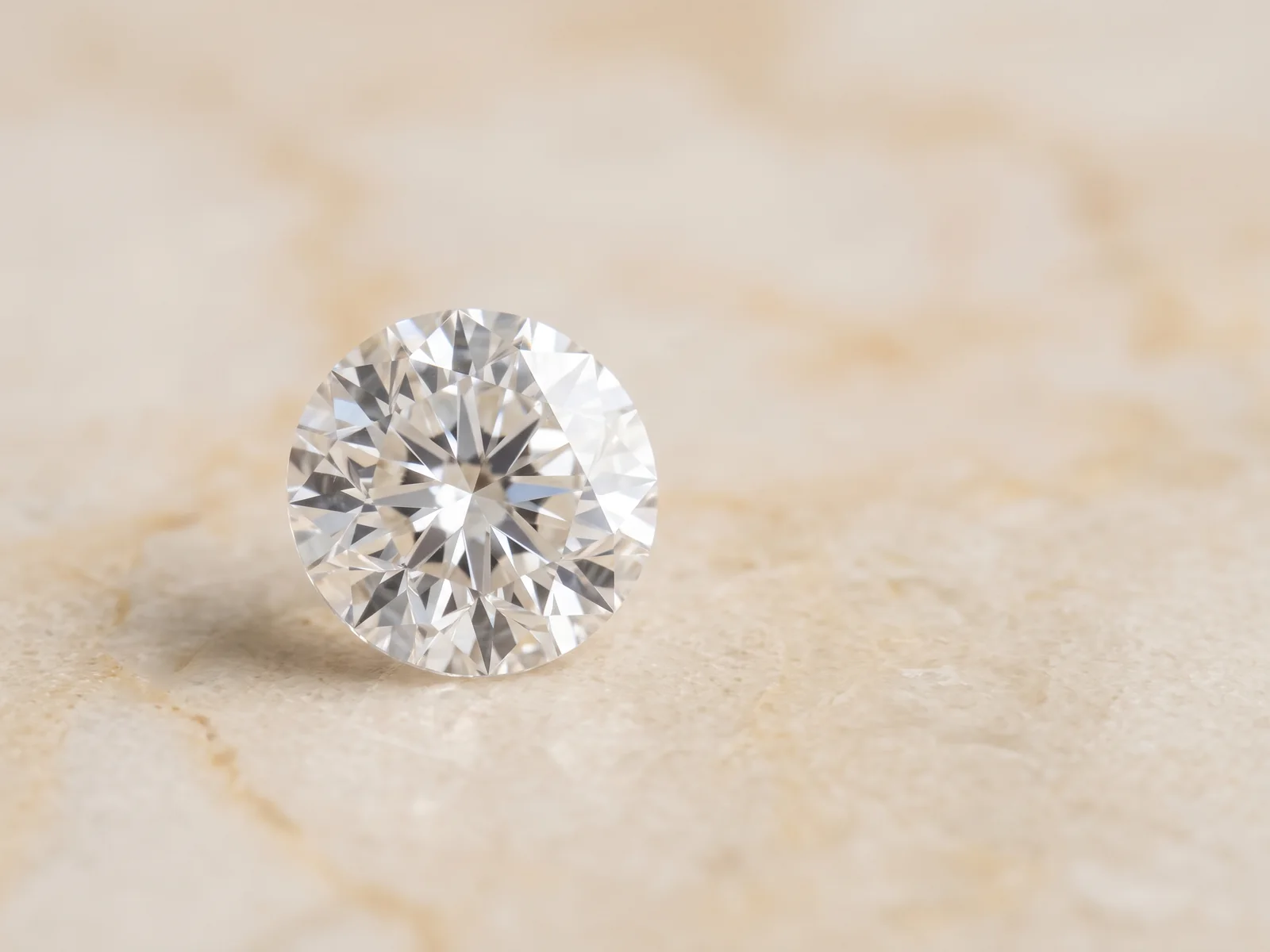
Pits and extra facets on diamonds are two of the smallest marks on a grading report, and two of the most misunderstood. Here is what they are, how they get there, how they are plotted, and when a gemmologist would actually worry about one.
 Reviewed by Raj Sood, Graduate Gemologist (GIA), AJP (GIA)Master jeweller and Graduate Gemologist (GIA) · reviewed 4 November 2026
Quick answer
A pit is a tiny opening on a polished diamond's surface, often a white dot on the table; an extra facet is a small unplanned facet, usually near the girdle. Both are blemishes, not inclusions. They are almost always eye-clean, rarely affect durability and mainly matter at Flawless to VVS clarity, or on the polish and symmetry grades.
What are pits and extra facets on diamonds?
A pit is a tiny opening on the polished surface of a diamond. Under a 10× loupe (the standard magnifier jewellers and graders use) it usually looks like a minute white dot or a pinprick hollow. Pits can sit on any facet, but the ones that get noticed are usually on the table, the large flat facet on top, because that is where the grader's eye goes first.
An extra facet is a small facet polished onto the stone that the cutting style does not call for. A standard round brilliant has 57 facets, or 58 if it has a culet (a tiny flat facet at the bottom point). Anything beyond those, placed without regard to the stone's symmetry, is an extra facet. Most sit on the pavilion (the lower half) just below the girdle, the thin outer edge that separates the top and bottom of the stone.
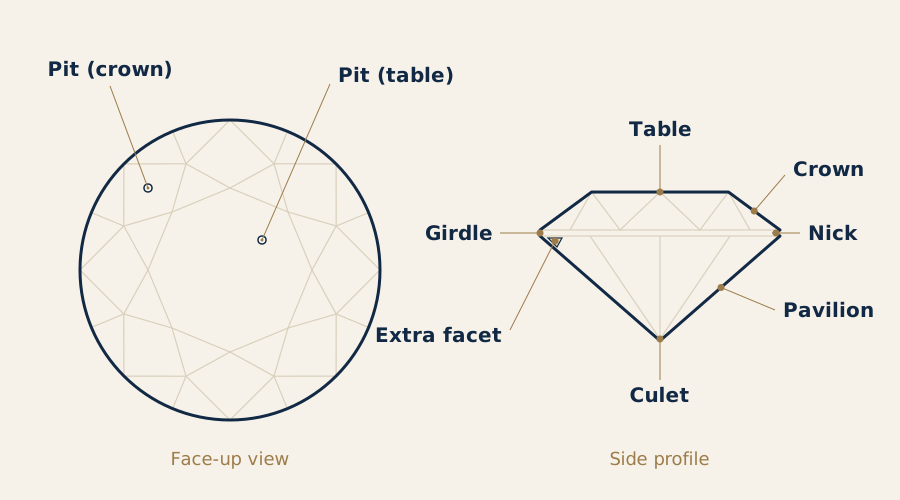
Both are blemishes: features confined to the surface, as opposed to inclusions, which sit inside the stone or reach into it from the surface. That distinction matters because clarity, one of the four Cs of diamond grading, is judged on both, but blemishes carry far less weight. If any of these terms are new, our plain-English jewellery glossary defines them.
Pits and extra facets belong to a wider family of surface features. Others include nicks, scratches, abrasions and burn marks and lizard skin left by the polishing wheel. Pits are sometimes confused with laser drill holes and naturally etched channels. Those also look like small openings at 10×, but they run into the stone, so they are graded as inclusions and treated quite differently.
How do pits and extra facets form?
Most pits form during cutting and polishing. A diamond is polished on a spinning cast-iron wheel called a scaife, charged with diamond powder. If a tiny crystal or pinpoint (a minute included crystal) sits right at the surface, the wheel can pluck it out and leave a small hollow. Pits can also come from a sharp knock after polishing, or from a cutter deciding not to polish a facet deeper because the extra weight loss was not worth it.
Areas where the crystal changes direction are harder to polish cleanly, so small pits and polish marks tend to cluster around twinning wisps and growth graining. The wheel bites differently on each side of the boundary, and tiny fragments can lift out.
Extra facets almost always have a reason behind them. The common ones:
- To remove a natural: a natural is a small patch of the original crystal skin left on the girdle to save weight. Polishing it flat creates an extra facet.
- To clean up a nick or small chip on the girdle edge, often after the stone has been knocked.
- To correct the outline: where the girdle is slightly out of round or uneven, a cutter may add a facet to even it out.
- During repair or repolishing: damage near the girdle of a worn stone is polished away, leaving a neat new facet.
In other words, an extra facet is often the tidy result of fixing something worse. A neatly placed extra facet on the pavilion usually tells you a cutter removed a rough or damaged spot rather than leave it on the edge.
How are pits and extra facets shown on a diamond grading report?
Full grading reports from labs such as GIA and IGI include a plotting diagram: a map of the stone, face-up and face-down, with each clarity characteristic drawn where it sits. GIA uses red for internal features (inclusions), green for external features (blemishes) and black for extra facets, which are drawn as a small outline in their actual position. Smaller, shorter-format reports often have no plot at all, only the grades.
| Feature | Type | Typical GIA plot mark | Report line it mainly affects |
|---|---|---|---|
| Pit | Blemish | Small green dot | Polish; clarity only at FL/IF |
| Extra facet | Blemish (symmetry feature) | Black outline of the facet | Symmetry; clarity only if seen face-up at the top grades |
| Nick | Blemish | Green notch at the girdle | Polish |
| Natural | Blemish | Green outline at the girdle | Clarity at high grades; sometimes noted in comments |
| Cavity | Inclusion | Red outline | Clarity |
| Laser drill hole | Inclusion | Red line ending in a dot | Clarity |
Read the key to symbols beside the plot, which lists every characteristic type drawn, and the comments section. Comments such as "Minor details of polish are not shown" mean small polish features, including tiny pits, were seen but not plotted. Extra facets are a symmetry feature, so they also feed into the symmetry grade; our guide to what Excellent to Poor symmetry means covers how that grade is built.
One practical point: plots are drawn on a generic outline, not a photograph, so a black extra facet mark can look larger on paper than it is on the stone. Treat the plot as a map of where to look, then look.
Do pits or extra facets lower a diamond's clarity grade?
Usually not. The GIA clarity scale has 11 grades: FL, IF, VVS1, VVS2, VS1, VS2, SI1, SI2, I1, I2 and I3. Flawless (FL) means no inclusions and no blemishes visible at 10×. Internally Flawless (IF) means no inclusions, with only minor blemishes. So a pit on the table, or an extra facet on the crown that can be seen face-up, is exactly the kind of thing that separates FL from IF.
Below IF, the grade is set almost entirely by inclusions. A VS1 diamond with a pit is VS1 because of its inclusions, not its pit. Only an unusually large or prominent blemish might nudge a VVS stone down a grade. Extra facets on the pavilion that cannot be seen through the crown face-up are generally not considered in the clarity grade at all.
Where they do show up is in polish (pits) and symmetry (extra facets), each graded Excellent, Very Good, Good, Fair or Poor. For round brilliants, GIA's overall cut grade takes polish and symmetry into account, so a cluster of polish features or several extra facets can hold a round back from an Excellent cut grade. Like fluorescence strength from None to Very Strong, these lines are worth reading, but they rarely decide whether a diamond is a good one.
If you are tempted by a Flawless or Internally Flawless stone, ask whether the difference is worth paying for, because it is invisible without a loupe. Our guide to choosing between a bigger diamond and a higher grade works through that trade-off.
Not sure which one is right?
Send us the stones you are looking at and our gemologist will tell you which to choose and why.
Can you see a pit or extra facet with the naked eye?
Almost never. A typical pit is a fraction of a millimetre across and needs 10× magnification to find, even for a trained grader. Extra facets near the girdle can be hidden by a claw or a bezel once the stone is set, and on the pavilion they are seen through the stone at an angle that scatters them among the normal facet reflections.
Cut style changes how hidden they are:
- Round brilliants and other brilliant cuts: the busy sparkle pattern hides small surface marks well.
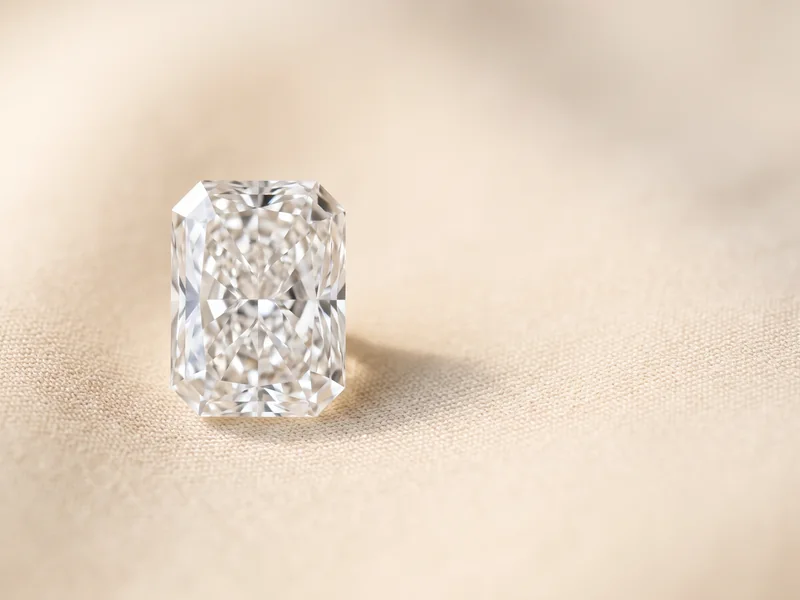
- Crushed-ice patterns: in a radiant or cushion with many small, fragmented reflections, tiny marks all but disappear; see our comparison of crushed-ice and brilliant radiant facet patterns.
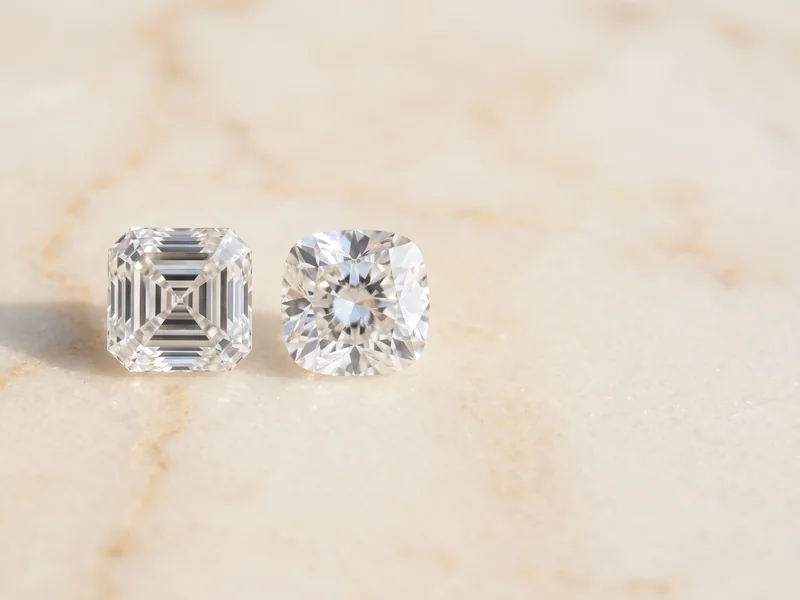
- Chunky, larger-facet patterns: broad flashes show the surface more clearly, so a pit on the table is slightly easier to spot up close, as explained in our guide to chunky versus crushed-ice cushion faceting.
- Step cuts (emerald, Asscher): the large open table is the most revealing surface, though a small pit is still rarely seen without a loupe.
In small stones the question hardly arises. Melee and diamonds between 0.25 and 0.4 carat often carry minor extra facets and polish marks that no one would ever see in a finished ring.
Are pits and extra facets on diamonds a durability risk?
Diamond is 10 on the Mohs hardness scale, with a refractive index of about 2.42, but hardness is not toughness. Diamond has cleavage: four directions along which it can split if struck hard at the wrong angle. A simple, shallow pit is not a crack, so it does not create a cleavage weakness. An extra facet is just more polished surface. The risk depends far more on where the feature sits than on what it is.
| Feature and location | GemTrove gemmologist risk rating | Why |
|---|---|---|
| Shallow pit on the table or crown | Low | A surface hollow with no crack; cosmetic only |
| Extra facet on the pavilion or crown | Very low | Often the result of removing a nick or natural; no structural weakness |
| Pit right at the girdle edge | Low to moderate | Sits on the thinnest edge; check it is not the start of a chip |
| Pit at the culet or the point of a pear, marquise or heart | Moderate | Thin points take knocks; protect with the setting |
| A 'pit' with a white line running inwards | Moderate | Likely a feather or cavity opening, which is an inclusion, not a simple pit |
The everyday nuisance is dirt. A pit on the table can trap skin oils or detergent residue and show as a tiny dark dot. Warm water, a drop of mild dishwashing liquid and a soft toothbrush clear it.
Pit, extra facet, nick, chip or cavity: what is the difference?
These features are easy to mix up on a report, so here they are side by side.
| Pit | Extra facet | Nick | Chip | Cavity | |
|---|---|---|---|---|---|
| What it is | Tiny surface hollow | Unplanned small facet | Small notch on an edge | Small piece broken off | Larger opening reaching into the stone |
| Surface or internal | Surface (blemish) | Surface (blemish) | Surface (blemish) | Breaks the surface | Internal (inclusion) |
| Usual cause | Polishing or a knock | Removing a natural, nick or outline fault | A knock on the girdle or a facet junction | A harder knock | A crystal lost during polishing |
| Graded on | Polish; FL/IF | Symmetry; FL/IF | Polish | Clarity | Clarity |
| Eye-visible? | Almost never | Almost never | Rarely | Sometimes, if large | Sometimes, if large |
| Typical risk | Low | Very low | Low; can grow if knocked again | Moderate | Low to moderate |
The girdle is where most of these meet. While you are inspecting it, also look for bearding, fine hair-like feathers along the girdle, which comes from the shaping stage of cutting and is graded as an inclusion.
Related guideBearding in DiamondsDo lab-grown diamonds have pits and extra facets too?
Yes. Lab-grown diamonds, grown in a laboratory by the CVD or HPHT method, are real diamond with the same hardness and refractive index as natural diamond. After growth they are cut and polished on the same kind of wheels by the same techniques, so they show the same pits, extra facets, nicks and polish lines. Their reports plot them with the same symbols and state clearly that the stone is laboratory-grown.
For both natural and lab-grown diamonds, these marks have very little effect on price. Price is driven by carat, colour, clarity and cut. The exception is the very top of the clarity scale, where a single table pit can be the reason a stone is IF rather than FL, and that grade step carries a noticeable premium for natural diamonds.
Browse natural and lab-grown diamonds
Can a pit or extra facet be polished out?
Often, yes. A pit on the table can usually be removed by repolishing the table a fraction deeper. An extra facet cannot be undone, because material cannot be added back to a diamond, but it can sometimes be blended into the neighbouring facets. Both cost weight, typically only a point or two (0.01–0.02 carat) on a 1 carat stone for a light table repolish, though deeper work takes more.
That weight matters at the round-number thresholds. Taking a 1.01 carat stone below 1.00 carat can lower its value by more than the repair is worth, which is why our explainer on how carat weight is stated and rounded is worth reading before you ask for any recutting. For most pits and extra facets the sensible answer is to leave them alone.
Setting is the easier fix. A claw placed over a girdle extra facet, or a bezel around the edge, hides it completely and protects the girdle at the same time. The same setting choices appear in our guide to making a diamond look larger on the hand.
How do you check a diamond for pits and extra facets? Step by step
- Read the plot and key. Look for green dots (pits) and black facet outlines (extra facets), and note where they sit.
- Read the comments. Check for lines such as "Minor details of polish are not shown" and confirm whether the stone is natural or lab-grown.
- Check polish and symmetry. Excellent or Very Good on both means any pits or extra facets are minor.
- Find each mark at 10×. Ask the jeweller to show you every plotted feature, face-up and through the girdle.
- Check the edges and points. Pay closest attention to pits on the girdle, the culet or the point of a fancy shape, and to any white line running inwards.
- Plan the setting. Ask whether a claw or bezel can sit over a girdle extra facet or edge pit to hide and protect it.
Free consultation
Talk to a gemologist
Compare stones in person or online with Raj Sood, Graduate Gemologist (GIA), AJP (GIA).
Book a consultationShop this shape
FAQ
Common questions
Is a pit on a diamond bad?
Usually not. A shallow pit is a tiny surface blemish that is almost never visible without magnification and does not weaken the stone. The only pits worth questioning are those on a thin edge or point, or ones with a fine line running into the stone.
Do extra facets affect a diamond's clarity?
Rarely. Extra facets can keep a diamond from Flawless if they can be seen face-up, but below IF they almost never change the clarity grade. They are mainly reflected in the symmetry grade.
What does a green dot on a GIA diamond plot mean?
Green marks show external blemishes. A small green dot is usually a pit, and the key to symbols beside the plot will confirm it.
Why would a cutter add an extra facet?
Most often to polish away a natural, a nick or a small chip at the girdle, or to even out the outline. It is usually a sign that a rough spot was cleaned up.
Can you remove a pit from a diamond?
A pit on the table can often be polished out by repolishing the facet slightly deeper, at the cost of a small amount of weight. Because it rarely matters to appearance or durability, most people leave it alone.
Do lab-grown diamonds have pits and extra facets?
Yes. Lab-grown diamonds are cut and polished the same way as natural diamonds, so they show the same surface features, plotted with the same symbols on their grading reports.

Ask a gemologist
Not sure which diamond to choose?
Raj Sood is a Graduate Gemologist (GIA) and master jeweller. Bring the stones you are considering, or send the reports, and he will tell you honestly which one is better and why.
Keep learning
Related guides
 Diamond 4Cs & GradingBearding in DiamondsDiamond 4Cs & GradingLaser Drill Holes in Diamonds
 Diamond 4Cs & GradingBurn Marks and Lizard Skin on DiamondsDiamond 4Cs & GradingDiamond Symmetry Grades ExplainedDiamond 4Cs & GradingDiamond 4Cs
 Diamond ShapesCushion Diamond Chunky Facets vs Crushed Ice
 Diamond ShapesRadiant Diamond Crushed-Ice vs Brilliant Facet PatternsDiamond 4Cs & GradingDiamond Fluorescence Strengths: None to Very Strong
Explore more
More guides on this topic
Education