
- Education
- Diamond 4Cs & Grading
- Burn Marks and Lizard Skin on Diamonds: What They Are and Whether They Matter
Diamond 4Cs & Grading
Burn Marks and Lizard Skin on Diamonds: What They Are and Whether They Matter
Burn marks and lizard skin on diamonds are two of the less familiar words on a grading report, and they can sound alarming. Here is what each one is, how it forms, how it is recorded and whether it should change your choice.
 Reviewed by Raj Sood, Graduate Gemologist (GIA), AJP (GIA)Master jeweller and Graduate Gemologist (GIA) · reviewed 4 November 2026
Quick answer
Burn marks and lizard skin are surface blemishes left by polishing, not flaws inside the diamond. A burn mark is a hazy white patch caused by heat; lizard skin is a wavy texture from polishing close to the grain. Both are usually tiny, rarely eye-visible (a torch or fire burn is the exception), harmless to durability and often repolishable.
What are burn marks and lizard skin on diamonds?
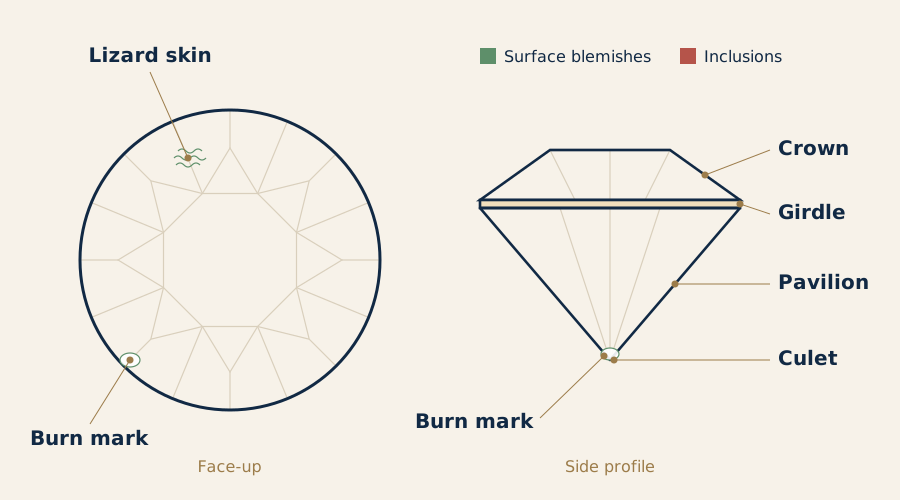
Burn marks and lizard skin are both blemishes: features on the outside surface of a polished diamond, as opposed to inclusions, which sit inside it. Graders group them with polish lines, scratches and abrasions as polish features, because they are left behind by cutting and polishing rather than formed when the diamond grew. They touch two parts of grading, clarity and polish, both explained in our guide to the 4Cs of diamond grading.
A burn mark is a whitish, hazy or frosted patch where the surface has been overheated and lost its polish. Lizard skin is a transparent, wavy or bumpy texture on a facet, a bit like the scales of a lizard or the skin of an orange, caused by polishing a facet too close to the diamond's grain. Neither goes deeper than the surface, and in most stones both are visible only at 10× magnification, the standard grading loupe.
Diamond is 10 on the Mohs scale of hardness, with a refractive index of about 2.42, and it is polished with diamond powder on a spinning cast-iron wheel called a scaife. Because only diamond can cut diamond, every facet is a small contest between the stone, the wheel and the direction of the crystal's atoms. Burn marks and lizard skin are what that contest leaves behind when it does not go perfectly. If you are new to grading language, our diamond education hub sets out the basics, and the glossary of jewellery and grading terms defines every word you will meet on a report.
What causes a burn mark on a diamond?
A burn mark forms when a facet gets too hot. Diamond conducts heat extremely well, but at the tiny point of contact with a scaife turning at roughly 2,500–3,000 revolutions per minute, friction can push the surface temperature high enough for it to react with oxygen in the air. In air, diamond begins to oxidise (in plain terms, burn) from roughly 700°C upwards, and the result is a thin, cloudy layer that no longer reflects light cleanly.
- Too much pressure on the wheel: a polisher pressing hard to finish a facet faster, especially on small stones that heat up quickly.
- Too long in one spot: facet junctions, the culet (the tiny bottom facet) and the girdle edge heat fastest, because there is less diamond around them to carry heat away.
- A jeweller's torch: heating a ring while the diamond is still set, for claw retipping, resizing or soldering, without protecting the stone.
- Fire or accidental heat: a ring caught in a house fire can come out with a frosted, milky surface all over.
The third cause is the one most people meet in real life. A burn from polishing is usually a tiny patch near a facet edge, a fraction of a millimetre across. A burn from a torch can frost an entire facet or the whole crown (the top part of the stone), and it typically shows up after a repair. Standard bench practice is to coat the diamond in a boric acid flux, or remove it, before heating, which keeps oxygen away from the surface.
Heat matters even more for treated stones. A diamond whose cracks have been filled with a glass-like material, explained in our guide to laser drilling and fracture filling, can have its filler bubble, cloud or leak at much lower temperatures than an untreated diamond would burn. Always tell a jeweller if your stone is fracture-filled before any repair.
What causes lizard skin on a diamond?
Lizard skin has a different cause: direction rather than heat. Diamond is a crystal, and its atoms line up in planes. The most important are the octahedral planes, the four directions along which diamond can cleave (split cleanly). Polishing a facet that crosses the grain at a good angle is straightforward. Polishing a facet that lies almost parallel to an octahedral plane is very hard, because the wheel tends to pluck at the surface instead of grinding it smooth. Cutters call these the 'hard directions'.
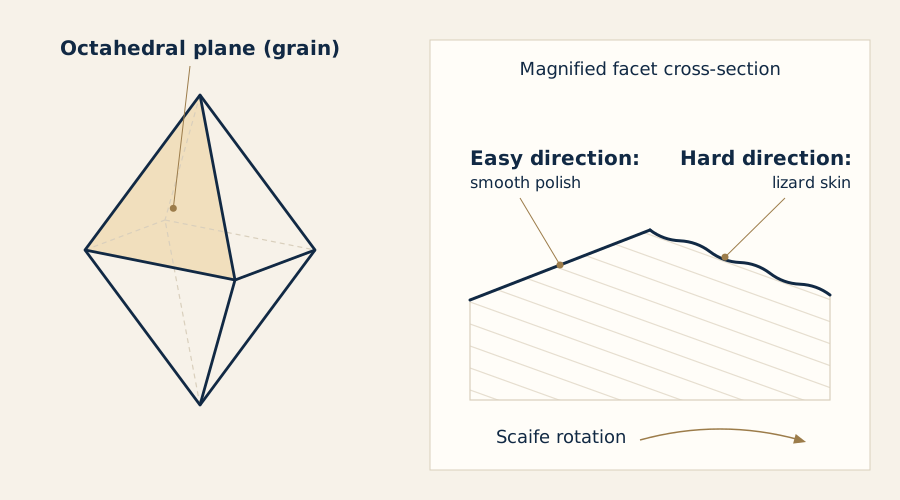
When a facet sits within a few degrees of an octahedral plane, the polished surface can end up with a faint, transparent, rippled texture. Under 10× magnification, with the light catching the facet at an angle, it looks wavy or pebbled, like lizard skin. It can also appear where the grain changes direction inside the stone, for example around a twinning plane (where two crystal sections meet at an angle) or a knot (an included crystal that reaches the surface), because the cutter cannot keep the wheel in an easy direction across the whole facet.
Lizard skin is easy to confuse with two related features. Polish lines are fine parallel grooves left by the wheel, straight rather than wavy. Surface graining shows as faint lines or ridges where internal growth layers meet the surface, and it can run across facet junctions. Like lizard skin, both are surface-level only. For the other surface features you will often see listed on reports, read our page on pits and extra facets, and for the fine hair-like lines that run inward from a roughly finished girdle, see bearding at the girdle.
How are burn marks and lizard skin on diamonds shown on a grading report?
On a GIA or IGI report, the plotting diagram is a map of the diamond's clarity characteristics. By convention, inclusions are drawn in red and blemishes in green (GIA uses black for extra facets), and a key to symbols lists each feature by name. Burn marks and lizard skin are usually too minor to plot. Instead, they count towards the polish grade, and many GIA reports carry the comment 'Minor details of polish are not shown.' When a burn or lizard skin is large enough to matter, it can be plotted and named in the key.
| Polish feature | Name in key (abbreviation) | What it looks like at 10× | Usually affects |
|---|---|---|---|
| Burn mark | Burn mark (Brn) | Whitish, hazy or frosted patch | Polish grade; clarity only if large |
| Lizard skin | Lizard skin (LS) | Transparent wavy or bumpy texture | Polish grade |
| Polish lines | Polish lines (PL) | Fine parallel grooves | Polish grade |
| Abrasion | Abrasion (Abr) | Rough, whitish facet junctions | Polish grade |
| Scratch | Scratch (S) | Thin white line | Polish grade; clarity if prominent |
| Surface graining | Surface graining (SGr) | Faint lines crossing facets | Polish or clarity, depending on size |
| Extra facet | Extra facet (EF) | Small unplanned facet | Clarity at the top grades |
| Pit | Pit | Tiny hole in the surface | Clarity |
The polish grade runs Excellent, Very Good, Good, Fair and Poor. A single small burn or a patch of lizard skin on one facet usually still allows Very Good, and sometimes Excellent. Several burned junctions, or lizard skin across a number of facets, can pull polish down to Good. Polish sits beside symmetry as the finish grades, set out in our guide to how polish and symmetry are graded. On a round brilliant, both feed into the overall GIA cut grade, so weak polish can stop a stone reaching Excellent cut even if its proportions are ideal.
Blemishes also matter at the very top of the clarity scale. Flawless (FL) means no inclusions and no blemishes visible at 10×. Internally Flawless (IF) allows minor blemishes but no inclusions. A burn mark or lizard skin on an otherwise perfect stone can be the difference between FL and IF. Below IF, blemishes rarely change the clarity grade at all, because the inclusions decide it.
Related guidePolish and SymmetryNot sure which one is right?
Send us the stones you are looking at and our gemologist will tell you which to choose and why.
Do burn marks and lizard skin on diamonds weaken the stone?
No. Both features sit in a very thin layer at the surface, measured in thousandths of a millimetre. They do not reach into the stone, they do not open a cleavage path and they cannot spread with wear. That puts them at the bottom of the risk scale, well below internal features such as feathers. The table gives our gemmologist's risk rating for common clarity characteristics, so you can see where these two sit.
| Feature | Surface or internal | Durability risk | Why |
|---|---|---|---|
| Lizard skin | Surface | None | Texture only; no break in the crystal |
| Polish lines | Surface | None | Fine grooves from the wheel |
| Burn mark | Surface | None to very low | Dull layer only; a severe torch burn affects looks, not strength |
| Extra facet | Surface | None | A small polished plane, usually near the girdle |
| Pit | Surface | Low | Tiny hole; can collect dirt |
| Nick | Surface, at an edge | Low to moderate | A small chip that can grow if knocked again |
| Bearding | Girdle into stone | Low; moderate if heavy | Fine cracks from bruting the girdle |
| Feather reaching the surface | Internal | Moderate to high if large or near the girdle | A crack that can extend under impact |
| Fracture-filled feather | Internal, treated | Moderate | Filler is sensitive to heat and some cleaning methods |
The real risks in a diamond are feathers (cracks) that reach the surface near the girdle or under a claw, large cavities and heavy bearding, where a knock can turn an existing weakness into a chip. Burn marks and lizard skin have nothing to do with that. The only practical issue is a large torch burn, which dulls sparkle and is worth polishing off, but even that does not make the diamond more likely to break.
Can you see burn marks and lizard skin with the naked eye?
Almost never. An eye-clean diamond is one with nothing you can see without magnification at a normal viewing distance of about 25–30 cm. Polishing burns and lizard skin are usually a fraction of a millimetre across and transparent or only faintly white, so they disappear face-up among the reflections. Our page on what eye-clean really means in practice explains how to judge this for inclusions, which are what normally decide it.
- Small polishing burn: invisible to the eye; seen at 10× as a hazy patch near a facet edge.
- Lizard skin on one facet: invisible to the eye; seen at 10× in angled light as a wavy texture.
- Torch burn over a facet or the crown: can be visible as a dull, milky or frosted area that does not sparkle.
- Burn from a house fire: visible; the whole stone can look frosted white or grey.
If a diamond looks hazy all over rather than in one spot, a burn is not the usual suspect. A film of hand cream and skin oil is the commonest cause, and a gentle clean in warm soapy water fixes it. In a small number of stones, very strong blue fluorescence and its effect on transparency can give an oily or milky look in sunlight. That is a property of the diamond itself, not a surface blemish, and the report will list it.
Do burn marks and lizard skin lower a diamond's price?
Only a little, and mostly through the polish grade. Price is driven mainly by carat, colour, clarity and cut, as explained in what sets a diamond's value. A step from Excellent to Very Good polish usually makes only a small difference to price. A Good polish grade can bring a larger discount on a round, partly because it can block an Excellent cut grade.
Who should care? Buyers paying for the top of the scale, such as a D colour, the highest colour grade, an E colour diamond or an F colour stone with FL or IF clarity, usually expect Excellent polish as part of the package, and a burn would be out of place. At the other end, someone choosing a J colour diamond to set in yellow gold at SI clarity is unlikely to ever notice a patch of lizard skin on one pavilion facet (the facets underneath). If you are weighing grades against size, our guide to choosing a bigger diamond or a better-quality one helps you decide where your budget does the most work.
Natural and laboratory-grown diamonds are polished the same way, on the same kind of wheels, so both can show burn marks and lizard skin, and both are graded for polish on the same scale. Lab-grown diamonds, made by the HPHT (high pressure, high temperature) or CVD (chemical vapour deposition) methods, are real diamond with the same crystal structure and the same hard directions. They cost much less than natural diamonds, but the same polishing standards apply, so check the polish grade and comments either way.
Shop natural and lab-grown diamonds
Can burn marks and lizard skin be polished off a diamond?
Usually, yes. Because both are surface-only, a diamond cutter can repolish the affected facet and remove them. A small polishing burn or patch of lizard skin normally costs very little weight, often well under one point (0.01 carat). Fixing lizard skin may mean shifting the facet angle very slightly so it is no longer in a hard direction. A torch burn across the crown takes more work, because every affected facet must be repolished and the stone has to come out of its setting.
Repolishing is usually worth doing for a visible torch burn and rarely worth doing for a minor polish feature you can only find at 10×. Every repolish removes a little diamond, and on a stone sitting just over a weight threshold such as 1.00 carat, even a small loss can take it below the round number. As a rough guide, repolishing one or a few facets typically costs around AUD $100–$400, depending on the stone's size and the cutter, plus the cost of removing and resetting it. Ask for a written quote and the expected weight loss before work starts.
How to check a diamond for burn marks and lizard skin: step by step
- Read the polish grade. Excellent or Very Good means any burn marks or lizard skin are minor.
- Read the comments and key to symbols. Look for 'Minor details of polish are not shown' and any entries such as Brn, LS or PL.
- Check the top clarity grades. If a stone is IF rather than FL, a blemish such as a burn or lizard skin can be the reason.
- Look at 10×. Use a loupe or magnified video and tilt the stone so light reflects off each facet; burns show as hazy white, lizard skin as a wavy texture.
- Inspect facet junctions and the girdle. Whitish, rounded edges point to burns or abrasions.
- Before any repair, ask about heat. Confirm the stone will be removed or protected with flux, and mention if it is fracture-filled.
- If a burn appears after a repair, have the diamond assessed and repolished by a cutter rather than living with a dull facet.
Free consultation
Talk to a gemologist
Compare stones in person or online with Raj Sood, Graduate Gemologist (GIA), AJP (GIA).
Book a consultationShop this shape
FAQ
Common questions
Is a burn mark on a diamond a flaw?
It is a blemish, a surface polish feature, not an internal flaw. It usually affects the polish grade and only changes the clarity grade on otherwise Flawless stones or when it is large.
Does lizard skin make a diamond weaker?
No. Lizard skin is a surface texture from polishing close to the grain, and it does not create any crack or cleavage path. It has no effect on how well the diamond stands up to everyday wear.
Can a jeweller burn my diamond during a repair?
Yes, if the stone is heated with a torch without protection, the surface can oxidise and turn frosty white. Ask whether the diamond will be removed or coated with boric acid flux before retipping, resizing or soldering.
Can burn marks be removed from a diamond?
Usually. A cutter can repolish the affected facets, normally losing very little weight, though the stone must be taken out of its setting first.
Do lab-grown diamonds get burn marks and lizard skin?
Yes. Lab-grown diamonds have the same crystal structure as natural diamonds and are polished the same way, so they can show the same polish features and are graded on the same polish scale.
Should I avoid a diamond that lists lizard skin on its report?
Not usually. If the polish grade is Excellent or Very Good and you cannot see it without magnification, it makes no practical difference; it matters most for buyers paying for FL clarity and top polish.

Ask a gemologist
Not sure which diamond to choose?
Raj Sood is a Graduate Gemologist (GIA) and master jeweller. Bring the stones you are considering, or send the reports, and he will tell you honestly which one is better and why.
Keep learning
Related guides
 Diamond 4Cs & GradingPits and Extra Facets on Diamonds
 Diamond 4Cs & GradingPolish and SymmetryDiamond 4Cs & GradingBearding in DiamondsDiamond 4Cs & GradingEye Clean DiamondsDiamond 4Cs & GradingDiamond 4Cs
 Diamond 4Cs & GradingBigger Diamond or Better Quality?
 Diamond 4Cs & GradingClarity-Enhanced Diamonds: Laser Drilling and Fracture FillingDiamond 4Cs & GradingWhat Determines a Diamond's Value
Explore more
More guides on this topic
Education