
- Education
- Lab-Grown Diamonds
- What Actually Drives Lab-Grown Diamond Prices?
Lab-Grown Diamonds
What Actually Drives Lab-Grown Diamond Prices?
Lab-grown diamond prices have dropped faster than almost anything else in jewellery, and two stones that look alike can still differ by hundreds of dollars. Here is what sets the price, why it keeps moving, and how to compare stones fairly in Australia.
 Reviewed by Raj Sood, Graduate Gemologist (GIA), AJP (GIA)Master jeweller and Graduate Gemologist (GIA) · reviewed 4 November 2026
Quick answer
Lab-grown diamond prices are driven mainly by carat weight, colour, clarity and cut, plus growing method, any post-growth treatment, the grading report and retail markup. Production costs have fallen as capacity has expanded, especially in India and China, so prices have dropped sharply since about 2018 and can keep moving. Resale value is low.
What sets lab-grown diamond prices?
A lab-grown diamond is real diamond: carbon atoms locked in the same cubic crystal structure as a mined stone, with the same hardness (10 on the Mohs scale) and the same refractive index of about 2.42. Our page on why a lab-grown stone is chemically real diamond explains the science. The difference is origin, and origin changes the economics completely. A natural diamond's price reflects geological rarity. A lab-grown diamond's price reflects what it costs to make, cut and sell one, and how many other people are making them.
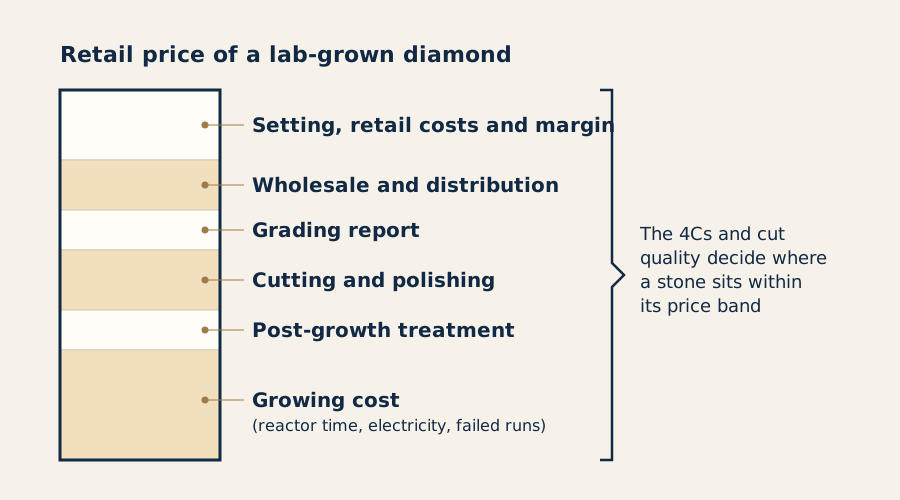
In practice, the price of any one lab-grown stone comes from a stack of factors:
- Production cost: reactor time, electricity, labour and the failure rate of growth runs.
- Growing method: CVD or HPHT, and whether the stone was treated after growth.
- The 4Cs: carat, colour, clarity and cut, still the biggest differences between stones in the same batch.
- Shape and cutting: how much rough is lost and how carefully the stone is polished.
- The grading report: which laboratory graded it and how much detail the report gives.
- Supply and competition: how much capacity exists worldwide, which has grown very quickly.
- Retail costs: rent, staff, setting, warranty and the margin each seller chooses.
If you are new to the topic, our complete guide to lab-grown diamonds covers the basics first, and any unfamiliar term here is defined in our glossary of jewellery terms.
How does the way a diamond is grown affect its price?
There are two growing methods. CVD (chemical vapour deposition) builds diamond layer by layer from a carbon-rich gas, usually methane and hydrogen, energised into a plasma above thin diamond seed plates. A run can take several weeks, and many stones grow in one chamber. HPHT (high pressure, high temperature) copies conditions deep in the Earth, squeezing carbon around a seed at roughly 5–6 gigapascals and 1,300–1,600 °C in a large press. Our explainer on how CVD and HPHT reactors grow diamond shows each step.
| CVD | HPHT | |
|---|---|---|
| How it grows | Layers from a gas plasma on a flat seed | Carbon dissolves and crystallises around a seed under pressure |
| Typical crystal | Flat, tabular; suits larger stones | Cuboctahedral; very efficient for small to mid sizes |
| Common post-growth step | Often HPHT-annealed to remove brown tint | Usually none; some show a faint blue or grey tint |
| Main producing regions | India, also the United States and elsewhere | China, also Russia and elsewhere |
| Effect on retail price | Little difference once graded | Little difference once graded |
The honest gemmologist view: once a stone is cut and graded, the method alone rarely changes the retail price much. A G VS1 1 carat CVD and a G VS1 1 carat HPHT stone usually sit in the same price band. Method matters more indirectly. Growing a larger stone means a longer run with more chance of a flaw ending it early, so the production cost per carat rises with size.
Post-growth treatment is the other link. Many CVD diamonds come out of the reactor slightly brown, and a short HPHT treatment afterwards can lift them several colour grades. That is normal, stable and should be stated on the report. It adds a processing cost, but it lets a grower sell a stone as G instead of J, which is why it is so common.
How do the 4Cs change the price of a lab-grown diamond?
Within lab-grown, the 4Cs still sort stones into price bands, but the steps between grades are much smaller than for natural diamonds. That is because high grades are not rare when you can control the growth. A D colour lab-grown stone is common; a D colour natural stone is not.
| Lab-grown round, G–H, VS | Approximate retail range (AUD) | Lab-grown price per carat |
|---|---|---|
| 0.50 ct | about $400–$1,000 | about $800–$2,000 |
| 1.00 ct | about $800–$2,500 | about $800–$2,500 |
| 1.50 ct | about $1,300–$3,500 | about $870–$2,300 |
| 2.00 ct | about $1,800–$5,000 | about $900–$2,500 |
| 3.00 ct | about $3,000–$8,000 | about $1,000–$2,700 |
These are broad ranges for well-cut stones with an independent report; they move often and differ between sellers. Notice that the price per carat climbs only gently with size. For natural diamonds, the price per carat can rise by 70% or more from 1 to 2 carats. That gentle curve is the main reason lab-grown buyers often choose larger stones.
- Carat: the biggest single driver. Weights just over 1.00, 1.50 and 2.00 carats still carry a small jump, so a 0.95 carat can cost less than a 1.01 carat that looks almost the same.
- Colour: D to F costs more than G to H, but the gap is often only a few hundred dollars at 1 carat. See how colour grades work on lab-grown stones.
- Clarity: VVS and VS stones are plentiful. An eye-clean stone (no inclusions visible without magnification) is easy to find, so paying extra for flawless is rarely needed.
- Cut: the factor that most changes how a stone looks. Our page on what separates a well-cut lab-grown diamond covers proportions and grades.
Why can two lab-grown diamonds with the same grades cost different amounts?
The headline grades leave out a lot. Two 1.00 carat, F, VS1 lab-grown stones can differ in price for reasons the 4Cs do not show:
- Proportions: a deep stone hides weight underneath and looks smaller face-up (the size you see from above). A 1 carat round should measure about 6.4–6.5 mm across.
- Polish and symmetry: Excellent across the board costs more than Good.
- Fluorescence and tint: a faint blue or grey cast in some HPHT stones, or residual brown in some CVD stones, lowers the price even when the colour letter matches.
- Strain and graining: internal growth patterns that can make a stone look slightly hazy.
- Report lab: buyers tend to pay more for reports from labs with consistent grading.
- Shape: fancy shapes such as ovals and pears usually cost a little less per carat than rounds because more of the rough is kept. Our page on how price per carat differs between diamond shapes sets out the pattern, and the overview of every diamond shape shows what each one looks like.
The same logic applies to natural stones; our guide on why matching 4Cs can still mean different prices goes through the details with examples.
Not sure which one is right?
Send us the stones you are looking at and our gemologist will tell you which to choose and why.
Why do lab-grown diamond prices keep falling?
This is the question behind most searches, and the answer is supply. Growing diamond is a manufacturing process, and like most manufacturing, it gets cheaper as technology improves and capacity grows. In the mid-2010s, gem-quality lab-grown diamonds were still relatively scarce and priced as a moderate discount to natural. Since then, thousands of new CVD reactors and HPHT presses have come online, mostly in India and China, and output has risen far faster than demand.
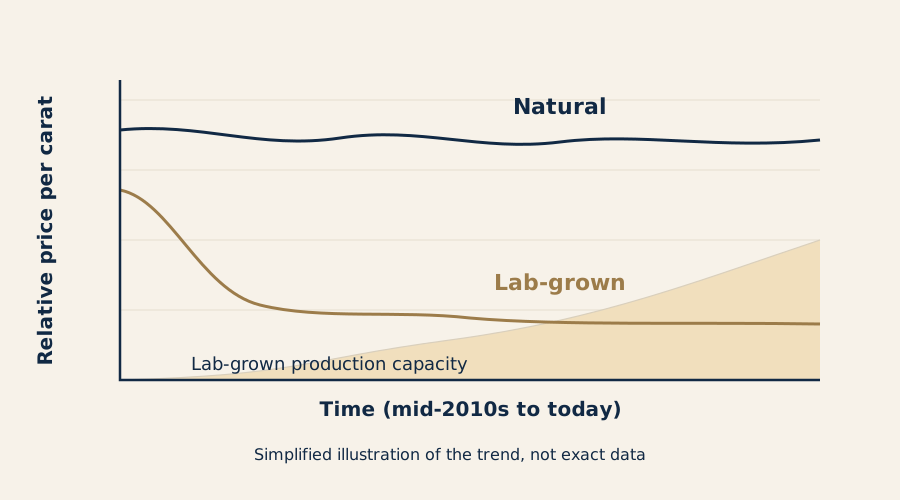
Several forces push lab-grown diamond prices down together:
- Better reactors: faster growth rates and more stones per run lower the cost of every carat.
- More producers: many growers compete for the same wholesale buyers, so they compete on price.
- Cheaper cutting: most lab-grown stones are cut in India, where efficient cutting has kept that cost low.
- Price-led brands: when De Beers launched its Lightbox lab-grown brand in 2018 with a flat, low price per carat, it reset expectations across the market.
- Retail competition: online sellers list thousands of near-identical stones, so prices are easy to compare.
Why do prices change so quickly? Because there is little to hold them up. Natural diamond supply is limited by mining, and producers can slow sales when demand drops. Lab-grown supply can be expanded in months. Wholesale lab-grown prices have, by most industry estimates, fallen to a small fraction of their mid-2010s level, and retail prices follow with a lag. Nobody can say exactly where they will settle, though falls tend to slow as prices approach production cost. For today's numbers, see our current Australian lab-grown price ranges by carat.
How do lab-grown diamond prices compare with natural diamonds?
At GemTrove we sell both natural and lab-grown diamonds, and the two look identical to the eye. The price gap is large and has widened over time.
| Round, G–H, VS, well cut | Lab-grown (approx. AUD) | Natural (approx. AUD) |
|---|---|---|
| 0.50 ct | $400–$1,000 | $2,000–$5,000 |
| 1.00 ct | $800–$2,500 | $7,000–$15,000 |
| 2.00 ct | $1,800–$5,000 | $25,000–$50,000 |
| What drives the price | Production cost and competition | Rarity and controlled supply |
| Price trend | Falling, sometimes fast | Moves more slowly; has also softened |
| Resale value | Low | Well below retail, but usually higher than lab-grown |
These ranges are approximate and change with the market. The gap matters most at larger sizes: a 2 carat lab-grown stone can cost less than a 0.50 carat natural of similar grades. For everything beyond price, including origin, detection and how each is graded, read our full natural versus lab-grown comparison.
Related guideLab-Grown Diamond Price Guide AustraliaBrowse lab-grown diamonds
Do lab-grown diamonds hold their value?
No, not in the sense of resale. Because new lab-grown stones keep getting cheaper, a second-hand one has to compete with them, and many jewellers and dealers will not buy lab-grown diamonds back at all. If they do, expect a small fraction of what you paid. Neither natural nor lab-grown diamond should be bought as an investment; natural stones also resell well below retail, though they usually keep more of their price. Our page on resale and value differences between natural and lab-grown goes further.
The fair way to think about a lab-grown diamond is as something you buy to wear. Its hardness, sparkle and durability do not change as its price falls. Two practical points follow:
- Insurance: a replacement valuation (what it would cost to replace the item today) can go out of date quickly. Ask for a fresh valuation every two to three years so you are not paying premiums on an inflated figure.
- Upgrades: some jewellers offer trade-in or upgrade credit on lab-grown stones. Read the conditions carefully, as they vary widely.
What should an Australian price label and grading report tell you?
Under the Australian Consumer Law, a business must not mislead you about what a product is or what it is worth. For diamonds that means a lab-grown stone must be clearly described as lab-grown or laboratory-grown, not just as a "diamond" with the origin hidden in fine print. Price claims such as "was $5,000, now $2,000" must reflect a genuine earlier price, and environmental claims about any product must be able to be backed up.
The grading report is your main check. A good lab-grown report should show:
- Origin: "laboratory-grown" stated clearly, usually with the growth method (CVD or HPHT).
- Treatment: whether the stone was treated after growth to improve colour.
- Grades and measurements: carat, colour, clarity, cut (for rounds), polish, symmetry and millimetre dimensions.
- Laser inscription: a report number, often with "LG" or "lab-grown", written microscopically on the girdle (the thin outer edge).
- The issuing lab: IGI grades most lab-grown diamonds; GIA has moved to a simpler descriptive system for lab-grown stones, so its reports read differently from its natural reports.
A basic diamond tester confirms that a lab-grown stone is diamond, not that it is natural; our page on whether a diamond tester can tell lab from natural explains why. And if a price looks too low even for lab-grown, check you are not looking at a simulant: see how lab-grown diamond differs from cubic zirconia.
How to compare lab-grown diamond prices: step by step
- Confirm the origin. Check that the report and the label both say laboratory-grown, and note the growth method and any treatment.
- Match the grades. Compare stones of the same shape, carat band, colour and clarity; small grade differences cost less in lab-grown than in natural.
- Compare millimetres, not just carats. For a 1 carat round, look for about 6.4–6.5 mm across.
- Check the cut. Look for Excellent or Ideal cut, polish and symmetry on rounds; use our cut grades and proportions for lab-grown stones as a reference.
- Look for tint and haze. Watch a video in daylight and ask about any blue, grey or brown cast.
- Check today's ranges. Compare with our price tables for every size, since figures from even a year ago may be out of date.
- Price the whole ring. The setting, metal and labour can be a large share of the total once the stone costs less.
That last step matters more with lab-grown than with natural. When the centre stone costs $1,500 rather than $10,000, the quality of the setting and metal becomes a much bigger part of what you are paying for, and of how long the ring lasts.
For the wider picture before you start comparing, our starting point for lab-grown buyers brings every topic together.
Free consultation
Talk to a gemologist
Compare stones in person or online with Raj Sood, Graduate Gemologist (GIA), AJP (GIA).
Book a consultationShop this shape
FAQ
Common questions
Why are lab-grown diamonds so cheap?
Because they are manufactured, and production capacity has grown much faster than demand. Better reactors, many competing growers and efficient cutting have pushed costs and prices down.
Will lab-grown diamond prices keep dropping?
Nobody can say for certain. Most of the steep falls have already happened, and prices tend to level off as they approach production cost, but further gradual falls are likely.
How much is a 1 carat lab-grown diamond in Australia?
A well-cut 1 carat round, G–H colour and VS clarity, with an independent report, is roughly AUD $800–$2,500. The range depends on cut, report and seller, and it changes often.
Is a CVD or HPHT diamond more expensive?
Once graded, there is usually little price difference between them. Colour, clarity, cut and any tint matter far more than the growth method.
Do lab-grown diamonds have resale value?
Very little. Many buyers will not purchase them second-hand, so treat a lab-grown diamond as something to wear rather than something to sell.
Why do lab-grown diamond prices change so quickly?
Supply can be expanded in months by adding reactors, and there is no producer able to hold prices up. When wholesale prices fall, retail prices follow within months.

Ask a gemologist
Not sure which diamond to choose?
Raj Sood is a Graduate Gemologist (GIA) and master jeweller. Bring the stones you are considering, or send the reports, and he will tell you honestly which one is better and why.
Keep learning
Related guides
 Buying Knowledge & Custom ProcessLab-Grown Diamond Price Guide Australia
 Buying Knowledge & Custom ProcessWhy Two Diamonds With the Same 4Cs Can Have Different PricesLab-Grown DiamondsLab-Grown Diamonds vs Natural Diamonds
 Lab-Grown DiamondsHow Are Lab-Grown Diamonds Manufactured?Lab-Grown DiamondsLab-Grown Diamonds Guide
 Lab-Grown DiamondsAre Lab-Grown Diamonds Real Diamonds
 Lab-Grown DiamondsLab-Grown Diamond Cut QualityLab-Grown DiamondsDo Lab-Grown Diamonds Test as Diamonds
Explore more
More guides on this topic
Education