
- Education
- Diamond 4Cs & Grading
- Diamond Cloud Inclusion Guide: What It Is and When It Matters
Diamond 4Cs & Grading
Diamond Cloud Inclusion Guide: What It Is and When It Matters
A diamond cloud inclusion is one of the most common features on a grading report, and one of the most misunderstood. Most clouds are harmless and invisible, but a few can make a diamond look hazy, so it pays to know which is which.
 Reviewed by Raj Sood, Graduate Gemologist (GIA), AJP (GIA)Master jeweller and Graduate Gemologist (GIA) · reviewed 4 November 2026
Quick answer
A cloud is a cluster of tiny pinpoint inclusions, or very small crystals, packed too closely to see individually at 10× magnification. Most clouds are harmless and invisible to the eye, and do not weaken the diamond. A large or dense cloud can make a stone look hazy and lower its clarity grade to SI2 or I1.
What is a cloud inclusion in a diamond?
An inclusion is any feature inside a diamond, as opposed to a blemish, which sits only on the surface. A cloud is a particular kind of inclusion: a group of extremely small pinpoints (dots so tiny they look like specks of dust even under a loupe) sitting close together. At 10× magnification, the standard for clarity grading, the individual dots blur into a soft, whitish or greyish patch, a little like a puff of smoke inside the stone. That is where the name comes from.
Clouds come in every size. Some are so faint a trained grader has to tilt the stone under a microscope to find them. Others spread across much of the diamond and give it a soft, milky look. Some clouds also contain slightly larger crystals (tiny minerals trapped inside the diamond), and a few line up along a growth plane in a pattern graders call a twinning wisp. Our full guide to diamond inclusions covers every type, and any word here you have not met before is defined in our jewellery glossary of grading terms.
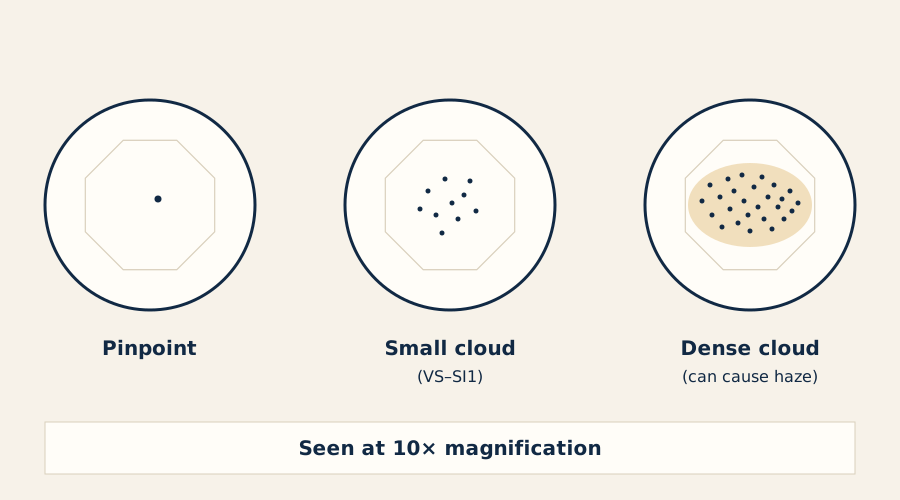
The important point for buyers is that a cloud is not a crack. It is made of separate tiny points, not a break running through the crystal, so in almost all cases it has no effect on how tough the diamond is. What it can affect is transparency, meaning how cleanly light passes through the stone, and that is what decides whether a cloud matters to you.
How do clouds form in natural and lab-grown diamonds?
Natural diamonds crystallise deep in the Earth's mantle, typically somewhere around 150–200 km down, under enormous heat and pressure. As the crystal grows, it can trap minute amounts of other material, or grow unevenly in some zones. Clouds tend to form where growth was disturbed and many microscopic points were captured at once. Some of those points are tiny mineral crystals trapped during growth; others are so small that even a gem lab cannot easily say what they are.
Lab-grown diamonds are real diamond, grown in a laboratory, and they can have clouds too. Diamonds grown by HPHT (high pressure, high temperature) sometimes contain pinpoints or clouds of metallic flux, the metal mixture used to help the diamond grow; these can look grey or silvery. Diamonds grown by CVD (chemical vapour deposition) more often show dark pinpoints of non-diamond carbon. Dark points behave differently from white ones, which we cover in dark graphite and black inclusions.
Whether a stone is natural or lab-grown, it is graded on the same clarity scale, and a cloud is judged in exactly the same way: by how much it shows and how it affects the look of the diamond.
How does a cloud inclusion affect the clarity grade?
Clarity is one of the 4Cs of colour, cut, clarity and carat. A grader at GIA or IGI judges each inclusion on five factors: size, number, position, nature (what kind of inclusion it is) and relief (how much it contrasts with the diamond around it). A cloud's size and density matter most, because those decide whether it scatters enough light to be noticed.
| Clarity grade | What it means at 10× | How clouds usually show at this grade |
|---|---|---|
| FL / IF | No inclusions visible (IF may have minor surface blemishes) | No clouds visible to a grader |
| VVS1 / VVS2 | Very, very slightly included; extremely hard to see | A faint, tiny cloud may be the only feature |
| VS1 / VS2 | Very slightly included; hard to see | Small, scattered clouds, invisible to the eye |
| SI1 | Slightly included; noticeable at 10× | Clouds often visible at 10×; nearly always eye-clean |
| SI2 | Slightly included; easy to see at 10× | Larger clouds; check for haze in some lighting |
| I1 / I2 / I3 | Included; may be visible to the eye | Dense clouds can reduce transparency and brilliance |
On many GIA reports you will see a comment such as "Clouds are not shown". It means the grader found clouds but did not draw them on the plot, usually because they are small, numerous or spread out. That is common and not a warning in itself. What you want to know is whether the clouds are grade-setting, meaning they are the main reason the stone received its clarity grade. If the only listed inclusions are clouds and pinpoints and the grade is VS2 or SI1, the clouds are almost certainly deciding the grade.
Are cloud inclusions bad? When a cloud makes a diamond hazy
Most clouds are not bad at all. Diamond has a refractive index of about 2.42, which bends light strongly and sends it back out through the top as brilliance and fire. A small cloud catches so little of that light that you cannot tell it is there. The problem only starts when a cloud is large or dense enough to scatter light across a big part of the stone. Then the diamond can look soft, slightly grey or milky, a bit like a window with condensation on it. Jewellers call this a hazy diamond.
| Type of cloud | Typical look | Effect on appearance |
|---|---|---|
| Tiny, isolated cloud | A faint wisp at 10× | None you can see |
| Several scattered small clouds | Dusting of white specks at 10× | Usually none; may be plotted or noted |
| One larger cloud near the table | Visible patch at 10×, sometimes at arm's length in SI2 | Can show as a soft spot under the table |
| Cloud spread through the stone | General milky or grey look | Reduced brilliance and contrast; often SI2 or I grades |
| Cloud with dark pinpoints | Grey patch rather than white | More visible because of higher relief |
Cut style matters. Round brilliants, oval diamonds, pear cut diamonds and other brilliant cuts break light into many small flashes, which hides small clouds well. Step cuts such as emerald and Asscher cuts have large, open facets that act like windows, so a cloud near the table is easier to see. If you are choosing a step cut, it is reasonable to aim one clarity grade higher than you would for a round, or to look closely at the stone's video. Our overview of how each diamond shape handles light explains which shapes are brilliant cuts and which are step cuts.
Position matters too. A cloud under the table (the large top facet) is more noticeable than one near the girdle (the outer edge), where it may be hidden by a claw. A cloud that reflects off the pavilion facets can also appear several times over, which makes it look bigger than it really is.
Not sure which one is right?
Send us the stones you are looking at and our gemologist will tell you which to choose and why.
Cloud vs pinpoint, crystal, feather and needle: what's the difference?
Clouds are often confused with other small inclusions. Here is how they compare, from the buyer's point of view:
| Inclusion | What it is | Usual visibility | Durability risk |
|---|---|---|---|
| Cloud | Cluster of pinpoints too close to separate | Usually invisible; large clouds cause haze | Very low |
| Pinpoint | A single tiny dot | Invisible to the eye | Very low |
| Crystal | A mineral crystal trapped inside | Varies; dark crystals show more | Low, unless large or near the surface |
| Needle | A long, thin crystal | Usually invisible | Very low |
| Feather | A small break or fracture | Varies with size and colour | Possible, if large or reaching the surface |
| Knot | A crystal that reaches the surface | May be visible as a raised spot | Low to moderate |
A cloud is really a crowd of pinpoints, so the closest relative is the single pinpoint inclusion. Our guides to long, thin needle inclusions and included crystals and how they are graded explain the other growth inclusions. The two to treat more carefully are covered in how feather inclusions differ from clouds and knots that reach the surface of the stone, because those can affect polish or toughness in a way a cloud almost never does.
Related guidePinpoint Inclusions in DiamondsClouds are not only a diamond feature. Many coloured gemstones are expected to have them: the silky, cloud-like rutile needles in some sapphires, and the garden of inclusions in emeralds that is often treated with oil or resin. If you are comparing stones, our page on why inclusions are expected in emeralds explains how that differs from diamond grading.
How do you read a cloud on a diamond grading report?
A GIA or IGI report includes a plotting diagram: a map of the diamond seen from the top and from underneath. Internal inclusions are drawn in red and surface blemishes in green. A cloud is drawn as a small dotted outline, so you can see roughly how big it is and where it sits. A pinpoint is a single red dot and a feather is a short red line.
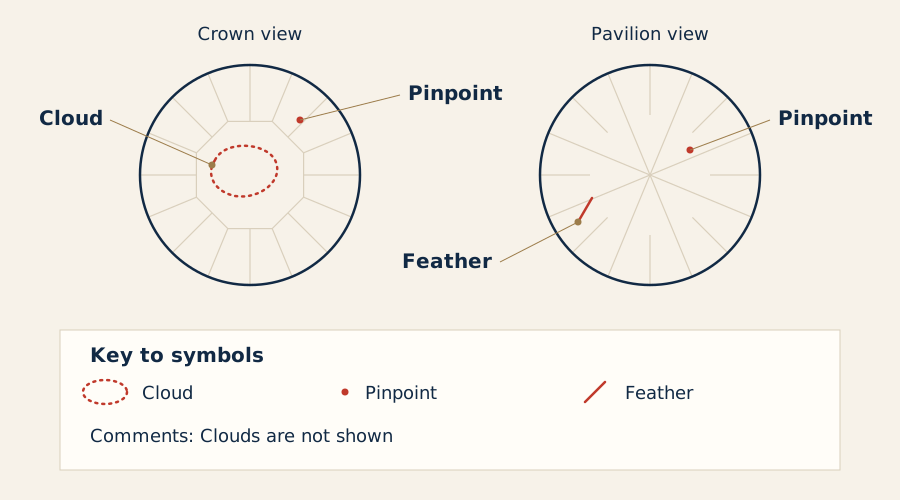
When you read the report, look at three things:
- Key to symbols: the list of inclusion types in order of importance. If "Cloud" is listed first, it is the main clarity feature.
- Comments: notes such as "Clouds are not shown" or "Pinpoints are not shown" tell you there are more features than the plot displays.
- Position on the plot: a cloud drawn under the table matters more than one at the edge, and one that appears on both the crown and pavilion view may be larger than it looks.
Reports for smaller diamonds, often under 2 carats (such as the GIA Diamond Dossier), may not include a plot at all. In that case, a clear 360° video or a look under a loupe is the only way to judge the cloud. For how each inclusion type is mapped and named, see how every inclusion is plotted and described.
Do cloud inclusions affect diamond durability?
Almost never. Diamond is 10 on the Mohs scale of hardness, and a cloud is made of separate microscopic points, not a break through the crystal. It does not create a weak plane the way a large feather can. A diamond with an SI1 cloud is as wearable day to day as a VVS stone.
The rare exception is a very large, dense cloud combined with other inclusions, especially near the girdle or a pointed tip. In those stones it is usually the feathers that can affect toughness, not the cloud itself, that a jeweller looks at. If an I1 to I3 diamond has a cloud next to a feather at the edge, ask how the setting will protect that area.
Is a diamond with a cloud inclusion worth buying?
Often, yes. Because clouds rarely show to the eye in the VS and SI1 grades, a diamond whose clarity is set by small clouds can look identical to a higher grade at a noticeably lower price. This is one of the clearest ways to put more of a budget into cut or carat, the Cs you can actually see; our guide to how clarity trades against colour and carat shows how the grades interact.
The price step between grades is real for natural diamonds, and much smaller for lab-grown. As a broad guide for a 1 carat round, G colour, excellent cut:
| Clarity | Natural (approx. AUD) | Lab-grown (approx. AUD) |
|---|---|---|
| VS1 | about $11,000–$15,000 | about $1,000–$2,500 |
| VS2 | about $10,000–$13,500 | about $900–$2,300 |
| SI1 | about $8,000–$11,000 | about $800–$2,000 |
| SI2 | about $6,500–$9,000 | about $700–$1,800 |
These ranges are approximate and move with the market. With natural diamonds, choosing an eye-clean SI1 over a VS2 can free up a meaningful amount of money. With laboratory-grown diamonds, clarity has less effect on price, so many people simply choose VS2 or better and avoid the question. In either case, avoid a stone whose cloud makes it look hazy, because that affects every other quality you are paying for.
Browse natural and lab-grown diamonds by clarity
How do you check a diamond cloud inclusion before you buy? Step by step
- Read the report. Check the clarity grade, whether the stone is natural or lab-grown, and whether "Cloud" is the first inclusion in the key to symbols.
- Look at the comments. Note any "Clouds are not shown" or "Pinpoints are not shown" lines, and ask whether those clouds set the grade.
- Find the cloud on the plot. A cloud under the table matters more than one near the girdle; a large dotted outline deserves a closer look.
- Watch a 360° video in natural light. Look for a soft, grey or milky patch, and compare brightness with a stone one grade higher.
- Consider the cut. Brilliant cuts hide clouds well; for emerald and Asscher cuts, check the table area especially carefully.
- Check it at arm's length. If you cannot see the cloud at normal viewing distance and the stone looks bright, it is eye-clean for practical purposes.
- Confirm the terms. If a word on the report is unfamiliar, look up the definitions of every clarity term before you decide.
Free consultation
Talk to a gemologist
Compare stones in person or online with Raj Sood, Graduate Gemologist (GIA), AJP (GIA).
Book a consultationShop this shape
FAQ
Common questions
What is a cloud in a diamond?
A cloud is a cluster of tiny pinpoint inclusions sitting so close together that they look like a soft, hazy patch at 10× magnification. It forms as the diamond grows and is one of the most common clarity features.
Are cloud inclusions bad in a diamond?
Usually not. Small clouds are invisible to the eye and do not weaken the stone. Only large or dense clouds are a concern, because they can make the diamond look hazy and less bright.
What does "Clouds are not shown" mean on a GIA report?
It means the grader found clouds but did not draw them on the plotting diagram, usually because they are small or spread out. Ask whether those clouds are what set the clarity grade, then check the stone's video for any haze.
Is an SI1 diamond with clouds eye-clean?
Most SI1 diamonds with clouds as the main inclusion are eye-clean, especially in brilliant cuts such as rounds and ovals. Check a video in natural light to make sure the stone does not look soft or milky.
Do lab-grown diamonds have cloud inclusions?
Yes. Lab-grown diamonds can contain clouds of metallic flux or dark carbon pinpoints, depending on how they were grown, and they are graded on the same clarity scale as natural diamonds.
Can a cloud inclusion be removed?
Not without recutting the diamond, which loses weight and is only worth it in rare cases. Laser drilling and fracture filling are used for other inclusions, not clouds, so it is better to choose a stone where the cloud does not show.

Ask a gemologist
Not sure which diamond to choose?
Raj Sood is a Graduate Gemologist (GIA) and master jeweller. Bring the stones you are considering, or send the reports, and he will tell you honestly which one is better and why.
Keep learning
Related guides
 Diamond 4Cs & GradingDiamond Inclusions Guide
 Diamond 4Cs & GradingPinpoint Inclusions in Diamonds
 Diamond 4Cs & GradingWhat Is a Feather Inclusion in a Diamond?Diamond 4Cs & GradingCrystal Inclusions in DiamondsDiamond 4Cs & GradingDiamond 4CsDiamond 4Cs & GradingKnot Inclusions in Diamonds
 Diamond 4Cs & GradingNeedle Inclusions in DiamondsDiamond 4Cs & GradingAre Black Inclusions Bad in a Diamond?
Explore more
More guides on this topic
Education