
- Education
- Diamond 4Cs & Grading
- Knot Inclusion in a Diamond: What It Is, Durability Risk and Grading
Diamond 4Cs & Grading
Knot Inclusion in a Diamond: What It Is, Durability Risk and Grading
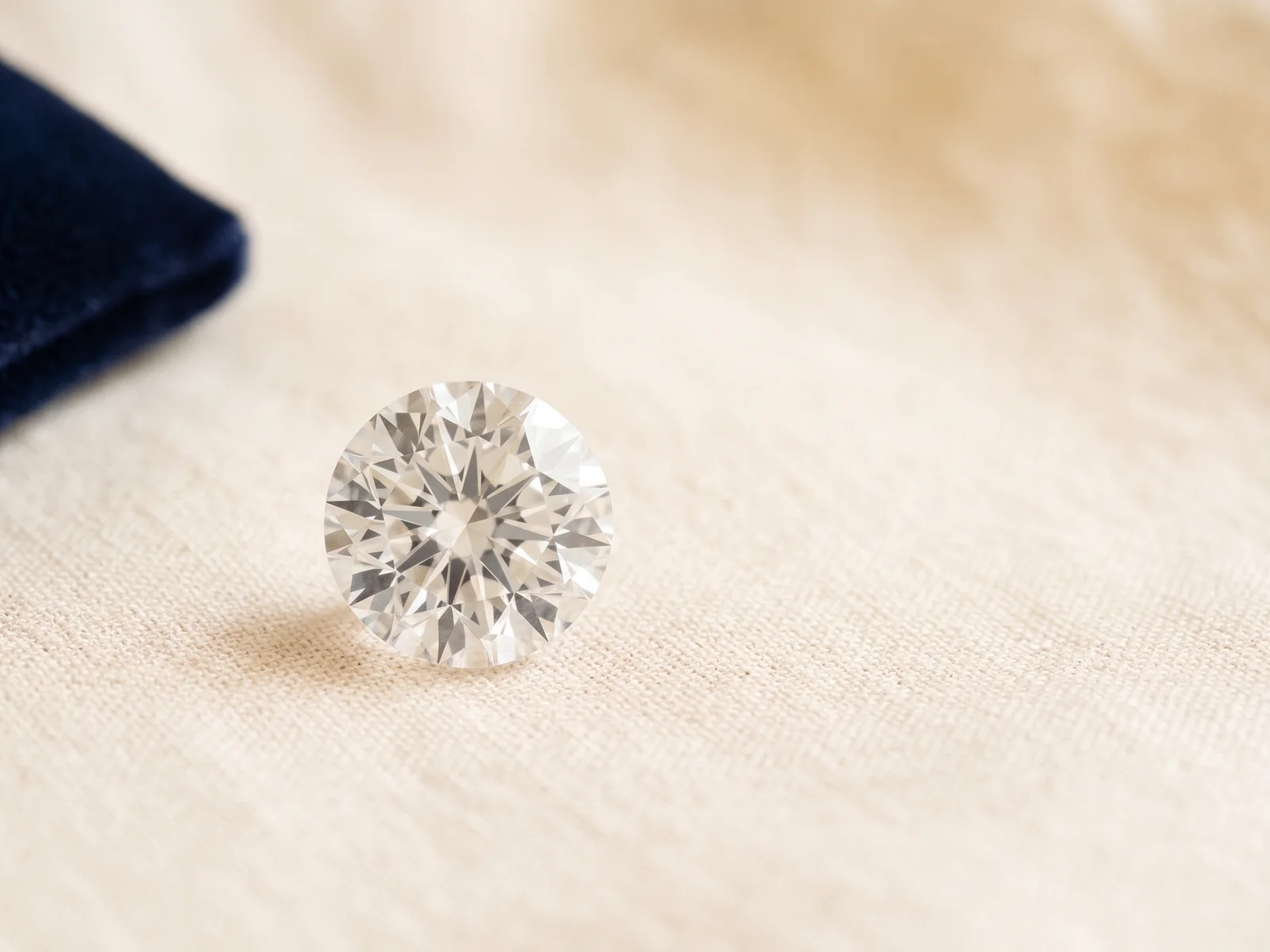
A knot inclusion in a diamond is one of the few inclusions you can sometimes feel as well as see. It is rarely a deal-breaker, but where it sits and what is around it decide whether it is harmless or worth a second look.
 Reviewed by Raj Sood, Graduate Gemologist (GIA), AJP (GIA)Master jeweller and Graduate Gemologist (GIA) · reviewed 4 November 2026
Quick answer
A knot is a crystal trapped inside a diamond that reaches the polished surface. It is usually another diamond crystal, so it often shows as a tiny raised bump. Most knots are harmless, but one at the girdle or touching a feather adds chip risk. Small knots appear in VS stones; SI-grade knots are often still eye-clean.
What is a knot inclusion in a diamond?
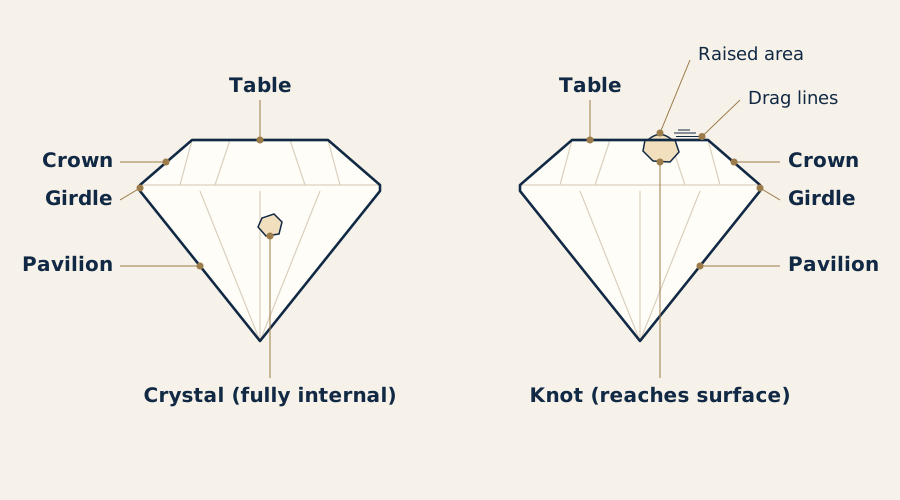
A knot is an included crystal that reaches the surface of a polished diamond. An inclusion is any feature inside the stone, and an included crystal is a small mineral grain the diamond grew around. While that crystal stays completely inside, graders call it a crystal. Once the cutter grinds down far enough to expose part of it on a facet, it becomes a knot.
In most cases the trapped crystal is itself diamond. Less often it is another mineral such as garnet or olivine. Either way, it is a natural feature, not damage. It is one of the characteristics graders weigh when they assign clarity, one of the four Cs of diamond grading alongside cut, colour and carat.
Knots are less common than pinpoints, feathers or clouds, and many people meet the word for the first time on a grading report. If you want the wider picture first, our complete guide to diamond inclusion types covers every characteristic a grader can plot. Any term here you have not met before is also in our plain-English jewellery glossary.
How does a knot form inside a diamond?
Natural diamonds crystallise deep in the Earth's mantle, roughly 150–200 km below the surface, and many are more than a billion years old. As a diamond grows, it can surround smaller crystals that were already there or that formed alongside it. Those trapped grains are what graders later see as crystals. Our page on included crystals that stay below the surface explains the different minerals involved and what each looks like.
A knot needs one more step: cutting. The cutter plans facets to keep as much weight as possible from the rough, and sometimes the path of a facet runs straight through a crystal close to the surface. Moving the facet to avoid it would cost weight, so the cutter polishes through and leaves part of the crystal exposed.
Here is why knots behave differently from other inclusions. Diamond is 10 on the Mohs scale, but its hardness changes with direction: along some directions (the "grain") it polishes easily, across others it barely polishes at all. A trapped diamond crystal usually sits at a different angle to its host. When the polishing wheel passes over it, the host is being cut along its soft direction while the knot is being cut across its hard one. The knot wears down more slowly and ends up slightly proud of the facet.
If the knot is a different mineral, the contrast can work the other way: a softer mineral such as garnet (about 6.5–7.5 on the Mohs scale) can polish lower than the surrounding diamond. Dark minerals in this position can also look like a black spot; see our page on dark mineral crystals and black inclusions for how those are judged.
What does a knot look like in a diamond?
Face-up, a knot often looks like a small clear or whitish crystal, sometimes with a faint outline, because its edges reflect light slightly differently from the host. Under a 10× loupe, the giveaway is the surface. Tilt the stone so a facet reflects the light like a mirror and a knot usually shows as one or more of these:
- A raised area: a tiny bump or ripple in the otherwise flat reflection of the facet.
- Drag lines: fine polishing marks trailing away from the knot in one direction, where the wheel skipped or dragged as it crossed the harder crystal.
- An outline at the surface: a thin boundary line where the knot meets the facet, sometimes with a small gap.
- Stress or small cracks: fine feathers radiating from the crystal, caused by the slight mismatch between the crystal and its host.
That last point matters most. A feather is a small internal crack, and knots sometimes have one attached. Read our page on feathers, the small internal cracks in diamond to understand how they are graded, because a feather beside a knot changes the durability picture far more than the knot alone.
Some knots sit within a scatter of tiny crystals. Single specks too small to show shape at 10× are called pinpoints, covered in our guide to tiny pinpoint inclusions, and a dense group of them forms a cloud.
Where does a knot inclusion show on a diamond report plot?
A clarity plot is the map on a grading report showing where the main inclusions sit, drawn on a face-up outline (the crown, seen from above) and a face-down outline (the pavilion, seen from below). GIA reports use red symbols for internal characteristics and green for external ones (features on the surface only).
Because a knot is both inside the stone and at the surface, its symbol typically combines the two: a red outline showing the crystal, with green marking where it breaks the surface. Symbol styles vary between labs and over time, so rely on the Key to Symbols beside the plot, which names each characteristic in words. Look for the word "Knot".
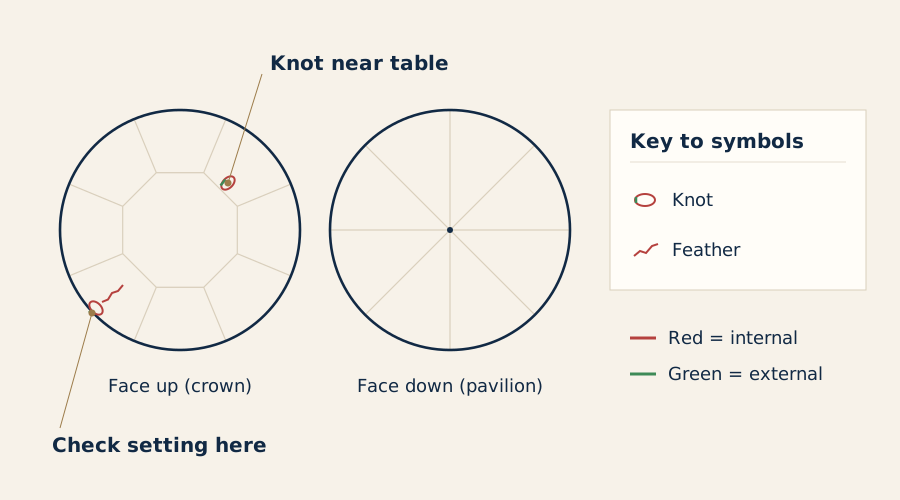
Three things to read from the plot:
- Which outline it is on. A knot on the crown plot is on the top of the stone, where you look; one on the pavilion plot is underneath.
- Distance from the edge. A knot drawn right at the outline is at or near the girdle, the thin rim around the widest part of the stone.
- What is drawn next to it. A feather symbol touching the knot is the detail that deserves a closer look.
Plots do not show everything. Very small pinpoints and light haze are often left off, with a comment such as "clouds not shown" instead; our page on how cloud inclusions are noted on a report explains when that matters. The report also lists other measurable features such as fluorescence, the glow under ultraviolet light, which has nothing to do with knots but sits on the same document.
Not sure which one is right?
Send us the stones you are looking at and our gemologist will tell you which to choose and why.
Knot vs crystal inclusion: what is the difference, and how do other inclusions compare?
Knots are often confused with several neighbouring characteristics. This table sets them side by side.
| Characteristic | What it is | Reaches surface? | Main concern |
|---|---|---|---|
| Knot | Included crystal exposed on a facet | Yes | Visibility on the table; chip risk at the girdle or with a feather |
| Crystal | Mineral grain fully inside the stone | No | Visibility, especially if dark |
| Needle | Long, thin crystal or rod | Usually no | Visibility if long or reflective |
| Feather | Internal crack or cleavage | Often | Durability if large or open at the surface |
| Cavity | Opening left where a crystal fell out or a feather broke away | Yes | Dirt can collect; visible in reflected light |
| Indented natural | Part of the original rough surface dipping below the polish | Yes | Usually minor; mostly at the girdle |
| Chip | Small break at an edge, caused by a knock | Yes | Shows wear or impact; can worsen with further knocks |
The difference between a knot and a cavity is worth knowing. If a knot is loosened, for example by a hard knock, part of it can come away and leave a cavity. That is uncommon, but it is one reason graders and setters pay attention to knots near the edge. Long, thin crystals are a separate category; our guide to long, thin needle inclusions explains them.
Related guideCrystal Inclusions in DiamondsHow does a knot affect diamond clarity grade?
GIA grades clarity on an 11-step scale from Flawless (FL) to Included (I3), judged under 10× magnification. Graders consider five factors for every inclusion: size, number, position, nature (what kind of inclusion it is) and relief (how much it contrasts with the diamond). A knot scores on nature because it reaches the surface, and on position if it sits under the table.
| Clarity grade | How a knot typically presents |
|---|---|
| IF (Internally Flawless) | Not possible; a knot is partly internal, so it rules out IF |
| VVS1–VVS2 | Tiny knot, extremely to very difficult to find at 10×, often near the girdle or on the pavilion |
| VS1–VS2 | Small knot, difficult to somewhat easy to see at 10×; rarely visible without magnification |
| SI1–SI2 | Noticeable at 10×; may be the grade-setting inclusion; SI1 usually still eye-clean in brilliant cuts, SI2 varies |
| I1–I3 | Large or multiple knots, often with feathers; may be visible to the eye and affect durability |
A knot with no other inclusions nearby rarely pulls a stone into the I grades on its own. Where it often makes a difference is between VS2 and SI1: a knot right under the table can set the grade lower than the same knot near the girdle.
Knots can also affect the polish grade. Drag lines and a raised area are surface features, and if they are noticeable they can lower polish from Excellent to Very Good. That is separate from clarity; our page on how polish and symmetry grades are set explains the finish grades, and Excellent, Very Good and Good cut grades shows how the overall cut grade is built.
Does a knot inclusion weaken a diamond?
Usually not much. A knot by itself is a crystal bonded into its host, and most knots sit in a diamond for life without any trouble. The risk rises in specific situations: when the knot is at the girdle or a point, when a feather runs from it, or when it sits right where a claw will press.
| Knot position | Visibility | Durability concern |
|---|---|---|
| Centre of the table | Highest; looked at directly | Low, unless a feather is attached |
| Crown, off-centre | Moderate; brilliant faceting helps hide it | Low |
| Pavilion (underneath) | Lower; seen through the stone and in reflections | Low |
| Girdle edge | Low; often under a claw | Higher; the edge takes most knocks |
| Point or corner of a fancy shape | Low to moderate | Higher; thin areas are more exposed |
Two practical points follow. First, when a diamond with a knot at the girdle is set, the setter can place claws to protect that area, or avoid pressing a claw directly onto it. Second, if a knot has a feather attached, ultrasonic cleaning and strong heat during repairs are better avoided unless the jeweller has checked the stone first.
Unlike emeralds, which are routinely oiled or resin-filled to hide surface-reaching fissures (see how emeralds are clarity-enhanced), knots in diamond are not normally treated. Diamond treatments such as fracture filling target feathers, and any treatment must be disclosed to the buyer; GIA will not issue a grading report for a fracture-filled diamond.
Is a diamond with a knot inclusion eye-clean?
Eye-clean means no inclusion is visible without magnification at normal viewing distance, about 25–30 cm. Most knots in VS diamonds are eye-clean. In SI1, most knots in brilliant cuts such as round, oval and cushion are eye-clean too, because the many small facets break up light and hide small features. In SI2, it depends on size and position, so check each stone.
Shape makes a real difference. Brilliant-faceted shapes mask a knot well; our guide to shapes that disguise inclusions and tint compares them. Step cuts are the opposite: their large, open facets act like windows, so a knot under the table of an emerald or Asscher cut is much easier to see. Our page on why step cuts show inclusions more clearly explains why many people choose VS2 or higher in those shapes.
Clarity has a real effect on price. As a rough guide for a 1 carat natural round, G colour, Excellent cut:
| 1 ct natural round, G, Excellent cut | Approximate price range (AUD) |
|---|---|
| VS2 | about $9,000–$14,000 |
| SI1 | about $7,000–$11,000 |
| SI2 | about $5,500–$9,000 |
These are broad ranges only and move with the market. An eye-clean SI1 with a well-placed knot can look identical to a VS2 on the hand for a lower price, which is why it pays to judge the individual stone rather than the grade alone.
Browse natural and lab-grown diamonds
Do lab-grown diamonds have knots?
Knots made from trapped mantle minerals are a feature of natural diamonds, because a laboratory-grown diamond never grows in the Earth's mantle. Lab-grown diamonds are real diamond with the same hardness and refractive index (about 2.42), but their inclusions come from the growth process instead.
- HPHT lab-grown (high pressure, high temperature): can contain metallic flux inclusions, left by the metal solvent used to grow the crystal. Our page on metallic inclusions in HPHT lab-grown stones explains how they look and why some are magnetic.
- CVD lab-grown (chemical vapour deposition): can contain dark specks of non-diamond carbon and pinpoints, often in layers that follow the growth direction.
- Included diamond grains: small extra diamond crystals can occasionally form during lab growth and be exposed by polishing, and a grader may then plot a knot. This is uncommon.
Labs such as GIA and IGI state on the report whether a diamond is natural or lab-grown, so you never have to infer the origin from its inclusions.
How do you check a diamond with a knot before you buy?
- Find it on the report. Check the Key to Symbols for the word "Knot" and note the clarity grade and polish grade.
- Locate it on the plot. Is it on the crown or the pavilion, under the table or out near the girdle?
- Look at what touches it. A feather symbol joined to the knot is the one detail to discuss with the jeweller.
- View the stone face-up. At 25–30 cm, in normal light, decide whether you can see it without magnification.
- Tilt it under a light with a loupe. Look for a raised bump or drag lines on the facet so you know what the plot is describing.
- Plan the setting. If the knot is at the girdle, ask for the claws or bezel to protect that area rather than press on it.
- Ask about care. Check whether the stone is suited to ultrasonic cleaning before you use one at home.
Free consultation
Talk to a gemologist
Compare stones in person or online with Raj Sood, Graduate Gemologist (GIA), AJP (GIA).
Book a consultationShop this shape
FAQ
Common questions
Is a knot inclusion bad in a diamond?
Not usually. Most knots are small, stable and invisible to the eye. A knot becomes a concern mainly when it sits at the girdle or a point, or has a feather attached.
What is the difference between a knot and a crystal inclusion?
Both are included crystals. A crystal stays completely inside the diamond, while a knot reaches the polished surface, so it can often be seen as a tiny raised area in reflected light.
Can a knot fall out of a diamond?
It is uncommon, but a hard knock can loosen a knot, particularly one near the edge, and leave a small cavity. A protective setting and avoiding hard impacts keep that risk low.
Can an SI1 diamond with a knot be eye-clean?
Yes, especially in brilliant cuts such as round and oval. Check where the knot sits on the plot and view the stone at normal distance; a knot under the table of a step cut is more likely to show.
How is a knot shown on a GIA report?
It is drawn on the clarity plot, usually combining red for the internal crystal with green where it meets the surface. The Key to Symbols beside the plot names it as a knot.
Do lab-grown diamonds have knot inclusions?
Rarely. Lab-grown diamonds more often show metallic flux inclusions (HPHT) or dark carbon specks (CVD), though occasionally a small diamond grain exposed by polishing is plotted as a knot.

Ask a gemologist
Not sure which diamond to choose?
Raj Sood is a Graduate Gemologist (GIA) and master jeweller. Bring the stones you are considering, or send the reports, and he will tell you honestly which one is better and why.
Keep learning
Related guides
 Diamond 4Cs & GradingDiamond Inclusions Guide
 Diamond 4Cs & GradingCrystal Inclusions in DiamondsDiamond 4Cs & GradingWhat Is a Feather Inclusion in a Diamond?Diamond 4Cs & GradingAre Black Inclusions Bad in a Diamond?Diamond 4Cs & GradingDiamond 4CsDiamond 4Cs & GradingWhat Is a Cloud Inclusion in a Diamond?
 Diamond 4Cs & GradingPinpoint Inclusions in Diamonds
 Diamond 4Cs & GradingNeedle Inclusions in Diamonds
Explore more
More guides on this topic
Education