
- Education
- Diamond 4Cs & Grading
- What Is a Feather Inclusion in a Diamond? Grades, Risks and Checks
Diamond 4Cs & Grading
What Is a Feather Inclusion in a Diamond? Grades, Risks and Checks
The feather is the most common inclusion in a diamond, and the one people worry about most. Here is how to tell a harmless feather inclusion in a diamond from one that affects durability, and what it means for the clarity grade and the price.
 Reviewed by Raj Sood, Graduate Gemologist (GIA), AJP (GIA)Master jeweller and Graduate Gemologist (GIA) · reviewed 4 November 2026
Quick answer
A feather inclusion in a diamond is a small internal crack, named for the white, feathery look it has from the side. Most feathers are harmless and only affect the clarity grade. Take care with large feathers that reach the surface or sit near the girdle or a claw, as these can weaken the stone.
What is a feather inclusion in a diamond?
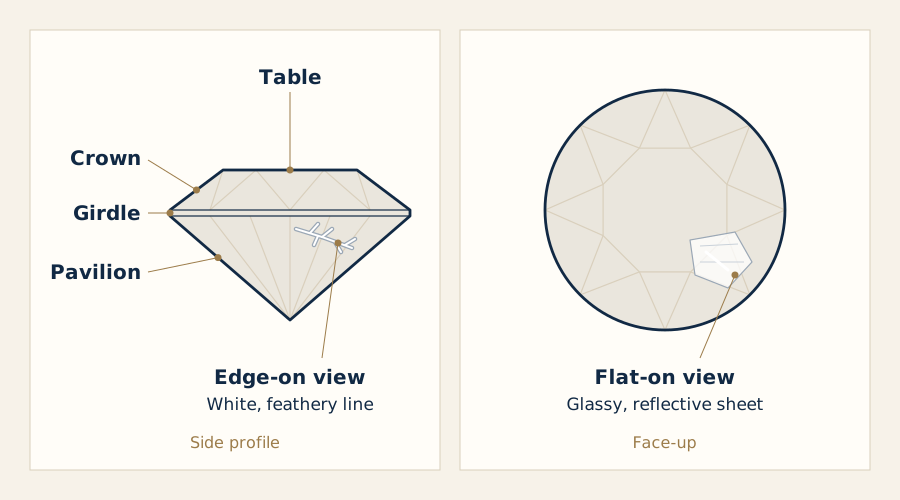
A feather is a break inside a diamond: a fracture or a cleavage crack that has opened within the crystal. Grading labs such as GIA use the word feather for almost any crack, whether it is tiny and fully enclosed or large enough to reach the surface. The name comes from how it looks. Seen from the side, the edge of the crack often has fine, wispy lines that look like the barbs of a bird's feather. Seen straight on, it can be almost invisible, a thin transparent sheet that only shows up when light catches it.
An inclusion is any feature inside a diamond, as opposed to a blemish, which sits only on the surface. Feathers are classed as inclusions even when they break the surface, because most of the crack lies inside the stone. On a grading report's plotting diagram (the map of the stone's clarity features) they are drawn in red, like other inclusions; surface blemishes are drawn in green. For the full family of features, from crystals to clouds, see our full guide to diamond inclusion types, and any term you have not met before is in our jewellery glossary of grading terms.
Feathers matter in two different ways. First, they affect clarity, one of the four Cs, because they can be seen under magnification and sometimes with the naked eye. Our page on how clarity fits alongside cut, colour and carat explains how the grades interact. Second, and more importantly for a ring you will wear every day, some feathers affect durability. Most do not. The rest of this guide is about telling the two apart.
How do feathers form in a diamond?
Diamond is the hardest natural material, 10 on the Mohs scale, but hardness only measures resistance to scratching. Toughness, the resistance to breaking, is a different property. Diamond has cleavage: four directions, parallel to the faces of its octahedral crystal, along which the atomic bonds are weaker. A sharp blow in the wrong direction can split it along one of those planes. Many feathers follow a cleavage plane and look flat and straight; others are irregular fractures that curve or step through the stone.
- Natural stress during growth: diamonds form roughly 150–200 km underground and are carried to the surface in volcanic eruptions. Changes in pressure and temperature on the way up can crack the crystal.
- Around other inclusions: a mineral crystal trapped inside a diamond expands and contracts differently from the diamond around it. That strain often produces a small feather around crystal inclusions, tiny minerals trapped in the diamond, sometimes called a halo or tension fracture.
- Cutting and polishing: heat and pressure on the wheel can start small feathers, especially near the girdle (the thin outer edge). Very fine hair-like feathers along the girdle are called a bearded girdle.
- Wear and setting: a knock against a hard surface, or too much pressure from a claw during setting, can create a new feather or extend an existing one.
A related feature is the knot, a crystal that reaches the surface of the polished stone. Knots often have feathers around them for the same strain reasons, which is why surface-reaching knots are judged much like feathers when it comes to durability.
What does a feather look like, and how is it different from other inclusions?
Under a 10x loupe (the standard magnification for clarity grading), a feather usually looks white or transparent. Viewed edge-on it is a fine white line, often with feathery branches. Viewed flat-on it can look like a pale, glassy sheet, and if the crack is open to air it may reflect light like a tiny mirror or show a faint rainbow of colour. A feather can also look dark in some positions when it reflects the pavilion facets, so the same feather can change appearance as you turn the stone.
| Inclusion | What it is | Typical look at 10x | Durability risk |
|---|---|---|---|
| Feather | A fracture or cleavage crack | White, wispy line or glassy sheet | Low to high, depending on size and position |
| Pinpoint | A tiny crystal | Minute white or dark dot | Very low |
| Cloud | A cluster of pinpoints | Hazy, milky patch | Usually low; large clouds can reduce brightness |
| Crystal | A trapped mineral | Clear, white, dark or coloured grain | Low, unless surrounded by feathers |
| Needle | A long, thin crystal | Fine white rod | Very low |
| Knot | A crystal reaching the surface | Raised spot on a facet | Moderate, especially with feathers |
Of these, the feather is the one with a real range of risk. A tiny pinpoint or long, thin needle inclusion almost never affects strength. A cloud is a different case again: it rarely weakens a diamond but a large one can dull the sparkle, so it is worth reading feather vs cloud inclusion: when a cloud matters more. Dark features are covered in our page on whether a black spot is worth worrying about.
Related guideDiamond Inclusions GuideHow does a feather inclusion affect a diamond's clarity grade?
Clarity is graded on how easily a trained grader can see features at 10x magnification, judged by their size, number, position, nature and relief (how much they contrast with the surrounding diamond). A feather that is small, fine and tucked near the girdle grades better than one of the same size sitting under the table (the large flat facet on top), where it is far easier to see. Here is how feathers typically show at each grade:
| Clarity grade | How a feather typically appears | Durability concern |
|---|---|---|
| FL / IF | No feathers (IF may have tiny surface blemishes only) | None |
| VVS1–VVS2 | Minute, very hard to find even at 10x | Negligible |
| VS1–VS2 | Small; seen with some effort at 10x | Rarely a concern |
| SI1 | Noticeable at 10x; usually eye-clean in rounds under about 1 ct | Check position and whether it reaches the surface |
| SI2 | Easily seen at 10x; may be visible to the eye, especially in step cuts | Check carefully |
| I1–I3 | Obvious to the eye; can be large or open | Can genuinely weaken the stone |
The feather inclusion SI1 stone is where most of the real decisions happen. An SI1 with a single fine feather near the edge can look identical face-up to a VS2, while another SI1 can have a long feather under the table that you notice every time you look down. That is why the grade alone is not enough. Eye-clean means no inclusions visible without magnification at a normal viewing distance of roughly 25–30 cm, and whether a feather is eye-clean depends on the cut as much as the grade. Brilliant cuts such as rounds and ovals hide feathers well; step cuts such as emerald and Asscher, with their large open facets, show them more. Our overview of how each diamond shape hides or shows inclusions puts the shapes side by side.
If a report lists a feather as the grade-setting inclusion (the first one listed under clarity characteristics is usually the most significant), look at where it is plotted before anything else. More on reading the whole report is in our explanation of the four Cs of diamond grading.
Not sure which one is right?
Send us the stones you are looking at and our gemologist will tell you which to choose and why.
Is a feather inclusion in a diamond bad for durability?
Most feathers are not a structural problem. A diamond with a small, enclosed feather is just as wearable as one without. The ones to take seriously combine several of the following risk factors:
- It reaches the surface. An open feather is an entry point for stress, dirt and cleaning fluids. A fully enclosed feather is much less likely to change.
- It sits at or near the girdle. The girdle is the thinnest edge and takes most of the knocks. A feather near the girdle that breaks the surface is the classic weak spot.
- It sits under a claw or at a corner or point. Claw pressure during setting, or a knock on a princess's corner or the tip of a pear cut diamond's exposed point, can extend it.
- It is large relative to the stone. A feather crossing a significant part of the diamond is more concerning than a short one.
- It runs parallel to the girdle. A feather lying roughly level with the girdle, close to the edge, can act like a pre-cut line that lets a chip break away.
- It is in a stone with lower clarity overall. In I-grade diamonds, several large feathers can together reduce toughness.
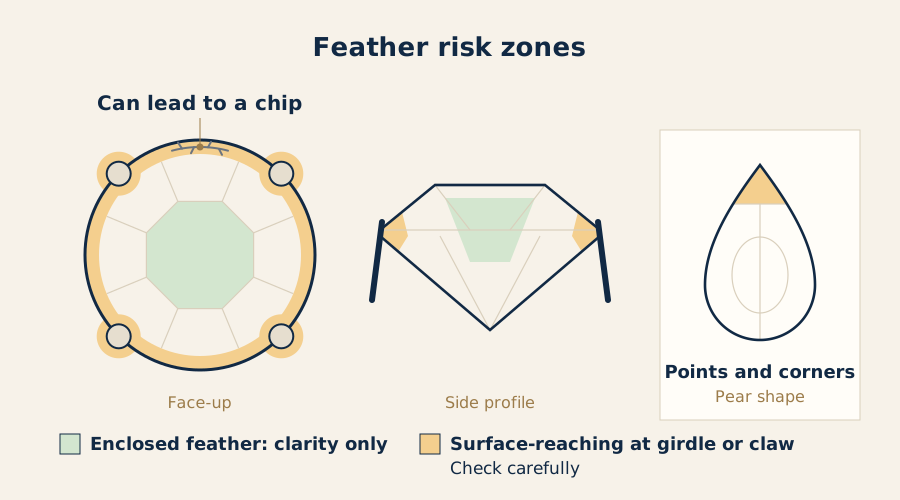
A good rule: a feather is a clarity question until it reaches the surface near the edge. Then it becomes a durability question, and the setting and how the ring is worn matter as much as the stone. Is a feather inclusion bad? Usually not, but it is the one inclusion where you should look at the plot and the stone, not just the grade.
What is a fracture filled diamond, and why does it matter for feathers?
Because feathers that reach the surface are open to the outside, they can be treated. Fracture filling forces a glass-like material, typically a high-lead glass, into a surface-reaching feather. The filler has a refractive index close to diamond's (about 2.42), so the crack becomes much harder to see and the stone looks cleaner than it is. A fracture filled diamond may look one or two grades better than its true clarity.
- How to spot it: under magnification a filled feather often shows a flash effect, flashes of colour such as orange, pink, blue or green as the stone is tilted. Trapped gas bubbles or flow lines can also show in the filler.
- Grading: GIA does not give a clarity grade to fracture filled diamonds. It will identify the treatment on a report but not grade the stone.
- Care: the filling can be damaged or cloud over with high heat, such as a jeweller's torch during sizing, and can be affected by some cleaning methods. Re-tipping or resizing a ring with a filled diamond needs the stone removed first.
- Disclosure: any treatment must be disclosed by the seller. If a report or invoice does not state it and the price looks low for the grade, ask.
A second treatment, laser drilling, targets dark crystals rather than feathers. A laser bores a fine channel to the inclusion, or creates a small feather-like fracture from it to the surface (internal laser drilling), and acid is used to bleach the dark crystal. The resulting feather or channel will be plotted and noted on a report. Treating cracks is far more common in coloured gems than in diamond: compare how emeralds are oiled and resin-filled, where filling surface-reaching fissures is standard practice in the trade.
Do lab-grown diamonds have feathers, and how do feathers change the price?
Yes. Lab-grown diamond inclusions include feathers, though they are less common at the grades most lab-grown stones are sold in. Laboratory-grown diamonds are real diamond, grown by HPHT (high pressure, high temperature) or CVD (chemical vapour deposition), with the same hardness, cleavage and refractive index as natural diamond, so a feather behaves the same way in both. HPHT stones more often show dark metallic flux inclusions, and CVD stones pinpoints or dark graphite specks, but strain during growth or cutting can produce feathers in either. Lab-grown diamonds are usually graded by IGI on the same clarity scale; GIA now describes lab-grown stones with simpler quality categories rather than the full clarity scale.
Clarity has a much bigger effect on the price of natural diamonds than lab-grown ones. In natural stones, each step down the clarity scale saves a noticeable amount, so a well-placed feather at SI1 can free up a real share of the budget. In lab-grown stones the steps between VS2, SI1 and SI2 are small in dollar terms, which is why many people choosing lab-grown simply go for a higher clarity and avoid the question.
| 1 ct round, G colour, excellent cut | Natural (approx. AUD) | Lab-grown (approx. AUD) |
|---|---|---|
| VS2 | about $9,000–$14,000 | about $900–$2,000 |
| SI1 | about $7,000–$11,000 | about $800–$1,800 |
| SI2 | about $5,500–$8,500 | about $700–$1,500 |
These are broad ranges only; prices move with the market and with the exact stone. Within a grade, a diamond whose grade-setting feather is small and near the edge can be just as attractive as a cleaner-looking stone at the grade above.
Browse natural and lab-grown diamonds
Can a feather inclusion grow or crack the diamond?
A fully enclosed feather in a diamond worn normally will almost always stay exactly as it is for life. Feathers can extend, though, under four conditions: a hard knock in the right direction, pressure from setting or re-tipping claws, sudden heat, and aggressive cleaning of a surface-reaching feather. So the answer to can a feather inclusion grow is: rarely, and nearly always because of something that happened to the ring rather than on its own.
- Setting: a jeweller should check where the feathers are before setting, and place claws away from any surface-reaching feather at the girdle.
- Cleaning: for a stone with a significant open feather, use warm water, mild detergent and a soft brush rather than an ultrasonic cleaner or steam, which can work dirt or vibration into the crack.
- Repairs and resizing: tell your jeweller about known feathers and any fracture filling, so they can protect or remove the stone before heat is applied.
- Wear: take rings off for gym work, gardening and anything where a hard knock is likely, especially for pear, princess, heart or marquise cut diamonds with two fine points.
Feathers are also why we look at a stone under magnification before every setting and repair job. A dark feather that looks new or larger than the plot on the report is worth a second look, and our page on telling dark inclusions and reflections apart helps here.
How do you check a feather inclusion before choosing a diamond? Step by step
- Read the report. Note the clarity grade, whether a feather is listed first (grade-setting), and any comments about treatment. Confirm whether the diamond is natural or lab-grown.
- Find it on the plot. Look at where the feather is drawn: centre, under the table, near the girdle, at a point or corner. Check both the crown (top) and pavilion (bottom) views.
- Ask if it reaches the surface. The plot and the grader's notes often show this; a jeweller can confirm with a loupe or microscope.
- Look at it face-up. Watch a video or view the stone at arm's length to judge whether it is eye-clean in the shape you have chosen.
- Plan the setting around it. Make sure no claw will sit directly on a surface-reaching feather, and consider a bezel or halo for shapes with exposed points.
- Compare the price step. Set the stone against the grade above; if the feather is fine and well placed, the lower grade is often the better use of the budget.
For how this compares with every other clarity feature, see how each inclusion type affects clarity, and look up any unfamiliar word in our glossary of diamond and jewellery terms.
Free consultation
Talk to a gemologist
Compare stones in person or online with Raj Sood, Graduate Gemologist (GIA), AJP (GIA).
Book a consultationShop this shape
FAQ
Common questions
Is a feather inclusion bad in a diamond?
Usually not. Most feathers are small and enclosed and only affect the clarity grade. Large feathers that reach the surface near the girdle, a claw or a point are the ones that can weaken a stone.
Can a feather inclusion grow over time?
Rarely. An enclosed feather in normal wear stays as it is; feathers usually extend only after a hard knock, claw pressure during setting, sudden heat or harsh cleaning of a surface-reaching crack.
Is an SI1 diamond with a feather OK for an engagement ring?
Often, yes. A fine feather near the edge that does not break the surface can be eye-clean and perfectly durable; check its position on the report's plot and how it looks face-up.
What is the difference between a feather and a cloud?
A feather is a crack, while a cloud is a cluster of tiny crystals called pinpoints. Feathers are the inclusion most linked to durability; clouds rarely weaken a diamond but a large one can reduce brightness.
Do lab-grown diamonds have feather inclusions?
They can. Lab-grown diamonds have the same structure as natural diamond, so strain during growth or cutting can create feathers, though they are less common at the clarity grades most lab-grown stones are sold in.
How can I tell if a diamond's feather has been filled?
Under magnification a filled feather often shows flashes of colour as the stone tilts. Treatment must be disclosed, and GIA will identify fracture filling but does not give the diamond a clarity grade.

Ask a gemologist
Not sure which diamond to choose?
Raj Sood is a Graduate Gemologist (GIA) and master jeweller. Bring the stones you are considering, or send the reports, and he will tell you honestly which one is better and why.
Keep learning
Related guides
 Diamond 4Cs & GradingDiamond Inclusions GuideDiamond 4Cs & GradingWhat Is a Cloud Inclusion in a Diamond?
 Diamond 4Cs & GradingCrystal Inclusions in DiamondsDiamond 4Cs & GradingDiamond 4CsDiamond 4Cs & GradingKnot Inclusions in Diamonds
 Diamond 4Cs & GradingPinpoint Inclusions in Diamonds
 Diamond 4Cs & GradingNeedle Inclusions in DiamondsDiamond 4Cs & GradingAre Black Inclusions Bad in a Diamond?
Explore more
More guides on this topic
Education