
- Education
- Diamond 4Cs & Grading
- Pinpoint Inclusion in a Diamond: What It Is, How It's Plotted and Whether It Matters
Diamond 4Cs & Grading
Pinpoint Inclusion in a Diamond: What It Is, How It's Plotted and Whether It Matters
Pinpoints are the most common inclusion found in a diamond and one of the most often listed on a grading report. Knowing what a pinpoint inclusion is, and when a cluster of them starts to matter, helps you avoid paying for clarity you cannot see.
 Reviewed by Raj Sood, Graduate Gemologist (GIA), AJP (GIA)Master jeweller and Graduate Gemologist (GIA) · reviewed 4 November 2026
Quick answer
A pinpoint inclusion is a tiny crystal or dot inside a diamond, usually white or colourless, that is only visible under 10x magnification. Single pinpoints are the most minor inclusion type: they are not eye-visible, pose almost no durability risk and often set VVS or VS grades. Only dense clusters, which form clouds, can dull a diamond.
What is a pinpoint inclusion in a diamond?
An inclusion is any feature inside a diamond, such as a tiny crystal, a crack or a growth irregularity. A pinpoint is the smallest kind: a minute crystal or point that, under a 10x loupe (the standard grading magnification), looks like a single dot. Most pinpoints are white or colourless, a few are dark, and many are so small that an experienced grader needs to tilt the stone under a darkfield microscope to find them.
Clarity is one of the four Cs of diamond grading, alongside colour, cut and carat weight. Clarity grades describe how many inclusions a diamond has, how big they are, where they sit, how they look and how easily they can be seen at 10x. Because a pinpoint is so small, it usually has the least effect of any inclusion on the clarity grade. For every other inclusion type, from feathers to knots, see our full guide to diamond inclusion types.
Grading labs use a fixed vocabulary. On a GIA report you will see Pinpoint listed under Clarity Characteristics, and on IGI reports it appears in the same way. When several pinpoints sit close together, the grader may call the group a cloud instead. If a word on the report is new to you, our glossary of jewellery terms explains it in plain English.
It helps to keep the scale in mind. A 1 carat round diamond is about 6.4 mm across, and a typical pinpoint is far smaller than a grain of fine sand. Diamond is 10 on the Mohs hardness scale with a refractive index of about 2.42, and its strong sparkle actually helps camouflage tiny features like pinpoints by breaking up the view through the stone.
How do pinpoint inclusions form?
In natural diamonds, most pinpoints are tiny mineral crystals that were trapped as the diamond grew, roughly 150–200 km down in the Earth's mantle, at temperatures of around 900–1,300 °C. Some are minute diamond crystals, others are minerals such as garnet or olivine, and some are so small that their identity cannot be confirmed without laboratory instruments. They are the same thing as larger crystal inclusions, just too small for a grader to describe as a crystal.
In laboratory-grown diamonds, pinpoints also occur but come from the growing process:
- HPHT lab-grown (high pressure, high temperature): diamond crystallises from a molten metal solvent, often iron, nickel or cobalt. Tiny droplets of that metal can be trapped as dark pinpoints. Our page on metallic flux inclusions in HPHT lab-grown stones covers these in detail; larger ones can make the stone weakly magnetic.
- CVD lab-grown (chemical vapour deposition): diamond is built up layer by layer from a carbon-rich gas. Small particles of non-diamond carbon, similar to graphite, can be trapped and show as dark pinpoints, sometimes lined up along growth layers.
- Both types can be very clean, and many lab-grown diamonds grade VVS or VS with only a few pinpoints.
Dark pinpoints sound worrying but are usually no more visible than white ones at this size. Whether colour makes a difference for larger inclusions is explained in our guide on whether dark or black inclusions are a problem.
How is a pinpoint shown on a diamond grading report?
A full grading report includes a plot: a line drawing of the diamond's outline from above (the crown) and from below (the pavilion), with each clarity characteristic marked in position. By convention, internal inclusions are drawn in red and external blemishes (surface marks) in green. A pinpoint is drawn as a small red dot.
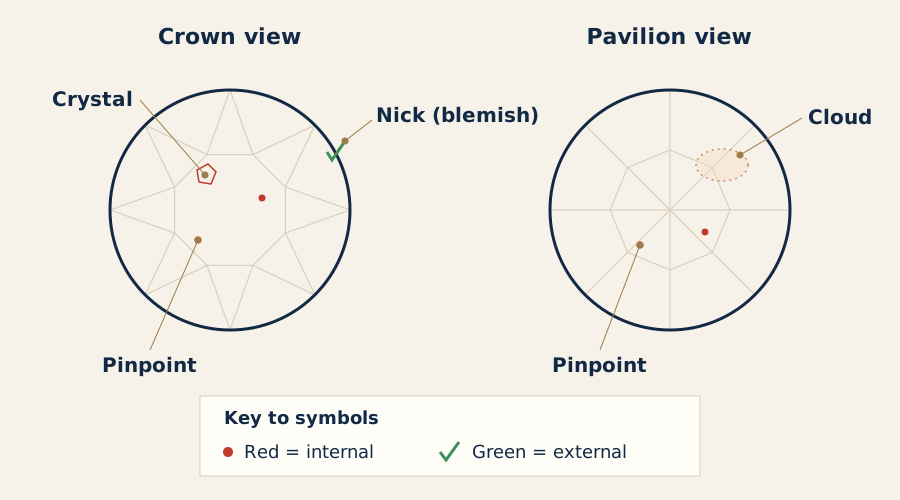
Three things to read carefully on the report:
- The key to symbols: lists the characteristics in order of their importance to the grade. If Pinpoint is listed first, it is the grade-setting inclusion. If it is listed after a feather or crystal, it played a minor role.
- The comments: GIA often adds wording such as Pinpoints are not shown or Clouds are not shown. This means there are too many tiny features to draw individually, which is common and usually harmless in VS and higher grades.
- The report type: a full GIA Diamond Grading Report includes a plot, while the shorter GIA Diamond Dossier format does not, so you will see the clarity grade but no plot showing where the inclusions sit.
The report also lists finish grades for polish and symmetry. These describe the surface and facet precision, not inclusions. A polish line or tiny nick is drawn in green as a blemish, never as a pinpoint. Our page on how polish grades are assigned shows how those surface marks are judged.
Which clarity grades have pinpoint inclusions?
GIA's clarity scale has 11 grades, from Flawless to I3. Pinpoints can appear at almost every grade, but they are most often the grade-setting inclusion in the VVS and VS range, where everything in the stone is small.
| Clarity grade | What pinpoints typically look like at 10x | Eye-visible? |
|---|---|---|
| FL / IF | None (FL), or none internally with only minor surface blemishes (IF) | No |
| VVS1–VVS2 | One or a few pinpoints, extremely hard to find even for a grader | No |
| VS1–VS2 | Several pinpoints, or a small faint cloud; may be listed alongside a tiny crystal or feather | No |
| SI1–SI2 | Pinpoints usually play a minor role; larger crystals, feathers or clouds set the grade | Usually not in SI1; sometimes in SI2 |
| I1–I3 | Pinpoints are incidental; obvious inclusions set the grade | Often, but not because of the pinpoints |
A single pinpoint is almost never the reason a diamond drops below VVS. When it is, the pinpoint is usually sitting directly under the table (the large top facet), where it reflects in several facets and is easier to spot. If a VVS stone lists only pinpoints, you are paying for a difference you can only see under a microscope.
Many pinpoints grouped together become a cloud. A faint cloud is just as harmless as a scatter of pinpoints, but a dense one can scatter light and make a diamond look slightly hazy. Our guide to cloud inclusions and haziness explains where that line sits.
Related guideWhat Is a Cloud Inclusion in a Diamond?Not sure which one is right?
Send us the stones you are looking at and our gemologist will tell you which to choose and why.
Are pinpoint inclusions visible to the naked eye?
No. A single pinpoint, or even a scattering of them, cannot be seen without magnification. A diamond whose only inclusions are pinpoints is eye-clean, meaning nothing shows at a normal viewing distance of about 25–30 cm. That holds for both natural and lab-grown stones.
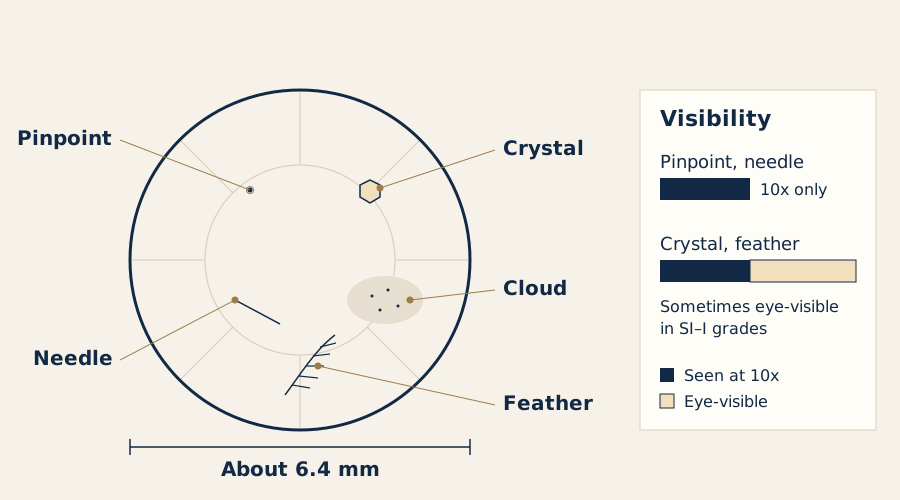
The exception is a dense cluster. When hundreds of pinpoints sit together, they can block some light and make the stone look a little milky or less lively, especially in larger diamonds. This is uncommon in VS grades and more likely in SI2 and I stones. Ask whether the report says Clouds are not shown, and look at a video in good daylight to check brightness, not just a magnified photo.
Cut shape affects how easily inclusions show. Brilliant cuts such as round, oval and cushion break light into many small flashes that hide tiny features, which is why our guide to shapes that hide inclusions well favours them. Step cuts such as emerald and Asscher have large open facets, so we explain why step cuts show inclusions more. Even so, pinpoints are small enough to stay hidden in a well-cut emerald cut at VS. Cut quality matters too: a stone with strong light return masks small features better, as our comparison of how cut grade affects sparkle shows.
Is a pinpoint inclusion in a diamond a durability risk?
For an isolated pinpoint, the risk is very low. Durability problems in diamonds usually come from inclusions that break or approach the surface, such as feathers, or from large crystals that create internal strain. A pinpoint is too small to weaken the stone in normal wear.
There are a few situations worth a second look:
- Pinpoints at the girdle: the girdle is the thin outer edge where claws grip. A cluster right at a thin girdle, especially beside a feather, is the only place pinpoints can add to chipping risk.
- Pinpoints with a feather: if the plot shows a pinpoint or crystal with a small crack around it, the crack is the issue, not the dot. Our guide to feather inclusions and durability explains how to judge them.
- Heat during repairs: included crystals expand at a different rate from diamond when heated. With a pinpoint this is a very small risk, but a jeweller retipping claws or resizing a ring should know what inclusions the stone has.
- Metallic pinpoints in HPHT lab-grown: tiny metal droplets have no practical effect on wear at pinpoint size.
In short, pinpoints are the inclusion gemmologists worry about least. If a diamond has only pinpoints, durability is decided by its cut, girdle thickness and setting, not by the dots.
How do pinpoints compare with crystals, clouds and feathers?
| Inclusion | What it is | Typical size at 10x | Eye-visible? | Durability risk |
|---|---|---|---|---|
| Pinpoint | Tiny crystal or dot | Smallest; a single dot | No | Very low |
| Cloud | Group of many pinpoints | Small to large hazy patch | Only if dense | Very low; dense ones can dull brightness |
| Crystal | Mineral trapped during growth | Small to large; visible shape | Sometimes in SI–I | Low; higher if large or near the surface |
| Needle | Long, thin crystal | Fine line | Rarely | Low |
| Feather | Small crack or fracture | Small to large | Sometimes in SI–I | Moderate; higher if it reaches the surface |
| Knot | Included crystal that reaches the surface | Small to medium | Sometimes | Moderate; can affect polish and strength |
Needles and pinpoints are both tiny crystals, differing mainly in shape; our page on needle inclusions covers the long, thin kind. Knots are more important because they break the surface, so read about knots that reach the surface if one appears on your plot.
Diamonds with pinpoints are almost never clarity-treated, because there is nothing to fill or hide. That is a clear contrast with coloured gems: many emeralds are routinely oiled, as explained in our guide to clarity enhancement in emeralds. Any clarity treatment on a diamond, such as laser drilling or fracture filling, must be disclosed by the seller; GIA notes laser drilling on its reports and will not issue a grading report for a fracture-filled diamond.
Do pinpoint inclusions affect diamond price, natural or lab-grown?
Pinpoints affect price only through the clarity grade they set. Two diamonds can look identical to the eye while one grades VVS2 and the other VS2, and the higher grade costs noticeably more, especially in natural diamonds. In lab-grown diamonds the gap between clarity grades is much smaller, because lab-grown stones cost much less overall and clean material is easier to produce.
| 1 ct round, G colour, excellent cut | Approximate price range (AUD) |
|---|---|
| Natural, VVS2 (pinpoints only) | about $11,000–$18,000 |
| Natural, VS2 (pinpoints and a small crystal) | about $8,000–$14,000 |
| Lab-grown, VVS2 | about $1,000–$2,500 |
| Lab-grown, VS2 | about $900–$2,200 |
These are broad ranges only; prices move with the market and with the exact grades, cut and report. Natural and laboratory-grown diamonds are both real diamond, with the same hardness and refractive index; the report will always state which one you are looking at.
Browse natural and lab-grown diamonds
How do you check a pinpoint inclusion before you buy? Step by step
- Read the clarity grade and key to symbols. Note whether Pinpoint is listed first (grade-setting) or later (minor).
- Check the comments. Pinpoints are not shown is common and usually harmless; Clouds are not shown deserves a look for brightness.
- Look at the plot. Find where the red dots sit. Under the table matters for the grade; at the girdle beside a feather matters for durability.
- Confirm natural or lab-grown. Dark pinpoints in a lab-grown stone are often metallic flux (HPHT) or non-diamond carbon (CVD), and both are normal.
- Watch a video in daylight. Judge brightness and life at normal size, not at 40x magnification.
- Decide what the grade is worth. If the only difference between two stones is a few pinpoints, consider putting the budget into cut quality or size instead.
Free consultation
Talk to a gemologist
Compare stones in person or online with Raj Sood, Graduate Gemologist (GIA), AJP (GIA).
Book a consultationShop this shape
FAQ
Common questions
Are pinpoint inclusions bad in a diamond?
No. Pinpoints are the most minor inclusion type, cannot be seen without magnification and have almost no effect on durability. Only very dense clusters, which form clouds, can slightly reduce brightness.
What does Pinpoints are not shown mean on a GIA report?
It means the diamond has pinpoints that are too small or too numerous to draw individually on the plot. It is a common comment on VS and higher grades and is not a warning sign by itself.
Can a VVS diamond have pinpoint inclusions?
Yes. Pinpoints are often the only inclusions in VVS1 and VVS2 diamonds, and they are extremely difficult to find even for a trained grader at 10x.
What is the difference between a pinpoint and a cloud?
A pinpoint is a single tiny dot; a cloud is a group of many pinpoints close together. Clouds are graded as one feature and only matter when dense enough to make the stone look hazy.
Do lab-grown diamonds have pinpoint inclusions?
Yes. HPHT lab-grown diamonds can contain tiny metallic pinpoints from the metal solvent, and CVD lab-grown diamonds can contain dark specks of non-diamond carbon. At pinpoint size neither affects appearance or wear.
Can a pinpoint inclusion cause a diamond to crack?
Very unlikely. An isolated pinpoint does not weaken a diamond in normal wear; cracks are usually linked to feathers, large crystals or knocks to a thin girdle.
Terms in this guide

Ask a gemologist
Not sure which diamond to choose?
Raj Sood is a Graduate Gemologist (GIA) and master jeweller. Bring the stones you are considering, or send the reports, and he will tell you honestly which one is better and why.
Keep learning
Related guides
 Diamond 4Cs & GradingDiamond Inclusions Guide
 Diamond 4Cs & GradingCrystal Inclusions in DiamondsDiamond 4Cs & GradingWhat Is a Cloud Inclusion in a Diamond?Diamond 4Cs & GradingWhat Is a Feather Inclusion in a Diamond?Diamond 4Cs & GradingDiamond 4Cs
 Diamond 4Cs & GradingNeedle Inclusions in DiamondsDiamond 4Cs & GradingKnot Inclusions in DiamondsDiamond 4Cs & GradingAre Black Inclusions Bad in a Diamond?
Explore more
More guides on this topic
Education