
- Education
- Diamond 4Cs & Grading
- Crystal Inclusions in Diamonds: What They Are and When They Matter
Diamond 4Cs & Grading
Crystal Inclusions in Diamonds: What They Are and When They Matter
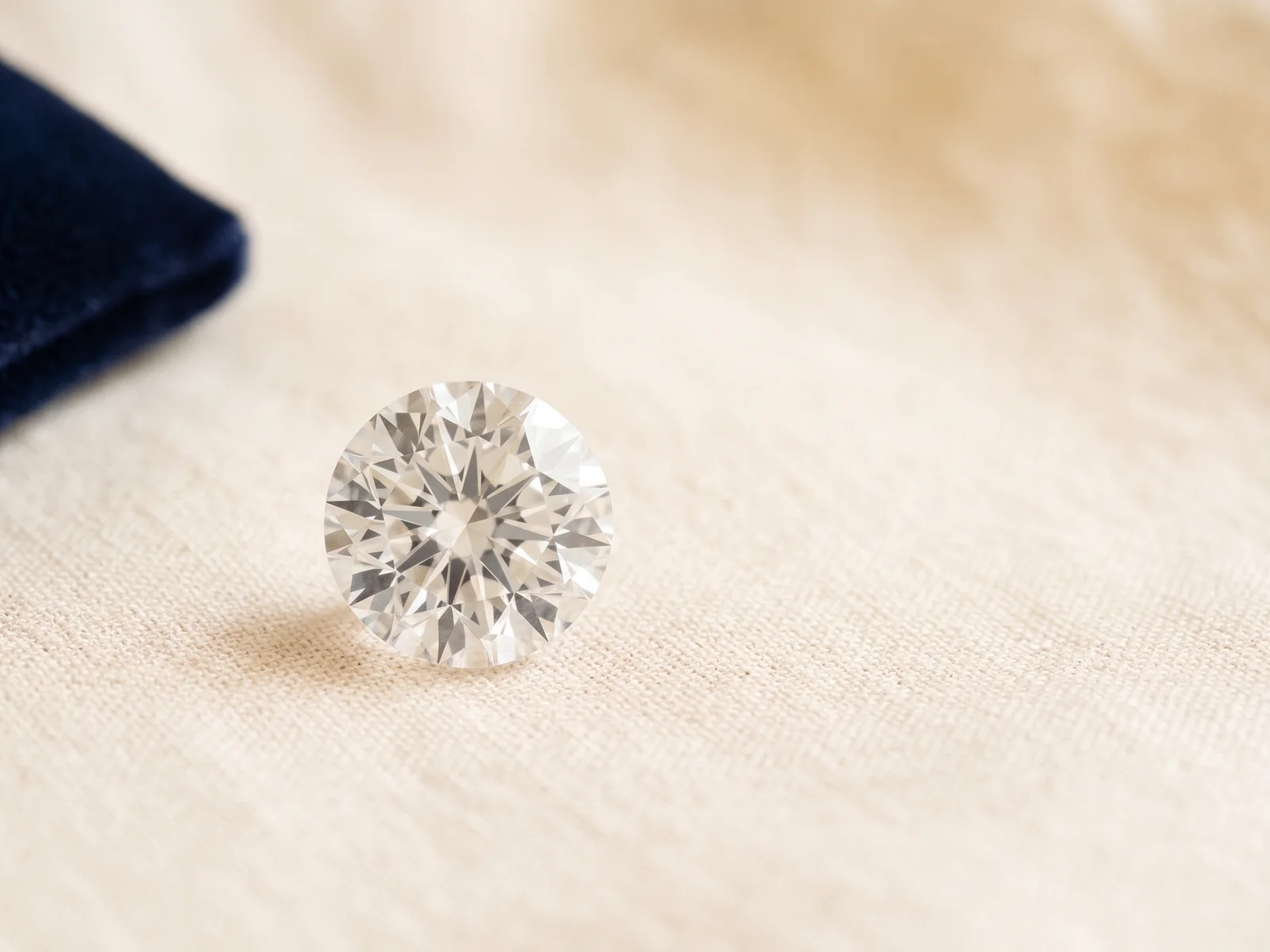
Crystal inclusions in diamonds are among the most common clarity features on a grading report, and among the most misunderstood. Here is what a crystal is, how it got there, how to read it on the plot and when it is worth worrying about.
 Reviewed by Raj Sood, Graduate Gemologist (GIA), AJP (GIA)Master jeweller and Graduate Gemologist (GIA) · reviewed 4 November 2026
Quick answer
A crystal inclusion is a tiny mineral, often another diamond, garnet, olivine or a dark sulphide, trapped inside a diamond as it grew. Most are harmless and eye-clean at VS2 or better. Check its colour, size and position on the report plot: a dark crystal under the table or a large one near the girdle matters most.
What is a crystal inclusion in a diamond?
A crystal inclusion is a small mineral grain completely enclosed inside a diamond. On a grading report it is simply called a 'crystal'. It might be a tiny diamond trapped inside the larger one, or a different mineral altogether, such as garnet, olivine, diopside or a dark sulphide. Gemmologists call any internal feature an inclusion, and features on the surface blemishes; a crystal is always an inclusion, because it sits inside the stone.
Crystals are one of the main features graders weigh when they set a clarity grade, alongside feathers, clouds and pinpoints. If you are new to clarity, it helps to see where it fits with cut, colour and carat in our explainer on clarity within the 4Cs, and to compare crystals with every other inclusion type in our full guide to diamond inclusions.
The important point is that 'crystal' tells you what the inclusion is, not how bad it is. A crystal can be a speck only a trained grader can find at 10× magnification in a VVS1 stone, or a dark grain you can see with your naked eye in an I1. Size, colour, position and whether it has cracked the diamond around it decide whether it matters. Any term you are unsure about is also explained in our plain-English jewellery glossary.
How do crystal inclusions form inside a diamond?
Most natural diamonds grow in the Earth's mantle, roughly 150–200 km below the surface, under enormous heat and pressure. They grow slowly, and as they do, they can surround grains of the minerals around them. Those grains are sealed in permanently. Gemmologists group them by when they formed:
- Protogenetic: the mineral existed before the diamond and was engulfed as the diamond grew around it.
- Syngenetic: the mineral grew at the same time as the diamond, often taking on the diamond's own shape (an octahedron, like two pyramids base to base).
- Epigenetic: material that entered later through a crack open to the surface, such as brown or orange iron-oxide staining. Strictly speaking these are not trapped crystals, but they are sometimes confused with them.
Because crystals were trapped deep underground, scientists study them to learn about the mantle and to date diamonds; many natural diamonds are estimated at between about 1 and 3.5 billion years old. For a buyer, the practical takeaway is simpler: a mineral crystal is a natural fingerprint of where the diamond grew, and it is one reason no two natural diamonds have the same plot.
Dark crystals deserve a separate note. Black graphite and sulphide grains are the crystals most likely to be noticed, which is why so many people ask whether black inclusions are a problem. The short answer is: it depends on size and position, the same as any crystal, but dark ones are easier to see.
What colour are crystal inclusions, and which minerals are they?
The colour of a crystal depends on the mineral. Here are the ones gemmologists see most often in natural diamonds:
| Crystal | Typical colour | How visible | Notes |
|---|---|---|---|
| Diamond | Colourless, sometimes slightly brown | Low; often hard to find | Often octahedral in shape; the 'diamond inside a diamond' |
| Olivine | Colourless to pale yellow-green | Low to moderate | One of the most common mineral crystals |
| Garnet (pyrope) | Purplish red to orange-red | Moderate; colour draws the eye | Can look like a tiny red spark |
| Chrome diopside | Bright green | Moderate | Sought after by collectors, rarely a selling point for jewellery |
| Enstatite | Colourless to pale brown | Low | Easily mistaken for a diamond crystal |
| Chromite | Black to dark red-brown | High | Small, sometimes metallic-looking |
| Sulphide | Black, often with a flat disc around it | High | Frequently surrounded by a small tension fracture |
| Graphite | Black | High | Carbon in a different form; often in small spots or flakes |
A white crystal inclusion in a diamond, meaning a colourless or whitish one, is usually the easiest to live with. It has a similar look to the diamond around it and often disappears among the facet reflections. A black crystal inclusion contrasts sharply and is the first thing your eye finds. Coloured crystals, like a red garnet, sit in between: small ones are rarely noticed once the stone is set.
Body colour plays a part too. In a slightly warmer diamond, such as the warmer K colour diamonds many people choose for yellow gold, a pale crystal blends in even more. One word of caution on naming: in opal, 'crystal' describes a transparent body tone, not an inclusion, so a guide to crystal opal, where 'crystal' means something else entirely is about a different subject.
How is a crystal inclusion shown on a diamond report?
Most full grading reports from labs such as GIA include a plotting diagram: a face-up and face-down outline of the diamond with each clarity characteristic drawn in position. Inclusions are drawn in red, blemishes in green. Beside the diagram is a key to symbols, which lists each type found, such as 'Crystal, Feather, Needle'.
- Crystal: drawn as a small closed red outline roughly matching its shape and relative size.
- Pinpoint: a single red dot. Pinpoints are really tiny crystals too small to show any shape; see pinpoints, the smallest crystals.
- Needle: a short red line; these are long, thin crystals, covered in our page on long thin needle inclusions.
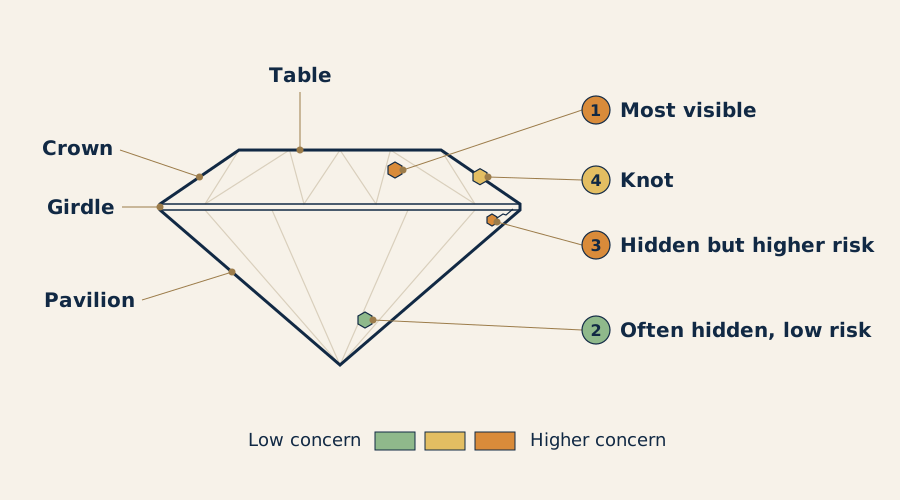
- Knot: a crystal that reaches the surface after polishing, plotted to show it breaking the surface.
- Feather: a red line or shape for a crack, often drawn touching a crystal when the crystal caused it.
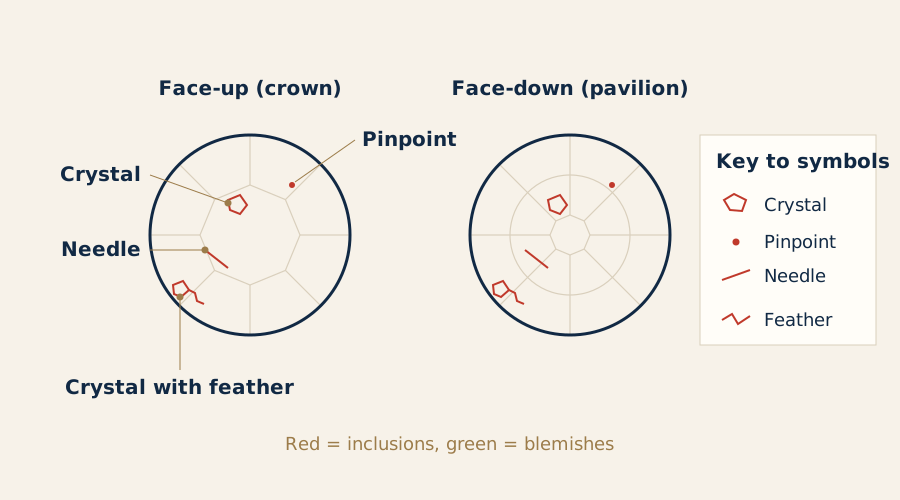
Read the plot with three questions in mind. Is the crystal face-up (crown side) or face-down (pavilion side)? Is it under the table, the large flat top facet, where it is most visible? And is there a feather drawn next to it? Also read the 'Comments' section. Phrases such as 'Additional clarity characteristics are not shown' or 'Pinpoints are not shown' mean small features exist that are not drawn. The plot shows position and type, not depth, so a 360° video or magnified photos are still needed to judge how a crystal really looks.
Related guideKnot Inclusions in DiamondsNot sure which one is right?
Send us the stones you are looking at and our gemologist will tell you which to choose and why.
Are crystal inclusions in diamonds bad for durability?
Usually not. Most crystals are completely stable and pose no risk in everyday wear. The exceptions come from physics. A trapped mineral expands and contracts with heat at a different rate from diamond, and it was trapped under far greater pressure than it sits under now. That mismatch can put the surrounding diamond under strain, and some crystals are ringed by small cracks called tension fractures or stress halos. On a report these appear as feather inclusions and the cracks they form, drawn touching the crystal.
From a gemmologist's view, these are the situations worth a closer look:
- A large crystal near the girdle (the thin outer edge): the girdle takes knocks, and a crystal with a feather here makes the edge weaker.
- A crystal under a claw: setting pressure is applied right at that point.
- A crystal at or near the surface: once polished through, it becomes a knot, which can pull out and leave a cavity. Read more on knots, crystals that reach the surface.
- A crystal with a feather that reaches the surface: knocks, ultrasonic cleaning and heat can extend it.
- Repairs involving heat: a jeweller's torch during resizing or re-tipping can cause a strained crystal to crack the stone if the diamond is not removed first.
Diamond is 10 on the Mohs hardness scale, but hardness is resistance to scratching, not to breaking. A clean crystal deep in the pavilion of a well-set stone is irrelevant to durability. A crystal with a fracture at the edge, in an exposed claw setting, is where care pays off: a bezel or a claw positioned away from that spot is a sensible choice.
Is a diamond with a crystal inclusion eye-clean?
Eye-clean means you cannot see any inclusion with the naked eye at normal viewing distance, about 25–30 cm, face-up. Whether a crystal is eye-clean depends on four things: its size, its colour, its position and the cut of the diamond.
| Clarity grade | Typical crystal | Eye-clean in a round? |
|---|---|---|
| FL / IF | None (IF may have tiny surface blemishes only) | Yes |
| VVS1–VVS2 | Minute, very hard to find at 10× | Yes |
| VS1–VS2 | Small, found with some effort at 10× | Almost always |
| SI1 | Noticeable at 10×, possibly darker or more central | Usually; check video |
| SI2 | Easy to see at 10×; often under the table or dark | Sometimes; inspect carefully |
| I1–I3 | Obvious at 10× and often to the eye | Rarely |
Round brilliants are forgiving. Their many facets break up the view and can hide a small white crystal, though they can also show reflections of a crystal, so one grain appears as several. Rounds, ovals and cushions are among the shapes that disguise inclusions well. Step cuts such as emerald and Asscher cuts have long, open facets that act like windows, which is why step cuts show inclusions more; in those shapes many people choose VS1 or better.
Position matters as much as grade. A white crystal near the girdle in an SI1 may be invisible, while a black crystal right under the table in a VS2 can occasionally be seen by someone who knows where to look. That is why two diamonds with the same clarity grade can look quite different on the hand.
Do lab-grown diamonds have crystal inclusions?
Lab-grown diamonds are real diamond, grown in a laboratory rather than mined, and they can have inclusions too, but not mineral crystals like garnet or olivine. Those come only from the Earth's mantle. Lab-grown inclusions depend on the growth method:
- HPHT (high pressure, high temperature): grown from a molten metal mixture, these can trap dark metallic flux inclusions, which look like black crystals and can make a stone weakly magnetic. See metallic flux inclusions in HPHT lab-grown diamonds.
- CVD (chemical vapour deposition): grown layer by layer from a carbon-rich gas, these can show small dark spots of non-diamond carbon, often plotted as pinpoints or crystals.
On a report, these may still be labelled 'crystal' or 'pinpoint', so the label alone does not tell you whether a stone is natural or lab-grown; the report itself states the origin. A garnet or diopside crystal is, however, a strong sign of natural origin to a gemmologist. Labs such as IGI grade natural and laboratory-grown diamonds on the same clarity scale (GIA now uses simpler descriptive terms for lab-grown), and the same rules about size, colour and position apply.
Browse natural and lab-grown diamonds
How do crystals compare with other diamond inclusions?
| Inclusion | What it is | Usual look | Durability risk |
|---|---|---|---|
| Crystal | Mineral grain trapped inside | White, coloured or black grain | Low, unless large, near girdle or with a feather |
| Pinpoint | Very tiny crystal | White or dark dot | Very low |
| Cloud | Cluster of many pinpoints | Hazy patch | Low; large clouds can dull brightness |
| Needle | Long, thin crystal | Fine white line | Very low |
| Feather | Crack inside the stone | White, wispy or glassy | Moderate if it reaches the surface |
| Knot | Crystal reaching the surface | Raised or polished-through grain | Moderate; can pull out |
Many inclusions are crystals in other forms. Pinpoints are tiny crystals, needles are elongated crystals, and clouds of tiny crystals are groups of pinpoints too small to plot one by one. Feathers are the type most often linked to crystals, because a strained crystal can crack the diamond around it.
Crystals are different from blemishes, which sit only on the surface and come from cutting or wear, such as surface blemishes like burn marks. They are also different from the situation in coloured gems: diamonds are rarely clarity-treated, whereas emeralds are routinely oiled or resin-filled, as explained in how emerald inclusions are treated. Any clarity treatment in a diamond must be disclosed by the seller; GIA notes laser drill holes on its reports and does not issue grading reports for fracture-filled diamonds.
How do you judge a crystal inclusion before you buy? Step by step
- Read the clarity grade and key to symbols. Note whether 'Crystal' is listed first, which usually means it is among the main features affecting the grade.
- Find it on the plot. Check whether it is face-up or face-down, under the table, near the girdle or under where a claw will sit.
- Look for a feather touching it. A crystal with a crack beside it near the edge deserves a closer look.
- Check its colour on video. Watch a 360° video or magnified photo at actual size and at magnification; white crystals blend, dark ones stand out.
- Test eye-cleanliness at real size. View the stone face-up at about 25–30 cm, the way it will be seen on the hand.
- Consider the shape. In step cuts and large tables, be stricter about central crystals than in a round or oval.
- Plan the setting. Ask for claws to sit away from any edge crystal, or consider a bezel to protect that area.
- Tell your jeweller about it later. Keep the report so anyone resizing or repairing the ring knows where the crystal is before using heat.
Free consultation
Talk to a gemologist
Compare stones in person or online with Raj Sood, Graduate Gemologist (GIA), AJP (GIA).
Book a consultationShop this shape
FAQ
Common questions
Are crystal inclusions bad in a diamond?
Usually not. Most crystals are small, stable and invisible to the naked eye at VS2 or better. They matter when they are dark and under the table, very large, or near the girdle with a feather beside them.
What does 'crystal' mean on a GIA report?
It means a mineral grain, sometimes another diamond, is enclosed inside the stone. It is drawn in red on the plotting diagram in its approximate position and size.
Can a crystal inclusion cause a diamond to crack?
Rarely, but it can. A crystal under strain may have small tension fractures around it, and a hard knock or a jeweller's torch during repairs can extend them, especially near the girdle.
Is a white crystal inclusion better than a black one?
For appearance, generally yes. A white or colourless crystal blends into the diamond's reflections, while a black crystal contrasts and is easier to see at the same size.
Can you remove a crystal inclusion from a diamond?
Not without recutting the stone, which loses weight and is only worthwhile if the crystal is near the surface. Laser drilling can lighten dark inclusions, but it is a treatment that must be disclosed.
Do lab-grown diamonds have crystal inclusions?
Not mineral crystals like garnet, but they can have dark metallic flux inclusions (HPHT) or non-diamond carbon spots (CVD), which may be plotted as crystals or pinpoints. The report states whether the diamond is lab-grown.

Ask a gemologist
Not sure which diamond to choose?
Raj Sood is a Graduate Gemologist (GIA) and master jeweller. Bring the stones you are considering, or send the reports, and he will tell you honestly which one is better and why.
Keep learning
Related guides
 Diamond 4Cs & GradingDiamond Inclusions Guide
 Diamond 4Cs & GradingKnot Inclusions in DiamondsDiamond 4Cs & GradingWhat Is a Feather Inclusion in a Diamond?Diamond 4Cs & GradingAre Black Inclusions Bad in a Diamond?Diamond 4Cs & GradingDiamond 4CsDiamond 4Cs & GradingWhat Is a Cloud Inclusion in a Diamond?
 Diamond 4Cs & GradingPinpoint Inclusions in Diamonds
 Diamond 4Cs & GradingNeedle Inclusions in Diamonds
Explore more
More guides on this topic
Education