
- Education
- Diamond 4Cs & Grading
- Emerald Inclusions and Clarity Enhancement: The Complete Guide
Diamond 4Cs & Grading
Emerald Inclusions and Clarity Enhancement: The Complete Guide
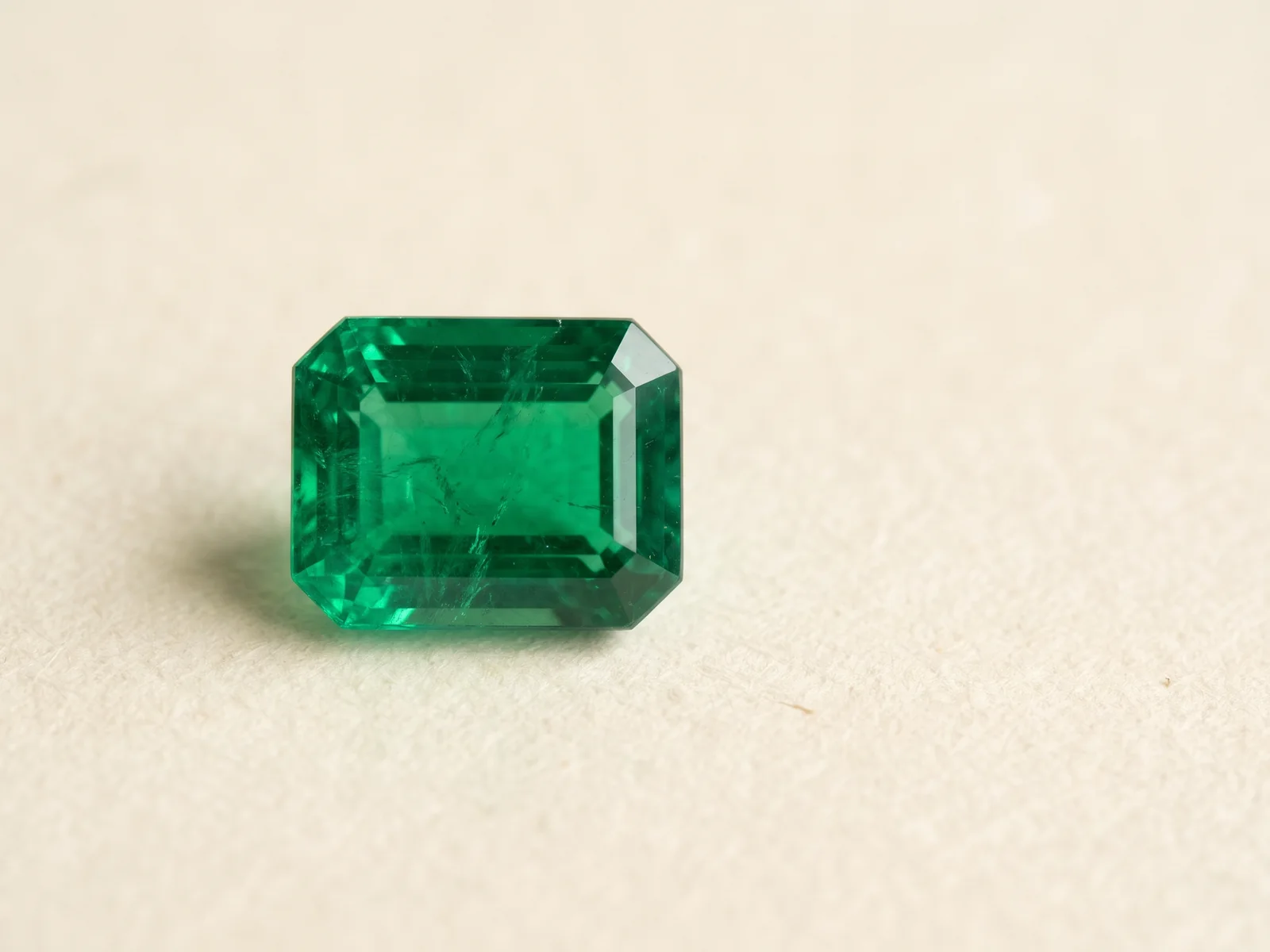
Almost every natural emerald has inclusions, and most have been clarity enhanced with oil or resin. Knowing how emerald inclusions and enhancement work tells you what a stone is really worth and how to look after it.
 Reviewed by Raj Sood, Graduate Gemologist (GIA), AJP (GIA)Master jeweller and Graduate Gemologist (GIA) · reviewed 4 November 2026
Quick answer
Emerald inclusions, called jardin, are normal: emerald is a Type III gem that almost always shows fissures, crystals or fluid inclusions. Most emeralds are clarity enhanced with oil or resin that fills surface-reaching fissures. Check the lab report for the enhancement level (none to significant), choose an eye-clean stone, and avoid ultrasonic cleaners and heat.
What are emerald inclusions?
Emerald is the green variety of the mineral beryl (beryllium aluminium silicate, Be3Al2Si6O18). Its colour comes from traces of chromium, vanadium or both. Inclusions are the internal features trapped inside it as it grew: tiny cracks, mineral crystals and pockets of fluid. The trade has a gentle name for them, jardin, French for garden, because a magnified emerald can look like a tangle of moss and leaves.
Emerald forms in geological settings full of fluids, pressure changes and other minerals, so a clean crystal is very rare. That is why GIA places emerald in its Type III group of coloured stones: gems that are almost always included, even in fine qualities. Aquamarine, also a beryl, is usually far cleaner, because it grows in calmer conditions.
Hardness is 7.5–8 on the Mohs scale, which resists scratching well. Toughness, the resistance to chipping and breaking, is only poor to fair. The cause is the inclusions themselves: fissures that reach the surface are weak points, and a hard knock or sudden heat can make them grow. Much of the advice in this guide follows from that.
If you have been reading about diamonds, it helps to know that emerald clarity works very differently from the 4Cs of diamond grading. Any term you have not met before is explained in our jewellery glossary.
What do emerald inclusions look like?
Each emerald deposit leaves its own fingerprints, and gemmologists use them to help identify origin and to separate natural from lab-created stones. These are the inclusions you are most likely to see under a 10× loupe:
| Inclusion | What it looks like | What it tells you |
|---|---|---|
| Fissures (feathers) | Flat, glassy or white cracks, often reaching the surface | The main durability risk; the feature enhancement fills |
| Three-phase inclusions | Jagged cavity holding liquid, a gas bubble and a tiny cube of salt (halite) | Classic of Colombian emeralds |
| Two-phase inclusions | Cavity with liquid and a gas bubble | Found in many origins |
| Mica platelets | Brown or bronze flakes | Common in Zambian, Brazilian and other schist-hosted stones |
| Tremolite or actinolite needles | Fine fibres or rods | Often seen in Zambian and some Afghan emeralds |
| Pyrite and calcite crystals | Brassy metallic grains or pale crystals | Pyrite is typical of Colombian deposits |
| Growth tubes and colour zoning | Parallel lines or bands of uneven green | Show how the crystal grew |
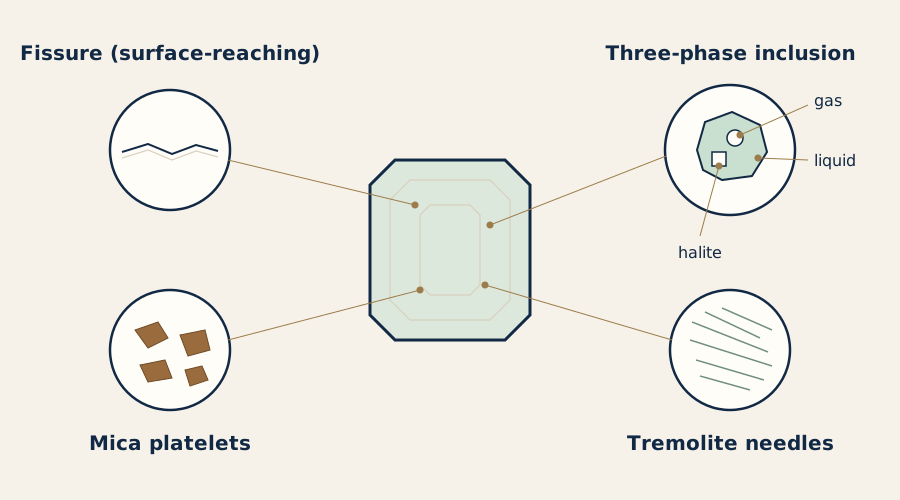
Many of these have diamond counterparts. A mica flake or pyrite grain is the same idea as mineral crystals trapped in diamond, tremolite fibres resemble needle-like inclusions in diamond, and an emerald fissure is closely related to feather inclusions in diamond. A haze of tiny fluid inclusions in emerald looks rather like cloud inclusions, made of clustered specks. The difference is scale: what would drop a diamond several grades is ordinary in emerald.
How is emerald clarity graded compared with diamond clarity?
There is no single international clarity scale for emeralds. Diamond clarity uses the familiar FL to I3 ladder, judged at 10× magnification. Coloured stones, including emerald, are judged mainly by eye, and the key question is whether inclusions affect the beauty or durability of the stone.
| Emerald | Diamond | |
|---|---|---|
| Grading standard | No universal scale; GIA groups by clarity type (emerald is Type III) | Standard scale FL, IF, VVS1–2, VS1–2, SI1–2, I1–3 |
| How it is judged | Mainly face-up, by eye | At 10× magnification |
| Expected inclusions | Visible jardin is normal | Eye-clean is the usual goal |
| Treatment for clarity | Oil or resin very common; disclosed on reports | Fracture filling exists but is uncommon and lowers value |
| Effect on durability | Surface-reaching fissures are a real risk | Rarely a concern except large feathers or knots |
| Refractive index | about 1.57–1.58 | about 2.42, so more sparkle to hide inclusions |
Dealers often describe emeralds in plain terms: eye-clean (nothing visible without magnification at normal viewing distance), lightly included, moderately included or heavily included. An eye-clean emerald with good colour is genuinely rare, roughly the coloured-stone equivalent of the visual standard people look for in VS2 clarity diamonds, even though the two are graded under different systems.
For perspective, tiny pinpoint inclusions can be enough to separate one diamond grade from the next, and the differences between what VS1 clarity looks like and VS2 are invisible without a loupe. Emerald buyers work at a completely different scale. The lower refractive index also matters: emerald returns less sparkle than diamond, so inclusions are less disguised by brilliance. Our full guide to diamond inclusion types sets out the diamond side in detail.
What is emerald clarity enhancement?
Clarity enhancement means filling surface-reaching fissures with a colourless substance whose refractive index is close to emerald's. Air in a crack reflects light and shows as a white or silvery plane. Replace the air with oil or resin and light passes through, so the fissure almost disappears. Enhancement cannot reach inclusions fully enclosed inside the stone, such as crystals or three-phase pockets.
Emerald oiling has been practised for centuries, and today most natural emeralds on the market have some degree of enhancement. It is an accepted trade practice, but it must be disclosed, because it changes how the stone looks, how it should be cared for and what it is worth.
| Filler | Typical RI | Stability | Notes |
|---|---|---|---|
| Cedarwood oil | about 1.51–1.52 | Can dry out or seep over years | The traditional filler; removable and can be redone |
| Mineral or other oils | about 1.47–1.48 | Less durable than cedarwood oil | Fissures can reappear sooner |
| Polymer resins (such as Opticon) | about 1.54–1.55 | More stable, can cloud or yellow with age | Hardened resins are hard to remove fully |
| Coloured oil or dyed resin | Varies | Colour can fade or leach | Adds green colour; should be clearly disclosed and greatly lowers value |
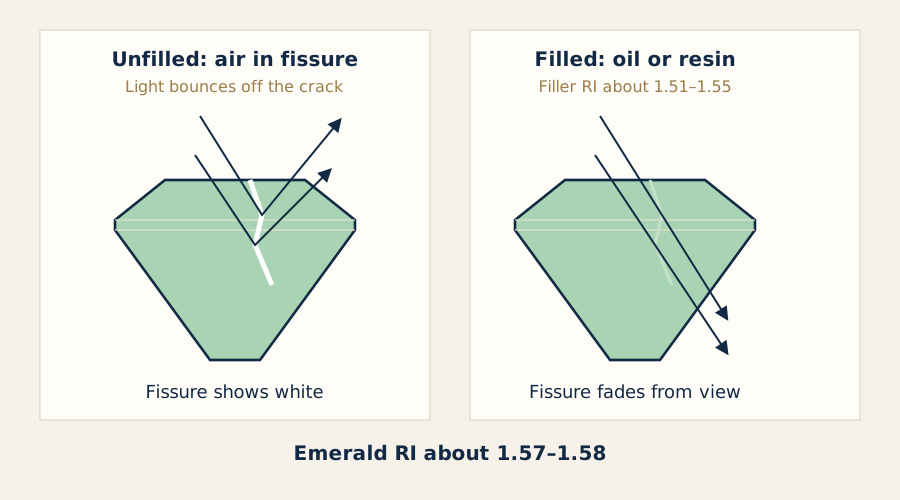
Clarity enhancement is not the same as making a stone from scratch. An enhanced emerald is still a natural emerald; it simply has a filled surface. A lab-created emerald (also called synthetic emerald) is grown in a laboratory and is covered further down.
Not sure which one is right?
Send us the stones you are looking at and our gemologist will tell you which to choose and why.
How do labs report emerald enhancement levels?
Independent labs such as GIA, SSEF, Gübelin and AGL test emeralds with magnification and instruments such as infrared (FTIR) and Raman spectroscopy. A report usually states whether clarity enhancement is present, how much, and sometimes the type of filler. Wording differs between labs, but the scale generally runs like this:
| Level | What it means | Effect on value |
|---|---|---|
| None | No indications of clarity enhancement | Highest premium; rare in fine colour |
| Insignificant or faint | Tiny amount in one or two small fissures | Small discount, often close to untreated |
| Minor | Small amounts in a few fissures | Moderate discount |
| Moderate | Noticeable filling in several fissures | Clear discount; check durability |
| Significant | Extensive filling; the look depends heavily on it | Large discount; most fragile and most care needed |
The level describes how much filler is present and how much it contributes to the face-up appearance, not how many inclusions the stone has overall. An emerald with minor enhancement can still show plenty of jardin. Read the level together with the photos and your own look at the stone.
How can you tell if an emerald is oiled?
Confirming enhancement, and measuring how much, needs a gem lab. A trained eye with a loupe or microscope can pick up strong hints, though:
- Flash effect: as the stone tilts, filled fissures show brief flashes of orange or yellow, then blue, a typical sign of resin fillers.
- Faint outlines: a filled fissure often still shows as a shadowy, slightly textured plane rather than vanishing completely.
- Dried filler: oil that has dried or partly drained leaves white, crusty or bubbly traces inside the fissure.
- Fluorescence: some oils and resins glow yellowish or bluish under long-wave ultraviolet light, even where the emerald itself does not.
- Sweating: gentle warmth can draw oil to the surface, though this is a test for labs, not for the shop counter.
If the fissures in your emerald seem more visible than when you bought it, the oil may have dried or been washed out, often by an ultrasonic cleaner or hot water. A gemmologist can clean and re-oil the stone, which usually restores its earlier appearance.
Do lab-created emeralds have inclusions?
Yes. Lab-created emeralds are real beryl with the same chemistry and hardness as natural emerald, grown in a laboratory by one of two methods. They are usually cleaner than natural stones, but they carry their own tell-tale inclusions:
- Flux-grown (for example Chatham and Gilson): wispy, veil-like flux fingerprints, small flakes of platinum from the growth crucible and phenakite crystals. Refractive index often slightly lower, around 1.56.
- Hydrothermal (for example Biron and Tairus): chevron or wavy growth patterns and nail-head spicules, tiny tubes capped with a crystal or cavity.
An inclusion-free green stone is not automatically lab-created, and a heavily included one is not automatically natural. Lab-created emeralds can be oiled too. A reliable report should state whether the stone is natural or laboratory-grown, and any seller should disclose this clearly.
Is an untreated emerald worth the extra cost?
Colour drives emerald value first, then clarity, enhancement level, size and origin. Within stones of similar colour, an emerald with no enhancement costs much more than one with significant enhancement, because it is rarer and needs less special care. These approximate per-carat ranges for a 1 ct stone show the pattern:
| 1 ct emerald, good green | Approximate price per carat (AUD) |
|---|---|
| Lab-created emerald | about $100–$600 |
| Natural, significant enhancement | about $200–$1,500 |
| Natural, moderate enhancement | about $1,500–$5,000 |
| Natural, minor or insignificant enhancement | about $4,000–$15,000 |
| Natural, no enhancement, fine colour | about $10,000–$30,000+ |
These are broad ranges only; prices vary widely with colour saturation, origin and market conditions. An untreated emerald makes most sense when you want a fine stone that needs no future re-oiling. For an everyday ring on a budget, an eye-clean stone with minor enhancement often gives the better balance of beauty and durability. Natural emeralds are bought for their beauty, not as an investment.
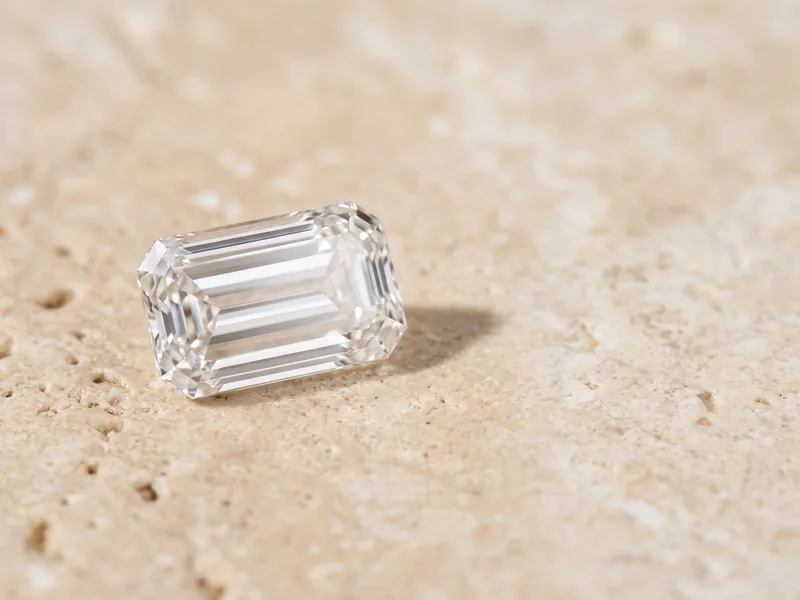
Some people weighing an emerald end up choosing an emerald-cut diamond instead, for its hardness and toughness. That cut was named after the emerald, and its long open facets show inclusions clearly; our page on why step-cut diamonds show inclusions more explains what clarity to choose.
Compare natural and lab-grown diamonds
How do you care for a clarity-enhanced emerald?
Enhancement is stable under normal wear if you avoid the things that remove or damage fillers:
- Never use an ultrasonic cleaner or steam cleaner; vibration and heat drive oil out and can extend fissures.
- Clean with lukewarm water, a drop of mild soap and a soft brush, then pat dry.
- Avoid hot water, solvents such as acetone, household chemicals and sudden temperature changes.
- Take the ring off for gardening, the gym and heavy work.
- Have the setting checked about once a year, and ask about re-oiling if fissures start to show.
Emeralds sit best in protective settings. The emerald cut, a step cut with bevelled corners, was developed partly to reduce strain on this brittle gem, and a bezel or claws over the corners add protection. Any resizing or repair near an emerald should be done with the stone removed, because a jeweller's torch can damage the filler and the stone.
Related guideEmerald-Cut Diamond Clarity: Why Inclusions Show MoreDiamonds tolerate far more, but they have weak points too: knots that reach the surface of a diamond and large feathers can also chip with a knock, which is why the way diamond inclusions are classified includes their position as well as their size.
How to check emerald inclusions and enhancement before you buy
- Judge the colour first. Colour matters most; then decide how much jardin you are comfortable seeing.
- Look face-up at arm's length. Check that no inclusion draws your eye or makes the stone look cloudy.
- Find the fissures. Under a loupe, note any that reach the surface, especially near corners and edges.
- Read the lab report. Confirm natural or lab-created, the enhancement level and, ideally, the filler type.
- Ask about coloured fillers. Make sure any coloured oil or dye is disclosed in writing.
- Plan the setting and care. Choose protective claws or a bezel and keep it away from ultrasonic cleaning.
If you are comparing an emerald with a diamond for the same ring, review diamond colour, cut, clarity and carat side by side with what you have learnt here.
Free consultation
Talk to a gemologist
Compare stones in person or online with Raj Sood, Graduate Gemologist (GIA), AJP (GIA).
Book a consultationShop this shape
FAQ
Common questions
Are inclusions in emeralds normal?
Yes. Emerald is a Type III gem, so almost every natural emerald has visible inclusions, known as jardin. An eye-clean emerald with good colour is rare and priced accordingly.
Is an oiled emerald a real emerald?
Yes. Oiling fills surface-reaching fissures so they show less, but the stone is still a natural emerald. The treatment should be disclosed, and the enhancement level affects price and care.
Does emerald oil wear off?
It can dry out or seep away over many years, faster with hot water, solvents or ultrasonic cleaning. A gemmologist can clean and re-oil the stone to restore its appearance.
What is the difference between oil and resin in emeralds?
Oil, usually cedarwood oil, is traditional and can be removed and redone. Resins are more stable but can cloud or yellow with age and are hard to remove fully.
Can I clean my emerald ring in an ultrasonic cleaner?
No. Ultrasonic and steam cleaners can drive out the filler and worsen fissures. Use lukewarm water, mild soap and a soft brush instead.
Do lab-created emeralds have inclusions?
Yes, though usually fewer. Flux-grown stones show veil-like flux fingerprints and platinum flakes, while hydrothermal stones show chevron growth lines and nail-head spicules.

Ask a gemologist
Not sure which diamond to choose?
Raj Sood is a Graduate Gemologist (GIA) and master jeweller. Bring the stones you are considering, or send the reports, and he will tell you honestly which one is better and why.
Keep learning
Related guides
 Diamond ShapesEmerald-Cut Diamond Clarity: Why Inclusions Show More
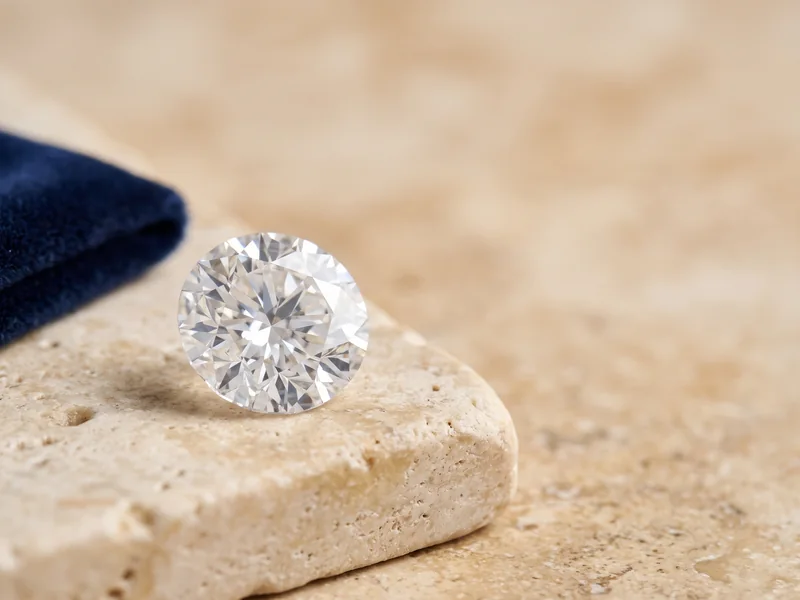 Diamond 4Cs & GradingDiamond Inclusions Guide
 Diamond 4Cs & GradingWhat Is a Feather Inclusion in a Diamond?Diamond 4Cs & GradingDiamond 4CsDiamond 4Cs & GradingCrystal Inclusions in Diamonds
 Diamond 4Cs & GradingPinpoint Inclusions in Diamonds
 Diamond 4Cs & GradingNeedle Inclusions in DiamondsDiamond 4Cs & GradingKnot Inclusions in Diamonds
Explore more
More guides on this topic
Education