
- Education
- Diamond 4Cs & Grading
- Needle Inclusions in Diamonds: What They Are and When They Matter
Diamond 4Cs & Grading
Needle Inclusions in Diamonds: What They Are and When They Matter
Needle inclusions in diamonds are common, usually tiny and often misunderstood. Here is how they form, how to read them on a report plot, and when one is actually worth worrying about.
 Reviewed by Raj Sood, Graduate Gemologist (GIA), AJP (GIA)Master jeweller and Graduate Gemologist (GIA) · reviewed 4 November 2026
Quick answer
A needle inclusion is a long, thin crystal trapped inside a diamond as it grew, usually white or colourless and seen only under 10× magnification. Grading reports plot it as a short red line. Single needles rarely affect durability or eye-cleanliness; check clusters, dark needles and any that reach the girdle or surface.
What is a needle inclusion in a diamond?
A needle is a long, thin crystal enclosed inside a diamond. Under a loupe (a 10× hand magnifier) it looks like a tiny rod, a fine white scratch or a sliver of glass suspended inside the stone. Most needles are colourless or white, a few are grey or dark, and they can appear on their own, in small groups or in criss-crossing bundles.
Gemmologists group needles with other trapped minerals under the heading of included crystals. A needle is simply a crystal that grew much longer than it is wide. If you want the wider picture first, our guide to crystal inclusions, the family needles belong to explains the rounder and more angular versions, and our full guide to every diamond inclusion type puts all of them side by side.
An inclusion is any internal feature in a gemstone; a blemish is a feature confined to the surface. Needles are inclusions. They are among the most common features in natural diamonds and, in most stones, among the least harmful. Any grading term you have not met before is explained in our jewellery glossary of grading terms.
How do needle inclusions form?
Natural diamonds crystallise deep in the Earth's mantle, roughly 150–200 kilometres down, under intense heat and pressure. As a diamond grows, it can surround small crystals of other minerals that are forming at the same time, or tiny crystals of diamond itself. When one of those crystals grows in a long, narrow habit (its natural crystal shape), it becomes a needle once it is sealed inside.
Because the diamond grew around it, a needle is usually completely enclosed. That is the key difference between a needle and a crack or a drilled channel: a needle is solid material inside the stone, not an opening. Needles often line up with the diamond's internal growth directions, which is why several needles in one stone may run parallel to each other.
Needles are much more famous in coloured gemstones. Fine rutile needles, called silk, are typical of natural sapphire and ruby, and when they are dense and aligned they can create the six-rayed star of a star sapphire. Emeralds have their own inclusion story, covered in our page on emerald inclusions and how clarity is enhanced with oil or resin. In diamond, needles are usually far smaller and fewer.
What do needle inclusions look like under magnification?
Under 10× magnification, the way a needle looks depends on its size, colour, depth and how many there are. These are the forms you will see on magnified photos and 360° videos:
- Single white needle: a fine, bright line, often only visible when the stone is tilted. The most common and least concerning form.
- Parallel needles: two or more lines running the same way, following the diamond's growth.
- Needle bundles: many short needles grouped together. From a distance a dense bundle can read as a soft haze, much like how clusters of tiny inclusions form a cloud.
- Dark needles: grey or black rods. These stand out more against the white flashes of a brilliant cut; see whether dark inclusions are a problem.
- Reflected needles: a single needle mirrored by the facets, so one inclusion appears as several. The plot shows only the real one.
Needles are often confused with three other features. A row of pinpoint inclusions, the tiny dot-like crystals can look like a dotted line. A thin, edge-on feather (a small internal fracture) can look like a straight line until you tilt the stone and see its flat plane. And a laser drill hole, a treatment channel burnt in from the surface, looks like a very straight white tube; our page on laser drill holes, a treatment that can mimic a needle explains how to tell them apart.
How are needle inclusions shown on a diamond grading report plot?
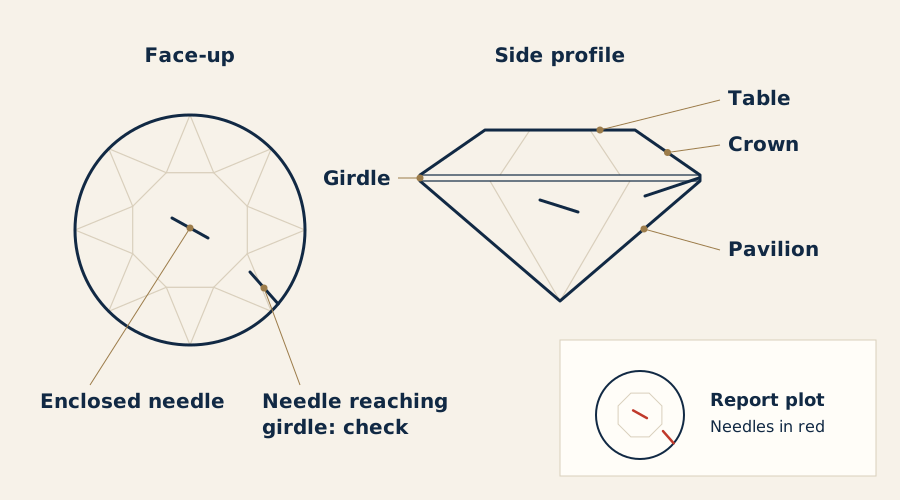
Most full grading reports from labs such as GIA include a plot (or plotting diagram): an outline of the diamond seen from the top (crown) and the bottom (pavilion), with each clarity characteristic drawn in its real position. On GIA reports, internal features are drawn in red and surface features in green. A needle is usually drawn as a short, straight red line, at roughly its real length and angle.
Next to the plot is a key to symbols. It lists the features in order of importance, starting with the ones that most influenced the clarity grade. If needle appears first, it is the grade-setting inclusion. If it appears after crystal or feather, it is a secondary feature and matters less. Some labs, and some smaller reports such as GIA's Diamond Dossier for stones under 2 carats, do not include a plot, so you may only see the list.
| What you see on the report | What it tells you |
|---|---|
| Needle listed first in the key | The needle is the main reason for the clarity grade |
| Needle listed after other features | A minor feature; focus on the first-listed inclusion |
| Short red line in the centre of the crown view | Sits under the table; most visible face-up |
| Red line reaching the outline edge | Runs to or near the girdle; check whether it reaches the surface |
| Several parallel red lines | A group of needles; check how they look together on video |
| Comment such as 'Clouds not shown' or 'Additional pinpoints not shown' | Small features too numerous to plot individually |
The plot is a map, not a photo. Lines on paper can look alarming even when the real needle is barely visible at 10×. Always match the plot with magnified images or a 360° video of the actual diamond.
Not sure which one is right?
Send us the stones you are looking at and our gemologist will tell you which to choose and why.
How do needle inclusions affect a diamond's clarity grade?
Clarity is one of the 4Cs used to grade every diamond, alongside colour, cut and carat. Graders judge each inclusion at 10× by its size, number, position, nature and relief (how much it contrasts with the surrounding diamond). A tiny white needle deep in the pavilion counts for little; a longer one under the table counts for more.
| Clarity grade | What needles typically look like at this grade |
|---|---|
| FL / IF | No needles (IF can have surface blemishes only) |
| VVS1–VVS2 | Minute needles, very hard to find even at 10× |
| VS1–VS2 | Small needles visible at 10× with some effort; not visible to the eye |
| SI1–SI2 | Needles easy to see at 10×; usually eye-clean in SI1, sometimes visible in SI2 |
| I1–I3 | Large, dark or numerous needles, often visible without magnification |
Because white needles have low relief, they are often the grade-setting inclusion in VS and VVS stones, where nothing larger is present. They are less often the main inclusion in SI and I grades, where crystals, feathers and clouds tend to dominate.
Are needle inclusions in diamonds a durability risk?
For most stones, no. Diamond is 10 on the Mohs scale of hardness, but hardness is resistance to scratching, not toughness. Diamond can split along its cleavage planes (directions where the atomic bonds are weaker) if it takes a hard knock at the wrong angle. Inclusions matter for durability when they create or sit beside a weak point along those planes.
A small needle completely enclosed inside the diamond adds very little risk. The cases worth a closer look are:
- Needles reaching the girdle or a facet: a surface-reaching inclusion can give a knock somewhere to start. The thin girdle edge is where most chips happen.
- Needles with stress fractures: some included crystals expand differently from the diamond and leave tiny feathers, the small internal fractures around them. The feather, not the needle, is the concern.
- Needles near a point or corner: in pear, marquise, heart and princess shapes, the tips are thin and exposed.
- Dense bundles near the girdle: rarely a problem, but worth noting if the stone will sit under a claw.
- Needles that break the surface as a knot: a crystal that reaches the surface can show as a raised spot; see knots that reach the surface of a diamond.
Everyday care is the same as for any diamond. Ultrasonic cleaners are generally fine for a diamond with enclosed needles, but a jeweller should check first if the report also shows feathers that reach the surface. During repairs that involve heat, such as retipping claws, an experienced bench jeweller will look at where inclusions sit before applying the torch.
Are diamonds with needle inclusions eye-clean?
Eye-clean means you cannot see any inclusion without magnification at a normal viewing distance of about 25–30 centimetres. Most diamonds where needles are the main inclusion are eye-clean, because the needles are white and fine. In a well-cut brilliant, the flashes of light, which come from diamond's high refractive index of about 2.42, break up and hide thin white lines very effectively.
Three things make a needle more likely to show: a dark colour, a position directly under the table, and a cut style with large open facets. Step cuts such as emerald and Asscher cuts have long, flat facets that act like windows, so a needle that disappears in a round can be visible in an emerald cut of the same grade. Our page on why step cuts show inclusions more clearly explains the effect, and the diamond shapes that hide inclusions most easily covers the opposite end.
| Cut style | How needles show | Typical safe clarity for needles |
|---|---|---|
| Round brilliant | Well hidden by sparkle | SI1, sometimes SI2 |
| Oval, pear, cushion, radiant | Mostly hidden; check under the table | VS2–SI1 |
| Princess | Hidden in the centre; check the corners | VS2–SI1 |
| Emerald, Asscher (step cuts) | Easier to see through the open table | VS1–VS2 |
Strong blue fluorescence (a glow under ultraviolet light) does not change how a needle looks in normal light, but in rare stones it can give a slightly hazy look that combines with dense needle bundles. Our page on diamond fluorescence and how it affects appearance covers when that matters.
How do needles compare with other diamond inclusions?
Needles sit at the gentler end of the inclusion scale. This table compares them with the other features you are most likely to see listed on a report.
| Feature | What it is | Can reach the surface? | Usual durability risk | Usually visible to the eye? |
|---|---|---|---|---|
| Needle | Long, thin included crystal | Occasionally | Low | Rarely |
| Pinpoint | Tiny dot-like crystal | No | Very low | No |
| Crystal | Mineral crystal, rounded or angular | Sometimes | Low to moderate | Depends on size and colour |
| Cloud | Cluster of pinpoints | No | Very low | Only if large or dense |
| Feather | Small internal fracture | Often | Moderate; higher if near the girdle | Sometimes |
| Knot | Crystal reaching the surface | Yes | Low to moderate | Sometimes |
| Laser drill hole | Treatment channel from the surface | Yes | Low | Rarely |
The general rule is simple: what an inclusion is matters less than where it sits and whether it reaches the surface. A needle under the table affects looks; a feather at the girdle affects durability. That is why reading the plot is more useful than reading the grade alone.
Do lab-grown diamonds have needle inclusions?
Laboratory-grown diamonds are real diamond, with the same hardness and refractive index as natural diamond, but they grow in weeks under controlled conditions rather than over millions of years in the mantle. Their inclusions reflect how they were grown. Needles of mantle minerals are a natural feature, so they are not expected in a lab-grown stone.
Lab-grown diamonds have their own inclusions instead. HPHT (high pressure, high temperature) lab-grown diamonds can contain dark metallic inclusions from the metal flux used in growth, and some are elongated and rod-like, so they can be mistaken for dark needles; see metallic inclusions in HPHT lab-grown diamonds. CVD (chemical vapour deposition) lab-grown diamonds more often show small dark pinpoints of non-diamond carbon. Most grading reports for lab-grown diamonds, such as IGI's, use the same clarity scale (GIA now uses simpler descriptive categories for lab-grown stones) and state clearly that the stone is laboratory-grown.
Whether a diamond is natural or lab-grown, you assess its inclusions the same way: grade, position, colour and whether anything reaches the surface. The rest of our diamond education library covers how the two types differ in price, grading and origin.
Browse natural and lab-grown diamonds
How do you check a diamond with needle inclusions? Step by step
- Read the key to symbols. See whether needle is listed first (grade-setting) or further down (minor).
- Find each needle on the plot. Note whether the red lines sit under the table, near the girdle or near a point or corner.
- Match the plot to real images. Use 10× photos or a 360° video to see how bright, dark or long each needle really is.
- Check the surface. Ask whether any needle reaches the girdle or a facet, and whether feathers surround it.
- Judge eye-cleanliness for the shape. Allow more in a round brilliant than in an emerald or Asscher cut.
- Plan the setting. If a needle runs near the girdle, position it away from claws so it is protected rather than stressed.
Free consultation
Talk to a gemologist
Compare stones in person or online with Raj Sood, Graduate Gemologist (GIA), AJP (GIA).
Book a consultationShop this shape
FAQ
Common questions
Are needle inclusions bad in a diamond?
Usually not. Most needles are small, white and fully enclosed, so they rarely affect durability or what you see with the naked eye. Check dark needles, dense bundles under the table and any needle that reaches the girdle or surface.
What does a needle look like on a GIA report?
It is usually drawn as a short, straight red line on the plot, at roughly its real length and position. Red means the feature is internal; green marks surface features.
Can a needle inclusion make a diamond crack?
A fully enclosed needle adds very little risk. The risk rises if the needle reaches the surface or has small feathers around it, especially near the girdle or a point.
What is the difference between a needle and a feather inclusion?
A needle is a solid crystal shaped like a rod. A feather is a small fracture, a thin crack inside the stone, which looks like a line edge-on but shows a flat plane when tilted and is the bigger durability concern.
Are diamonds with needle inclusions eye-clean?
Most are, because needles are fine and white and a brilliant cut's sparkle hides them well. In step cuts such as emerald and Asscher cuts, choose a higher clarity grade because the open facets show more.
Do lab-grown diamonds have needle inclusions?
Natural mineral needles are not expected in lab-grown diamonds. HPHT lab-grown stones can have rod-shaped metallic inclusions that look similar, and the report will always state that the diamond is laboratory-grown.

Ask a gemologist
Not sure which diamond to choose?
Raj Sood is a Graduate Gemologist (GIA) and master jeweller. Bring the stones you are considering, or send the reports, and he will tell you honestly which one is better and why.
Keep learning
Related guides
 Diamond 4Cs & GradingDiamond Inclusions Guide
 Diamond 4Cs & GradingCrystal Inclusions in Diamonds
 Diamond 4Cs & GradingPinpoint Inclusions in DiamondsDiamond 4Cs & GradingWhat Is a Cloud Inclusion in a Diamond?Diamond 4Cs & GradingDiamond 4CsDiamond 4Cs & GradingWhat Is a Feather Inclusion in a Diamond?Diamond 4Cs & GradingKnot Inclusions in DiamondsDiamond 4Cs & GradingAre Black Inclusions Bad in a Diamond?
Explore more
More guides on this topic
Education