
- Education
- Diamond 4Cs & Grading
- Are Black Inclusions in a Diamond Bad? Causes, Clarity and Risks
Diamond 4Cs & Grading
Are Black Inclusions in a Diamond Bad? Causes, Clarity and Risks
A black spot is usually the first thing people notice when they look at a diamond under a loupe. Here is what black inclusions in a diamond actually are, when they matter, and when they are nothing to worry about.
 Reviewed by Raj Sood, Graduate Gemologist (GIA), AJP (GIA)Master jeweller and Graduate Gemologist (GIA) · reviewed 4 November 2026
Quick answer
Black inclusions in a diamond aren't automatically bad. They are usually dark mineral crystals or graphite that rarely affect durability. The problem is visibility: dark spots contrast more than white ones, so they can lower the clarity grade and show to the naked eye. Near the girdle they often go unseen; under the table in SI grades, check closely.
What are black inclusions in a diamond?
An inclusion is any feature inside a diamond: a tiny crystal of another mineral, a crack, or a cluster of specks that was trapped or formed as the diamond grew. Natural diamonds crystallise roughly 150–200 kilometres below the surface, and the minerals around them at that depth can end up locked inside. Clarity, the grade that describes these features, is one of the 4Cs of diamond grading, and our complete guide to diamond inclusions covers every type in detail.
'Black inclusion' is not a formal grading term. It is how most people describe anything that looks dark when they look through a loupe (a small 10× magnifying glass). In the trade you will also hear carbon spots, but that name is mostly wrong. Diamond itself is pure carbon, and the majority of dark spots in diamonds are crystals of other minerals, not lumps of carbon. The exception is graphite, the soft, black form of carbon, which can coat the inside of tiny cracks. If any of these terms are new, our jewellery glossary explains them in plain English.
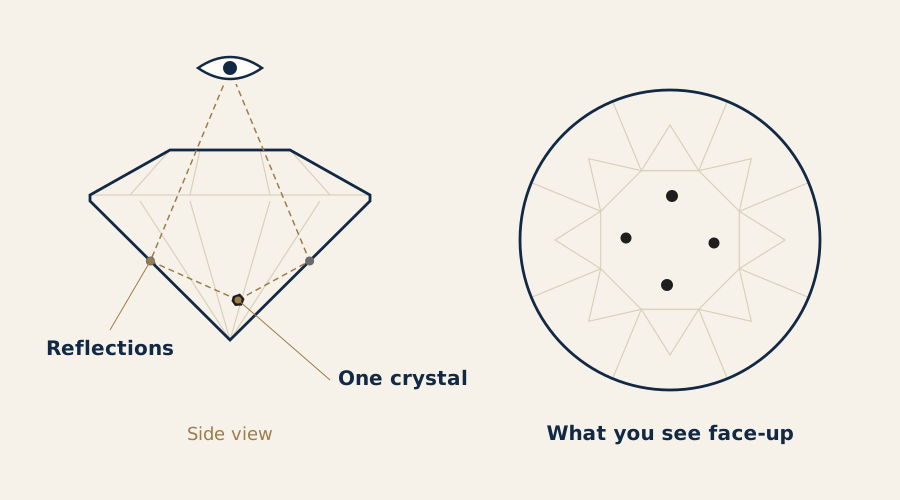
An inclusion can look dark for two different reasons. Either the mineral itself is dark and opaque, or a perfectly clear crystal or crack sends light away from your eye at certain angles, so it reads as black. Diamond has a very high refractive index of about 2.42, which bends light strongly. That is what makes it sparkle, but it also means a single small inclusion near the bottom of the stone can be reflected by the facets and appear several times over. Graders call this a reflector.
What causes black spots in a diamond?
Most black spots in a diamond fall into a handful of types. The table below sets out what each one is, how it usually looks under magnification and whether it raises any concern for durability.
| Dark inclusion | What it is | Typical look at 10× | Durability concern |
|---|---|---|---|
| Sulphide crystal | Iron-nickel sulphide minerals such as pyrrhotite and pentlandite | Black, sometimes metallic, often ringed by a flat halo of tiny cracks (a 'rosette') | Low, unless the halo is large or reaches the surface |
| Chromite | A chromium-rich mineral from the mantle | Small, very dark crystal with sharp edges | Low |
| Dark garnet or other minerals | Deep red, brown or green crystals | Read as black face-up, show colour when viewed side-on | Low |
| Graphite | Carbon in its soft form, usually lining a crack | Black flakes or a dark film along a feather | Depends on the crack underneath |
| Reflected crystal or feather | A clear inclusion that blocks or bounces light | Dark from some angles, clear or white from others | Same as the underlying inclusion |
| Metallic flux | Metal trapped during HPHT lab growth (lab-grown only) | Opaque, metallic, sometimes elongated | Low |
Dark crystals are only one part of the picture. Clear and white inclusions are far more common, from tiny pinpoints that look like specks of dust to long, thin needle-shaped crystals and knots that reach the surface of the stone. Many dark crystals also come with feather inclusions, small internal cracks around them, caused by the crystal expanding at a different rate from the diamond as it rose to the surface.
Related guideCrystal Inclusions in DiamondsSulphide inclusions have one surprising use: geologists can date them, and some have shown that the diamonds holding them formed more than three billion years ago. That makes a black speck a small piece of Earth history, even if most buyers would still rather not see it.
Are black inclusions bad in a diamond?
Not automatically. A black crystal is just one type of inclusion, and whether it matters comes down to three questions:
- Can you see it? This is the main issue. Dark inclusions contrast with the bright diamond around them, so a black spot is easier to see than a white one of the same size.
- Does it threaten durability? Usually not. A fully enclosed crystal does not weaken the stone in normal wear. The exceptions are a crystal with large stress cracks around it, a dark inclusion that breaks the surface, or one sitting right at the girdle (the thin outer edge) or a point.
- Does the price reflect it? Clarity grade already prices in the inclusion. Among stones of the same grade, a diamond with an obvious black spot under the table is often harder to sell than one with scattered white pinpoints, and is often priced a little lower.
Diamond is 10 on the Mohs hardness scale, but hardness is resistance to scratching, not resistance to knocks. Diamond can still split along its cleavage planes, and an inclusion with feathers running out from it gives a hard knock somewhere to start. That is why a gemmologist looks not just at the black spot itself but at what surrounds it, and whether any cracks run towards the surface. Shapes with thin points, such as heart shaped diamonds with a fragile tip, deserve extra care if a dark crystal sits near the point.
For most buyers the practical answer is simple. In VVS and VS grades, a black crystal is microscopic and is not a concern. In SI1 and SI2, it is often the inclusion that sets the grade, and you need to see the actual stone, or a sharp, magnified video, before deciding.
How do black inclusions affect a diamond's clarity grade?
GIA graders judge clarity at 10× magnification using five factors: size, number, position, nature (what type of inclusion it is, and whether it reaches the surface) and relief. Relief means how much an inclusion contrasts with the diamond around it. Dark inclusions have high relief, so a black crystal usually pulls the grade further down than a colourless crystal of the same size in the same place.
| Clarity grade | What a grader sees at 10× | A black inclusion here | Usually eye-clean? |
|---|---|---|---|
| FL / IF | No inclusions (IF may have tiny surface marks) | None | Yes |
| VVS1–VVS2 | Inclusions extremely difficult to see | A microscopic dark pinpoint at most | Yes |
| VS1–VS2 | Minor inclusions, difficult to somewhat easy to see | A small dark crystal, often off-centre | Almost always |
| SI1 | Noticeable inclusions | Often the grade-setting feature | Usually, in rounds up to about 1 ct; check |
| SI2 | Easily noticeable inclusions | A dark crystal under the table may show face-up | Often not, especially in step cuts |
| I1–I3 | Obvious inclusions | Large or numerous dark crystals | Usually visible; durability may be affected |
An eye-clean diamond is one with no inclusions you can see without magnification at a normal viewing distance of about 25–30 centimetres. Larger stones show inclusions more, because everything inside is physically bigger. An SI1 diamond with a black inclusion can be eye-clean at 0.70 carat and visible at 2 carats, even with the same grade on the report.
On a GIA report, the clarity plot maps each inclusion: internal features are drawn in red and surface features in green. The report will not say 'black'. A dark crystal is simply labelled crystal, so the plot alone cannot tell you whether a spot is dark or clear. The key to symbols lists features roughly in order of how much they affect the grade, so the first item is usually the one to look for. Our guide to how each inclusion type is plotted on a report shows the symbols, and our overview of how clarity fits with cut, colour and carat explains how to balance the grades.
Not sure which one is right?
Send us the stones you are looking at and our gemologist will tell you which to choose and why.
Where is a black inclusion least visible in a diamond?
Position matters as much as size. The same dark crystal can be obvious in one spot and almost invisible in another.
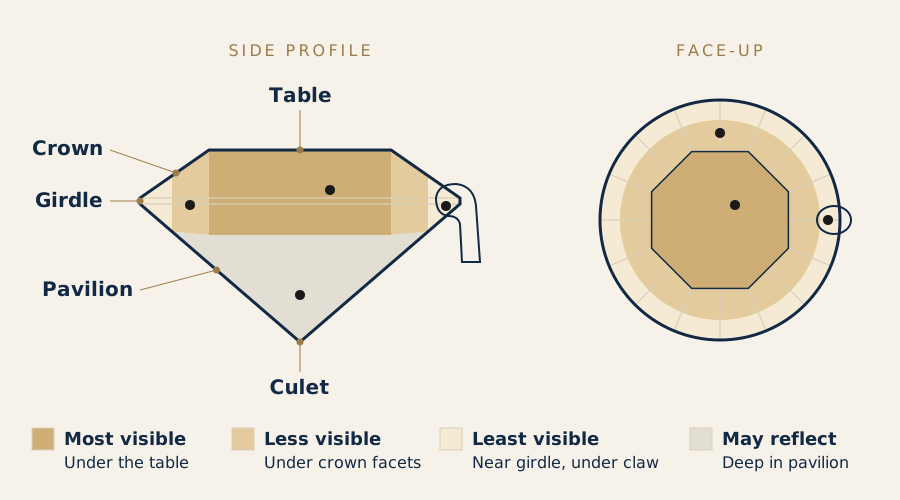
- Under the table: the large flat facet on top acts like a window. A black spot here is the most visible and the most likely to lower the grade.
- Under the crown facets: the angled facets around the table break up the view with sparkle, so small dark crystals are much harder to spot.
- Near the girdle: often the least visible zone, and a claw or bezel can sit right over it. Check that no feather runs from the inclusion out to the edge.
- Deep in the pavilion: the lower half can hide an inclusion from above, but it may be reflected several times, so check from more than one angle.
The cut style also changes things. Brilliant cuts such as round, cushion, oval diamonds and pear cut diamonds scatter light into small flashes that camouflage dark crystals well. Step cuts such as emerald and Asscher have long, open facets and a large table, so a black spot that would disappear in a round can sit there in plain view. For a step cut, most gemmologists suggest VS2 or higher. Our overview of how each diamond shape handles light shows which shapes hide inclusions best.
Black vs white inclusions: which is worse?
Many buyers assume white inclusions are always better than black ones. Often they are, but not always. Here is how they compare when the stones carry the same clarity grade.
| Black inclusions | White or clear inclusions | |
|---|---|---|
| Typical types | Sulphide, chromite and dark garnet crystals; graphite in feathers | Clear crystals, pinpoints, clouds, needles, feathers |
| Contrast (relief) | High; stand out against the bright stone | Low to moderate; blend with sparkle |
| Eye visibility at the same grade | More likely to be seen | Less likely to be seen |
| Effect on brightness | Usually none unless large | Large or dense clouds can make the stone look hazy |
| Durability | Low risk unless cracks reach the surface | Low risk, except feathers near the girdle |
| Price within the same grade | Often a little lower if under the table | Often preferred by buyers |
The exception is haze. Dense clouds of tiny pinpoints are white, but if they spread across the stone they can dull its brightness in a way a single black dot never would. A diamond with one small dark crystal near the girdle can look cleaner and livelier than a same-grade diamond with a large, milky cloud. Judge the whole stone, not the colour of the spot.
Can black inclusions be removed from a diamond?
Yes, in some cases, by a treatment called laser drilling. A laser bores a very fine channel, narrower than a human hair in many cases, from the surface to the dark crystal. The crystal is then dissolved or bleached with acid so it turns pale. The black spot disappears, but a fine white tube remains, visible at the right angle under magnification.
- Laser drill hole: a straight channel to the inclusion. GIA records it on the report and plots it, because it is a permanent treatment.
- Internal laser drilling (KM): a laser heats the inclusion until a tiny feather-like crack spreads to the surface, giving the acid a path in. It looks like a natural feather and is also noted on a GIA report.
- Fracture filling: a glass-like filler is pushed into feathers to hide them. Filled stones show a coloured 'flash' when tilted and the filler can be damaged by heat during jewellery repairs. GIA does not grade fracture-filled diamonds.
- Recutting: if a black crystal is close to the surface, a cutter may polish it away, at the cost of some weight.
Any treatment should be disclosed to you before you buy, and a laser-drilled diamond is generally worth less than an untreated stone of the same grade. Treatment to hide inclusions is far more routine in coloured gems: our page on how clarity enhancement works in emeralds shows how oils and resins are used there, and why disclosure matters just as much.
Do lab-grown diamonds have black inclusions?
Yes. Lab-grown diamonds are real diamond, with the same hardness and refractive index as natural diamond, and they can have inclusions too. The types are different because they come from the growth process, not from the Earth's mantle.
- HPHT lab-grown (high pressure, high temperature) diamonds grow from a molten metal mix, and droplets of that metal can be trapped as dark, metallic flux inclusions. Stones with a lot of flux can even be drawn to a strong magnet.
- CVD lab-grown (chemical vapour deposition) diamonds grow layer by layer from a carbon-rich gas, and can trap dark specks of non-diamond carbon, similar to graphite, along with pinpoints that form during growth.
- Both can be graded on the same clarity scale as natural diamonds by labs such as IGI, although GIA now uses simpler descriptive grades for lab-grown stones. The report will state that the diamond is laboratory-grown.
Because laboratory-grown diamonds cost much less than natural diamonds, the price step between clarity grades is much smaller in dollars. Many buyers who would choose SI1 in a natural diamond step up to VS in lab-grown and avoid the black-spot question altogether. In natural diamonds, a carefully chosen SI1 with its inclusions off-centre is often where the value sits.
| 1 ct round, G colour | Natural (approx. AUD) | Lab-grown (approx. AUD) |
|---|---|---|
| VS1 | $9,500–$14,000 | $1,200–$2,800 |
| VS2 | $8,500–$12,500 | $1,100–$2,600 |
| SI1 | $7,000–$10,500 | $1,000–$2,300 |
| SI2 | $5,500–$8,500 | $900–$2,000 |
These are broad ranges only. Prices move with the market, cut quality and the exact stone, and two SI1 diamonds can differ by thousands of dollars depending on where their inclusions sit. Shape moves the price too, as our comparison of prices across diamond shapes shows. Natural and lab-grown diamonds also behave differently over time, so choose on what you like and can see, not on resale expectations.
Browse natural and lab-grown diamonds by clarity
How do you check a diamond for black inclusions before you buy?
- Read the report first. Note the clarity grade, the plot and the key to symbols, and confirm whether the diamond is natural or lab-grown and whether any treatment such as laser drilling is listed.
- Find the grade-setting inclusion. It is usually the first item in the key. If it is a crystal, ask whether it is dark or clear.
- Locate it on the plot. Under the table is the zone to be careful with; near the girdle is usually easier to live with.
- Look face-up without magnification. View the stone or a sharp video at about 25–30 centimetres, the distance you will actually see it on your hand.
- Then use a loupe or magnified video. Check for feathers running from any dark crystal to the surface, and for reflections that repeat it.
- Plan the setting around it. If the inclusion is near the edge, ask whether a claw can cover it before you commit to the stone.
Done this way, a black crystal stops being a reason to panic and becomes one more piece of information. Some of the most sensible diamond choices are stones with a small dark crystal tucked where no one will ever see it. Learn the other inclusion types too, from how dark and light mineral crystals differ to when a feather is worth worrying about, and you will read any clarity report with confidence.
Free consultation
Talk to a gemologist
Compare stones in person or online with Raj Sood, Graduate Gemologist (GIA), AJP (GIA).
Book a consultationShop this shape
FAQ
Common questions
Are black inclusions in a diamond bad?
Not necessarily. They rarely affect durability, but they are more visible than white inclusions, so their size and position decide whether they matter. In VS grades they are microscopic; in SI grades, check where they sit.
Are black spots in a diamond carbon?
Mostly not, despite the trade name 'carbon spots'. Most are crystals of other minerals such as sulphides or chromite. Graphite, a soft form of carbon, can coat the inside of small cracks.
Is an SI1 diamond with a black inclusion worth buying?
It can be, if the inclusion is small, off-centre or near the girdle and the stone is eye-clean at normal viewing distance. Avoid SI1 stones with a dark crystal right under the table, especially above 1 carat or in step cuts.
Can black inclusions be removed?
Some can be removed by laser drilling, which bleaches or dissolves the dark crystal through a fine channel. It is a permanent treatment that should be disclosed and is noted on a GIA report.
Do lab-grown diamonds have black inclusions?
Yes. HPHT lab-grown diamonds can contain dark metallic flux, and CVD lab-grown diamonds can contain dark specks of non-diamond carbon. Labs such as IGI grade them on the same clarity scale as natural diamonds.
Will a black inclusion make my diamond crack?
Very unlikely for a fully enclosed crystal. The risk rises only when feathers around the inclusion reach the surface or it sits at the girdle, so ask a gemmologist to check those areas.

Ask a gemologist
Not sure which diamond to choose?
Raj Sood is a Graduate Gemologist (GIA) and master jeweller. Bring the stones you are considering, or send the reports, and he will tell you honestly which one is better and why.
Keep learning
Related guides
 Diamond 4Cs & GradingDiamond Inclusions Guide
 Diamond 4Cs & GradingCrystal Inclusions in DiamondsDiamond 4Cs & GradingWhat Is a Feather Inclusion in a Diamond?Diamond 4Cs & GradingDiamond 4Cs
 Diamond 4Cs & GradingPinpoint Inclusions in Diamonds
 Diamond 4Cs & GradingNeedle Inclusions in DiamondsDiamond 4Cs & GradingKnot Inclusions in DiamondsDiamond 4Cs & GradingWhat Is a Cloud Inclusion in a Diamond?
Explore more
More guides on this topic
Education