
- Education
- Buying Knowledge & Custom Process
- How to Measure Ring Size at Home (Australian Letter Sizes)
Buying Knowledge & Custom Process
How to Measure Ring Size at Home (Australian Letter Sizes)
A ring that is half a size out spins, pinches or slides off over the knuckle. Here is how to measure ring size at home accurately, and how to read the result in Australian letter sizes.
 Reviewed by Raj Sood, Graduate Gemologist (GIA), AJP (GIA)Master jeweller and Graduate Gemologist (GIA) · reviewed 4 November 2026
Quick answer
To measure ring size at home, wrap a strip of paper around the base of your finger, mark where it overlaps, and measure the length in millimetres. That is your circumference. Match it to the Australian letter chart (54.4 mm is about N). Measure three times, at the end of the day, and check it fits over the knuckle.
What are Australian ring sizes?
Australia uses the same letter system as the United Kingdom: sizes run from A (very small) to Z, then Z+1, Z+2 and so on for larger fingers. Each letter stands for an inner circumference, which is the distance around the inside of the ring, measured in millimetres. Half sizes (such as M½) sit in between.
Whole letters are only about 1.25 mm of circumference apart, and half sizes about 0.6 mm. That is why a careful measurement matters: an error of 2 mm with a stretchy piece of string is already more than a full size. Our full Australian ring size guide lists every letter, and our article on how Australian sizes compare with US, UK and EU explains why an overseas size printed on a website will not match ours.
| AU / UK size | Inner circumference | Inner diameter | Approx. US size |
|---|---|---|---|
| J | 49.3 mm | 15.7 mm | 5 |
| K | 50.6 mm | 16.1 mm | 5¼–5½ |
| L | 51.8 mm | 16.5 mm | 5¾–6 |
| M | 53.1 mm | 16.9 mm | 6¼–6½ |
| N | 54.4 mm | 17.3 mm | 6¾–7 |
| O | 55.7 mm | 17.7 mm | 7¼–7½ |
| P | 57.0 mm | 18.1 mm | 7¾–8 |
| Q | 58.3 mm | 18.6 mm | 8½ |
| R | 59.5 mm | 18.9 mm | 8¾–9 |
| S | 60.8 mm | 19.4 mm | 9½ |
| T | 62.1 mm | 19.8 mm | 10 |
| U | 63.4 mm | 20.2 mm | 10½ |
| V | 64.6 mm | 20.6 mm | 11 |
| W | 65.9 mm | 21.0 mm | 11½ |
Charts from different makers vary by a fraction of a millimetre, so treat these as close guides rather than exact standards. As a rough picture, many women in Australia wear somewhere around L to O, and many men around R to V, but fingers vary far too much to guess from averages. Men can find more detail in our men's ring size guide.
How to measure ring size at home with paper or string?
The paper-strip method is the most practical way to measure at home, and it is more reliable than string. You need a strip of paper about 5 mm wide and 10 cm long, a fine pen and a ruler with millimetre markings.
- Paper strip: paper does not stretch, so it gives a truer reading. Wrap it around the base of the finger, snug but not tight, and mark where the end overlaps.
- String or dental floss: it works in a pinch, but it stretches as you pull it and squashes into the skin. String readings often come out half to a full size small.
- Printable ring sizer: a paper sizer printed from a website. Print at 100% ("actual size"), then check the scale with a ruler or a bank card, which is 85.6 mm wide. If the scale is off, the reading is too.
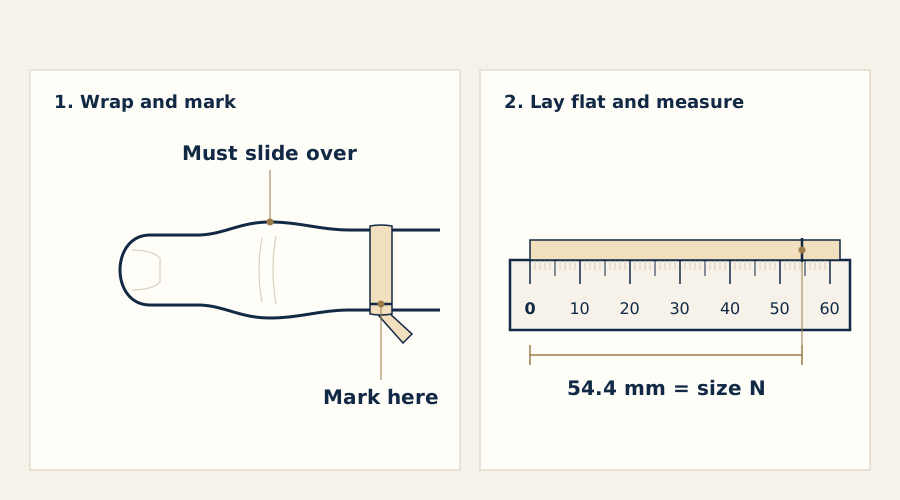
Once you have the length in millimetres, find the closest circumference on the chart above. If you fall between two letters, choose the larger, because a ring that is slightly loose can be fixed with small sizing beads inside the band, while a tight ring is uncomfortable every day. Our ring size converter turns a millimetre reading straight into a letter.
Can you measure an existing ring to find your size?
Yes, and if the ring already fits the right finger comfortably, it is often more reliable than measuring the finger. Lay the ring flat on a ruler and measure the inner diameter: the distance straight across the inside, from one inner edge to the other, at the widest point. Do not include the metal itself.
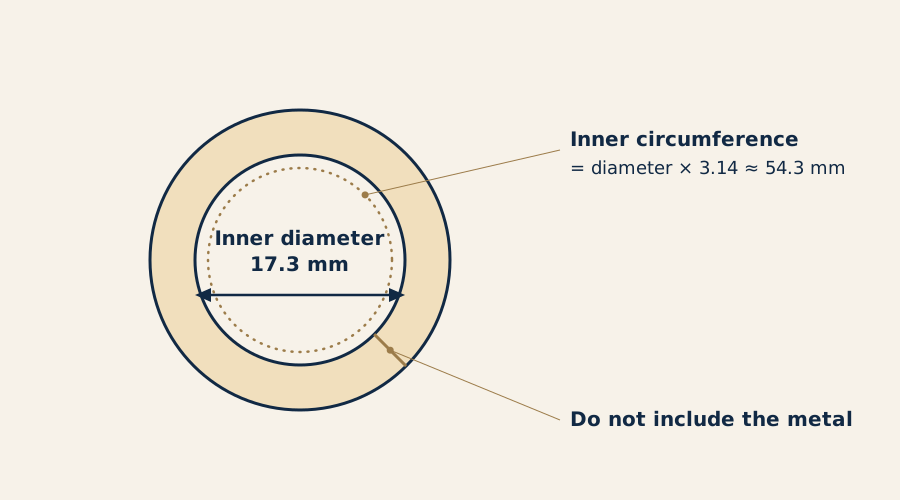
To turn a diameter into a circumference, multiply by π (about 3.14). A ring measuring 17.3 mm across, for example, has a circumference of about 54.3 mm, which is close to an N. Measure in two directions; older rings worn for years can go slightly oval, so average the two readings. A pair of digital callipers from a hardware shop gives a cleaner reading than a ruler.
A few cautions. Use a ring that is worn on the same finger and hand as the new ring will be, because the dominant hand is often slightly larger. A wide band and a thin band in the same size feel different, so measure a ring of similar width if you can. While the ring is out of the drawer, our guide to cleaning a diamond ring at home shows how to remove the build-up that collects inside the band.
How to measure ring size at home: which method is most accurate?
Every at-home method is an estimate. The aim is to get within half a size, then confirm it with a jeweller's metal finger gauges if you can. Here is how the common methods compare.
| Method | Typical accuracy | Good for | Main risk |
|---|---|---|---|
| String or floss | Within about 1 size | A quick first guess | Stretches and digs in, reads small |
| Paper strip | Within about ½ size | Measuring your own finger | Wrapping too tight or too loose |
| Printable paper sizer | Within about ½ size | When you have a printer | Printer scaling throws it out |
| Measuring an existing ring | Within about ½ size | A ring that already fits well | Wrong finger or an oval ring |
| Plastic adjustable sizer | Within about ½ size | Repeated checks over several days | Thin strip feels looser than a real band |
| Jeweller's finger gauges | Within ¼ size | Confirming before you order | Needs a visit to a jeweller |
Professional jewellers use a set of finger gauges (solid metal rings in every half size) and a ring mandrel, a tapered steel stick marked with sizes, to check finished rings. Finger gauges come in both narrow and wide widths, which is why they beat paper: you feel the real thing on your finger, including how it passes over the knuckle. Look up any unfamiliar workshop term in our jewellery glossary.
Not sure which one is right?
Send us the stones you are looking at and our gemologist will tell you which to choose and why.
When should you measure your finger for a ring?
Fingers change size through the day and through the year, sometimes by half a size or more. A reading taken on a cold winter morning can be noticeably smaller than one on a warm summer evening.
- Time of day: fingers are usually smallest in the morning and fuller in the late afternoon and evening. Measure towards the end of the day.
- Temperature: heat swells fingers and cold shrinks them. Measure in a comfortable room, not straight after a hot shower or coming in from the cold.
- Activity and diet: exercise, salty food and alcohol can all cause temporary swelling. Wait a few hours.
- The knuckle: if your knuckle is much larger than the base of your finger, the ring must pass over it. Measure both and choose a size that slides over the knuckle without forcing.
- Life changes: pregnancy, weight change and some medications can change finger size. If one is under way, a resize later is common and normal.
Does band width affect ring size?
Yes. A wide band covers more skin, so it feels tighter than a thin band of exactly the same size. Wedding bands and men's rings are where this matters most. The inside shape also plays a part: a comfort-fit band, which is gently rounded on the inside, slides on more easily and can feel a little looser than a flat-inside band.
| Band width | Typical adjustment | Example |
|---|---|---|
| Up to about 4 mm | Your measured size | Most solitaire engagement rings |
| About 5–6 mm | Measured size, or a quarter size up | Classic wedding bands |
| About 6–8 mm | About half a size up | Wide men's bands |
| Over 8 mm | Half to one full size up | Statement and wide cigar bands |
These are starting points, not rules; the only certain test is trying a gauge of the same width. When a ring is being designed from scratch, the width is part of the brief. Our comparison of handmade and CAD-designed rings explains how the band profile is set before anything is made.
Can a ring be resized if the size is wrong?
Most plain gold and platinum rings can be made larger or smaller, usually by about one to two sizes, sometimes more. A jeweller cuts the shank (the band part of the ring), removes or adds a small piece of matching metal, solders the join and refinishes it so the seam disappears. White gold that is rhodium plated is usually replated afterwards.
- Usually straightforward: solitaires, plain bands, most halo and three-stone rings.
- Harder or limited: rings with stones set part-way down the band, two-tone rings, and intricate patterned or engraved bands.
- Often not possible: full eternity bands (stones all the way round), tension settings, and rings made of tungsten, titanium or ceramic.
Resizing a simple gold ring commonly costs somewhere around AUD 60–250, depending on the metal, the size change and how many stones sit near the cut. Larger changes and platinum generally cost more. Because some designs cannot be resized at all, it is worth confirming the size before ordering a full eternity band.
Resize a ring or create your own
How do you find a ring size for someone else?
If the ring is a surprise, you cannot ask them to wrap paper around their finger. The most reliable option is to borrow a ring they already wear on the right finger and measure its inner diameter, as above, then put it back before it is missed. You can also press it gently into a bar of soap for an outline, or trace the inside onto paper. Our guide to estimating a size for a surprise proposal covers the other tricks, including asking a trusted friend.
Related guideRing Size Converter (Tool)Sizing is one step of many. Our engagement ring buying guide puts it in order with choosing a diamond and setting, and engagement ring etiquette covers questions such as whether to propose with a placeholder ring and size it afterwards. If you are still deciding on budget, see how much to spend on an engagement ring and why the three-month salary rule is a marketing idea rather than a rule.
Finger size also changes how big a centre stone looks: the same 1 carat diamond covers more of a size J finger than a size P. Our diamond size visualiser shows this by shape, and when you are down to two stones you can compare two diamonds side by side.
How to measure your ring size at home: step by step
- Pick the finger and hand. Engagement and wedding rings in Australia are usually worn on the left ring finger. Measure that finger, not the one next to it.
- Wait for the right moment. Late in the day, in a comfortable room, not after exercise, a hot shower or a salty meal.
- Cut a paper strip. About 5 mm wide and 10 cm long. Avoid string if you can.
- Wrap and mark. Wrap the strip around the base of the finger, snug but able to slide over the knuckle, and mark the overlap with a fine pen.
- Measure in millimetres. Lay the strip flat on a ruler and read the length to the mark. That is your inner circumference.
- Convert to a letter. Match it to the Australian chart, or use a millimetre-to-letter converter. Between two sizes, choose the larger.
- Adjust for width. For a band wider than about 6 mm, allow roughly half a size up.
- Repeat and confirm. Measure on three different days, then confirm with a jeweller's finger gauges before ordering a ring that cannot easily be resized.
Free consultation
Talk to a gemologist
Compare stones in person or online with Raj Sood, Graduate Gemologist (GIA), AJP (GIA).
Book a consultationShop this shape
FAQ
Common questions
What ring size is the average woman in Australia?
Many women wear around L to O in Australian letter sizes, but fingers vary widely. Measure rather than guess from an average.
What ring size is the average man in Australia?
Many men wear around R to V. Men's bands are often wider, so allow about half a size up for a band over 6 mm.
Is it better to size a ring up or down?
If you fall between two sizes, choose the larger. A slightly loose ring can be fixed with sizing beads, while a tight ring is uncomfortable and harder to remove.
Is measuring ring size with string accurate?
Not very. String stretches and presses into the skin, so it often reads half to a full size small. A paper strip is more reliable.
Are Australian ring sizes the same as UK sizes?
Yes, Australia uses the same letter sizes as the UK. US sizes use numbers and European sizes are based on the circumference in millimetres, so always convert.
How much does it cost to resize a ring in Australia?
A simple resize of a plain gold ring is commonly around AUD 60–250, depending on the metal, the change in size and any stones near the band. Some rings, such as full eternity bands, cannot be resized.

Ask a gemologist
Not sure which diamond to choose?
Raj Sood is a Graduate Gemologist (GIA) and master jeweller. Bring the stones you are considering, or send the reports, and he will tell you honestly which one is better and why.
Keep learning
Related guides
 Buying Knowledge & Custom ProcessRing Size Guide Australia
 Buying Knowledge & Custom ProcessRing Size Converter (Tool)
 Buying Knowledge & Custom ProcessMen's Ring Size Guide
 Buying Knowledge & Custom ProcessHow to Estimate Ring Size for a Surprise ProposalBuying Knowledge & Custom ProcessEngagement Ring Buying Guide
 Lab-Grown DiamondsCan I Make a Lab-Grown Diamond or Gemstone at Home?
 Buying Knowledge & Custom ProcessDiamond Size Visualiser by Shape (Tool)Care, Repairs & RemodellingHow to Clean a Diamond Ring at Home
Explore more
More guides on this topic
Education