
Pearls
Tahitian Pearls Guide: Origin, Colour, Size, Quality and Care
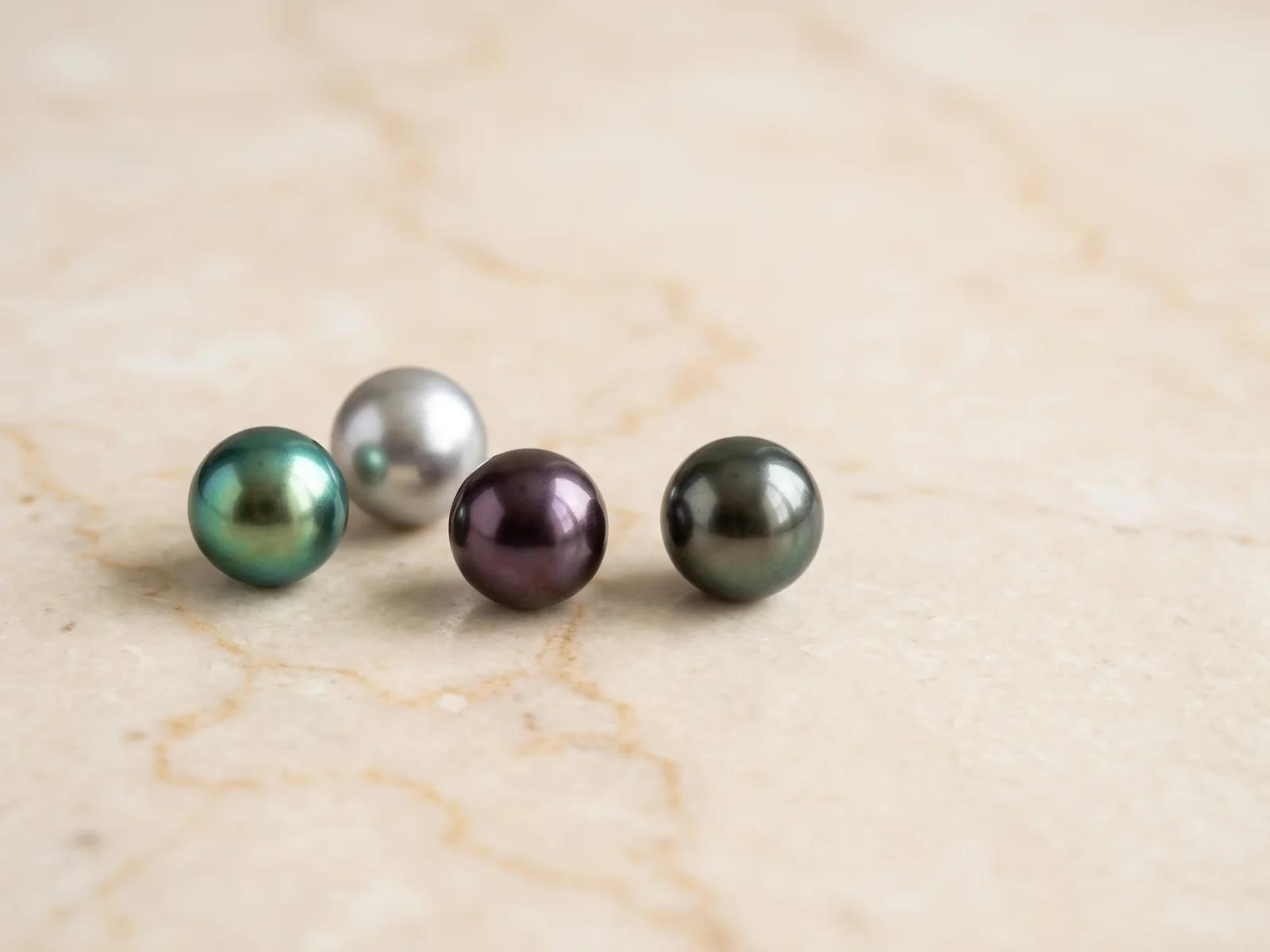
Tahitian pearls are among the few cultured pearls that are naturally dark, and their colour range surprises most people. Here is how to read their colour, size and quality, what drives the price, and how to look after them.
 Reviewed by Raj Sood, Graduate Gemologist (GIA), AJP (GIA)Master jeweller and Graduate Gemologist (GIA) · reviewed 4 November 2026
Quick answer
Tahitian pearls are saltwater cultured pearls grown in the black-lipped pearl oyster, Pinctada margaritifera, mainly in French Polynesia. They are naturally dark, from silver and grey to peacock green, aubergine and near-black, and usually 8–14 mm. Value depends on lustre, surface, shape, size and colour, with round, high-lustre peacock pearls costing most.
What are Tahitian pearls?
Tahitian pearls are saltwater cultured pearls grown inside the black-lipped pearl oyster, Pinctada margaritifera. The name comes from Tahiti, the best-known island of French Polynesia, although most of the farms are on the atolls of the Tuamotu and Gambier archipelagos rather than on Tahiti itself. They sit alongside white, golden and cream pearls in our pearl jewellery and custom pearl designs range, but they look like nothing else: dark, metallic and often shot with green or rose.
A pearl is built from nacre (pronounced NAY-ker), the same iridescent material that lines the inside of the shell. Nacre is made of microscopic plates of aragonite, a form of calcium carbonate, stacked in layers with a little organic binder called conchiolin. Light passing through and bouncing between those layers creates lustre (the mirror-like shine on the surface) and orient (the soft rainbow shimmer some pearls show).
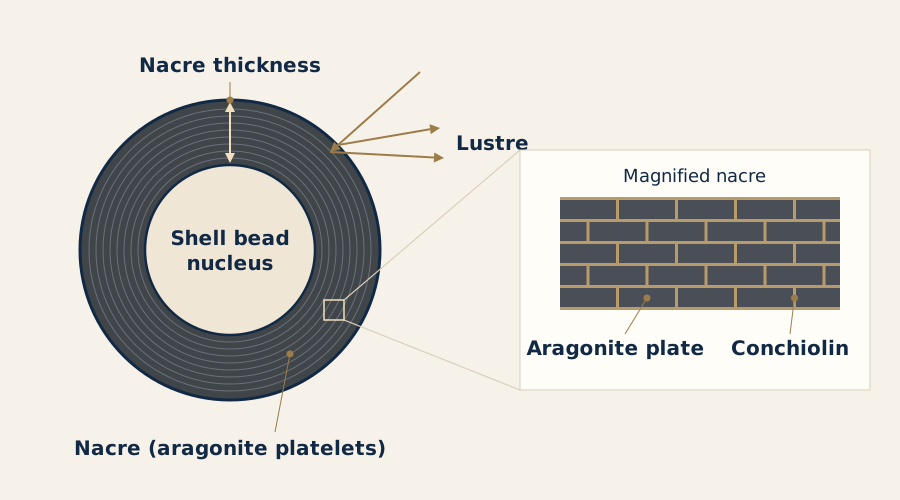
Almost every Tahitian pearl on the market is cultured. A farmer places a small shell bead (the nucleus) and a piece of mantle tissue from a donor oyster inside the oyster, which then coats the bead in nacre over roughly 18 months to two years. Truly natural black pearls, formed with no human help, do exist but are very rare; our guide to how natural and cultured pearls differ explains how labs tell them apart. To see where Tahitians fit among all pearl types, start with our pearl types and identification guide, and look up any unfamiliar term in the GemTrove jewellery glossary.
Pearls are soft for jewellery: about 2.5–4.5 on the Mohs hardness scale, compared with 7 for quartz and 10 for diamond. Their refractive index is roughly 1.52–1.66. That softness, and their sensitivity to acids and chemicals, shapes most of the care advice later in this guide.
Where do Tahitian pearls come from and how are they farmed?
The black-lipped oyster lives in warm lagoons across the Pacific, and it is named for the dark band around the edge of its shell. It is a large oyster, often 20–30 cm across when mature, which is why it can grow pearls much bigger than the small Akoya oyster. Commercial pearl culture in French Polynesia began in the 1960s and grew into a major industry from the 1970s and 1980s. Smaller amounts of black-lip pearls are also farmed in the Cook Islands, Fiji and elsewhere, though only pearls from French Polynesia are traditionally called Tahitian.
Farming is slow and largely manual. A typical cycle looks like this:
- Collecting spat: young oysters are gathered on lines in the lagoon and grown for two to three years until they are big enough to graft.
- Grafting: a skilled technician inserts the bead nucleus and a square of donor mantle tissue into the oyster's gonad.
- Growing: the oysters hang on lines in the lagoon for about 18–24 months while nacre builds up. Farmers clean the shells regularly.
- Harvest and regrafting: a healthy oyster that produced a good pearl can take a larger bead and be grafted again, which is how bigger pearls are grown.
- Sorting: pearls are sorted by size, shape, colour, lustre and surface before sale.
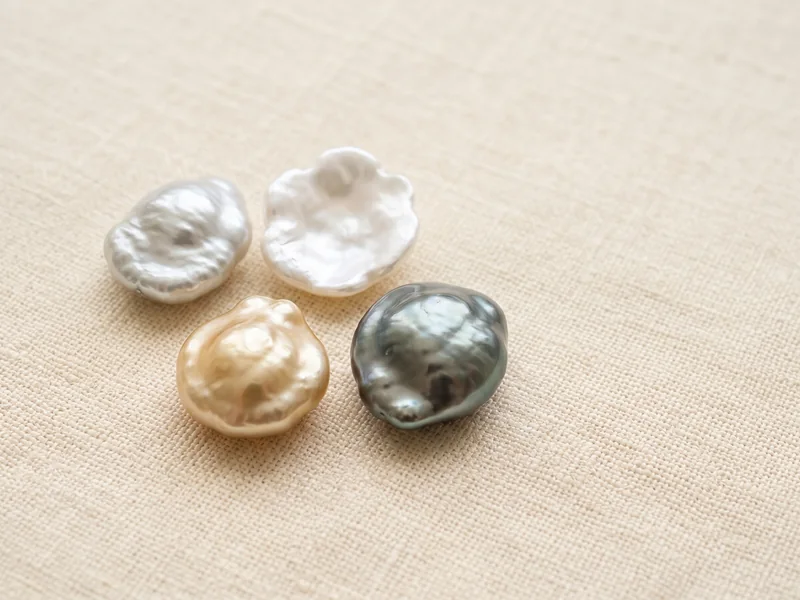
Not every graft produces a round pearl. Some oysters reject the bead and form a beadless pearl made entirely of nacre; these are sold as Tahitian keshi, and you can read more in our guide to keshi pearls. Farmers can also glue a half-bead to the inside of the shell to grow a dome-shaped blister pearl, the same method used for mabe pearls cut from the shell.
What colours do Tahitian pearls come in?
Tahitian pearls are called black pearls, but true jet black is uncommon. Most are some shade of grey, green or brown. Pearl colour is described in two parts: the body colour (the main colour) and the overtone (a translucent colour that seems to float over the surface). A pearl may also show orient on top of both.
| Colour name | What it looks like | Notes |
|---|---|---|
| Peacock | Dark green-gold body with rose or purple overtone | The most sought-after; usually priced highest |
| Aubergine | Deep purple-brown, like eggplant skin | Popular and distinctive |
| Pistachio | Light yellow-green | Softer look, often more affordable |
| Silver and light grey | Pale metallic grey | Suits people who want a subtle dark pearl |
| Charcoal and black | Dark grey to near-black, often with green overtone | True black with strong lustre is rare |
| Chocolate and copper | Warm brown tones | Sometimes treated; check disclosure |
| Cherry and rose | Dark body with strong pink-red overtone | Less common, valued for vivid overtone |
The colour comes from pigments in the oyster's own mantle tissue, which is why the donor oyster chosen for grafting has a big effect on the result. This natural colour is the main difference between Tahitians and dark Akoya or freshwater pearls, which are usually dyed or irradiated to look black. Tahitian pearls themselves are occasionally treated too, mainly to create chocolate or more even colours, and any treatment should be disclosed.
There is no single right colour. Lighter greys suit fair skin and silver jewellery; peacock and aubergine look rich against warmer skin tones and yellow gold. Pearl is a June birthstone, and dark pearls are a popular alternative to white in our June birthstone guide.
What size are Tahitian pearls, and what shapes can you get?
Pearl size is measured in millimetres across the diameter, not in carats. Tahitian pearls usually range from about 8 to 14 mm, with most strands and pendants falling between 9 and 12 mm. Pearls of 15 mm and above exist but are uncommon, and every extra millimetre adds noticeably to the price.
| Size | How common | How it wears |
|---|---|---|
| 8–9 mm | Common at the small end | Subtle studs, everyday strands |
| 9–10 mm | Very common | Classic earrings and strands |
| 10–11 mm | Common | A clear statement on the ear or as a pendant |
| 11–12 mm | Less common | Bold pendants and rings |
| 12–14 mm | Uncommon | Large pendants; strands become expensive |
| 14 mm+ | Rare | Showpiece single pearls |
Shape is just as important as size for price. Tahitian pearls are sorted into a handful of shape groups:
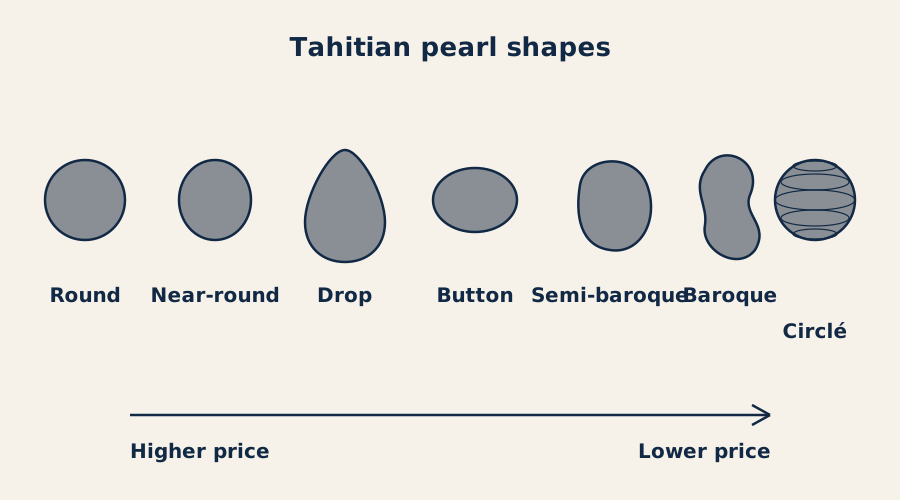
- Round and near-round: the rarest and most valuable; only a small share of each harvest.
- Drop and button: pear-shaped or flat-backed pearls, ideal for earrings and pendants.
- Semi-baroque: slightly irregular ovals and drops.
- Baroque: fully irregular shapes, often with strong lustre and very good value.
- Circlé: pearls with concentric rings or grooves around them, very typical of Tahitians and far less expensive than rounds.
For a strand, size and length work together: a 45 cm princess strand of 10 mm pearls has about 40–43 pearls in it, once knots and the clasp are allowed for. Our necklace lengths, from choker to opera page shows where each length sits on the body.
Not sure which one is right?
Send us the stones you are looking at and our gemologist will tell you which to choose and why.
How are Tahitian pearls graded?
There is no single worldwide pearl grading standard. Most gemmologists judge pearls on seven value factors: size, shape, colour, lustre, surface, nacre quality and, for strands and pairs, matching. French Polynesia also uses its own A to D scale for surface and lustre, while many retailers use AAA to A. Our detailed guide to grading pearls by lustre, nacre, surface, shape and size covers each factor.
| Grade | Lustre | Surface |
|---|---|---|
| A (Top) | Very high | Clean, or minor flaws on no more than about 10% of the surface |
| B | High to medium | Flaws on no more than about 30% of the surface |
| C | Medium | Flaws on no more than about 60% of the surface |
| D | Variable | Many flaws, but still sound enough for jewellery |
Lustre matters most. A high-lustre Tahitian shows sharp reflections, so you can see a window or your own face in it; a dull pearl looks chalky. Lustre depends heavily on nacre quality and thickness. Nacre on Tahitian pearls is typically around 0.8 mm or more thick, which is much thicker than most Akoya pearls and is one reason Tahitians wear well over the years.
Surface covers spots, pits, bumps and wrinkles. Some marks are normal in any pearl, which grew inside a living animal. What matters is where they sit: a small spot near the drill hole or hidden under a setting has little effect, while a pit in the middle of the face is obvious.
How do Tahitian pearls compare with South Sea, Akoya and freshwater pearls?
Australia has its own world-class pearl, the Broome South Sea pearl, so many people compare the two. Here is how the four main cultured pearl types differ:
| Tahitian | South Sea | Akoya | Freshwater | |
|---|---|---|---|---|
| Oyster or mussel | Pinctada margaritifera | Pinctada maxima | Pinctada fucata | Freshwater mussels |
| Main sources | French Polynesia | Australia, Indonesia, Philippines | Japan, China | China |
| Typical size | 8–14 mm | 9–16 mm+ | 6–9 mm | 4–12 mm |
| Natural colours | Grey, green, peacock, aubergine, black | White, silver, cream, golden | White, cream, silver-blue | White, pink, peach, lavender |
| Dark colours | Natural | Not natural | Dyed or treated | Dyed or treated |
| Typical nacre | Thick | Thick | Thin to medium | Solid nacre in most beadless pearls |
| Relative price | Mid to high | Highest | Mid | Lowest |
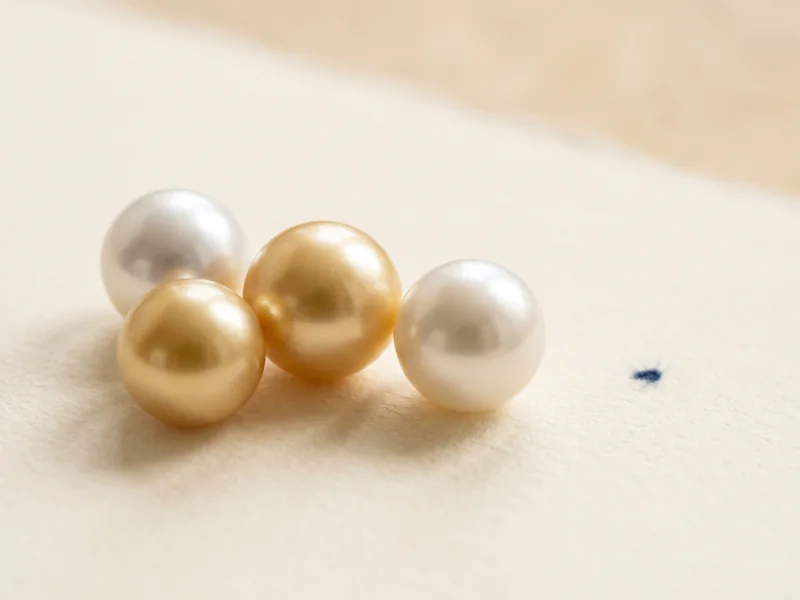
The white and golden pearls of the large silver-lipped and gold-lipped oyster are covered in our white and golden South Sea pearl guide, and the Australian side of the story, from Broome's history to its strict farming rules, is in our page on Australian pearls from Broome. A Broome pearl and a Tahitian overlap in size, though Broome pearls often run larger, and both have thick nacre; the most obvious difference is colour.
Related guideBroome South Sea Pearls (Australian)If you want a smaller, very round, bright white pearl, look at classic Akoya pearls. For a softer budget and pastel colours, freshwater pearls are the usual choice. A black Akoya or freshwater pearl can look similar to a Tahitian at a glance, but its colour is almost always dyed, so check the description and, for a significant purchase, ask for a lab report.
How much are Tahitian pearls worth in Australia?
Tahitian pearl prices vary widely, because each factor stacks on the others. A round, high-lustre 12 mm peacock pearl can cost many times more than a 10 mm circlé pearl in grey. The main value drivers, roughly in order:
- Shape: round and near-round cost the most; baroque and circlé the least.
- Lustre and surface: a clean, high-lustre pearl can cost several times more than a dull one of the same size.
- Size: price climbs steeply above 11–12 mm.
- Colour: peacock and vivid overtones attract a premium.
- Matching: a strand of evenly matched round pearls takes a long time to assemble, which adds cost.
| Piece | Approximate price range (AUD) |
|---|---|
| Pair of 9–10 mm studs, good quality | about $300–$1,200 |
| Single 10–12 mm pendant pearl | about $250–$1,500 |
| Strand, 9–11 mm, baroque or circlé | about $1,000–$3,000 |
| Strand, 9–11 mm, round, high quality | about $3,000–$10,000 |
| Strand, 12–14 mm, round, top quality | about $10,000–$30,000+ |
These are broad guides only, and they include setting or clasp costs that vary with the metal. Like any jewellery, Tahitian pearls should be bought because you love wearing them, not as a way to make money. For a significant strand, a report from a recognised gem lab can confirm that the pearls are cultured, naturally coloured and have sound nacre.
Browse natural gemstones and pearls
Which jewellery suits a Tahitian pearl?
Because Tahitians come in larger sizes and interesting shapes, they work in more styles than most pearls:
- Studs: 9–11 mm is the most popular range; pearls are drilled part-way and glued onto a post.
- Pendants: a single drop or round pearl on a bail, or held in a cap. See our guide to pendant and solitaire necklace settings for the options.
- Strands: knotted on silk so pearls do not rub, with a secure clasp.
- Rings: a pearl on a peg setting suits occasional wear. For daily rings, a bezel or a raised cup gives more protection; a bold pearl ring can borrow the chunky lines of a traditional signet ring.
- Mixed strands: Tahitian pearls alternated with white South Sea or golden pearls.
Metal choice changes the look: white gold and platinum bring out the silver and green tones, while yellow and rose gold warm aubergine and peacock pearls. Baroque Tahitians often suit a custom design that works around their shape rather than hiding it.
How do you care for Tahitian pearls?
Thick nacre makes Tahitian pearls durable for a pearl, but they are still soft and sensitive to acids, perfume and sweat. A few habits keep the lustre for decades:
- Last on, first off: put pearls on after make-up, perfume and hairspray, and take them off before exercise, swimming or cleaning.
- Wipe after wearing: use a soft, slightly damp cloth to remove skin oils, then let them dry flat.
- Store separately: in a soft pouch or lined box, away from diamonds and other hard gems that can scratch them.
- Never hang wet strands: wet silk stretches and can weaken.
- Avoid ultrasonic and steam cleaners: they can damage nacre and loosen drill holes.
- Restring regularly: every one to two years if you wear a strand often, or sooner if the silk looks grey or there are gaps between knots.
GemTrove restrings pearls in-house, knotting each pearl on new silk. Our page on pearl care and restringing explains what happens during a restring and how to tell when a strand is due.
How to choose Tahitian pearls: step by step
- Decide on the piece. Studs, pendant, strand or ring; this sets the size and shape you need.
- Pick a colour family. Look at silver-grey, green, peacock and aubergine side by side against your skin.
- Judge the lustre first. Look for sharp, clear reflections rather than a soft glow.
- Check the surface. Note where any spots sit and whether a setting will hide them.
- Choose the shape for the budget. Round costs most; drop, baroque and circlé give more size for the money.
- Confirm the description. Check that the pearls are cultured Tahitian, naturally coloured or with any treatment disclosed, and ask about a lab report for a significant strand.
- Check the finishing. For strands, look for even knots and a secure clasp; for studs, a firmly glued post.
Free consultation
Talk to a gemologist
Compare stones in person or online with Raj Sood, Graduate Gemologist (GIA), AJP (GIA).
Book a consultationShop this shape
FAQ
Common questions
Are Tahitian pearls real?
Yes. Tahitian pearls are real cultured pearls grown in the black-lipped pearl oyster. Cultured means a farmer started the process with a bead nucleus, but the nacre is produced by the oyster, just as in a natural pearl.
Are Tahitian pearls dyed?
Their dark colour is natural, coming from the oyster's own pigments. A small number are treated to change or even out the colour, which should be disclosed; black Akoya and freshwater pearls, by contrast, are usually dyed.
What is the most valuable Tahitian pearl colour?
Peacock, a dark green-gold body with a rose or purple overtone, usually commands the highest price. Strong lustre and a vivid overtone matter more than how dark the pearl is.
What is the difference between Tahitian and South Sea pearls?
Both grow in large Pinctada oysters and have thick nacre, but South Sea pearls from the silver-lipped or gold-lipped oyster are white, silver or golden. Tahitian pearls from the black-lipped oyster are naturally dark.
Can you wear Tahitian pearls every day?
Yes, with care. Studs and pendants handle daily wear well; keep pearls away from perfume, chlorine and knocks, and take rings off for manual work.
How often should a Tahitian pearl necklace be restrung?
Every one to two years if worn often, or whenever the silk looks discoloured or stretched. A strand worn only occasionally can go longer, but have it checked.

Ask a gemologist
Not sure which diamond to choose?
Raj Sood is a Graduate Gemologist (GIA) and master jeweller. Bring the stones you are considering, or send the reports, and he will tell you honestly which one is better and why.
Keep learning
Related guides
 PearlsTypes of Pearls and Pearl Identification GuidePearlsPearl Grading: Lustre, Nacre, Surface, Shape, Size
 PearlsSouth Sea Pearls (White and Golden)PearlsPearl Care and Restringing
 PearlsPearl Jewellery, Pearl Strands and Custom Pearl DesignsPearlsMabe Pearls
 PearlsKeshi PearlsPearlsFreshwater Pearls
Explore more
More guides on this topic
Education