
Pearls
Pearl Grading Guide: Lustre, Nacre, Surface, Shape, Size and Colour
Pearl grading has no single world standard, so two strands sold as AAA can look very different. Knowing how each quality factor is judged lets you compare pearls on what you can actually see.
 Reviewed by Raj Sood, Graduate Gemologist (GIA), AJP (GIA)Master jeweller and Graduate Gemologist (GIA) · reviewed 4 November 2026
Quick answer
Pearl grading judges seven value factors: lustre, nacre thickness, surface, shape, size, colour and, for strands, matching. Lustre and nacre matter most, because they decide how bright a pearl looks and how long it lasts. Sellers use AAA–A or A–D scales, but there is no single universal standard, so judge each factor yourself.
What is pearl grading?
Pearl grading is the way jewellers and gem labs describe how good a pearl is. Diamonds have one widely used scale for colour and clarity. Pearls do not. GIA (the Gemological Institute of America) uses seven value factors: size, shape, colour, lustre, surface, nacre quality and matching. Many sellers then compress those into a simple letter grade, such as AAA–A or A–D. Grading quality is a separate question from origin; whether a pearl formed by chance or with human help is covered in our guide to whether a pearl is natural or cultured.
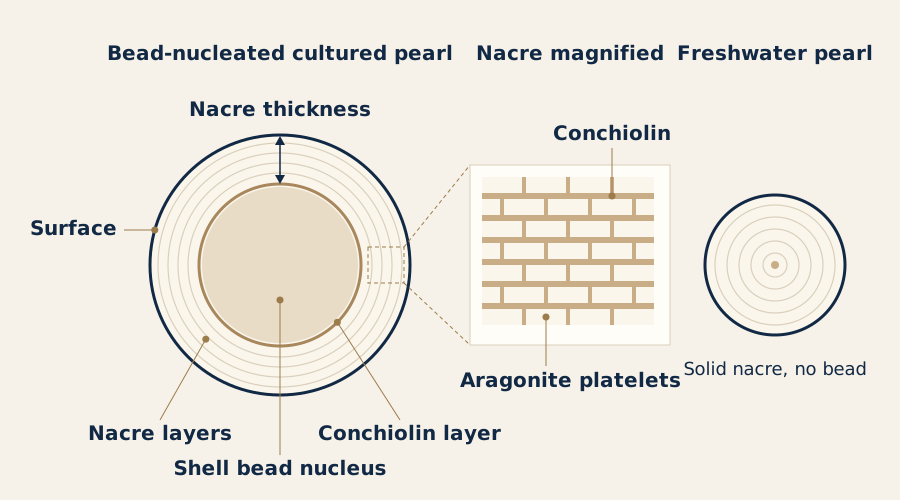
A pearl is built from nacre, the same iridescent material that lines the inside of the shell. Nacre is made of microscopic plates of aragonite (a crystal form of calcium carbonate) stacked like bricks and held together by conchiolin, a natural protein. Most cultured saltwater pearls grow around a bead nucleus, a polished sphere of shell placed inside the oyster with a small piece of mantle tissue. The oyster coats that bead in nacre over months or years.
Pearls are soft compared with gemstones: about 2.5–4.5 on the Mohs scale, against 9 for sapphire and 10 for diamond. Their refractive index is roughly 1.52–1.66. They are reasonably tough, though, because the layered structure resists breaking. That softness is why surface condition and care matter so much. To see how the main kinds of pearl differ before you grade them, start with the main pearl types and how to identify them, and look up any unfamiliar word in our glossary of jewellery terms.
What is pearl lustre and why does it matter most?
Lustre is the brightness and sharpness of light reflected from a pearl's surface and from just below it. Light passes through the thin, semi-transparent layers of nacre and bounces back from each one. When the layers are smooth, even and thick enough, those reflections combine into a crisp glow. Most gemmologists rank lustre as the single most important factor, because a high-lustre pearl looks alive even if it is small or slightly off-round.
| GIA lustre grade | What you see |
|---|---|
| Excellent | Reflections are bright and sharp; you can see a clear outline of a light source or window |
| Very good | Reflections are bright and near-sharp, slightly soft at the edges |
| Good | Reflections are bright but blurred |
| Fair | Reflections are weak and blurred |
| Poor | Reflections are dim and diffused; the pearl can look chalky |
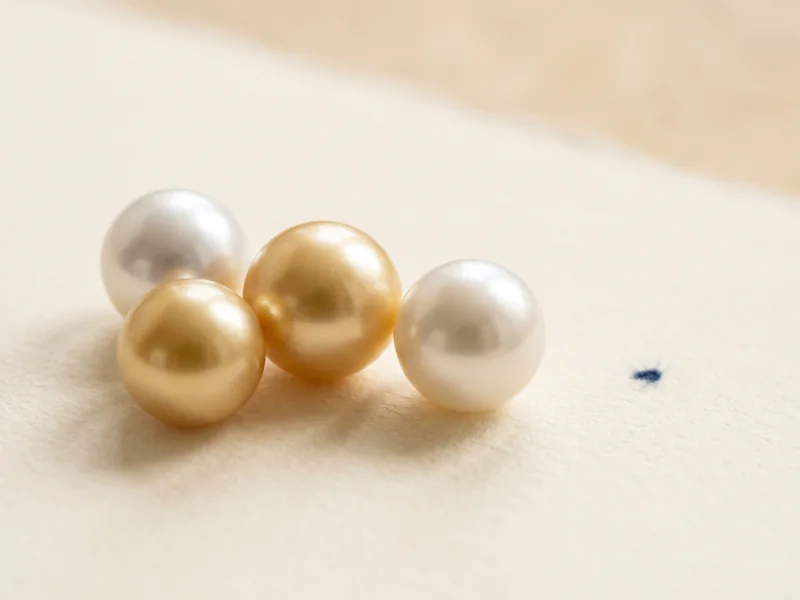
Lustre varies by type. Akoya pearls are known for a sharp, mirror-like lustre. Tahitian pearls range from metallic to soft. Large South Sea pearls often have a deeper, satiny glow rather than a hard mirror shine, which is how they are meant to look, not a fault. So compare lustre within the same type, not across types.
How thick should pearl nacre be?
Nacre thickness is the depth of nacre over the bead nucleus. It matters for two reasons. Thin nacre gives weaker lustre, and it can wear through, crack or peel with years of wear, exposing the dull bead underneath. GIA describes nacre on bead-nucleated pearls as acceptable (the nucleus is not visible), nucleus visible, or chalky. You usually cannot measure nacre in a set pearl without an X-ray, so lustre and a look down the drill hole are the practical clues.
| Pearl type | Mollusc | Usual nacre | Growth time |
|---|---|---|---|
| Akoya | Pinctada fucata (Akoya oyster) | about 0.3–0.7 mm per side | about 9–18 months |
| Tahitian | Pinctada margaritifera (black-lipped oyster) | about 0.8 mm minimum, often 1–2 mm | about 18–24 months |
| South Sea | Pinctada maxima (silver- or gold-lipped oyster) | about 2–6 mm | about 2 years |
| Freshwater (tissue-nucleated) | Hyriopsis mussels | Solid nacre throughout | about 1–6 years |
That table explains a lot about value. Classic Akoya pearls from Japan and China have the thinnest coats, so their lustre depends heavily on how long they stayed in the oyster. Dark Tahitian pearls from French Polynesia carry thicker nacre, and white and golden South Sea pearls carry the thickest of all, which is part of why they last for generations. Most solid-nacre freshwater pearls have no bead at all, so nacre thickness is not a concern, though newer bead-nucleated freshwater pearls do need checking.
How is pearl surface quality graded?
Almost every pearl has some surface marks, because it grows inside a living animal. Surface grading looks at how many blemishes there are, how large and deep they are, and where they sit. A mark near the drill hole can be hidden by the clasp or the next pearl; a mark on the face of a pendant pearl cannot. Common blemishes include:
- Spots: small dark or light patches in the nacre.
- Pits and pin-pricks: tiny holes or dents on the surface.
- Bumps and blisters: small raised areas.
- Wrinkles: fine ripples, often from uneven nacre growth.
- Circles: grooves or rings around the pearl, common in Tahitian and South Sea pearls.
- Flat spots, chips and cracks: more serious, because they can affect durability.
| GIA surface grade | What it means |
|---|---|
| Clean | No blemishes, or only minute ones that are very hard to see |
| Lightly spotted | Minor blemishes visible on close inspection |
| Moderately spotted | Noticeable blemishes |
| Heavily spotted | Obvious blemishes that can affect durability |
For pearl surface quality, look with your eye at normal distance first, then closer. Light, scattered marks on a strand are normal and rarely noticed once worn. Cracks near the drill hole, deep pits or flaking nacre are worth avoiding at any price.
Not sure which one is right?
Send us the stones you are looking at and our gemologist will tell you which to choose and why.
What pearl shapes are there, and which are most valuable?
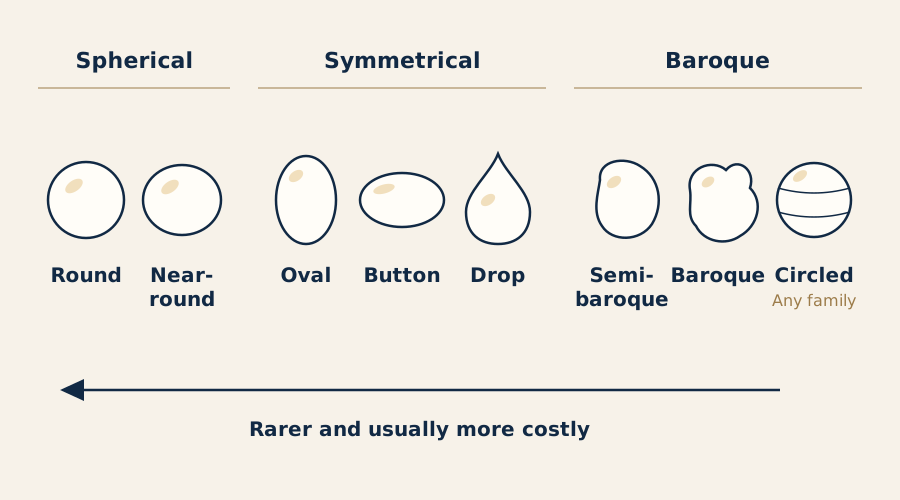
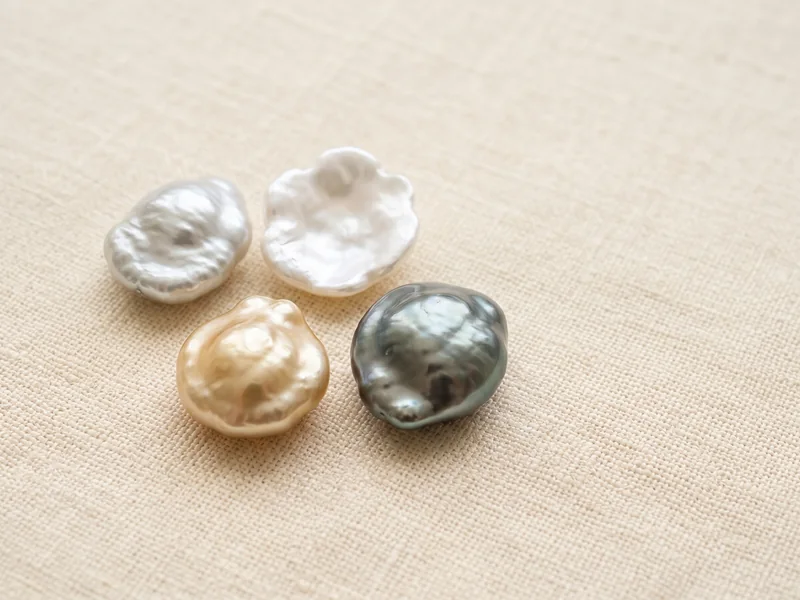
GIA groups pearl shapes into three families: spherical (round and near-round), symmetrical (oval, button and drop, which are balanced on an axis) and baroque (irregular). Circled pearls, with rings around them, can fall into any family.
- Round: diameter varies by less than about 2–3%. The rarest and usually the most costly.
- Near-round: very slightly flattened or oval; often hard to tell from round once strung.
- Oval and button: button pearls are flattened, so they suit earrings where the back sits against a post.
- Drop: teardrop or pear shaped, popular for pendants and drop earrings.
- Semi-baroque and baroque: irregular, often with strong lustre and a very individual look.
Round is not automatically better for everyone. Baroque pearls often show higher lustre for their price and suit modern designs. Two shapes sit outside the usual scale altogether: keshi pearls, formed without a bead are solid nacre and usually irregular, and half-dome mabe pearls grown against the shell are flat-backed blisters, graded mainly on lustre, colour and surface.
How is pearl size measured? Pearl size chart in mm
Pearls are measured by diameter in millimetres, usually rounded to the nearest 0.5 mm. A strand is described by its range, such as 7.0–7.5 mm. Non-round pearls are given as length by width. Size is one of the strongest price drivers: as pearls get larger, the price rises much faster than the size, because big round pearls are far rarer.
| Pearl type | Typical size range | Most common in jewellery |
|---|---|---|
| Freshwater | about 2–15 mm | 6–9 mm |
| Akoya | about 2–10 mm | 6–8.5 mm |
| Tahitian | about 8–16 mm | 9–12 mm |
| South Sea | about 9–20 mm | 10–14 mm |
Loose pearls are sometimes sold by weight. The trade units are the pearl grain (0.05 g, or a quarter of a carat) and the momme (3.75 g), a Japanese unit still used for Akoya pearls. Because pearls are lighter than most gems, a pearl looks larger for its weight than a sapphire would; our page on why carat weight and size differ between gems explains density in more detail.
Strand length changes the look as much as pearl size. A choker is about 40 cm, a princess length about 45 cm, a matinee about 50–60 cm and an opera length about 70–90 cm. For pearl bracelets, measure the wrist first using our guide to measuring your wrist for a bracelet, then allow for the extra length that round beads take up.
How is pearl colour graded?
Pearl colour has up to three parts. Body colour is the main colour, such as white, cream, gold, grey or black. Overtone is a translucent colour that seems to float over the surface, such as rose, silver or green. Orient is a shimmer of rainbow colours seen on or just below the surface, most often in thick-nacred and baroque pearls. GIA describes pearl colour using hue, tone and saturation, the same idea explained in our guide to how hue, tone and saturation describe colour.
- Akoya: usually white or cream with rose or silver overtones.
- Freshwater: white, peach, pink, lavender and many dyed colours.
- Tahitian: grey to near-black, with green, aubergine or peacock overtones.
- South Sea: white and silver from silver-lipped oysters, cream to deep gold from gold-lipped oysters.
No single colour is the best. Value follows rarity and demand: a deep, even natural gold South Sea pearl or a peacock Tahitian costs more than a paler stone of the same size. Pearls can be bleached, dyed or irradiated to change colour, and those treatments should always be disclosed. Pearl is also a traditional birthstone, which our June birthstone guide to pearl, moonstone and alexandrite covers.
How do pearl grading systems compare: AAA, A–D and GIA?
Retail pearl quality grades are useful shorthand, but they are set by each seller, not by an independent lab. An AAA pearl grade from one company may match an AA from another. The table shows how the three common systems line up in general terms.
| AAA–A system | A–D system | GIA 7 value factors | |
|---|---|---|---|
| Used mainly for | Akoya and freshwater | Tahitian and South Sea | All pearl types, by labs |
| Top grade | AAA: very high lustre, about 95%+ of surface clean | A: very light marks over less than about 10% of the surface | Each factor described separately, such as Excellent lustre, Clean surface |
| Middle grade | AA: very good lustre, about 75% clean | B: marks over up to about 30%; C: up to about 60% | Very good to good |
| Lowest jewellery grade | A: lower lustre, more blemishes | D: marks over more than about 60% | Fair to poor, heavily spotted |
| Independent? | No, set by each seller | Based on old French Polynesian rules, now applied by sellers | Yes, a lab assessment |
For a strand, the seventh factor, matching, is graded too: how evenly the pearls match in size, shape, colour, lustre and surface, and how smoothly any graduation runs from centre to clasp. GIA grades matching from Excellent to Poor. A well-matched strand of AA pearls can look better than a poorly matched strand of AAA pearls. For south sea pearl grading in particular, ask for the size, lustre and surface description, not just the letter.
Related guideBroome South Sea Pearls (Australian)What drives pearl value and price in Australia?
The pearl value factors work together, but in rough order of price impact: type (which oyster grew it), size, shape, lustre and nacre, surface, colour, then matching. A natural pearl, formed without any human help, is rare and is priced on a completely different scale from cultured pearls. Almost all pearls sold today are cultured.
Australia has a strong place in this story. Australian South Sea pearls from Broome and the north-west coast come from the large Pinctada maxima oyster and are known for white and silver colours, thick nacre and big sizes. They usually sit at the upper end of cultured pearl prices.
| About 45 cm strand, good quality | Approximate price range (AUD) |
|---|---|
| Freshwater, 7–8 mm | about $200–$1,500 |
| Akoya, 7–7.5 mm | about $1,000–$5,000 |
| Tahitian, 9–11 mm | about $2,500–$10,000 |
| South Sea, 10–12 mm | about $5,000–$25,000 |
These are broad ranges only. A single pearl pendant or a pair of studs costs a fraction of a strand, and exceptional sizes, colours or matching go well beyond them. Imitation pearls, made from coated glass or shell, are much cheaper and should always be sold as imitations. Our pearl strands and custom pearl designs page shows the jewellery styles these grades go into.
Browse natural gemstones
How do you check pearl quality and care for pearls? Step by step
- Confirm the type and origin. Ask whether the pearls are Akoya, freshwater, Tahitian or South Sea, natural or cultured, and whether any treatment such as dyeing has been used.
- Check lustre first. Look for a sharp reflection of a light source; a soft, chalky look suggests thin nacre.
- Look down the drill hole. On a bead-nucleated pearl, a clear boundary close to the surface points to thin nacre.
- Roll the strand on a flat surface. Round pearls roll smoothly; wobbling shows off-round pearls, and uneven colour or lustre shows poor matching.
- Inspect the surface. Scattered light spots are normal; cracks, chips or peeling nacre are not.
- Check the size and length. Confirm the millimetre range and strand length, and that the knots are tight and even.
- Rub two pearls gently together. Real pearls usually feel slightly gritty; imitations tend to feel smooth.
Pearls need gentle care. Put them on last, after perfume, hairspray and make-up, and take them off first. Wipe them with a soft, slightly damp cloth after wearing, and store them flat in a soft pouch, away from harder gems that can scratch them. Avoid ultrasonic and steam cleaners, chlorine and acids such as vinegar. Silk thread stretches and soils over time, so a strand worn often usually needs restringing every year or two. Our guide to cleaning, storing and restringing pearls covers knotting, clasps and how to tell when a strand is due.
Free consultation
Talk to a gemologist
Compare stones in person or online with Raj Sood, Graduate Gemologist (GIA), AJP (GIA).
Book a consultationShop this shape
FAQ
Common questions
What is the most important factor in pearl grading?
Lustre is usually treated as the most important, because it decides how bright and lively a pearl looks. Nacre thickness is closely linked, since thin nacre gives weak lustre and wears faster.
What does an AAA pearl grade mean?
AAA is the top grade in a scale used mainly for Akoya and freshwater pearls, meaning very high lustre and a mostly clean surface. It is set by each seller, not by an independent lab, so AAA from two sellers may not match.
How can you tell if pearls are good quality?
Look for sharp reflections, an even surface without cracks, consistent colour and size along the strand, and pearls that roll smoothly. A chalky look or a visible bead line in the drill hole points to thin nacre.
Are Australian South Sea pearls graded differently?
They are judged on the same factors, but sellers often use an A–D scale and nacre is far thicker than in Akoya pearls. Size, roundness and a clean surface drive most of the price differences.
How often should pearls be restrung?
A strand worn often usually needs restringing every one to two years, or sooner if the knots look loose, stretched or dirty. Pearls worn only occasionally can go longer.
Do pearls come with grading certificates?
Some high-value pearls, especially natural pearls, come with lab reports from labs such as GIA. Most cultured pearls are graded by the seller, so ask how each factor was judged.
Terms in this guide

Ask a gemologist
Not sure which diamond to choose?
Raj Sood is a Graduate Gemologist (GIA) and master jeweller. Bring the stones you are considering, or send the reports, and he will tell you honestly which one is better and why.
Keep learning
Related guides
Explore more
More guides on this topic
Education