
Pearls
South Sea Pearls Guide: White and Golden Pearls, Size, Quality and Care
South Sea pearls are the largest cultured saltwater pearls, and Australia grows some of the finest white ones. Here is how to judge their size, colour, lustre and nacre, what they cost, and how to keep them in good condition for decades.
 Reviewed by Raj Sood, Graduate Gemologist (GIA), AJP (GIA)Master jeweller and Graduate Gemologist (GIA) · reviewed 4 November 2026
Quick answer
South Sea pearls are cultured saltwater pearls grown in the large Pinctada maxima oyster in Australia, Indonesia, the Philippines and Myanmar. They usually measure 9–20 mm, come in white, silver, cream and gold, and carry thick nacre of about 2 mm or more. Value depends on size, lustre, surface, shape, colour and matching.
What are South Sea pearls?
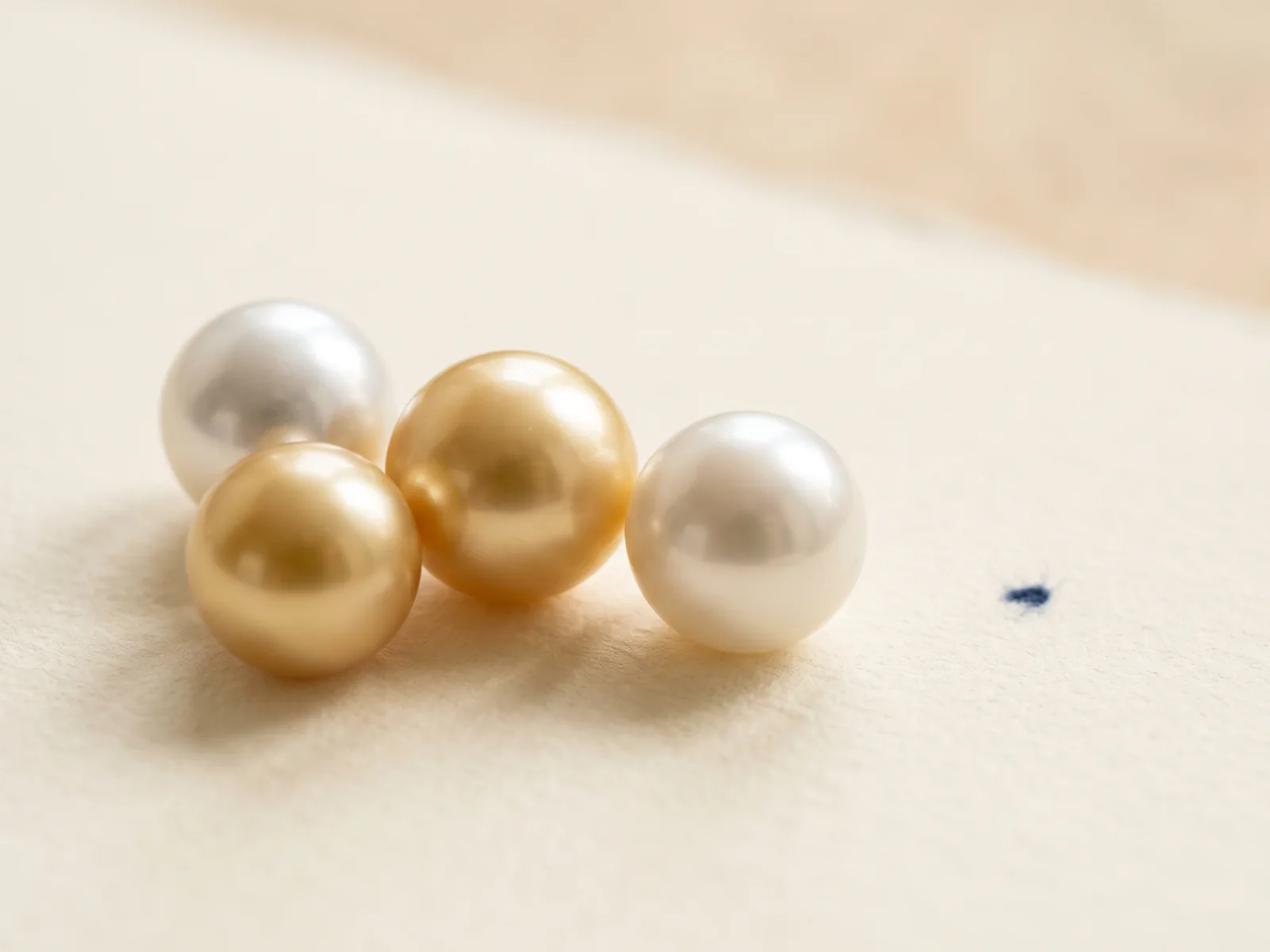
South Sea pearls are cultured pearls grown in the Pinctada maxima oyster, the largest pearl oyster in the world. A mature shell can measure around 25–30 cm across. Cultured means a person starts the process: a technician places a small round bead nucleus (usually cut from freshwater mussel shell) inside the oyster together with a piece of mantle tissue from a donor oyster. The oyster then coats that bead in layer after layer of nacre. The pearl itself is made entirely by the oyster; it is a real pearl, not an imitation.
Almost every South Sea pearl sold today is cultured. Natural pearls, which form with no human help at all, were once found in wild Pinctada maxima off northern Australia, but they are now extremely rare and sold mainly at auction. Our guide to how natural and cultured pearls differ explains how a lab tells them apart using X-ray imaging.
Nacre (say NAY-ker), also called mother-of-pearl, is what gives a pearl its glow. It is built from microscopic platelets of aragonite, a form of calcium carbonate, held together by an organic protein called conchiolin. Light bouncing between those thin layers creates lustre (the sharp, mirror-like shine on the surface) and sometimes orient (a soft rainbow shimmer just beneath it). Because South Sea oysters live in warm water and grow quickly, they lay down nacre fast, which is why these pearls are both large and thickly coated.
South Sea pearls sit alongside Akoya, Tahitian and freshwater pearls as the four main cultured types. If you want to see how they all fit together, start with our guide to every pearl type and how to identify it, and keep the plain-English jewellery glossary handy for any unfamiliar terms.
Where do South Sea pearls come from?
The name comes from the seas between northern Australia and South-East Asia. Pinctada maxima comes in two main colour varieties, and where a pearl is grown largely decides its colour:
- Australia: the north-west coast around Broome and the Kimberley, plus parts of the Northern Territory. Australian farms are known for large white and silver pearls from the silver-lipped oyster, and the industry has relied mainly on wild-caught oysters supplemented by hatchery stock.
- Indonesia: the largest producer by volume, growing both white and golden pearls, mostly from hatchery-raised oysters.
- The Philippines: known for golden pearls from the gold-lipped oyster. The Philippines named the South Sea pearl its national gem in 1996.
- Myanmar: a smaller producer of white and cream pearls from the Mergui Archipelago.
Culturing is slow. An oyster is usually nucleated, then left on lines in the sea for around two years while the nacre builds up. A healthy oyster may be re-nucleated two or three times, and later pearls are often larger because a bigger bead can be inserted into the pearl sac left by the first. Farmers clean and turn the shells regularly, and many oysters produce no saleable pearl at all.
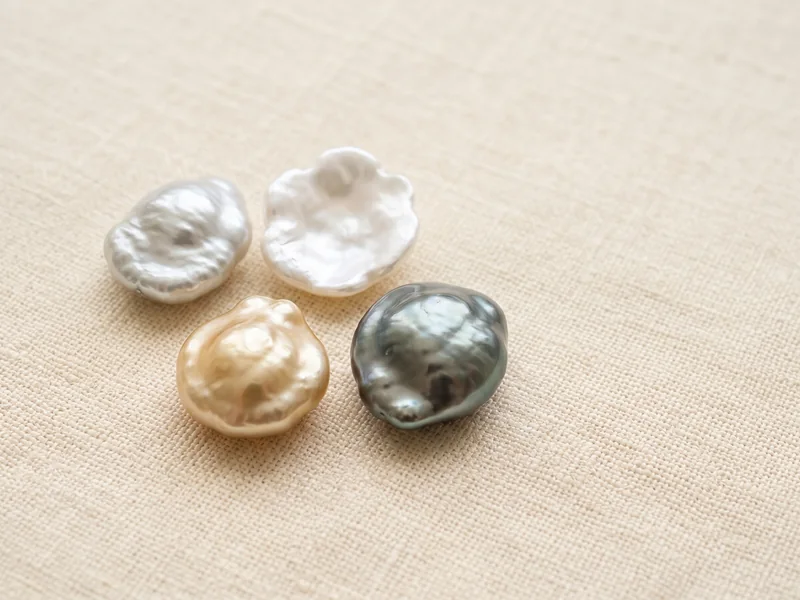
Not everything an oyster produces is a round, beaded pearl. When the oyster rejects the bead but keeps growing nacre, you get keshi pearls, the bead-free by-product, which are solid nacre with a very high lustre. Pearls grown deliberately against the inside of the shell become mabe or blister pearls, domed on one side and flat on the back. For the full history of pearling in Western Australia, read our page on Broome's Australian South Sea pearl story.
Related guideBroome South Sea Pearls (Australian)What colours are white and golden South Sea pearls?
Pearl colour has two parts: the body colour (the main colour you see) and the overtone (a translucent tint that seems to float over the surface, most visible in good light). South Sea pearls fall into three broad groups.
- White South Sea pearls: from pure white to silver-white, often with a pink, silver or occasionally blue-green overtone. White with a pink or silver overtone is the classic Australian look.
- Cream and champagne: a soft warm white between the two main groups. These usually cost less than pure whites or rich golds.
- Golden South Sea pearls: from light champagne through honey to deep gold. A deep, even, natural gold is the rarest and most prized, and costs noticeably more than a pale gold.
Treatments matter here. Some golden pearls on the market have been dyed or otherwise colour-enhanced to deepen a pale gold, and the colour can look slightly too even or sit in drill holes and surface pits. A reputable lab can check whether golden colour is natural, for example with UV-visible spectroscopy. White South Sea pearls are usually only cleaned and lightly polished after harvest; stronger bleaching is more common in Akoya and freshwater pearls. Either way, any treatment should be disclosed, so ask before you buy.
Which colour suits you is a personal call. White and silver tend to flatter cooler skin tones and sit well with platinum and white gold; golden pearls look warm against yellow gold and deeper skin tones. Pearl is also one of the traditional stones of the month of June, alongside moonstone and alexandrite, so see pearl as a June birthstone if you are buying for a birthday.
What size are South Sea pearls?
Size is the most obvious thing that sets South Sea pearls apart. Pearls are measured by diameter in millimetres, rounded to the nearest half millimetre, and a strand is described by its smallest and largest pearl (for example 10–12 mm). South Sea pearls usually start at about 9 mm, most sit between 10 and 15 mm, and a few exceptional pearls reach 18–20 mm. A typical classic Akoya strand, by comparison, is 6–8 mm.
| Diameter | How it looks | Common uses |
|---|---|---|
| 9–10 mm | Noticeable but still understated | Studs, petite strands, everyday pendants |
| 10–12 mm | The most common size, clearly substantial | Strands, pendants, rings |
| 12–14 mm | Bold, a statement piece | Single-pearl pendants, cocktail rings, graduated strands |
| 14–16 mm | Rare in round shapes with clean surfaces | Feature pendants and rings |
| 16 mm+ | Very rare, especially as matched pairs or strands | Collector pieces; prices rise steeply |
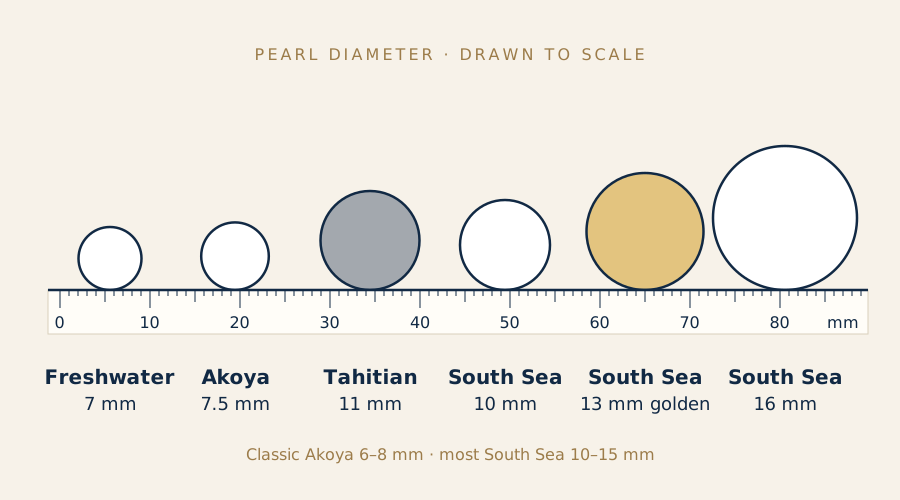
Price does not rise in a straight line with size. Each extra millimetre needs a bigger bead and a longer time in the water, and the chance of the pearl staying round and clean drops as it grows. So a 13 mm pearl can cost well over twice a 10 mm pearl of the same quality. Size also changes how a strand wears: a 45 cm strand of 12 mm pearls weighs noticeably more than one of 9 mm pearls, which is worth thinking about if you plan to wear it daily.
Not sure which one is right?
Send us the stones you are looking at and our gemologist will tell you which to choose and why.
How are South Sea pearls graded?
There is no single worldwide grading scale for pearls, which makes comparing them harder than comparing diamonds. Many sellers use A–AAA or A–D letter grades, but each company defines those letters a little differently. A more consistent approach is the set of seven value factors used by GIA: size, shape, colour, lustre, surface, nacre quality and matching. Here is how each applies to South Sea pearls.
| Factor | What to look for | What lowers value |
|---|---|---|
| Lustre | Sharp, bright reflections; you can see your face or a light clearly in the surface | Chalky or milky look, blurred reflections |
| Surface | Clean or lightly spotted, with marks only visible on close inspection | Pits, spots, wrinkles or rings you see at arm's length |
| Shape | Round or near-round; symmetrical drops and ovals also valued | Uneven, lumpy shapes (unless chosen as baroque) |
| Colour | Even body colour with an attractive overtone | Patchy colour, undisclosed dye |
| Nacre | Thick nacre, no bead visible through the surface | Thin spots, cracking, bead showing at drill holes |
| Size | Larger pearls of the same quality cost more | Undersized pearls for the quoted range |
| Matching | Pearls in a strand or pair alike in size, colour, lustre and shape | Visible mismatch along the strand |
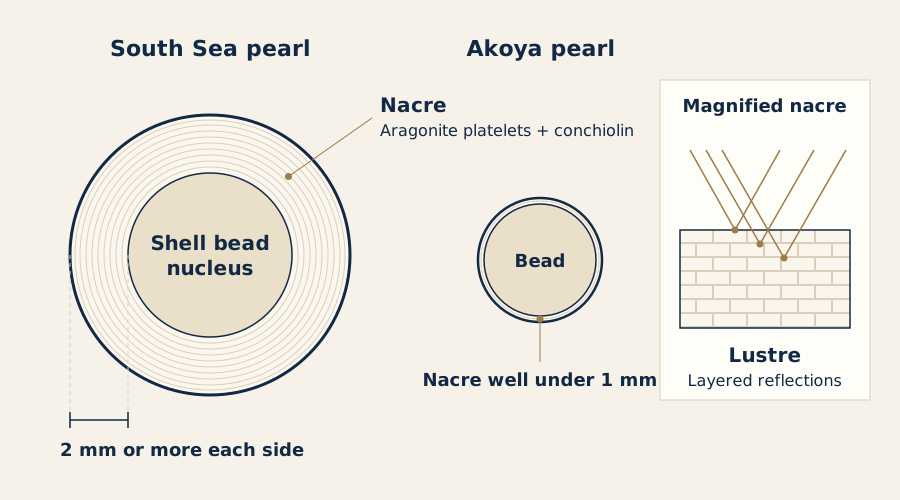
Lustre is the factor most gemmologists look at first, because it is what makes a pearl look alive. South Sea pearls have a softer, satiny lustre than Akoya pearls, thanks to the thicker aragonite platelets laid down in warm water, but a good one still shows crisp reflections.
Shape splits into round, near-round, oval, button (flattened), drop, circled (with rings around it), semi-baroque and baroque (freeform). Perfectly round South Sea pearls are a small share of any harvest, so baroque and circled pearls cost far less and are popular for modern, relaxed designs.
Nacre thickness is a strength of South Sea pearls. The nacre is commonly 2 mm or more on each side of the bead, compared with well under 1 mm for many Akoya pearls, which helps them resist wear. Our full pearl grading guide to lustre, nacre and surface covers each factor with examples.
How do South Sea pearls compare with Tahitian, Akoya and freshwater pearls?
Each of the four main cultured pearl types grows in a different mollusc, and that sets its size, colour and price range. This comparison gives the typical figures.
| South Sea | Tahitian | Akoya | Freshwater | |
|---|---|---|---|---|
| Mollusc | Pinctada maxima oyster | Pinctada margaritifera oyster | Pinctada fucata oyster | Freshwater mussels |
| Water | Salt | Salt | Salt | Fresh |
| Typical size | 9–20 mm | 8–16 mm | 6–9 mm | 4–12 mm (some larger) |
| Natural colours | White, silver, cream, gold | Grey, black, green, peacock, aubergine | White, cream, silver-blue | White, pink, peach, lavender |
| Nacre | Thick, often 2 mm+ | Moderate to thick | Thin | Usually solid nacre, no bead |
| Lustre | Soft, satiny | Metallic to satiny | Sharp, mirror-like | Softer, varies widely |
| Relative price | Highest | High | Mid | Lowest |
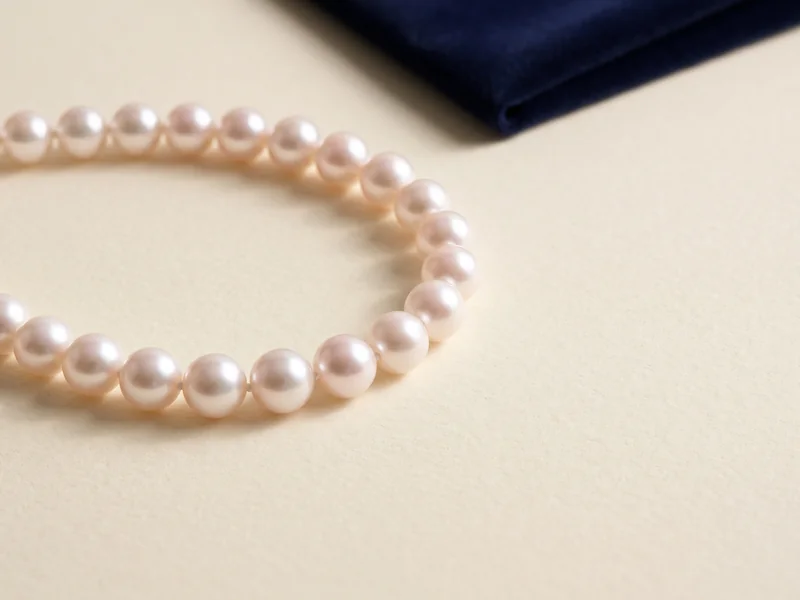
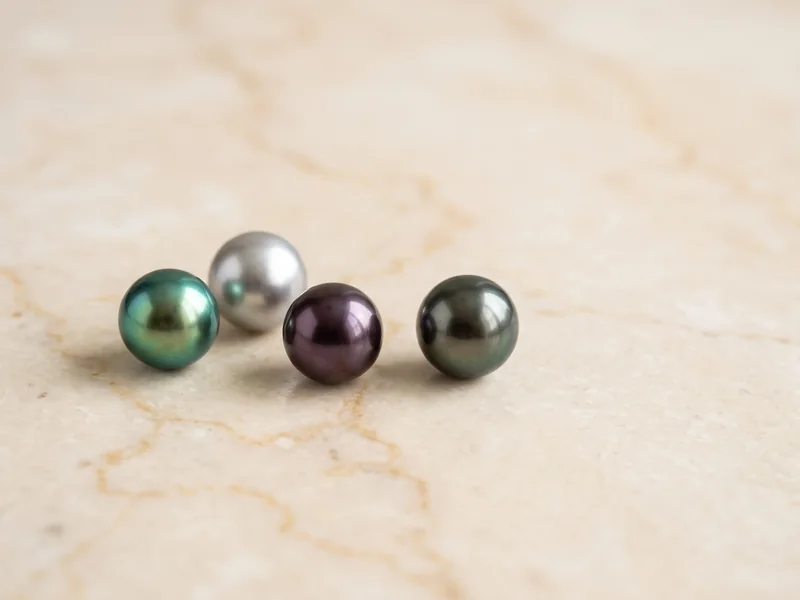
South Sea vs Tahitian pearls is the comparison people ask about most. Both are large and grown in warm Indo-Pacific waters, but Tahitian pearls from French Polynesia come naturally in dark shades, while South Sea pearls are light or golden. Size for size, a South Sea pearl usually costs more. Akoya pearls are smaller and brighter, the traditional choice for a classic white strand. Freshwater pearls from China are the most affordable and often solid nacre, but rarely match the size and lustre of a fine South Sea pearl.
Imitation pearls, made from coated glass or shell beads, are a different product altogether. They are not pearls grown by a mollusc and should always be sold as imitation. The quickest home check is to rub a pearl gently against the edge of a tooth: real pearls, cultured or natural, feel slightly gritty, while most imitations feel smooth.
How much do South Sea pearls cost in Australia?
South Sea pearls cover a wide price range, because size, shape and surface vary so much within a single harvest. The figures below are broad guides only for natural-colour pearls of good commercial quality; exceptional pearls cost much more, and prices move with each season's auctions.
| Piece | Approximate price range (AUD) |
|---|---|
| Pair of 10–11 mm white studs | about $600–$2,500 |
| Single 12–13 mm pendant pearl | about $800–$4,000 |
| 45 cm strand, 10–13 mm, round, white | about $5,000–$25,000 |
| 45 cm strand, baroque, 10–14 mm | about $1,500–$8,000 |
| Deep natural golden strand, 10–13 mm | about $6,000–$30,000 |
What moves the price most, in rough order: size, shape (round costs most), surface cleanliness, lustre, colour (a deep natural gold or a fine pink-overtone white costs more) and how well a strand is matched. A baroque strand with excellent lustre can be a more affordable way into South Sea pearls than a round strand with a dull finish, and many people prefer its character.
Please treat pearls as jewellery to wear and enjoy rather than as an investment. Resale prices for pearls are usually well below retail. For pieces we make, restring and design, see GemTrove's pearl jewellery and custom pearl designs.
Browse natural gemstones
What jewellery suits South Sea pearls?
Their size makes South Sea pearls easy to build a piece around. The common choices:
- Strands: a 42–45 cm princess length sits just below the collarbone and suits most necklines. Graduated strands, larger at the centre, are a traditional South Sea style.
- Pendants: a single 11–14 mm pearl on a fine chain, often with a small diamond or gemstone bail.
- Studs and drops: 9–12 mm is usually comfortable for daily wear; larger pairs suit drop earrings where the weight hangs below the lobe.
- Rings: pearls are soft, so a ring needs a protective design, such as a cup setting with a glued post plus a raised metal surround, and is better for occasional wear than for everyday knocks.
Pearls are usually set on a cup and peg: the pearl is half-drilled and glued onto a metal post. If you are adding accent stones, diamonds and white sapphire accents both sit well beside a white pearl; our lab-grown diamond versus white sapphire comparison helps you choose. For an Australian pairing in a custom piece, a white opal alongside a white South Sea pearl makes a soft, milky combination.
How do you care for South Sea pearls?
Pearls are organic gems with a hardness of only about 2.5–4.5 on the Mohs scale, so a steel file, sand or even other gemstones can scratch them. Nacre is also sensitive to acids, which slowly eat into the surface and dull the lustre. Thick South Sea nacre is forgiving, but the rules are the same for every pearl.
- Last on, first off: put pearls on after perfume, hairspray, sunscreen and make-up, and take them off before exercise or swimming.
- Wipe after wearing: a soft, slightly damp cloth removes skin oils and sweat, which are mildly acidic.
- Store flat and separately: keep them in a soft pouch away from harder jewellery, and never hang a strand, which stretches the silk.
- Never use ultrasonic or steam cleaners, household jewellery cleaners, vinegar or chlorinated water.
- Let them breathe: avoid sealing pearls in plastic for long periods, and do not leave them in very hot or very dry places.
Strands are threaded on silk with a small knot between each pearl, so if the thread breaks you lose at most one pearl. Silk stretches and weakens with wear. If you wear a strand most weeks, have it restrung about every one to two years, or sooner if you see gaps between the knots, fraying, or thread that looks grey near the clasp. We restring pearls in our own Melbourne workshop, knotting by hand between each pearl. Our pearl care and restringing guide explains the process and the signs a strand is due.
How to choose South Sea pearls, step by step
- Decide on colour first. White, silver, cream or golden; this narrows everything else.
- Set the size. Check the millimetre range, not just the description; 10–12 mm suits most people for everyday wear.
- Choose a shape. Round costs most; near-round, drop and baroque give more size and lustre for the money.
- Judge lustre in daylight. Look for crisp reflections and a glow that comes from inside the pearl.
- Check the surface. Small marks are normal; look for pits or rings visible at arm's length, especially near drill holes.
- Ask about treatment. For golden pearls, ask whether the colour is natural and whether a lab report is available.
- Check the strand and clasp. Pearls should be evenly matched, knotted on silk, with a secure clasp.
Free consultation
Talk to a gemologist
Compare stones in person or online with Raj Sood, Graduate Gemologist (GIA), AJP (GIA).
Book a consultationShop this shape
FAQ
Common questions
Are South Sea pearls real pearls?
Yes. They are cultured pearls, meaning a person places a bead inside the oyster, but the oyster grows all of the nacre itself. They are real pearls, not imitations.
Why are South Sea pearls so expensive?
Pinctada maxima oysters are large, slow to farm and produce only one pearl at a time over about two years. Many oysters yield no saleable pearl, and large, round, clean pearls are a small share of each harvest.
Are golden South Sea pearls natural colour?
Many are, coming from the gold-lipped variety of the oyster, mainly in Indonesia and the Philippines. Some pale golden pearls are dyed to look deeper, so ask whether the colour is natural and whether a lab has tested it.
What is the difference between South Sea and Tahitian pearls?
Both are large saltwater cultured pearls, but they grow in different oysters. South Sea pearls are white, silver, cream or golden, while Tahitian pearls are naturally dark grey, green or peacock, and South Sea pearls usually cost more size for size.
How often should a South Sea pearl strand be restrung?
About every one to two years if you wear it regularly, or sooner if the knots have gaps or the silk looks frayed or discoloured. A strand worn only occasionally can go longer.
Can you wear South Sea pearls every day?
Studs and pendants can be worn daily if you follow the last on, first off rule and wipe them after wearing. Rings take more knocks, so they are better suited to occasional wear.
Terms in this guide

Ask a gemologist
Not sure which diamond to choose?
Raj Sood is a Graduate Gemologist (GIA) and master jeweller. Bring the stones you are considering, or send the reports, and he will tell you honestly which one is better and why.
Keep learning
Related guides
Explore more
More guides on this topic
Education