
Gemstones
June Birthstone Guide: Pearl, Moonstone and Alexandrite
June is one of the few months with three birthstones, and they could hardly be more different. Here is how each June birthstone compares on history, colour and durability, and how to choose one for a ring you will actually wear.
 Reviewed by Raj Sood, Graduate Gemologist (GIA), AJP (GIA)Master jeweller and Graduate Gemologist (GIA) · reviewed 4 November 2026
Quick answer
June has three birthstones: pearl, moonstone and alexandrite. Pearl is the traditional choice, moonstone shows a soft floating blue-white glow, and alexandrite changes from green in daylight to red under warm light. For an everyday ring, alexandrite (8.5 on the Mohs scale) is the most durable; pearl (2.5–4.5) and moonstone (6–6.5) need protective settings and gentler wear.
What is the June birthstone?
The June birthstone is a choice of three gems: pearl, moonstone and alexandrite. No other month gives you such a range. One is organic and grown inside a mollusc, one is a feldspar mineral with a soft inner glow, and one is a rare variety of chrysoberyl that changes colour depending on the light. If you are planning a gift or a ring, our page on birthstone jewellery designed and made in Melbourne shows how each month's stones are typically used.
Because the three are so different, the right one depends less on tradition and more on how the piece will be worn. A pearl suits earrings, pendants and occasional rings. Moonstone suits pendants, earrings and carefully set rings. Alexandrite is hard and tough enough for a ring you wear every day. You can compare them with the other months in our overview of coloured gemstones and birthstones by month.
Throughout this guide we use the Mohs scale, a 1 to 10 ranking of scratch resistance where talc is 1 and diamond is 10. Everyday dust contains quartz at about 7, so anything softer than 7 slowly loses its polish with daily wear. We also talk about toughness (resistance to chipping and breaking) and cleavage (a tendency to split along flat planes in the crystal). Any other unfamiliar word is explained in our plain-English jewellery glossary.
Why does June have three birthstones?
Birthstone lists have changed over time. Older traditions linked gems to months through religious and folk sources, and different countries kept different lists. The modern list most Australian jewellers follow comes from the United States: in 1912 the American national association of jewellers published a standard list that gave June both pearl and moonstone. In 1952 a US jewellery industry council revised the list and added alexandrite as a further June option.
Each stone brings its own history and traditional meaning:
- Pearl: prized for thousands of years, long before cutting tools could polish hard gems. Until cultured pearls became common in the early 20th century, natural pearls were among the most valuable jewels in the world. Traditionally associated with purity and calm.
- Moonstone: named for its moonlight-like sheen and traditionally associated with the moon, intuition and travel. It was popular in Art Nouveau jewellery around 1900.
- Alexandrite: discovered in the Ural Mountains of Russia in the 1830s and named after the future Tsar Alexander II. Its green and red echoed the colours of the Imperial Russian military, which helped make it a national gem.
So the June birthstone meaning is really three meanings. Most people pick by look and wearability first, and enjoy the story second.
What is the pearl birthstone, and which type of pearl suits you?
A pearl forms when a mollusc coats an irritant, or an implanted nucleus, with layer after layer of nacre: microscopic platelets of aragonite (a form of calcium carbonate) held together by an organic protein called conchiolin. Light reflecting off those thin overlapping layers produces lustre, the sharp, mirror-like glow that is the single most important quality in a pearl. Pearl has a hardness of only 2.5–4.5 on the Mohs scale and a specific gravity of about 2.60–2.85.
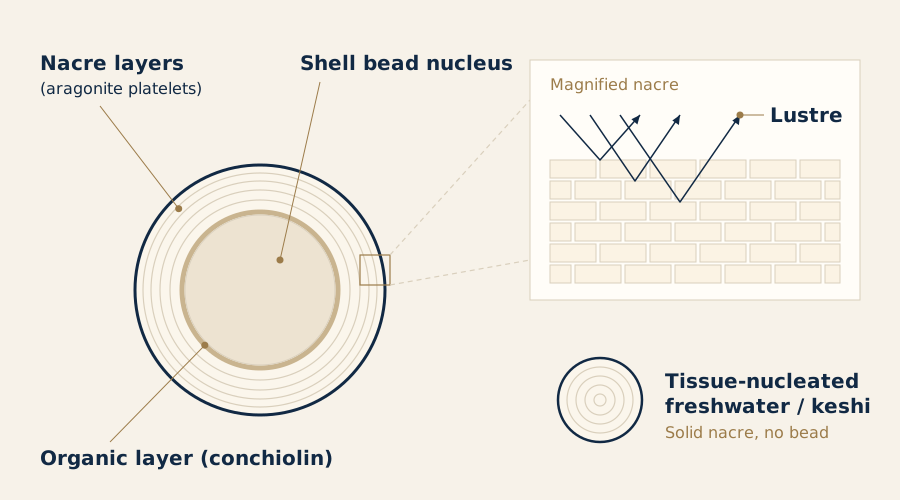
Natural pearls, formed with no human help, are now very rare and mostly seen in antique pieces. Almost every pearl sold today is cultured: a farmer places a nucleus (usually a polished bead of freshwater mussel shell) and a small piece of mantle tissue inside the mollusc, which then builds nacre around it. Cultured pearls are real pearls, made of the same nacre, and should be described as cultured.
| Pearl type | Mollusc and main sources | Typical size | Typical colours |
|---|---|---|---|
| Freshwater | Mussels (mainly Hyriopsis), China | 4–12 mm | White, pink, peach, lavender; dyed colours |
| Akoya | Pinctada fucata oysters, Japan and China | 6–9 mm | White and cream with rose or silver overtones |
| South Sea | Pinctada maxima oysters, Australia, Indonesia, Philippines | 10–20 mm | White, silver, cream (Australia); gold (Indonesia, Philippines) |
| Tahitian | Pinctada margaritifera oysters, French Polynesia | 8–16 mm | Grey, black, green, peacock, aubergine |
| Mabe | Grown against the inside of the shell | 10–20 mm | Varies by oyster; half-dome shape |
| Keshi | By-product of culturing, no nucleus | 2–10 mm | Varies; irregular shapes, all nacre |
Each type has its own guide. Start with our freshwater pearl guide for the most affordable option, or the classic round Akoya pearls used in traditional strands. For darker colours see our page on naturally dark Tahitian pearls; for flat-backed pearls that sit low in rings and earrings, read about half-dome mabe pearls; and for irregular, high-lustre shapes, see all-nacre keshi pearls. If you have a pearl and are not sure what it is, our guide to telling pearl types apart walks through the clues.
Australian South Sea pearls are Australia's real contribution to June. They are farmed mainly along the Western Australian coast around Broome and the Kimberley, and in the Northern Territory, using the large silver-lipped Pinctada maxima oyster. Each pearl typically takes around two years or more to grow, which is why they reach 10–20 mm and carry thick nacre. Their usual colours are white, silver and cream.
Imitation pearls (glass or shell beads with a pearly coating) are common. A quick home check is to rub the pearl gently against the edge of your front tooth: real nacre feels slightly gritty, while most imitations feel smooth. A gemmologist can confirm with magnification, and X-ray testing separates natural from cultured.
What is moonstone and why does it glow?
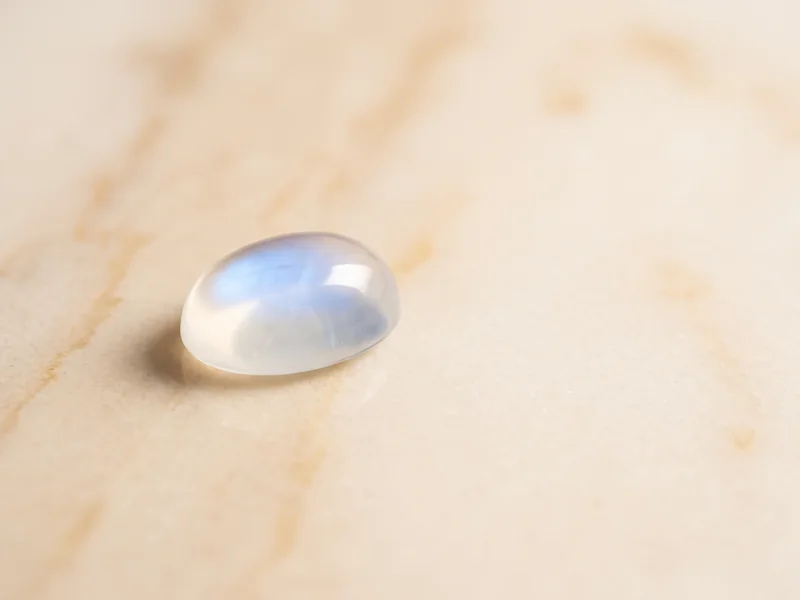
Moonstone is a feldspar, usually orthoclase or adularia (potassium feldspar). As the crystal cools, it separates into extremely thin alternating layers of two feldspars. Light entering the stone scatters between those layers, creating a soft, floating sheen called adularescence. The thinner the layers, the bluer the sheen; thicker layers give a whiter, milkier glow. Our full moonstone guide covering colours and quality goes deeper on grading.
Moonstone has a hardness of 6–6.5 on the Mohs scale, a refractive index of about 1.518–1.526 and a specific gravity of about 2.56–2.59. It is almost always cut as a cabochon (a smooth, domed stone with no facets). A well-cut moonstone has a high enough dome, and is oriented correctly, so the sheen sits in the centre and rolls across the stone as you tilt it.
- Body colours: colourless, white, grey, peach, champagne and brownish tones.
- Blue moonstone: a near-transparent stone with an electric blue sheen. Historically the finest came from Sri Lanka, and good blue sheen in larger sizes is scarce.
- Rainbow moonstone: a trade name for a white labradorite (a different feldspar) that flashes blue and other colours. It is attractive and widely sold, but technically not the same mineral as classic moonstone.
- Cat's-eye and star moonstone: rarer stones showing a single band of light or a star.
Main sources include Sri Lanka, India, Myanmar and Madagascar. Australia is not a significant commercial source of gem moonstone. The weakness to know about is cleavage: moonstone splits easily along two directions, so a sharp knock on a door frame or a dropped ring onto tiles can crack it even though it resists scratching reasonably well.
Not sure which one is right?
Send us the stones you are looking at and our gemologist will tell you which to choose and why.
Is alexandrite the June birthstone, and how does it change colour?
Yes. Alexandrite has been an official June birthstone since 1952, and it is the choice most people make for a June birthstone ring they want to wear daily. It is a rare colour-change variety of chrysoberyl (beryllium aluminium oxide, BeAl2O4), coloured by traces of chromium. It is 8.5 on the Mohs scale, has excellent toughness and a refractive index of about 1.746–1.755.
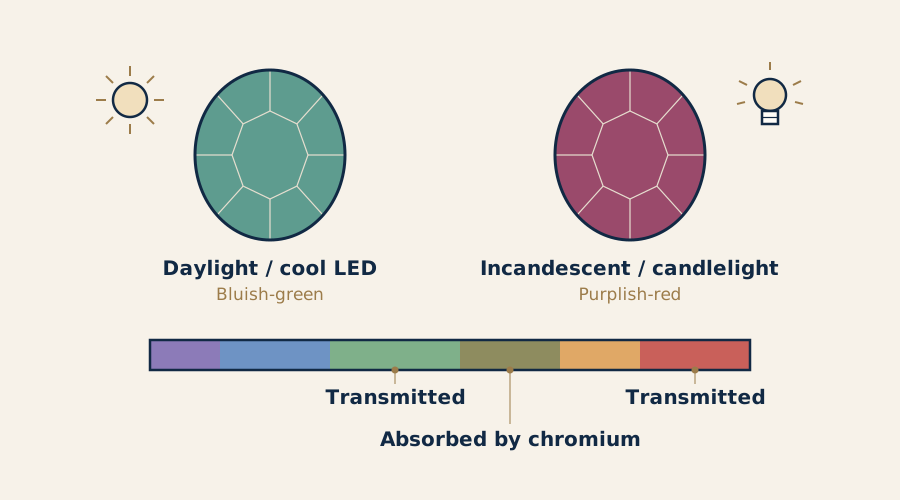
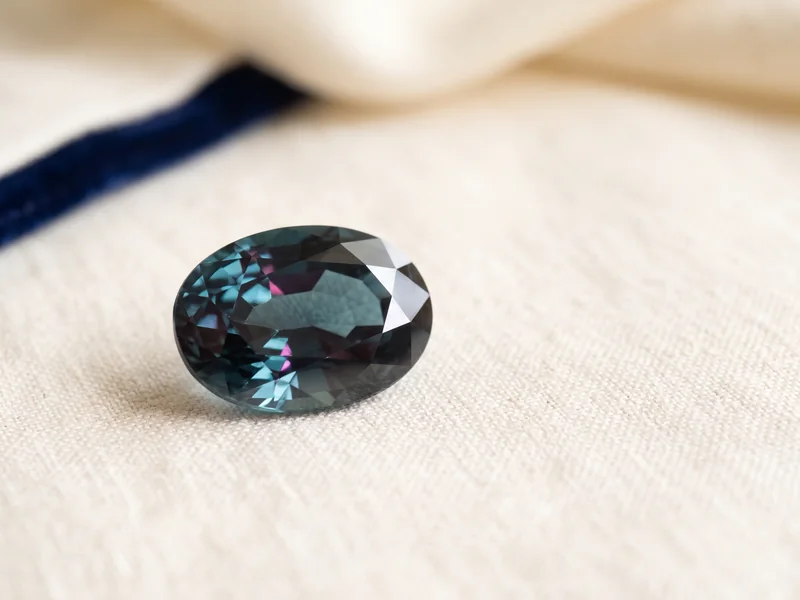
The colour change happens because chromium absorbs yellow light and some blue, leaving the stone transmitting green and red in nearly equal amounts. Daylight and cool LEDs are richer in blue-green, so the stone looks green or bluish-green. Candlelight and warm incandescent globes are richer in red, so it looks red or purplish-red. Alexandrite is also strongly pleochroic, meaning it shows different colours (green, orange-yellow and red) when viewed along different crystal directions. Our page on why alexandrite changes colour under different light explains how to judge the strength of the change.
Value depends heavily on how strong and clean the change is. A stone that moves from a pure green to a clear red is far rarer than one that shifts from brownish-green to brownish-pink. The original Russian deposits are largely worked out; most natural alexandrite today comes from Sri Lanka, Brazil, East Africa (including Tanzania) and India. Australia is not a significant source. Fine natural stones over 1 carat are rare, and most natural alexandrite in jewellery is under half a carat.
Lab-created alexandrite (also called synthetic alexandrite) has been grown since the 1970s. It is real chrysoberyl with the same hardness, toughness and colour change, often with a stronger, cleaner shift than mined stones, at a small fraction of the price. It must always be sold as lab-created. Be wary of imitations: synthetic colour-change corundum and spinel are sometimes sold loosely as alexandrite, but they are different materials and should be described accurately on any report or invoice.
Related guideAlexandrite Engagement RingsWhich June birthstone is most durable for an everyday ring?
Scratch hardness is only part of the story. For a ring, which takes knocks every day, you also need toughness, stability against heat and chemicals, and no strong cleavage. Here is how the three June stones compare, with sapphire and diamond for reference.
| Stone | Mohs hardness | Toughness | Cleavage | Chemicals and heat | Everyday ring? |
|---|---|---|---|---|---|
| Pearl | 2.5–4.5 | Fair to good | None | Damaged by acids, perfume, hairspray, sanitiser and heat; can dry out | Occasional wear only |
| Moonstone | 6–6.5 | Poor | Perfect, two directions | Generally stable; avoid sudden temperature change | With care, in a protective setting |
| Alexandrite | 8.5 | Excellent | Weak | Stable | Yes |
| Sapphire | 9 | Excellent | None | Stable | Yes |
| Diamond | 10 | Good | Perfect, four directions | Stable | Yes |
Alexandrite sits comfortably alongside sapphire, September's stone at 9 on the Mohs scale and diamond, the April birthstone as a genuine everyday ring gem. It is harder than quartz-family stones such as amethyst at 7 on the Mohs scale, so it keeps its polish and crisp facet edges for decades.
Pearl and moonstone can still be worn as rings, but expect to treat them more gently. A pearl worn daily will show scratches on its surface and can lose lustre where it touches skin products. Moonstone's cleavage means a hard knock can split it. For an engagement ring, our guide to choosing a birthstone for an engagement ring sets out which stones handle a lifetime of wear.
What is the best setting for a June birthstone ring?
The setting should match each stone's weak points. As a general guide:
- Pearl rings: a cup-and-peg setting, where the pearl is part-drilled and fixed onto a small metal post with adhesive, sitting in a shallow cup. A raised, protective design with metal or small diamonds around the pearl reduces knocks. Mabe pearls sit low and flat, which makes them more practical for rings.
- Moonstone rings: a full bezel (a continuous rim of metal around the edge) is the most protective choice for a cabochon. A lower profile helps too. Claws can work for pendants and earrings, but they leave the edge exposed on a ring.
- Alexandrite rings: four or six claws, a bezel, a halo or a three-stone design all work. Small natural alexandrites are often paired with diamonds to frame the colour. Because the colour shifts with light, white metals keep the green crisp, while yellow and rose gold warm the red side.
- Earrings and pendants: the safest place for pearl and moonstone, since they rarely take knocks. Pearl studs and drops suit everyday wear far better than a pearl ring.
For alexandrite set as a centre stone, see our collection of alexandrite engagement ring designs and settings. With all three stones, think about the wedding band too: a fitted or contoured band stops the stones rubbing against each other.
How much do June birthstones cost in Australia?
The three June birthstones span an enormous price range, from very affordable freshwater pearls and moonstone to fine natural alexandrite, which is among the most costly coloured gems per carat. These are broad approximate ranges only; prices change with the market and the exact quality.
| June stone | Typical example | Approximate price range (AUD) |
|---|---|---|
| Freshwater pearl | Strand, 7–8 mm, good lustre | about $150–$800 |
| Akoya pearl | Strand, 7–7.5 mm | about $1,000–$5,000 |
| Australian South Sea pearl | Single pearl, 10–12 mm, white | about $300–$2,000 |
| Moonstone | Per carat, commercial to fine blue sheen | about $10–$300 per carat |
| Lab-created alexandrite | About 1 ct, faceted | about $100–$600 |
| Natural alexandrite | Per carat, about 1 ct, strong colour change | about $8,000–$30,000+ per carat |
For pearls, price follows size, lustre, surface cleanliness, shape, colour, nacre quality and, for strands, how well the pearls match. For moonstone, it follows the strength and colour of the sheen and the transparency of the body. For alexandrite, the strength of the colour change outweighs almost everything else, followed by size and clarity. Ask for an independent report on any significant natural alexandrite; it should state the colour change and whether the stone is natural or lab-created.
Browse natural gemstones
How do you choose and care for a June birthstone ring? Step by step
- Decide how often you will wear it. Daily on the hand points to alexandrite; occasional wear opens up pearl and moonstone.
- Pick the stone by colour. Pearl for white, cream, silver or dark tones; moonstone for a soft glow; alexandrite for green-to-red change.
- Check natural or lab-created. For alexandrite, confirm on the invoice or report whether the stone is natural or lab-created, and that it is genuine chrysoberyl, not colour-change corundum or spinel.
- Judge the key quality. Lustre for pearls, a centred sheen for moonstone, and the colour in both daylight and warm light for alexandrite.
- Choose a protective setting. A bezel for moonstone, a raised protective design for pearl, claws or a bezel for alexandrite.
- Care for it properly. Put pearls on last, after perfume and cream, and wipe with a soft damp cloth. Clean moonstone and alexandrite in warm soapy water; never use an ultrasonic cleaner on pearl or moonstone.
- Have it checked. Ask a jeweller to check claws and bezels about once a year, and restring pearl strands every few years if worn often.
Free consultation
Talk to a gemologist
Compare stones in person or online with Raj Sood, Graduate Gemologist (GIA), AJP (GIA).
Book a consultationShop this shape
FAQ
Common questions
What is the June birthstone?
June has three birthstones: pearl, moonstone and alexandrite. Pearl and moonstone were listed in 1912, and alexandrite was added in 1952.
What colour is the June birthstone?
It depends on the stone. Pearls range from white and cream to grey and black, moonstone is colourless to peach with a blue-white sheen, and alexandrite changes from green in daylight to red under warm light.
Which June birthstone is best for an engagement ring?
Alexandrite is the most practical, at 8.5 on the Mohs scale with excellent toughness. Pearl and moonstone are soft or prone to cleavage, so they suit occasional wear or protective settings.
Is lab-created alexandrite real?
Yes. Lab-created alexandrite is real chrysoberyl with the same hardness and colour change as natural alexandrite, grown in a laboratory rather than mined. It costs a small fraction of the price and must always be disclosed as lab-created.
Can you wear a pearl ring every day?
You can, but it will wear faster than a hard gem. Pearls scratch easily and are damaged by perfume, sanitiser and cleaning products, so many people keep pearls for earrings and pendants.
Are Australian South Sea pearls a June birthstone?
Yes. Any genuine pearl counts as the June birthstone, and Australian South Sea pearls from the Broome and Kimberley region are among the largest cultured pearls, typically 10–20 mm.

Ask a gemologist
Not sure which diamond to choose?
Raj Sood is a Graduate Gemologist (GIA) and master jeweller. Bring the stones you are considering, or send the reports, and he will tell you honestly which one is better and why.
Keep learning
Related guides
 PearlsTypes of Pearls and Pearl Identification Guide
 GemstonesMoonstone
 GemstonesAlexandrite: Understanding the Colour-Change Effect
 GemstonesBirthstone Engagement Rings: Choosing for DurabilityGemstonesGemstones | Coloured Gemstones, Birthstones and Custom Jewellery
 GemstonesAlexandrite Engagement Rings
 GemstonesBirthstone Jewellery Melbourne
 GemstonesApril Birthstone: Diamond
Explore more
More guides on this topic
Education