
Pearls
Natural vs Cultured Pearls: How They Form, How to Tell Them Apart and What They Cost
Natural vs cultured pearls is the first question to settle before you buy a pearl, because it decides how the pearl formed, how it is tested and how it is priced. Here is what separates them, from the oyster to the laboratory report.
 Reviewed by Raj Sood, Graduate Gemologist (GIA), AJP (GIA)Master jeweller and Graduate Gemologist (GIA) · reviewed 4 November 2026
Quick answer
Natural pearls form by chance inside a wild mollusc, with no human help, and are extremely rare and costly. Cultured pearls are real pearls, but a pearl farmer starts them by inserting a shell bead or a piece of mantle tissue. Almost every pearl sold today is cultured; only X-ray testing by a laboratory can confirm a natural pearl.
What is the difference between natural vs cultured pearls?
The difference between natural and cultured pearls comes down to one thing: how the pearl started. A natural pearl forms entirely by chance inside a wild oyster or mussel. A cultured pearl forms because a person placed something inside the mollusc to start it. In both cases the mollusc builds the pearl itself, layer by layer, from the same material it uses to line its shell. Both are real pearls; neither is an imitation.
In practice, almost every pearl you will see in a jewellery shop today, including the strands and settings in our pearl jewellery and custom pearl designs, is cultured. Natural pearls still exist, but they turn up mostly in older jewellery, at specialist auctions and in museum collections. Technical words are explained as they come up, and you can look up any of them in our jewellery glossary of gem and setting terms.
- Natural pearl: no human involvement, formed in a wild mollusc, usually small and irregular, very rare.
- Cultured pearl: started by a pearl farmer with a bead and/or tissue graft, grown in farmed or wild-caught molluscs, widely available in every size and colour.
- Imitation (simulated) pearl: not a pearl at all, usually a glass, plastic or shell bead with a pearly coating.
How does a natural pearl form?
Pearls are made of nacre (said NAY-ker), also called mother-of-pearl. Nacre is built from microscopic platelets of aragonite, a crystal form of calcium carbonate, bound together by an organic protein called conchiolin. Each platelet is well under a thousandth of a millimetre thick. Light reflecting off thousands of these overlapping layers produces lustre, the soft mirror-like glow that makes a pearl look like a pearl.
A natural pearl begins when something gets into the mollusc's soft tissue by accident, most often a parasite or a scrap of organic debris, and only rarely the grain of sand of popular legend. Cells from the mantle (the organ that builds the shell) end up surrounding it and form a pearl sac, which coats the intruder in nacre for years. Because nothing guides the process, most natural pearls are small, off-round or baroque (irregular). A large, round natural pearl is exceptionally rare.
Only a small fraction of wild oysters ever contain a pearl, and few of those are of jewellery quality. Historically, divers opened enormous numbers of shells to find a handful of good pearls. The great natural pearl sources were the Persian Gulf (especially Bahrain), the Gulf of Mannar between India and Sri Lanka, the Red Sea, the Caribbean coast of Venezuela and Panama, and the waters off northern Australia. Most of these fisheries collapsed in the twentieth century from overfishing and competition from cultured pearls.
Some molluscs make pearls without nacre. The pink conch pearl of the Caribbean and the orange melo pearl of Southeast Asia are natural, non-nacreous pearls with a porcelain-like surface and a flame pattern. They have never been successfully cultured commercially, so essentially every conch or melo pearl on the market is natural.
How are cultured pearls made?
Pearl culturing was developed in Japan between the 1890s and the 1910s. Kokichi Mikimoto produced hemispherical (half) pearls first, while Tokichi Nishikawa and Tatsuhei Mise worked out how to grow round pearls by placing a bead and a piece of mantle tissue inside the oyster's body. Mikimoto built that method into a commercial industry, and by the 1930s cultured pearls had largely replaced natural pearls in everyday jewellery.
Bead-nucleated pearls. Most saltwater pearls are grown this way. A technician gently opens the oyster and inserts a polished round bead, usually cut from the thick shell of a freshwater mussel, together with a small square of mantle tissue from a donor oyster. The tissue forms a pearl sac around the bead and coats it in nacre. The oyster goes back into the sea for roughly 10–24 months for Akoya pearls and around two years for South Sea pearls, and healthy oysters may be nucleated again after harvest.
Tissue-nucleated pearls. Most freshwater pearls, mainly from China, are started with tissue grafts only, no bead. One mussel can carry a dozen or more grafts on each side of its shell, and the resulting pearls are nacre almost all the way through. Newer freshwater techniques also use beads to produce larger, rounder pearls, so not every freshwater pearl is tissue-nucleated.
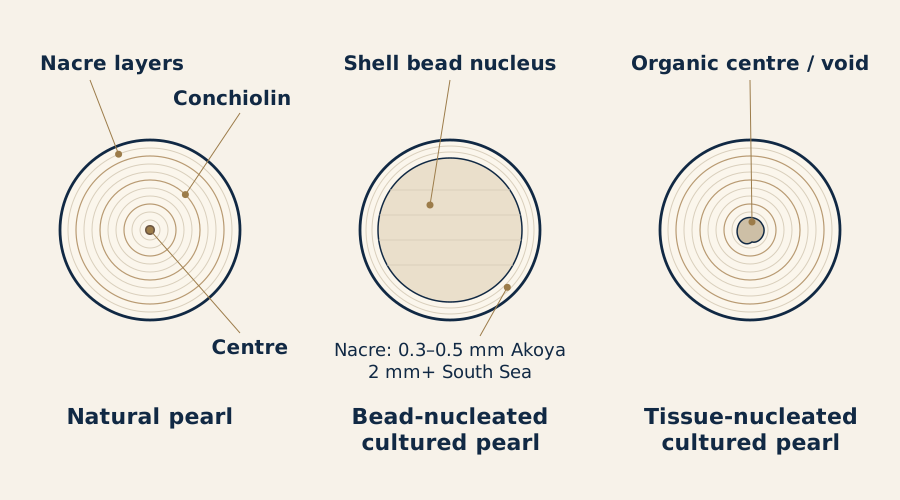
In a bead-nucleated pearl, the nacre thickness over the bead largely decides lustre and durability. Akoya pearls often carry about 0.3–0.5 mm of nacre per side, while South Sea pearls commonly carry 2 mm or more. Thin nacre can look chalky and may wear through to the bead. Our guide to how pearls are graded for lustre, nacre and surface explains each factor.
A cultured pearl is not a synthetic gem. A synthetic (or lab-created) gem has the same chemistry as the natural one but is grown entirely in a laboratory; a cultured pearl is still produced by a living mollusc, with people only starting the process. There are no commercially grown synthetic pearls. Our page on how natural, synthetic and simulant gems differ sets out these categories across all gemstones.
Which pearl types are natural and which are cultured?
All of the pearl types you commonly see named in jewellery are cultured. The type tells you which mollusc grew the pearl and where, which in turn sets the size range, colour and price.
| Pearl type | Mollusc | Main sources | Usual size | Nucleus | Natural or cultured |
|---|---|---|---|---|---|
| Akoya | Akoya oyster (Pinctada fucata) | Japan, China, Vietnam | 2–10 mm, mostly 6–8 mm | Bead | Cultured |
| Freshwater | Freshwater mussels (Hyriopsis) | Mainly China | 2–15 mm | Mostly tissue, some bead | Cultured |
| Tahitian | Black-lip oyster (Pinctada margaritifera) | French Polynesia | 8–15 mm | Bead | Cultured |
| South Sea | Silver-lip and gold-lip oysters (Pinctada maxima) | Australia, Indonesia, Philippines, Myanmar | 9–20 mm | Bead | Cultured |
| Keshi | Any pearl oyster or mussel on a farm | Pearl farms | 1–10+ mm | None (a by-product) | Cultured |
| Natural | Wild pearl oysters, mussels, conch, melo | Persian Gulf, Red Sea, Gulf of Mannar, historic Australia | Usually under 8 mm | None | Natural |
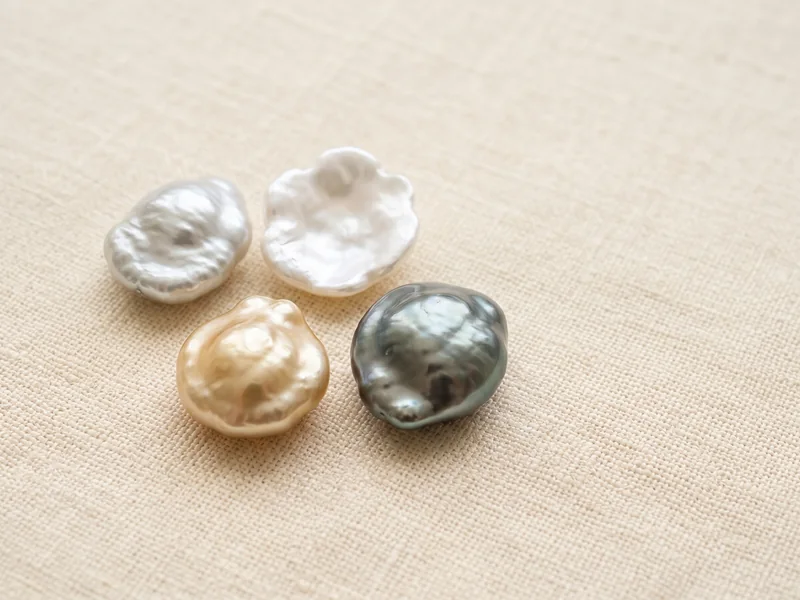
Akoya pearls are the classic round white strand, prized for sharp, mirror-like lustre. Freshwater pearls from mussels are the most affordable and come in white, pink, peach and lavender body colours. Dark Tahitian pearls range from grey to peacock green, and white and golden South Sea pearls are the largest cultured pearls of all, with thick nacre and a satiny glow.
Related guideTypes of Pearls and Pearl Identification GuideNot sure which one is right?
Send us the stones you are looking at and our gemologist will tell you which to choose and why.
Are keshi and mabe pearls natural or cultured?
These two cause more confusion than any other pearls, and some sellers describe them loosely. Keshi (a Japanese word meaning poppy seed) are pearls that form without a bead on pearl farms, usually when the oyster rejects the inserted bead but the tissue graft keeps producing nacre, or when a fragment of tissue forms a second pearl sac. They are solid nacre, often baroque and very lustrous.
Because they form in an oyster that was deliberately nucleated, international trade standards and the major laboratories class keshi as cultured, not natural, even though no bead sits inside. Calling a keshi a natural pearl is incorrect. Our guide to keshi pearls, the non-bead by-products of culturing covers their sizes and how they are sold.
Mabe pearls are cultured blister pearls. A hemispherical nucleus is glued to the inside of the oyster's shell, and the oyster coats it with nacre. After harvest the dome is cut out, the nucleus removed, the hollow filled with resin and the back sealed with a mother-of-pearl cap. A mabe is therefore an assembled cultured pearl, ideal for earrings and rings where only the dome shows. See our page on mabe blister pearls and how they are assembled for the detail.
What is the history of natural pearls in Australia?
Pearl shell was worked and traded by Aboriginal peoples of the Kimberley coast long before Europeans arrived; carved shell known as riji was exchanged along trade routes deep into the continent. From the 1860s, European pearlers began harvesting the large silver-lip oyster, Pinctada maxima, off Western Australia, and by the late 1800s Broome had become the centre of the world's pearl shell industry.
The main prize was the shell itself, sold as mother-of-pearl for buttons and inlay. Natural pearls were a valuable bonus found in only a small share of shells. Divers came from Japan, Malaya, Timor, the Philippines and the Torres Strait, alongside Aboriginal divers, and the work was dangerous; Broome's Japanese cemetery holds the graves of hundreds of pearl divers.
When plastic buttons undercut the shell trade in the 1950s, the industry turned to culturing. Australia's first South Sea cultured pearl farm opened at Kuri Bay in the Kimberley in the mid-1950s with Japanese expertise. A distinctive feature of the Australian industry is that it has relied largely on wild-caught oysters gathered under a strict quota, as well as hatchery-bred oysters. You can read more in our page on Broome's South Sea pearl industry.
How can you tell natural vs cultured pearls apart?
Not by eye, and not reliably by any test you can do at home. A fine bead-nucleated pearl and a natural pearl can look identical. The answer lies inside the pearl, so laboratories look through it with radiography (X-ray imaging) and, increasingly, micro-CT scanning, which builds a 3D image of the internal structure.
| Natural pearl | Bead-nucleated cultured | Tissue-nucleated cultured | Imitation | |
|---|---|---|---|---|
| How it starts | By chance, no human help | Shell bead plus tissue graft | Tissue graft only | Manufactured bead |
| Inside on X-ray | Fine concentric growth rings, often a small organic centre | A solid bead with a clear boundary line under the nacre | Nacre with a void or irregular organic centre | No nacre layers; glass, plastic or shell |
| Nacre | Solid nacre throughout | Nacre layer over the bead | Nearly solid nacre | Pearly coating only |
| Typical shape | Small, often off-round or baroque | Round to baroque | Rice, oval, button, round | Perfectly uniform |
| Tooth test (gentle rub) | Slightly gritty | Slightly gritty | Slightly gritty | Smooth, glassy |
| Typical price | Very high | Moderate to high | Low to moderate | Low |
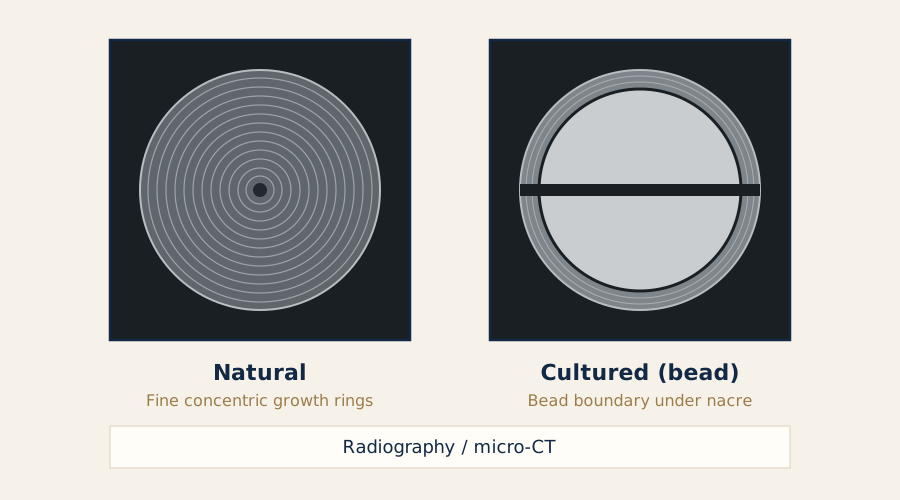
The tooth test only separates real pearls from imitations. It cannot tell natural from cultured, because both are nacre. Looking down the drill hole with a 10x loupe can sometimes reveal a bead's boundary in a cultured pearl, but a natural pearl should only ever be sold with a report from a recognised pearl laboratory such as GIA, SSEF or Gübelin. Under international trade standards, the unqualified word pearl is meant to describe a natural pearl, so a cultured pearl should always be described as cultured.
The word natural also means different things in different gems. On a pearl report it describes how the pearl formed; on a diamond, a natural is a patch of the original crystal skin left after cutting, as explained in our guide to naturals left on a diamond's surface. Our pearl identification guide covers the other tests labs use, including how they spot dyed and treated pearls.
Are cultured pearls real pearls, and are natural pearls worth more?
Yes, cultured pearls are real pearls. They are grown by living molluscs from genuine nacre, and a fine cultured pearl can have better lustre than an average natural one. Natural pearls command far higher prices because of their rarity and history, not because they always look better. Prices for both move with the market, and neither should be thought of as an investment; buy pearls you want to wear.
| Strand or piece (about 45 cm, good quality) | Approximate price range (AUD) |
|---|---|
| Freshwater cultured, 7–8 mm | about $150–$1,000 |
| Akoya cultured, 7–7.5 mm | about $800–$4,000 |
| Tahitian cultured, 9–11 mm | about $2,000–$8,000 |
| South Sea cultured, 10–12 mm | about $4,000–$25,000 |
| Natural pearl strand with lab report | tens of thousands to well over a million |
These are broad ranges only. Within each type, size, lustre, nacre thickness, surface, shape and matching across the strand move the price most. Pearl is also one of the traditional choices for the month of June, covered in our page on pearl as the June birthstone. If you are weighing pearls against other centre stones for a ring, our comparison of natural and lab-grown gemstones for engagement rings puts durability side by side.
Browse natural gemstones
How do you care for and restring natural and cultured pearls?
Natural and cultured pearls need exactly the same care. Nacre is soft, about 2.5–4.5 on the Mohs scale, so it scratches against harder gems and metal, and as calcium carbonate it is damaged by acids, perfume, hairspray, sunscreen and sweat. Put pearls on last, after make-up and perfume, and wipe them with a soft damp cloth after wearing.
- Storage: keep pearls apart from other jewellery in a soft pouch; never seal them airtight for years, as nacre can dry and crack.
- Cleaning: no ultrasonic or steam cleaners, and no jewellery dips.
- Hanging: store strands flat, as hanging stretches the silk.
- Restringing: strands worn often need restringing about every one to three years, or sooner if you see gaps between the knots.
A knotted strand has a small knot between each pearl so they do not rub together, and so that only one pearl is lost if the thread breaks. We restring pearls in our Melbourne workshop; our guide to pearl care and restringing explains silk versus nylon thread, clasp choices and how long the work takes.
How do you check a pearl before you buy? Step by step
- Ask what it is. Confirm whether the pearl is natural, cultured or imitation, and which type (Akoya, freshwater, Tahitian, South Sea, keshi or mabe).
- Ask for a report if it is natural. A natural pearl should come with a report from a recognised pearl laboratory that confirms its origin by X-ray.
- Ask about treatments. Many pearls are bleached, dyed or polished; dye is common in dark freshwater and some Akoya pearls and should be disclosed.
- Judge lustre first. Look for sharp, bright reflections of a light source on the surface; dull or chalky pearls may have thin nacre.
- Check the surface and drill holes. Look for spots, pits and chips near the hole, where thin nacre shows first.
- Check matching and stringing. On a strand, roll it on a flat surface to compare size, shape and colour, and confirm it is knotted between each pearl.
Free consultation
Talk to a gemologist
Compare stones in person or online with Raj Sood, Graduate Gemologist (GIA), AJP (GIA).
Book a consultationShop this shape
FAQ
Common questions
Are cultured pearls fake?
No. Cultured pearls are real pearls grown by living oysters or mussels from genuine nacre; people only start the process. Fake pearls are imitations made from glass, plastic or shell with a pearly coating.
How can I tell if my pearl is natural or cultured?
Only a laboratory can tell reliably, using X-ray or micro-CT imaging to see the pearl's internal structure. A bead nucleus points to a cultured pearl, while fine concentric growth rings suggest a natural one.
Are keshi pearls natural?
No. Keshi form without a bead, but they grow in oysters that were nucleated on pearl farms, so laboratories and trade standards class them as cultured pearls.
Are Australian South Sea pearls natural or cultured?
The South Sea pearls sold from Broome and the Kimberley today are cultured, grown in the silver-lip oyster Pinctada maxima. Natural pearls were found during Australia's historic pearl shell era but are rarely seen for sale now.
Why are natural pearls so expensive?
Very few wild molluscs produce a pearl, and far fewer produce a large, round, lustrous one. Most natural pearl fisheries closed in the twentieth century, so the supply is mainly antique pearls, which adds to the price.
Do natural and cultured pearls need different care?
No. Both are nacre, so both are soft and sensitive to acids and chemicals. Wipe them after wear, store them separately and have strands restrung every one to three years if worn often.
Terms in this guide

Ask a gemologist
Not sure which diamond to choose?
Raj Sood is a Graduate Gemologist (GIA) and master jeweller. Bring the stones you are considering, or send the reports, and he will tell you honestly which one is better and why.
Keep learning
Related guides
Explore more
More guides on this topic
Education