
Gemstones
Emerald vs Diamond: Hardness, Sparkle, Price and Everyday Wear Compared
Emerald and diamond are both popular engagement ring choices, but they behave very differently on the hand. This emerald vs diamond guide compares hardness, sparkle, inclusions, price and care, so you know exactly what you are choosing.
 Reviewed by Raj Sood, Graduate Gemologist (GIA), AJP (GIA)Master jeweller and Graduate Gemologist (GIA) · reviewed 4 November 2026
Quick answer
Emerald vs diamond comes down to colour versus durability. A diamond is pure carbon, 10 on the Mohs scale and full of white sparkle. An emerald is green beryl, 7.5–8 on the Mohs scale, usually included and often oil-treated, so it needs a protective setting and gentler care. Diamond suits hard daily wear; emerald rewards careful wearers.
What is the difference between an emerald and a diamond?
An emerald is the green variety of the mineral beryl, a beryllium aluminium silicate (Be3Al2Si6O18). Its colour comes from traces of chromium, vanadium or both. A diamond is crystallised carbon (C), formed under enormous heat and pressure deep in the earth. Because one is a complex silicate and the other a single element locked in a very tight crystal structure, they differ in almost every property that matters for jewellery. Our page on how the chemistry of beryl and carbon differs goes deeper into why.
In practice, people choose an emerald for its colour and a diamond for its brightness and durability. Emerald is one of the traditional 'big three' coloured gemstones, alongside ruby and sapphire, and it is valued mostly on the richness of its green. A diamond is valued on the 4Cs: cut, colour, clarity and carat. For the history, sources and grading of the green stone on its own, see our full emerald gemstone guide.
| Emerald | Diamond | |
|---|---|---|
| Material | Beryl (beryllium aluminium silicate) | Carbon |
| Mohs hardness | 7.5–8 | 10 |
| Toughness | Poor to good; often brittle | Good, but can cleave |
| Refractive index | about 1.57–1.58 | about 2.42 |
| Dispersion (fire) | 0.014, very little | 0.044, strong |
| Specific gravity | about 2.72 | about 3.52 |
| Typical clarity | Inclusions usually visible | Usually eye-clean in fine jewellery |
| Common treatment | Oil or resin filling | Usually none; some colour or fracture treatments |
| Ultrasonic cleaning | No | Usually safe |
| Lab version | Lab-created emerald | Lab-grown diamond |
Two of these terms need a quick explanation. Refractive index measures how strongly a stone bends light, and dispersion measures how much it splits white light into rainbow colours, which jewellers call fire. Any other unfamiliar words are explained in our plain-English jewellery glossary.
Emerald vs diamond: which is harder and more durable?
Diamond is harder. On the Mohs scale, which ranks minerals by how well they resist scratching, diamond sits at 10, the top. Emerald sits at 7.5–8. That gap is bigger than the numbers suggest, because the Mohs scale is not even: diamond is several times harder than corundum (sapphire and ruby, at 9), which is itself much harder than beryl.
The practical point is household dust. Dust contains quartz, which is 7 on the Mohs scale. A diamond shrugs it off for decades. An emerald is only just harder than quartz, so over years of daily wear the facet edges can soften and the surface can pick up fine scratches and small nicks along the edges, especially on the corners and girdle (the outer edge of the stone).
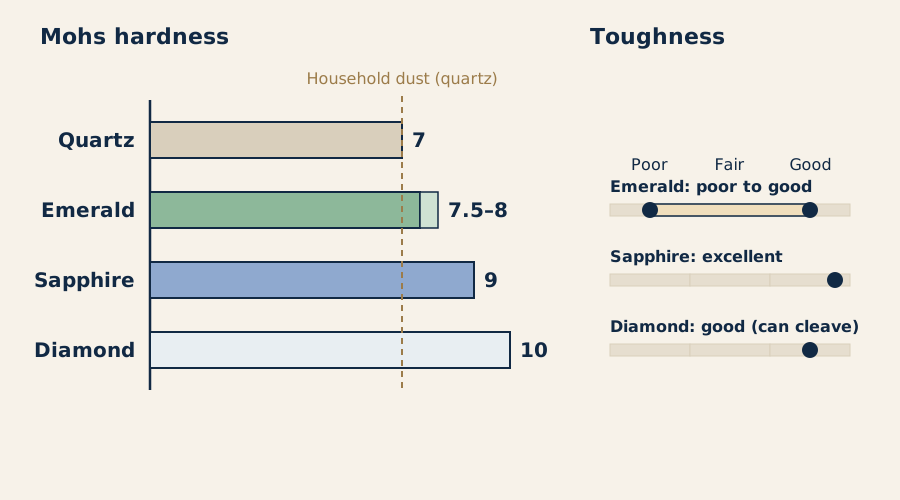
Hardness is not the same as toughness, which is resistance to chipping and breaking. This is where emerald is weakest. Most emeralds contain natural fractures and inclusions, and a sharp knock on a doorframe or bench can turn one of those into a chip or crack. Diamond is tough overall, but it has cleavage planes, directions along which its crystal can split cleanly, so even a diamond can chip if a thin edge takes a hard blow at the wrong angle.
So, is emerald harder than diamond? No. Is it durable enough for jewellery? Yes, with the right setting and some care. If you are weighing emerald against other coloured stones for durability, our wider guide to coloured gemstones compares hardness across the main options.
Why does a diamond sparkle more than an emerald?
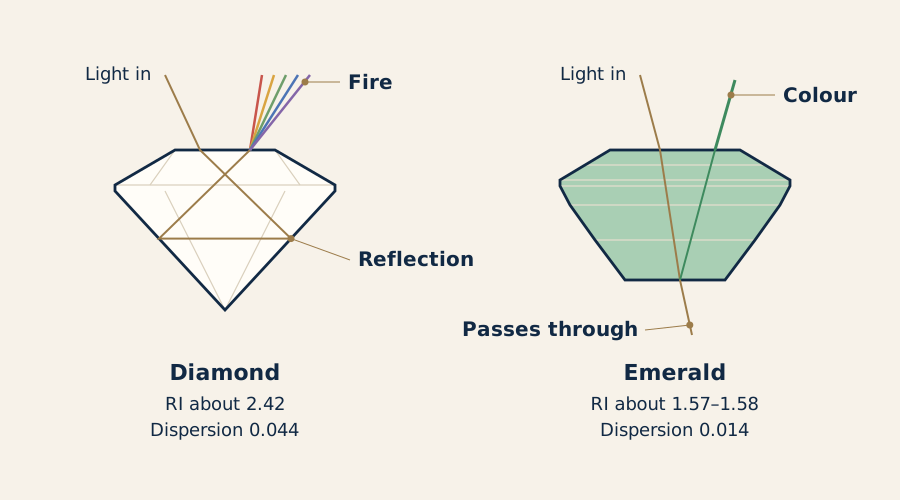
It comes down to how each stone handles light. Diamond's refractive index of about 2.42 is one of the highest of any natural gem. Light entering a well-cut diamond bends sharply and reflects internally off the back facets, so most of it comes back out through the top as brightness. Emerald's refractive index is about 1.57–1.58, so light bends far less and more of it passes straight through.
Dispersion makes the second difference. Diamond's dispersion of 0.044 splits light into strong flashes of colour. Emerald's is only 0.014, and its body colour masks what little fire there is. An emerald does not flash; it glows, with a deep, even green that many people find calmer and richer than sparkle.
That is also why emeralds are usually cut as step cuts: long, flat, parallel facets arranged like stairs, rather than the many small triangular facets of a brilliant. Step cuts show colour and clarity rather than sparkle. Diamonds cut the same way show broad flashes rather than glitter, often described as the hall-of-mirrors look of step-cut diamonds.
Are inclusions and treatments normal in emeralds?
Yes. Inclusions are internal features such as crystals, fluid pockets and fine fractures. In diamonds, buyers usually aim for an eye-clean stone, meaning nothing visible without magnification. In emeralds, visible inclusions are normal and accepted. The trade even has a fond name for them: jardin, French for garden, because under magnification they can look like moss and foliage. GIA places emerald among the gems that are almost always included.
Because emeralds so often have fractures reaching the surface, most are clarity-enhanced. The fractures are filled with a colourless oil (traditionally cedarwood oil) or an artificial resin, which makes them far less visible. This has been standard practice for a very long time, and it must be disclosed. A gem lab report can state the degree of enhancement, usually as none, minor, moderate or significant.
- Minor: little effect on appearance; the stone looks much the same before and after.
- Moderate: a noticeable improvement; common in good commercial stones.
- Significant: filler is doing a lot of work; these stones are more fragile and cost much less.
- No enhancement: rare, and priced well above treated stones of similar appearance.
Oil can slowly dry out or be drawn out by heat and solvents, so an oiled emerald may look a little more included after some years. It can be cleaned and re-oiled by a jeweller. Diamonds, by contrast, are usually untreated; where a diamond has been fracture-filled or colour-treated, the report will say so.
Lab-created emeralds have the same chemistry and crystal structure as natural emerald and are grown by the flux or hydrothermal methods. They are often cleaner than natural stones and cost far less, though they still show tell-tale inclusions under magnification. Our page on how lab-created emeralds are grown explains the methods. The diamond equivalent is the lab-grown diamond, which is real diamond made by HPHT or CVD growth.
Not sure which one is right?
Send us the stones you are looking at and our gemologist will tell you which to choose and why.
Is an emerald cut diamond the same as an emerald?
No, and this catches a lot of people out. An emerald cut is a shape, not a gem. It is a rectangular step cut with cut corners, originally developed for emeralds: the long facets show off colour, and the cut corners reduce the risk of chipping and the stress on the stone during cutting and setting. Diamond cutters borrowed the style, so an emerald cut diamond is a colourless (or coloured) diamond in that rectangular shape.
If the clean lines appeal but you want diamond's hardness, our emerald cut diamond guide covers how they are graded. Because step cuts have a large open table, a poorly proportioned stone can show a dull centre; we explain why some emerald cuts show a window and how to spot it in a video.
- Ratio: most emerald cut diamonds sit around 1.30–1.50 length to width; see choosing an emerald cut ratio.
- Proportions: table and depth percentages affect brightness; our proportions chart for emerald cuts sets out typical ranges.
- Square option: the Asscher is the square cousin; compare them in our emerald vs Asscher comparison.
- Longer look: ratios above about 1.50 make fingers look longer and slimmer; see longer, slimmer emerald cuts.
Emerald vs diamond engagement ring: which suits everyday wear?
For a ring worn every day, including gardening, gym sessions and dishes, diamond is the more forgiving stone. It resists scratches, stays bright longer between cleans and tolerates more knocks. An emerald engagement ring is entirely wearable, and many have lasted generations, but it suits someone who takes the ring off for hard work and is happy to have it checked regularly.
The setting does a lot of the protective work. For emerald, the usual choices are:
- Bezel or half-bezel: a rim of metal around the edge; the most protective option for corners and girdle.
- Four claws on cut corners: claws placed on the angled corners rather than on sharp points.
- Lower profile: a stone that sits closer to the finger takes fewer knocks than a tall cathedral setting.
- Diamond halo: small diamonds around the emerald add sparkle and act as a bumper for the edge.
Combining the two is common: an emerald centre with diamond side stones or a halo gives colour and sparkle in one ring. Our page on emerald engagement ring designs shows the main styles, and the same protective principles apply to the step-cut diamonds covered in settings that protect step-cut corners. If you want a coloured centre stone that is tougher than emerald, compare emerald vs sapphire for engagement rings.
How do you clean an emerald ring compared with a diamond?
Cleaning is where the two stones part ways most clearly. A diamond ring can usually go into an ultrasonic cleaner or steamer at a jeweller. An emerald should not, because vibration and heat can push out the filler, open fractures and leave the stone looking more included.
- Emerald: warm water, a drop of mild dishwashing liquid and a soft toothbrush. Rinse and pat dry. No ultrasonic, no steam, no solvents.
- Diamond: the same soapy water works well at home; ultrasonic cleaning is usually fine unless the stone is fracture-filled.
- Both: take rings off for cleaning products, chlorine pools and heavy work. Lotions and soap film dull a diamond quickly.
- Checks: have claws and settings checked about once a year, and more often for emerald.
Also avoid sudden temperature changes with emerald, such as hot washing-up water followed by cold. Heat can affect fillers and stress existing fractures.
Are there Australian emeralds and diamonds?
Australia has produced both, though on very different scales. Emeralds have been found at Emmaville and Torrington in the New England region of New South Wales, mined on a small scale since the late 1800s, and at Poona in Western Australia. Production has always been small and the stones are rarely seen in retail today. Most emeralds on the market come from Colombia, Zambia and Brazil: Colombian stones are known for a pure, slightly warm green, while Zambian stones often lean bluish green.
Diamonds are a bigger Australian story. The Argyle mine in the Kimberley region of Western Australia was one of the world's largest producers by volume until it closed in 2020, and it was famous for pink diamonds. Argyle stones are now sought after but increasingly scarce.
If you like the idea of a green Australian stone, look at Australian sapphire. The fields of central Queensland (around Anakie) and New England in New South Wales (around Inverell and Glen Innes) produce green, teal and parti sapphires, which show two or more colours in one stone. At 9 on the Mohs scale, sapphire is tougher and harder than emerald, though its green is usually more olive or teal than an emerald's vivid grass green.
Emerald is also the traditional stone for May; our page on emerald as the May birthstone covers its meaning and gift ideas.
Emerald vs diamond price: how much do they cost in Australia?
Emerald prices range far more widely than diamond prices, because there is no single grading system. Value depends mostly on colour (hue, tone and saturation), then on how visible the inclusions are, the degree of treatment, the cut and, for fine stones, the origin. Remember too that emerald is lighter than diamond, about 2.72 against 3.52 in specific gravity, so a 1 carat emerald is roughly 30% larger in volume than a 1 carat diamond.
| About 1 carat | Approximate price range (AUD) |
|---|---|
| Lab-created emerald | about $150–$800 |
| Natural emerald, commercial quality, moderate enhancement | about $500–$3,000 |
| Natural emerald, fine colour, minor enhancement | about $4,000–$15,000+ |
| Lab-grown diamond, round, G–H, VS | about $800–$3,000 |
| Natural diamond, round, G–H, VS | about $8,000–$16,000 |
These are broad ranges only and move with the market. Exceptional untreated emeralds with top colour sell for well above these figures, while heavily filled stones sell well below them. In general, a good natural emerald costs less per carat than a natural diamond of similar standing, and lab-grown diamonds cost much less than natural diamonds.
Ask for a report. For diamonds, GIA and IGI are the usual labs. For emeralds, a report from a recognised gem lab should confirm natural or lab-created, the degree of clarity enhancement and, for valuable stones, the likely origin.
Shop natural gemstones
How do you choose between an emerald and a diamond? Step by step
- Decide how the ring will be worn. Hard daily wear points towards diamond; careful wear or occasional pieces suit emerald well.
- Decide what matters more: colour or sparkle. Emerald gives deep green; diamond gives brightness and fire.
- Check the report. For emerald, confirm natural or lab-created and the degree of clarity enhancement. For diamond, confirm natural or lab-grown and the 4Cs.
- Judge emerald by eye, in daylight. Look for even, saturated colour and inclusions that do not reach the surface near the corners.
- Choose a protective setting. A bezel, cut-corner claws or a diamond halo for emerald; secure claws or a bezel for any step-cut diamond.
- Plan the care. Soapy water only for emerald, and a yearly setting check for both.
Free consultation
Talk to a gemologist
Compare stones in person or online with Raj Sood, Graduate Gemologist (GIA), AJP (GIA).
Book a consultationShop this shape
FAQ
Common questions
Is emerald harder than diamond?
No. Diamond is 10 on the Mohs scale and emerald is 7.5–8. Emerald is also less tough, because most stones contain natural fractures.
Can you wear an emerald engagement ring every day?
Yes, with care. Choose a protective setting such as a bezel or halo, take the ring off for heavy work, and avoid ultrasonic cleaners.
Is an emerald cheaper than a diamond?
Usually, carat for carat, a good natural emerald costs less than a natural diamond. Fine untreated emeralds with top colour can cost as much as or more than a diamond of the same weight.
What is the difference between an emerald and an emerald cut diamond?
An emerald is a green gemstone, the green variety of beryl. An emerald cut is a rectangular step-cut shape, and an emerald cut diamond is a diamond cut in that shape.
Are lab-created emeralds real emeralds?
A lab-created emerald has the same chemistry and structure as natural emerald, but it is grown in a laboratory, so it must always be sold as lab-created or synthetic. It costs far less than a natural emerald of similar appearance.
Why do emeralds have so many inclusions?
Emeralds grow in geological conditions that leave fractures and trapped crystals, so nearly all natural stones are included. The trade calls these inclusions jardin, and visible ones are accepted in a way they are not in diamonds.

Ask a gemologist
Not sure which diamond to choose?
Raj Sood is a Graduate Gemologist (GIA) and master jeweller. Bring the stones you are considering, or send the reports, and he will tell you honestly which one is better and why.
Keep learning
Related guides
 GemstonesEmerald Gemstone
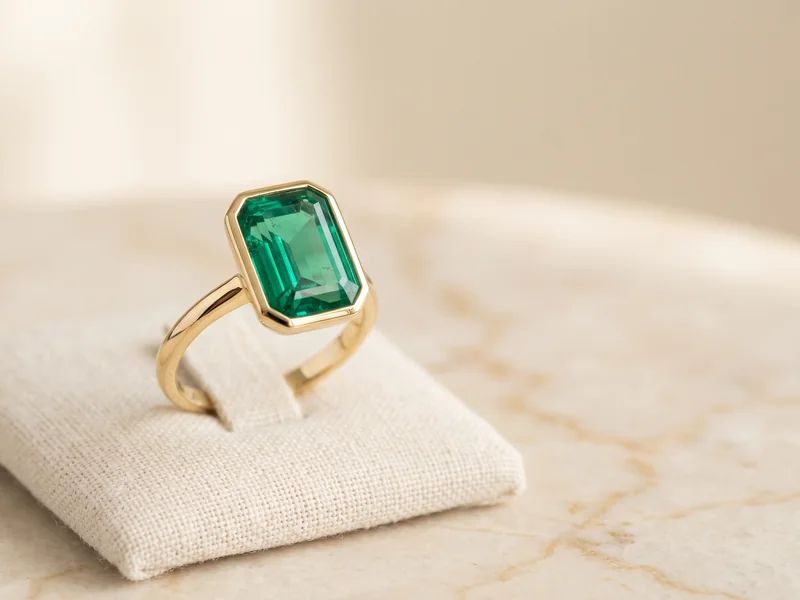 GemstonesEmerald Engagement Rings
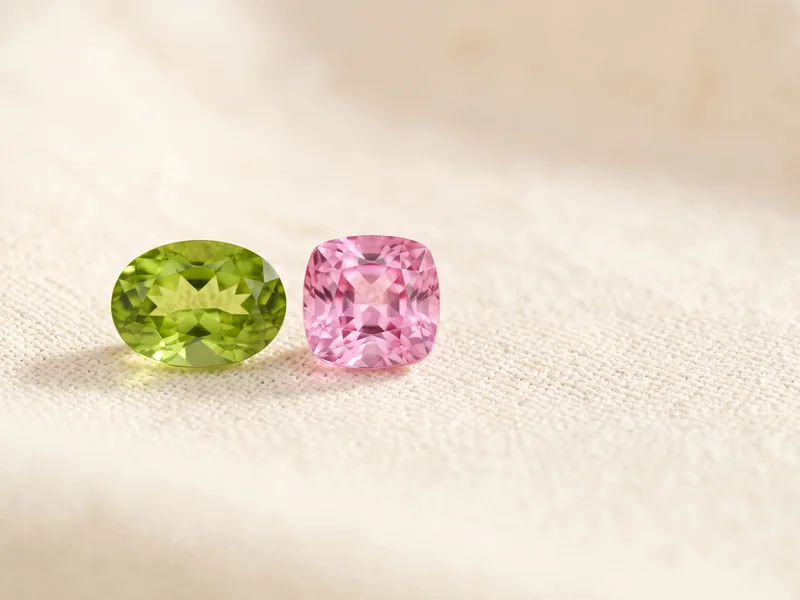 GemstonesEmerald vs Sapphire Engagement Rings
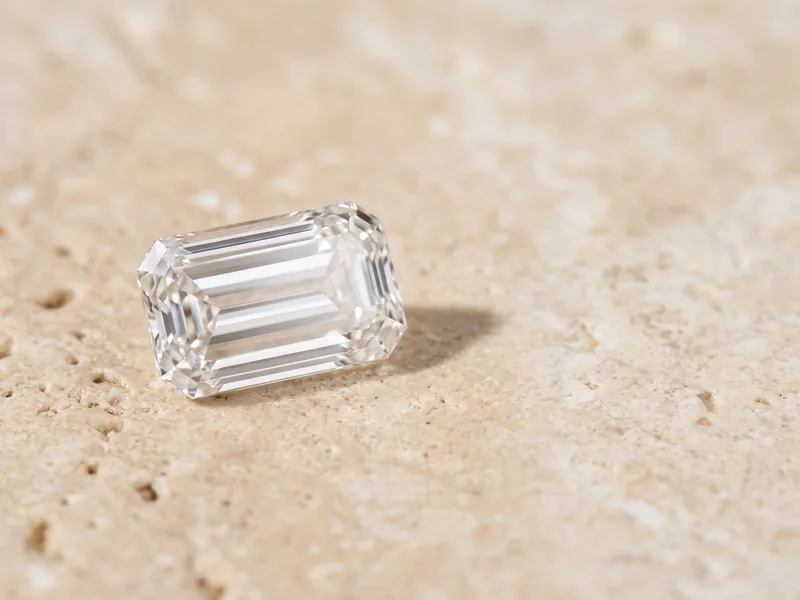 Diamond ShapesEmerald Cut DiamondsGemstonesGemstones | Coloured Gemstones, Birthstones and Custom JewelleryGemstonesMay Birthstone: EmeraldEngagement Rings & SettingsBest Settings for Emerald Cut Diamonds
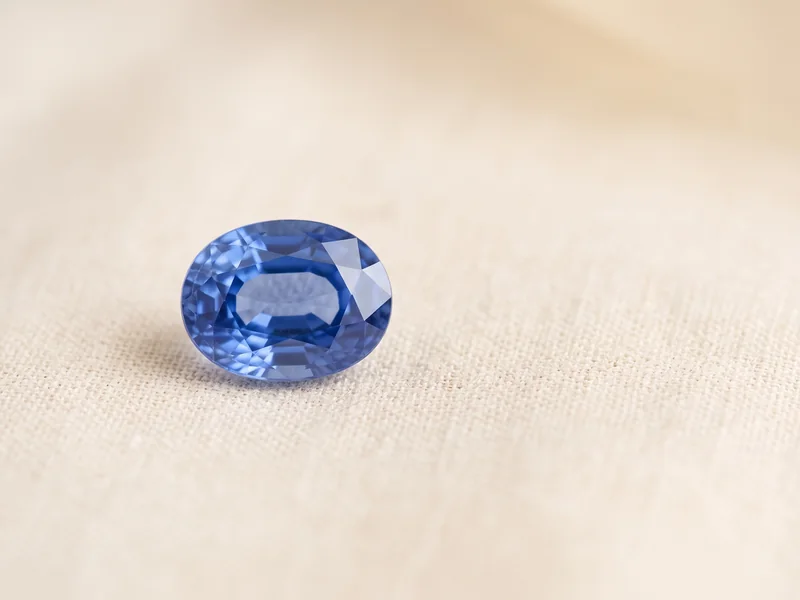 GemstonesChemical Composition of Diamonds, Sapphires, Rubies, Emeralds, Opals and Other Gemstones
Explore more
More guides on this topic
Education