
- Education
- Engagement Rings & Settings
- Best Setting for Emerald Cut Diamond Rings: Claws, Halos and Bands
Engagement rings & settings
Best Setting for Emerald Cut Diamond Rings: Claws, Halos and Bands
An emerald cut hides nothing, so the setting does a lot of the work. Here is how to choose the best setting for emerald cut diamond rings, from where the claws sit to whether a halo helps.
 Reviewed by Raj Sood, Graduate Gemologist (GIA), AJP (GIA)Master jeweller and Graduate Gemologist (GIA) · reviewed 4 November 2026
Quick answer
The best setting for emerald cut diamond rings is usually four claws on the cut corners, or four double claws for extra security, because they protect the corners and leave the long step facets open. A bezel suits active hands, a halo adds size, and a three-stone with baguettes matches the clean lines.
Why does an emerald cut diamond need a careful setting?
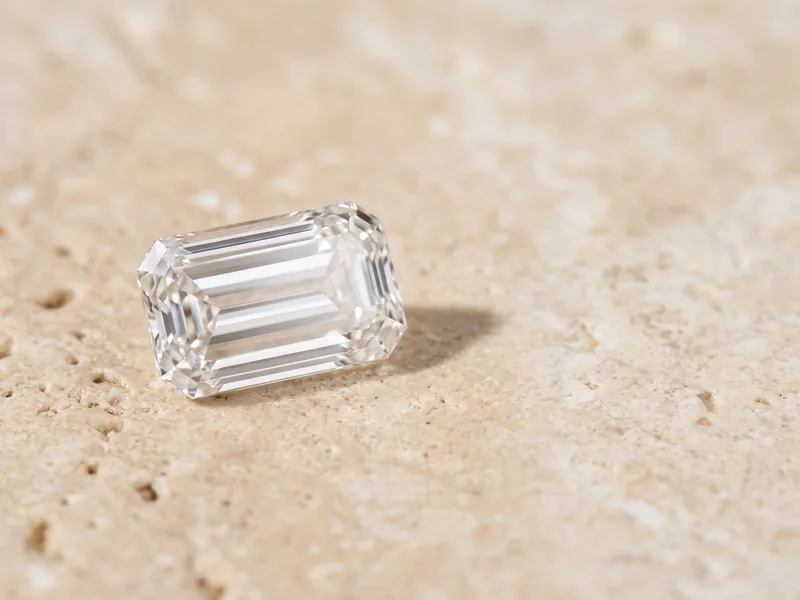
An emerald cut is a step cut. Instead of the triangular and kite-shaped facets of a brilliant cut, it has long, flat facets arranged in parallel rows, like steps running down each side of the stone. The outline is a rectangle with cropped corners, small angled facets that cut off each corner. Most emerald cuts have somewhere around 50 to 58 facets and a large, open table (the flat top facet). Our guide to choosing an emerald cut diamond covers the stone itself in full; this page is about what holds it.
That open design changes what a setting needs to do. A step cut does not break light into lots of small sparkles. It shows broad flashes of light and dark that move across the stone as it tilts, often called the hall-of-mirrors effect. Anything that blocks those long facets, such as heavy claws on the long sides, interrupts the effect. A setting that sits the stone too low or closes off the pavilion (the lower half of the stone) can also make a shallow stone look flat and glassy in the middle, a problem explained in our page on windowing in emerald cuts.
The large table also works like a window into the stone, so inclusions (internal features) show more than they would in a brilliant of the same grade; see why inclusions are easier to see in step cuts. A well-placed claw can sometimes sit over a small inclusion near a corner, but that is a bonus, not a reason to drop clarity. Diamond is 10 on the Mohs hardness scale, yet hardness is not the same as toughness: a hard knock on a thin edge can still chip it, and the cropped corners are the most exposed part of an emerald cut. If any word here is new, our plain-English jewellery glossary explains it.
What is the best setting for an emerald cut diamond?
There is no single right answer. The setting that suits you depends on how you use your hands, the ratio of your stone, and whether you want the emerald cut to look calm and architectural or framed and larger. These are the settings that work well with an emerald cut, and the trade-offs of each.
| Setting | How it holds the stone | Strengths | Watch out for |
|---|---|---|---|
| Four corner claws | One claw over each cropped corner | Shows the most of the stone; clean and classic | Corners take knocks first; have claws checked yearly |
| Four double claws | Two slim claws at each corner, eight in total | More secure; if one claw lifts, the stone is still held | Slightly busier from above |
| Six claws | Four corners plus one on each long side | Extra support for long or large stones | Side claws interrupt the step facets |
| Full bezel | A thin rim of metal around the whole girdle | Most protective; smooth, nothing to catch | Hides a sliver of the outline; can look a little smaller |
| Half-bezel | Metal wraps the two short ends only | Protects all four corners, leaves the long sides open | Long sides are less protected |
| Halo | A border of small diamonds around the centre stone | Looks larger; frames the rectangle | Brilliant sparkle can compete with the step flashes |
| Three-stone | Centre stone with a smaller stone either side | Lengthens the look across the finger | More stones and claws to maintain |
| East-west | Stone set sideways across the finger | Modern look; can catch a little less on gloves and pockets | Looks shorter on the finger; claws need careful placement |
For most people, four claws or four double claws on the corners is the place to start. It holds the stone securely, keeps the long facets clear and lets light reach the pavilion from the sides, which keeps the step flashes lively. The other styles are refinements for a particular look or lifestyle. Our overview of engagement ring setting styles explains each style in more depth across every diamond shape.
Where should the claws go on an emerald cut diamond?
On an emerald cut, the claws belong on the cropped corners, not on the long sides. The corners are the points most likely to meet a door frame or a bench top, so a claw over each one protects the stone where it is most exposed, and the long step facets stay open to show their flashes. Because the corners are already cropped, an emerald cut is less prone to corner chips than a sharp-cornered princess cut, but it still needs that cover.
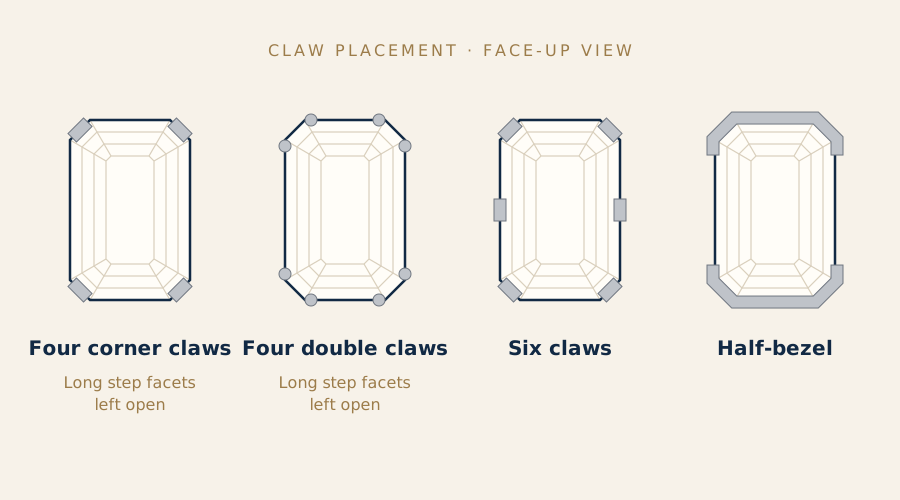
- Round claws: a rounded tip over each corner. Simple and easy to re-tip later, though a small round claw covers less of the corner.
- Flat or tab claws: a flattened claw shaped to follow the angle of the cropped corner. It covers the corner neatly and matches the straight lines of a step cut.
- V-claws: a claw that folds around the corner on both sides. Very protective, and worth considering for a stone with small corner crops.
- Double claws: two slim claws either side of each corner, eight in total. Very secure, and each claw can be finer, so the stone still looks open from above.
Claw size matters as much as position. On a 1 carat emerald cut, claws are commonly made from wire of roughly 1.0–1.5 mm. They need enough metal to last years of wear, but not so much that they crowd the outline. Claws wear down slowly over time, so plan to have them checked every year or so. Platinum is dense and tough, which is why many jewellers prefer it for claws even when the band is gold.
Related guideWhat Is Windowing in an Emerald-Cut Diamond?Does the ratio change which setting suits an emerald cut?
Yes. The length-to-width ratio (the length divided by the width, both taken from the grading report) decides how long the stone looks and how much unsupported girdle (the thin outer edge) runs between the corners. Most emerald cuts sit between about 1.30 and 1.50. Our page on how emerald cut ratios change the look explains the numbers in full.
| Ratio | How it looks | Settings that tend to suit |
|---|---|---|
| 1.20–1.30 | Shorter, closer to a square-ish rectangle | Four claws; a halo or tapered baguettes to add length |
| 1.30–1.50 | The classic emerald cut rectangle | Almost any: four or double claws, bezel, halo, three-stone |
| 1.50–1.70 | Long and slim | Double claws or six claws; east-west; a slim band |
| Above 1.70 | Very elongated, almost a bar | Six claws or a bezel for support along the long sides |
Longer stones have more girdle between corners, so six claws or a bezel adds support along the long sides. They also look larger for their weight and suit a fine band that does not shorten the outline. If the slim look appeals, our page on long, slim emerald cuts covers what to check.
| Carat weight | Typical size at about 1.40 ratio (length × width) |
|---|---|
| 0.50 ct | about 5.6 × 4.0 mm |
| 0.75 ct | about 6.4 × 4.5 mm |
| 1.00 ct | about 7.0 × 5.0 mm |
| 1.50 ct | about 8.0 × 5.7 mm |
| 2.00 ct | about 8.8 × 6.3 mm |
These are typical figures only. Emerald cuts are often cut fairly deep, and a deeper stone carries more weight underneath and looks smaller face-up (the size you see from above). When comparing stones for a setting, compare the millimetre measurements rather than the carat weight, because the setting is made to fit the millimetres.
Not sure which one is right?
Send us the stones you are looking at and our gemologist will tell you which to choose and why.
Is a halo the best setting for emerald cut diamond rings?
A halo can be, but it changes the character of the stone more than it does with a round or oval. A border of small diamonds, usually about 1.0–1.5 mm each, adds roughly 2–3 mm to the overall width and length of the head. That makes the centre stone look larger, and the halo also shields the girdle from knocks.
The trade-off is style. An emerald cut is admired for its calm, broad flashes. Most halos use small round brilliants, which throw lots of quick sparkle. Some people love that contrast; others feel it distracts from the step cut. If you are unsure, ask to see the same stone with and without a halo, either side by side or as computer renders.
- Classic halo: round melee (small diamonds) set all the way around, following the cropped corners.
- Hidden halo: a row of small diamonds under the girdle, seen from the side rather than from above. It keeps the top view clean and adds detail in profile.
- Step-cut halo: tiny baguettes around the stone. It matches the step faceting and gives an Art Deco look, though it is harder to make and repair.
- Micro-pavé halo: very small diamonds held by tiny beads of metal, for a finer edge.
Small stones need care. Melee can work loose over years of wear, so a halo ring should be checked every 6–12 months. Our guide to how micro-pavé and bead settings hold small diamonds explains how they are set and what to look for in good workmanship.
Are bezel and three-stone settings good for emerald cuts?
Bezel settings suit an emerald cut well, because a straight-sided rim follows the outline naturally. A full bezel wraps the whole girdle and is the most protective option for people who work with their hands, such as nurses, tradies or gardeners. The visible rim is usually thin, around 0.5–1.0 mm, but it does hide a little of the stone, and a yellow gold bezel will reflect some warmth into a white diamond. A half-bezel, with metal on the two short ends only, protects all four corners while leaving the long sides open to light.
Three-stone settings are a natural match because the side stones can echo the step cut. Popular pairings:
- Tapered baguettes: narrow step cuts that point towards the centre stone and lengthen the look.
- Trapezoids: step cuts with angled sides that sit flush against the centre stone, for a wider, bolder ring.
- Smaller emerald cuts: a matched pair either side for a very clean, symmetrical look.
- Half-moons or pears: softer outlines for contrast with the straight lines.
Side stones are usually chosen at about a quarter to a third of the centre stone's width, and they should match its colour closely, because step cuts make colour differences easy to see. If you are still choosing the centre shape itself, compare the emerald cut against its square cousin, the Asscher, or read emerald or radiant: step cut vs brilliant. A radiant has the same outline with brilliant faceting, so it hides inclusions better and pairs more easily with a sparkly halo.
Which metal and colour grade suit an emerald cut setting?
Step cuts show body colour more than brilliants, because their broad facets do not mask a tint with sparkle. In platinum or white gold, many people choose G colour or better; some are happy at H. In yellow or rose gold, I or J can look white, because the warm metal colours everything around it. A useful trick is two-tone: white claws on a yellow gold band, so the stone sits against white metal while the band stays warm.
- Platinum: naturally white, dense and hard-wearing, and well suited to claws. Heavier and usually dearer than gold.
- 18ct white gold: usually rhodium plated for a bright white finish; the plating wears and is refreshed every year or two.
- 18ct yellow gold: a classic, warm look that pairs well with near-colourless stones in the I–J range.
- 18ct rose gold: soft pink warmth; again, white claws help a colourless stone stay white.
A CAD (computer-aided design) render lets you see the same stone in a four-claw, double-claw, bezel or halo setting before anything is made. For an emerald cut that is especially useful, because small changes in claw shape or head height change the look more than they would on a round.
What wedding band suits an emerald cut engagement ring?
Because an emerald cut has straight sides, a straight wedding band often sits neatly beside it, as long as the setting's head and basket (the metal frame under the stone) sit high enough to clear the band. A low-set ring may need a slightly curved or notched band. Our guide to the wedding bands that sit flush with an emerald cut shows the options side by side.
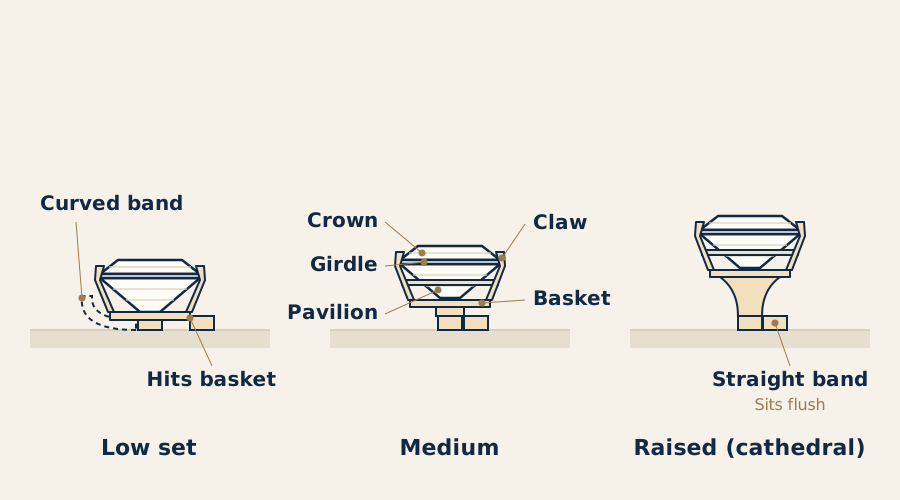
- Width: most people match the engagement band, often about 1.8–2.5 mm, so the two look like a set.
- Plain band: keeps the focus on the step cut and suits a clean four-claw solitaire.
- Pavé band: adds sparkle; works well when the engagement ring has a pavé shoulder or hidden halo.
- Baguette band: channel-set baguettes repeat the step faceting for a cohesive Art Deco look.
Try the two rings together before you finalise either one. Check for a gap between them, whether the band rubs the claws, and whether the head tips sideways when the band is worn. Rubbing against a band is a common cause of worn claws over time.
Does a natural or lab-grown emerald cut diamond change the setting?
No. Natural and laboratory-grown diamonds are both real diamond, with the same hardness (10 on the Mohs scale) and the same refractive index of about 2.42, so they are set in exactly the same way. The difference is origin and price: lab-grown diamonds are grown in a laboratory rather than mined, and they cost much less, which lets many people choose a larger stone or a higher clarity for the same budget. Either way, ask for an independent grading report from a lab such as GIA or IGI.
| Item (approximate) | Price range (AUD) |
|---|---|
| 1 ct emerald cut, G–H, VS, lab-grown | about $800–$2,500 |
| 1 ct emerald cut, G–H, VS, natural | about $6,000–$12,000 |
| Four-claw solitaire setting, 18ct gold or platinum | about $1,500–$3,500 |
| Halo or three-stone setting with small diamonds | about $2,500–$5,500 |
These are broad ranges only; prices move with the market, the metal price and the exact grades. Emerald cuts often cost a little less per carat than rounds of the same grade, but clarity matters more in a step cut, so budget for a cleaner stone.
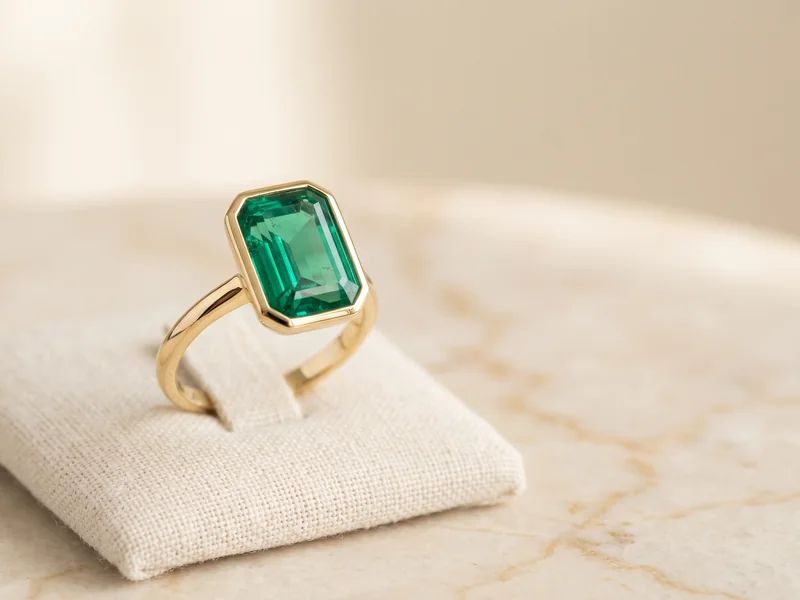
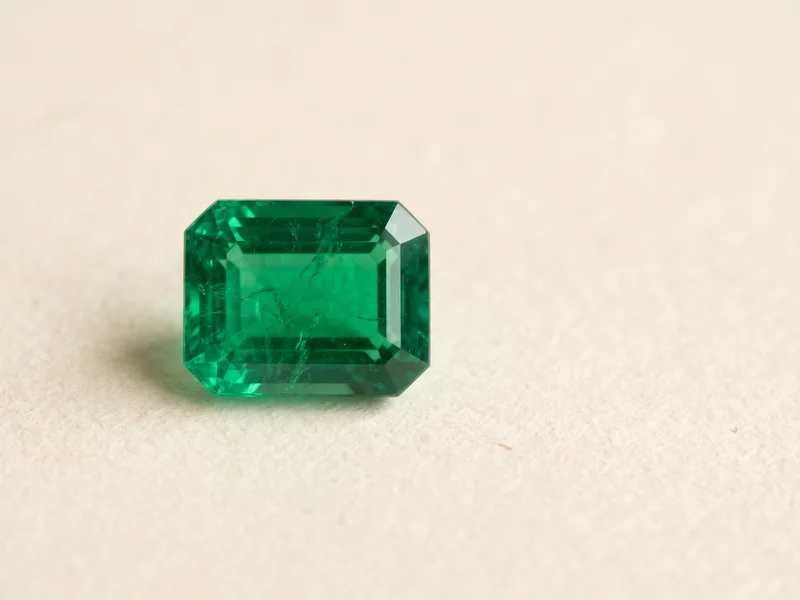
One common mix-up is worth clearing up. An emerald cut is a shape; an emerald is a green gemstone, a variety of beryl. The cut is named after the stone it was traditionally used for. Emerald gemstones are 7.5–8 on the Mohs scale, usually included, and very often treated with oil or resin, so they need a more protective setting and gentler cleaning than a diamond. Our emerald gemstone guide covers the stone itself, emerald compared with diamond for everyday wear sets out the durability differences, and engagement rings set with green emeralds covers settings for the gem. For birthday gifts, see the May birthstone, and if you are weighing up a coloured centre stone, read emerald or sapphire for an engagement ring.
Shop emerald cut diamonds and ring settings
How do you choose a setting for an emerald cut diamond? Step by step
- Start with the stone. Read the report: measurements, ratio, colour, clarity, and whether the diamond is natural or lab-grown.
- Be honest about your hands. Active work or sport points to double claws, a half-bezel or a full bezel; office hands can wear four claws easily.
- Place the claws on the corners. Choose round, flat, V or double claws, and avoid claws on the long sides unless the stone is long and needs support.
- Decide on a halo. Compare the stone with and without one; choose a hidden halo if you want detail without changing the top view.
- Match the metal to the colour grade. White metal for G or better; yellow or rose gold, ideally with white claws, for warmer grades.
- Set the head height with the band in mind. Check that your planned wedding band will sit flush, or plan a curved band.
- Review a render or try-on. Look from above and side-on before the ring is made, and plan yearly claw checks once you wear it.
Free consultation
Talk to a gemologist
Compare stones in person or online with Raj Sood, Graduate Gemologist (GIA), AJP (GIA).
Book a consultationFAQ
Common questions
How many claws should an emerald cut diamond have?
Four claws, one on each cropped corner, is the classic choice. Four double claws (eight in total) add security, and six claws suit long or large stones that need support along the sides.
Does a halo suit an emerald cut diamond?
It can. A halo makes the stone look larger and protects its edge, but the sparkle of small round diamonds contrasts with the calm step flashes, so compare the stone with and without a halo first.
Is a bezel setting good for an emerald cut?
Yes. The straight sides suit a bezel, and it is the most protective option for active hands. It hides a small amount of the outline, so the stone can look slightly smaller than in claws.
Can a straight wedding band sit flush with an emerald cut engagement ring?
Often, yes, if the head and basket are set high enough for the band to slide underneath. Low-set rings may need a slightly curved or notched band.
What colour metal suits an emerald cut diamond?
Platinum or white gold suits G colour and better, because step cuts show body colour clearly. Yellow or rose gold suits warmer I–J stones, and white claws on a gold band help a colourless stone stay white.
Is an east-west emerald cut ring practical?
Yes. Set sideways, the stone sits across the finger and can catch a little less on gloves and pockets. It looks shorter on the hand, so check the face-up size in millimetres.

Ask a gemologist
Not sure which diamond to choose?
Raj Sood is a Graduate Gemologist (GIA) and master jeweller. Bring the stones you are considering, or send the reports, and he will tell you honestly which one is better and why.
Keep learning
Related guides
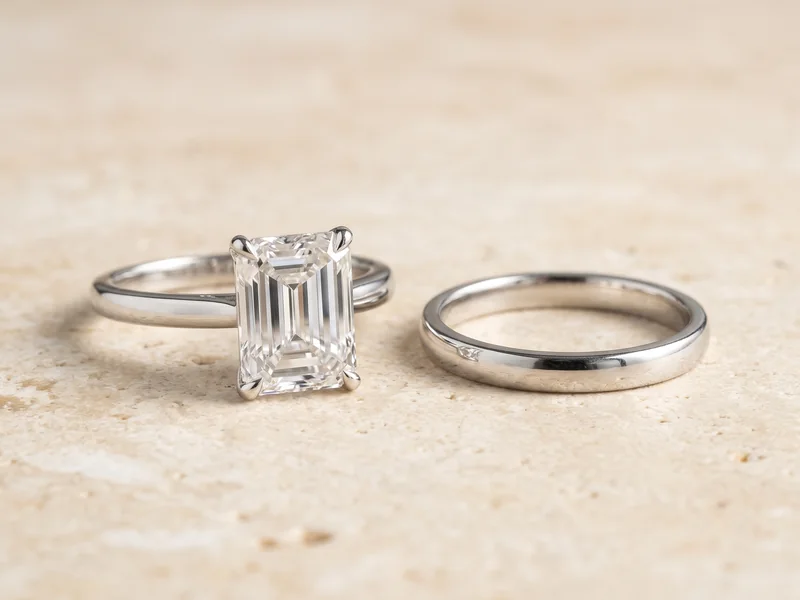 Wedding Bands & EternityBest Wedding Band for Emerald Cut Engagement Rings
 Diamond ShapesEmerald Cut DiamondsEngagement Rings & SettingsEngagement Ring Setting Styles GuideDiamond ShapesEmerald-Cut Diamond Length-to-Width Ratio
 GemstonesEmerald vs Diamond
 GemstonesEmerald Engagement RingsDiamond ShapesWhat Is Windowing in an Emerald-Cut Diamond?
 GemstonesEmerald Gemstone
Explore more
More guides on this topic
Education