
Gemstones
May Birthstone: Emerald Guide to Colour, History, Durability and Settings
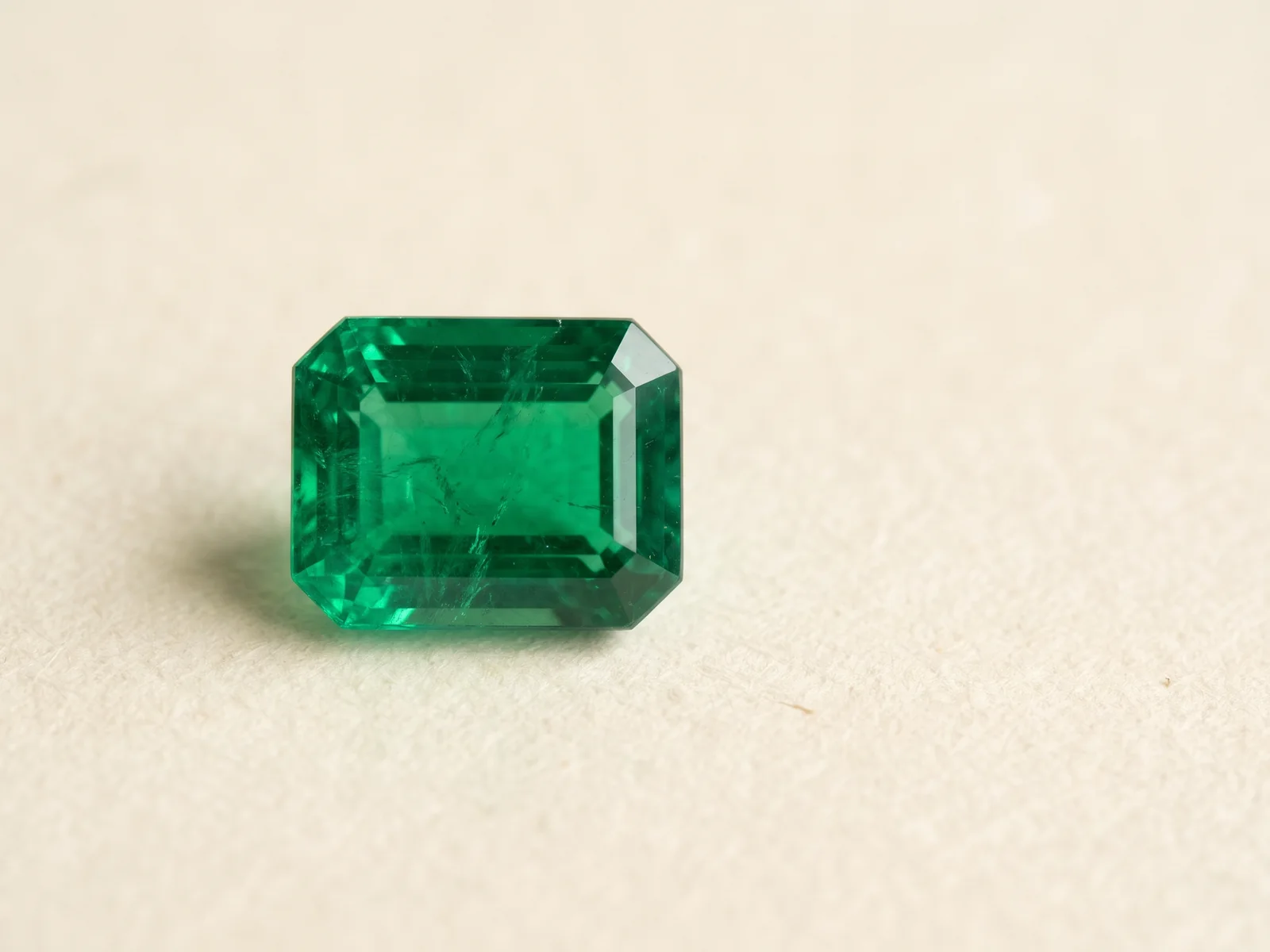
Emerald is the May birthstone, and one of the few gems where some inclusions are expected. Here is what decides its colour, how tough it really is in an everyday ring, and how to set it so it lasts.
 Reviewed by Raj Sood, Graduate Gemologist (GIA), AJP (GIA)Master jeweller and Graduate Gemologist (GIA) · reviewed 4 November 2026
Quick answer
The May birthstone is emerald, the green variety of beryl coloured by chromium or vanadium. It rates 7.5–8 on the Mohs scale but is brittle and usually included, and most stones are oil- or resin-treated. For an everyday ring, choose a protective bezel or halo setting, avoid ultrasonic cleaners, and expect to have it checked regularly.
What is the May birthstone?
The May birthstone is emerald, on both the modern list first published by American jewellers in 1912 and the older traditional lists. Emerald is the green variety of the mineral beryl, a beryllium aluminium silicate (Be3Al2Si6O18). Its green comes from tiny amounts of chromium, vanadium or both replacing some of the aluminium in the crystal. Iron can add a bluish or yellowish touch.
Beryl is a big family. Blue beryl is aquamarine, pink is morganite and yellow is heliodor. Only a green beryl with enough depth of colour is called emerald; paler stones are sold as green beryl and cost far less. Where that line sits is a judgement call that gem labs make, so the word on the report matters. For the wider picture of how coloured stones are graded, start with our guide to coloured gemstones and birthstones.
In the hand, emerald has a refractive index (how strongly it bends light) of about 1.57–1.58, well below diamond's 2.42. That is why emerald is admired for its colour rather than its sparkle. It has a specific gravity of about 2.72, so it is lighter for its size than diamond or sapphire, and a 1 carat emerald can look a little bigger than a 1 carat diamond, depending on how deeply it is cut.
If you are planning a gift for a May birthday, our page on birthstone jewellery made in Melbourne covers pendants, studs and rings across every month, and our full profile of emerald as a gemstone in depth goes further into the mineralogy. Any term that is new to you is explained in our glossary of jewellery terms.
What is the history and meaning of the emerald birthstone?
The word emerald comes from the Greek smaragdos, meaning green gem, through Latin and Old French. Some of the earliest known emerald mines were in Egypt's Eastern Desert near the Red Sea, worked in Ptolemaic and Roman times; these are the mines popularly linked with Cleopatra. The Roman writer Pliny the Elder noted that nothing was greener, and that gem cutters looked at emerald to rest their eyes.
The big change came in the 1500s, when Spanish colonists took over emerald mines already worked by the Muisca people in what is now Colombia. Colombian emeralds were far larger and richer in colour than anything known in Europe, and many travelled on to the Mughal emperors of India and the Ottoman court, where they were carved, engraved and set into some of the most famous jewels of the period.
Emerald has long been linked with renewal, growth and spring, which suits a May birthday in the Northern Hemisphere. In Australia May is late autumn, but the green-for-life meaning carries over well. Emerald is also the traditional gem for the 55th wedding anniversary, and some lists use it for the 20th.
What colour is the most valued emerald?
Colour drives most of an emerald's value. Gemmologists describe colour by three things: hue (the colour itself), tone (how light or dark) and saturation (how strong). The most valued emeralds are pure green to slightly bluish green, medium to medium-dark in tone, with strong, even saturation. Too light and the stone reads as green beryl; too dark and it looks inky, especially indoors.
Where an emerald was mined often shows in its colour and inclusions, although origin can only be confirmed by a gem lab. Emerald shares its crystal structure with aquamarine, emerald's blue beryl sibling, but the two form in quite different conditions, which is part of why emerald is so much more included.
| Source | Typical look | Notes |
|---|---|---|
| Colombia (Muzo, Chivor, Coscuez) | Pure to slightly bluish green, lively and warm | Often carries a premium for origin; classic three-phase inclusions |
| Zambia (Kagem area) | Bluish green, often a little darker | Iron gives the cooler tone; major modern source |
| Brazil (Minas Gerais, Bahia) | Light to medium green | Much commercial-quality material |
| Afghanistan (Panjshir Valley) | Vivid green, similar to Colombian | Smaller, irregular supply |
| Ethiopia | Bright green, sometimes lighter | Newer source since the 2010s |
| Australia (Poona WA, Emmaville NSW) | Small, often included crystals | Historic, small-scale production; rarely seen in jewellery today |
Lighting changes how emerald looks. Daylight shows its true green; warm indoor light can push it slightly yellow, and cool LED light can make bluish stones look bluer. Look at any emerald in more than one light before you decide.
Are emeralds treated? Inclusions, jardin and oiling
Almost every emerald has inclusions (internal features such as fractures, crystals and fluid pockets). The French call them jardin, meaning garden, because under magnification they can look like moss and branches. Gem graders accept a certain amount of inclusion in emerald that would mark down a sapphire or a diamond. An eye-clean emerald, with nothing visible at normal viewing distance, is already a good stone.
Because so many emeralds have small surface-reaching fractures, most are clarity-enhanced. The stone is soaked in a colourless oil (traditionally cedarwood oil) or a resin, which fills the fractures so they show less. This is a long-accepted practice, but it must be disclosed. Independent labs usually describe the amount as none, minor, moderate or significant.
- None or minor: the most valued; small fractures only lightly filled.
- Moderate: common in good commercial stones; the filler makes a visible difference.
- Significant: large fractures filled; looks fine but less durable and lower in value.
- Green-tinted oil or dye: adds colour as well as clarity and should always be stated; it lowers value considerably.
Oil can slowly dry out or be drawn out by heat, solvents and ultrasonic cleaning, leaving fractures more visible. A jeweller can clean and re-oil an emerald, while resin fillers are more stable but harder to remove. Either way, treatment is a reason to be gentle with emerald, not a reason to avoid it.
Not sure which one is right?
Send us the stones you are looking at and our gemologist will tell you which to choose and why.
Are emeralds durable enough for an everyday ring?
Emerald is hard but not tough. Hardness (the Mohs scale) measures resistance to scratching, and at 7.5–8 emerald resists the everyday dust and grit that dulls softer gems. Toughness measures resistance to chipping and breaking, and that is emerald's weak point. Its inclusions and filled fractures mean a sharp knock on a doorframe or bench top can chip a corner or extend a fracture.
So emerald can be worn every day, with care and the right setting. Here is how it compares with other birthstones, from diamond, April's stone to sapphire for September:
| Birthstone | Month | Mohs hardness | Toughness | Everyday ring? |
|---|---|---|---|---|
| Garnet | January | 6.5–7.5 | Fair to good | With a protective setting |
| Amethyst | February | 7 | Good | Yes, with care |
| Aquamarine | March | 7.5–8 | Good | Yes |
| Diamond | April | 10 | Good (can cleave) | Yes |
| Emerald | May | 7.5–8 | Poor to fair | With a protective setting and care |
| Ruby | July | 9 | Excellent | Yes |
| Peridot | August | 6.5–7 | Fair | Occasional wear |
| Spinel | August | 8 | Good | Yes |
| Sapphire | September | 9 | Excellent | Yes |
| Topaz | November | 8 | Poor (cleaves easily) | With a protective setting |
| Citrine | November | 7 | Good | Yes, with care |
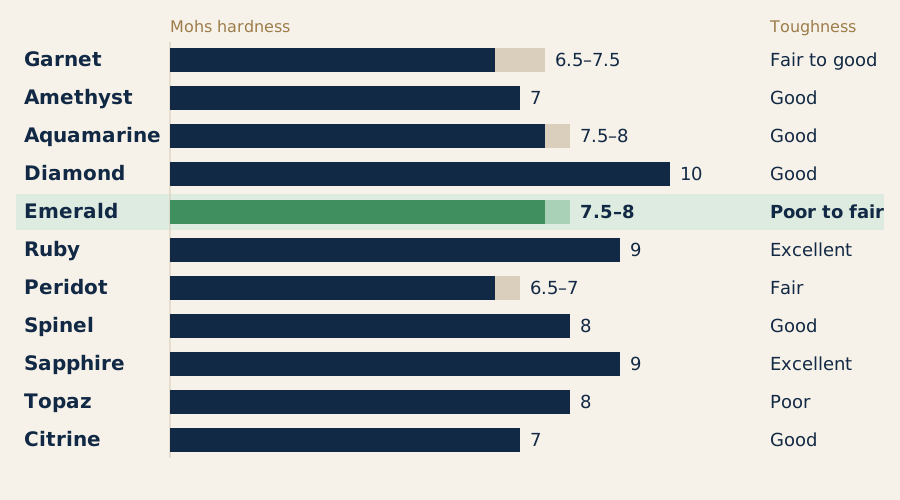
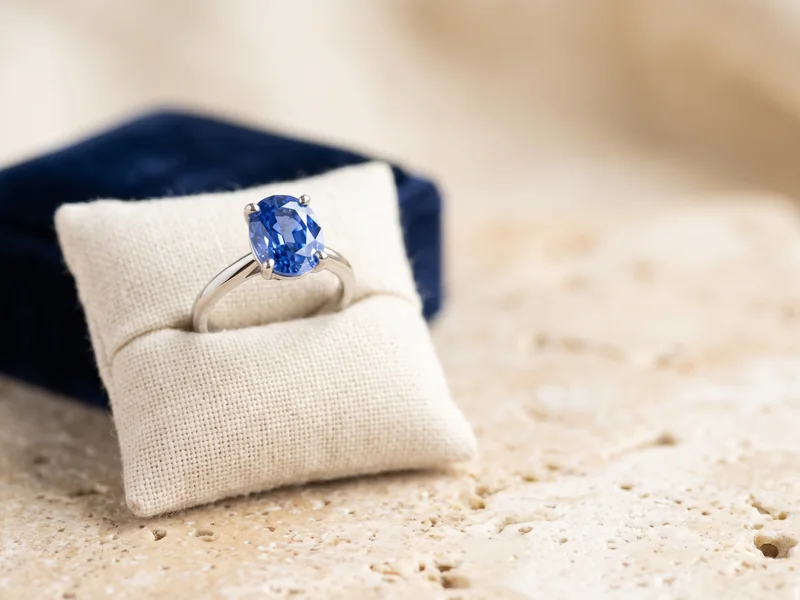
If toughness is your top priority, July's ruby and sapphire are corundum, rated 9 with excellent toughness. For other stones such as amethyst for February, garnet in January, peridot and spinel for August or topaz and citrine in November, the same setting logic applies. Our guide to choosing a birthstone engagement ring for durability sets out which stones suit daily wear.
Related guideBirthstone Engagement Rings: Choosing for DurabilityWhich setting suits an emerald ring?
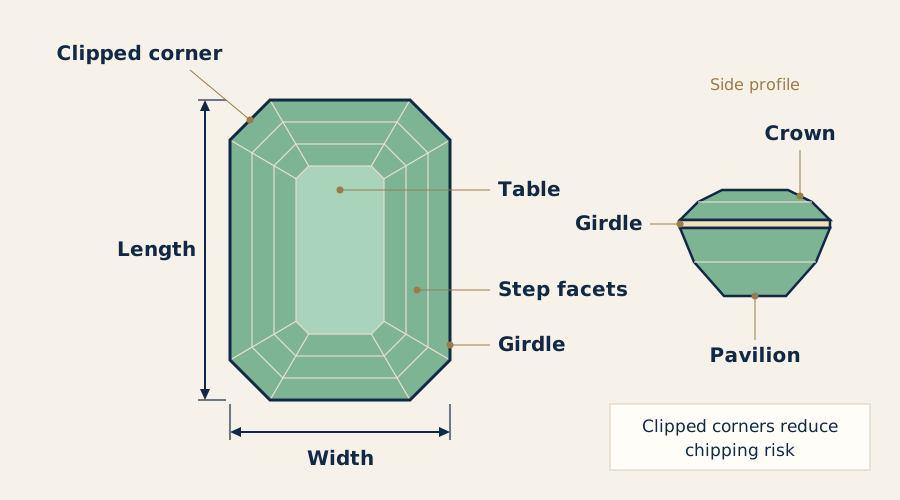
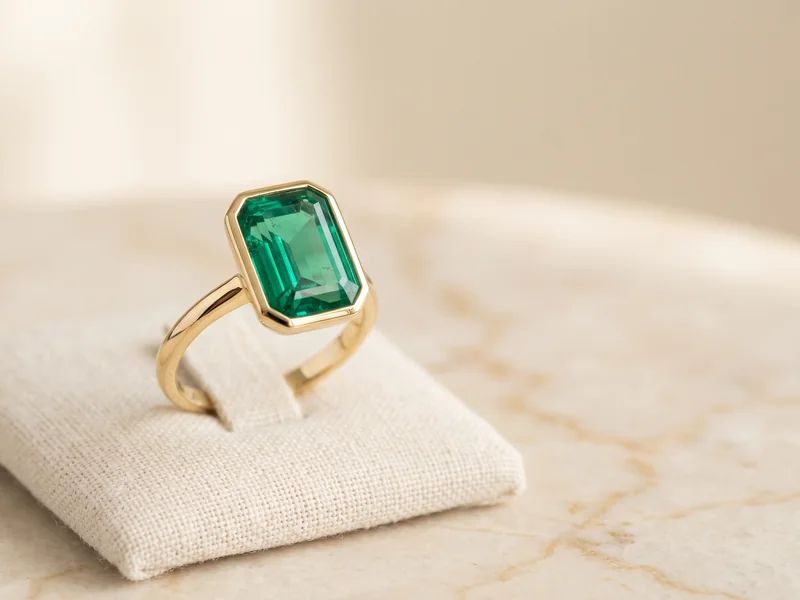
The setting's job with emerald is to shield the corners and edges from knocks and to avoid pressure on the stone. The emerald cut, a rectangular step cut with clipped corners, was developed partly for this reason: the cut corners remove the sharp points most likely to chip, and the long step facets show off colour rather than sparkle. Ovals, rounds, pears and cushions are also common, and heavily included stones are often cut as smooth-domed cabochons.
- Bezel or half-bezel: a rim of metal around the edge. The most protective option for an everyday emerald ring.
- Halo: small diamonds around the emerald frame its colour and take the first knock.
- Four claws with corner protection: for emerald cuts, claws that sit over the clipped corners, not on them. Double claws spread the load.
- Lower profile: a stone that sits closer to the finger is less exposed than a tall cathedral setting.
- Avoid tension settings: they hold the stone by pressure alone, which emerald's fractures do not handle well.
Metal changes how the green reads. Yellow gold warms emerald and suits Colombian-style pure greens; white gold and platinum give a crisp, cooler frame that flatters bluish Zambian stones. For design ideas, see our emerald engagement ring designs, and if you are weighing up colour against durability, read emerald versus sapphire as an engagement stone.
Setting an emerald takes a lighter hand than setting a diamond. Claws should be closed with gentle, even pressure, and the stone should never be heated, because heat can drive out the oil or damage resin. If an emerald ring needs resizing or re-tipping, the stone is usually removed first.
Is there an alternative May birthstone, or an Australian one?
Some older traditional birthstone lists give chrysoprase as an alternative for May. Chrysoprase is an apple-green, translucent chalcedony (a fine-grained form of quartz) coloured by nickel. It rates about 6.5–7 on the Mohs scale, costs far less than emerald and is usually cut as cabochons or beads. Australia is one of the main sources of gem chrysoprase, with deposits in Queensland and Western Australia, which makes it a natural choice if you want a locally sourced May stone.
Australia also has a small emerald history. Emeralds were found near Emmaville in New South Wales in the 1890s and at Poona in Western Australia, but production has always been small and most crystals are included. Australian emeralds are rarely available in jewellery today, so treat any claim of Australian origin with care and ask for documentation.
If you love green but need a tougher stone for a hard-working ring, green sapphire (Mohs 9) and tsavorite garnet (about 7–7.5, with good toughness) are worth comparing. Neither is a May birthstone, but both give a strong green with fewer worries.
How much does a May birthstone emerald cost, natural or lab-created?
Emerald prices span a very wide range. Colour matters most, then clarity and the degree of treatment, then size and cut. Origin can add a premium, especially for Colombian stones with a lab report confirming it. Untreated or minor-oil emeralds of fine colour cost many times more than moderately treated stones of similar appearance.
Lab-created emeralds (also called synthetic emeralds) are grown by hydrothermal or flux methods and have essentially the same chemistry, hardness and optical properties as natural emerald. They tend to be cleaner, though they still have their own kinds of inclusions, and they cost a small fraction of a natural stone. They must always be sold as lab-created or synthetic. A gem lab can separate them from natural emerald; it is rarely possible by eye.
| About 1 ct emerald | Approximate price range (AUD) |
|---|---|
| Lab-created emerald | about $150–$600 |
| Natural, commercial (lighter colour, significant treatment) | about $200–$1,500 |
| Natural, good (medium green, minor to moderate oil) | about $1,500–$6,000 |
| Natural, fine (vivid green, none or minor oil) | about $8,000–$20,000+ |
These are broad ranges only, and fine stones above 2 carats rise steeply per carat. A 1 carat emerald cut measures about 7 × 5 mm; although emerald is lighter than diamond, coloured stones are usually cut deeper, so it faces up similar to or slightly larger than a 1 carat diamond in the same shape. For a side-by-side look at price, hardness and sparkle, see how emerald compares with diamond.
| Carat weight | Typical emerald-cut size (length × width) |
|---|---|
| 0.50 ct | about 6 × 4 mm |
| 1.00 ct | about 7 × 5 mm |
| 1.50 ct | about 8 × 6 mm |
| 2.00 ct | about 9 × 7 mm |
| 3.00 ct | about 10 × 8 mm |
Browse natural gemstones
How do you choose and care for a May birthstone emerald? Step by step
- Start with colour. Look for pure to slightly bluish green, medium to medium-dark, with even colour across the stone. View it in daylight and indoor light.
- Check it is eye-clean enough. Some jardin is normal; avoid fractures that reach the surface near a corner or edge.
- Read the report. Confirm emerald (not green beryl), whether it is natural or lab-created, and the type and amount of clarity enhancement.
- Choose a protective setting. A bezel, halo or corner-protecting claws, in a lower profile for everyday rings.
- Compare size in millimetres. Emerald is lighter than diamond, so judge face-up size from measurements, not carat weight.
- Clean it gently. Warm water, a drop of mild detergent and a soft brush. No ultrasonic, steam, harsh chemicals or heat.
- Have it checked yearly. A jeweller can tighten claws, inspect fractures and re-oil the stone if it has dried out.
Free consultation
Talk to a gemologist
Compare stones in person or online with Raj Sood, Graduate Gemologist (GIA), AJP (GIA).
Book a consultationShop this shape
FAQ
Common questions
What is the May birthstone?
Emerald is the May birthstone on both modern and traditional lists. Some older traditional lists also name chrysoprase, an apple-green chalcedony mined in Australia.
Can you wear an emerald ring every day?
Yes, with care. Emerald resists scratches well at 7.5–8 on the Mohs scale but chips more easily than sapphire or diamond, so choose a bezel or halo setting and take it off for heavy work.
Are all emeralds treated?
Most are. Filling surface-reaching fractures with colourless oil or resin is a long-accepted practice, and it should be disclosed; untreated emeralds exist but cost considerably more.
Is a lab-created emerald a real emerald?
A lab-created emerald has the same chemistry and physical properties as natural emerald, but it was grown in a laboratory rather than formed in the earth. It must always be described as lab-created or synthetic, and it costs a fraction of a natural stone.
How do you clean an emerald?
Use warm water, a little mild detergent and a soft brush, then pat dry. Avoid ultrasonic and steam cleaners, solvents and heat, which can remove the oil filling fractures.
Are there emeralds mined in Australia?
Yes, small deposits were worked near Emmaville in New South Wales and at Poona in Western Australia, but production has always been small. Australian emeralds are rarely found in jewellery today.

Ask a gemologist
Not sure which diamond to choose?
Raj Sood is a Graduate Gemologist (GIA) and master jeweller. Bring the stones you are considering, or send the reports, and he will tell you honestly which one is better and why.
Keep learning
Related guides
 GemstonesEmerald Gemstone
 GemstonesEmerald Engagement Rings
 GemstonesBirthstone Engagement Rings: Choosing for Durability
 GemstonesEmerald vs DiamondGemstonesGemstones | Coloured Gemstones, Birthstones and Custom Jewellery
 GemstonesBirthstone Jewellery Melbourne
 GemstonesApril Birthstone: Diamond
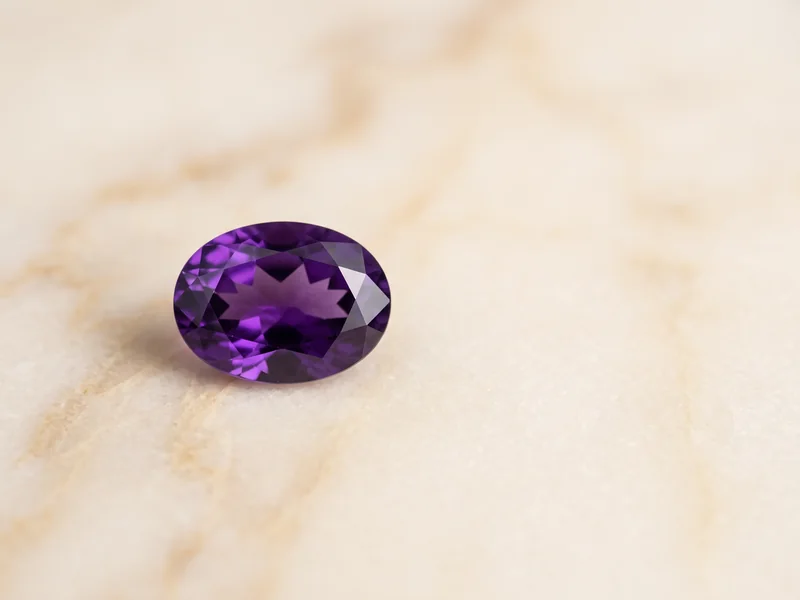 GemstonesFebruary Birthstone: Amethyst
Explore more
More guides on this topic
Education