
- Education
- Diamond Shapes
- Marquise Diamond Ratio Guide: Length-to-Width, Shape and Size
Diamond shapes
Marquise Diamond Ratio Guide: Length-to-Width, Shape and Size
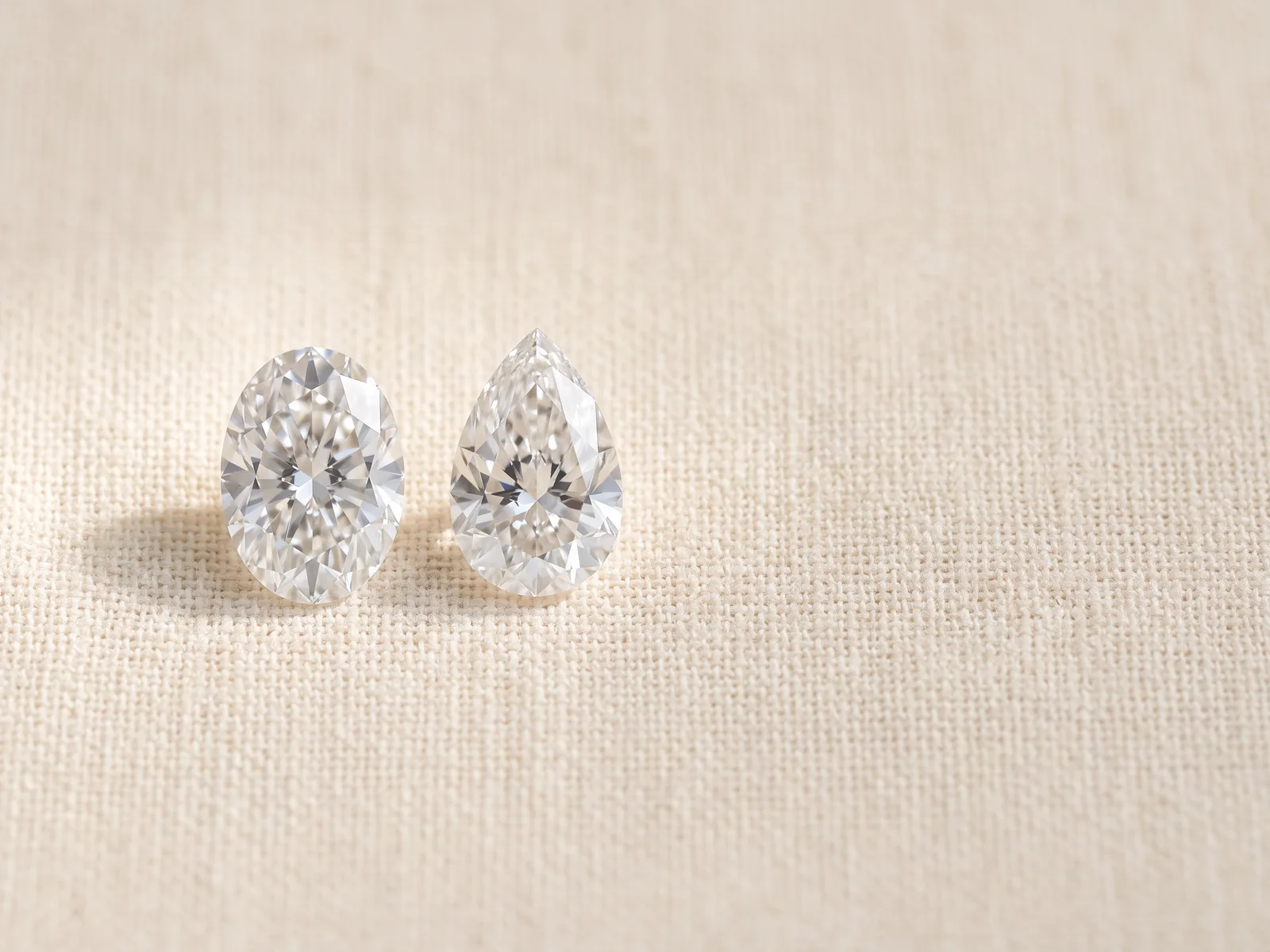
The marquise diamond ratio decides more about how the stone looks than almost any other number on the report. A small change turns a slim, classic boat shape into a short, chubby one, so it pays to understand the range before you compare stones.
 Reviewed by Raj Sood, Graduate Gemologist (GIA), AJP (GIA)Master jeweller and Graduate Gemologist (GIA) · reviewed 4 November 2026
Quick answer
The marquise diamond ratio is its length divided by its width. Most people choose about 1.85–2.10, which gives the classic slim boat shape with balanced points. Below about 1.75 a marquise looks short and chubby; above about 2.20 it looks very narrow. Check matching points, even wings and a soft bow-tie, and protect both tips with V-claws.
What is a marquise diamond ratio?
The length-to-width ratio (often shortened to L/W ratio) is the stone's length divided by its width, measured face-up, meaning looking straight down on the diamond as it sits in a ring. For a marquise, the length runs from tip to tip and the width is the widest point across the middle, called the belly. A marquise measuring 12.00 × 6.00 mm has a ratio of 2.00: it is exactly twice as long as it is wide.
You will find both numbers on the grading report, usually written as length × width × depth in millimetres. Divide the first by the second and you have the ratio. The same sum works for every fancy shape, and our length-to-width ratio guide for every shape shows how the numbers compare across the whole range.
A marquise is a modified brilliant cut: it uses the triangular and kite-shaped facets of a round brilliant, rearranged around a long outline with two pointed ends and two curved sides. Most marquise diamonds have around 56–58 facets. The shape is also called a navette, French for little boat, and it is often linked to an 18th-century story about a French noblewoman, although that tale is more legend than record. For the history, cutting and wear of the shape as a whole, see our full marquise cut diamond guide.
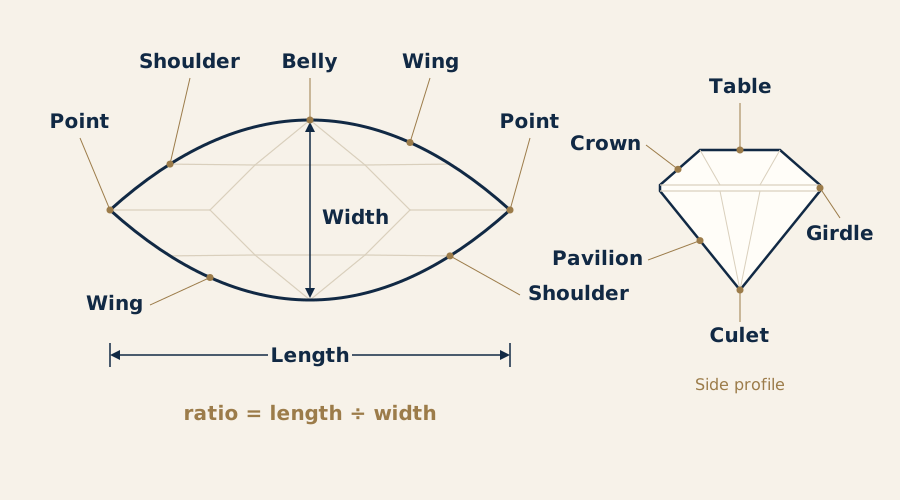
Diamond is 10 on the Mohs hardness scale, with a refractive index of about 2.42, which is where the strong sparkle of a brilliant cut comes from. Hardness is not toughness, though. The two points of a marquise are the thinnest parts of the stone, and a knock on a thin edge can chip it along a cleavage plane. Ratio matters here too: the longer and slimmer the stone, the sharper and more exposed those points become. The marquise is the most stretched member of the elongated brilliant family, and if any term on this page is new to you, our plain-English jewellery glossary explains it.
What is the ideal marquise diamond ratio?
There is no official ideal. GIA does not give marquise diamonds an overall cut grade the way it does for rounds, so the ideal ratio is a matter of trade preference and personal taste. Most buyers, and most cutters, settle in the range of 1.85–2.10, with 2.00 as the classic point where the stone reads clearly as a marquise from across the room.
| Ratio | How it looks | Often suits |
|---|---|---|
| Below 1.75 | Short and wide, with rounded wings; can look close to an oval with points | East-west settings and people who want a softer outline |
| 1.75–1.85 | Full marquise, more width across the belly | Shorter fingers; more sparkle across the middle |
| 1.85–2.10 | Classic slim boat shape, balanced points | Most engagement rings and pendants |
| 2.10–2.25 | Long and slender | Longer fingers and vintage-style designs |
| Above 2.25 | Very narrow, almost needle-like | A personal choice; points are longer and more exposed |
Ratio is only one number. A well-cut marquise also needs sensible proportions underneath. As a rough guide, many attractive marquise diamonds sit at a total depth of about 58–62% and a table (the large flat top facet) of about 53–63% of the width. Look at these alongside the ratio:
- Depth %: a stone much deeper than about 64% carries hidden weight underneath and looks smaller face-up.
- Table %: very large tables can flatten the sparkle; very small ones can look dark.
- Girdle at the points: the girdle is the thin outer rim. Medium to slightly thick at the tips helps resist chipping; extremely thin is a risk.
- Culet: none or very small. A large culet shows as a dark dot in the centre.
- Polish and symmetry grades: Very Good or Excellent is a sensible minimum for a shape this sensitive to balance.
Where the marquise sits among all the shapes, and why its numbers differ so much from a round, is covered in our overview of all the main diamond shapes.
How does the ratio change how a marquise looks on the hand?
Two marquise diamonds of the same carat weight can look like quite different stones. A higher ratio stretches the same weight into a longer, narrower outline; a lower ratio packs it into a shorter, wider one. Because the marquise is already the most elongated of the common shapes, a change of 0.20 in ratio is easy to see on the hand.
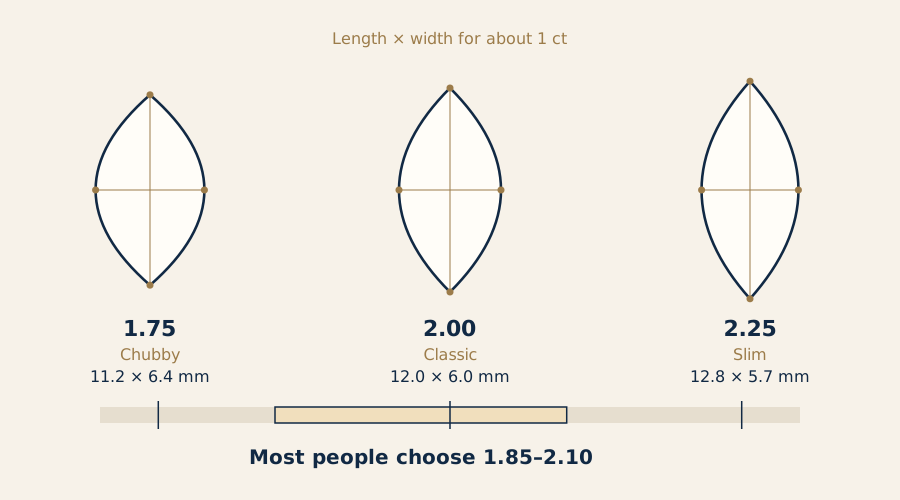
Set north-south (pointing along the finger), a classic or slim marquise makes the finger look longer and slimmer, which is a large part of the shape's appeal. A chubby marquise covers more of the finger's width and shows more brightness across the belly, but it can look stubby once the claws cover part of each point. A very slim stone looks elegant and long, but less of the stone faces you across the middle.
The curve of the sides also shapes the look. Cutters call the curve near each end the shoulder, and the long sides the wings. Two stones with the same ratio can still differ:
- Flatter wings: a sleeker, more pointed boat shape, with long tapering points.
- Rounder wings: a fuller, softer outline that can look larger across the middle.
- High shoulders: the stone stays wide until close to the tips, which can look bold but leaves less metal room at the points.
- Low shoulders: a gentle taper from the belly, typical of a traditional marquise.
A photo is not enough to judge this; a 360° video or seeing the stone in person tells you far more. If you already know the look you want, our page on settings that flatter a slim or chubby marquise shows how each outline sits in a finished ring.
How big is a marquise diamond for its carat weight?
Because a marquise spreads its weight along a long, shallow outline, it is often said to look larger face-up than most other shapes of the same weight; our comparison of which shapes look largest for their carat weight puts that claim to the test. The figures below are typical sizes for a marquise at a ratio of about 2.00 with average depth. Use them as a guide, not a promise: depth and wing shape move them up or down.
| Carat weight | Typical size (length × width) |
|---|---|
| 0.25 ct | about 8.0 × 4.0 mm |
| 0.50 ct | about 10.0 × 5.0 mm |
| 0.75 ct | about 11.0 × 5.5 mm |
| 1.00 ct | about 12.0 × 6.0 mm |
| 1.50 ct | about 13.5 × 6.8 mm |
| 2.00 ct | about 15.0 × 7.5 mm |
| 3.00 ct | about 17.0 × 8.5 mm |
Ratio changes those numbers noticeably. A 1 ct marquise at 1.80 might measure around 11.3 × 6.3 mm, while the same weight at 2.20 could be about 12.6 × 5.7 mm. Both cover a similar area, but the slimmer stone looks longer on the finger and the fuller one looks wider. Always compare the millimetre measurements on the report, not just the carat weight.
Small marquise diamonds, from about 0.05 to 0.25 carat, are used as accent stones, in vintage-style clusters and in eternity bands. At these sizes a ratio of about 2.00–2.50 is common, because the slimmer outline lines up neatly in rows.
Not sure which one is right?
Send us the stones you are looking at and our gemologist will tell you which to choose and why.
Does the ratio affect the bow-tie and symmetry of a marquise?
Most marquise diamonds show a bow-tie: a darker band across the belly, shaped like a bow-tie, where light leaks out instead of coming back to your eye. The marquise is one of the shapes most prone to it, alongside the pear and oval. A faint bow-tie that shifts as the stone moves adds contrast and is normal. A dark band that stays put in every position points to poor proportions.
Ratio and bow-tie are linked but not in a simple way. Very short, wide marquise diamonds and very long, slim ones are both harder to cut with even light return, because the facet angles across the belly become more extreme. Stones in the classic 1.85–2.10 range are usually the easiest to cut well, which is one reason the range is so popular.
Symmetry is the other half of the story. A marquise is two halves mirrored along the line from point to point, so any imbalance stands out. Check four things:
- Points aligned: an imaginary line from tip to tip should run straight through the centre, not drift to one side.
- Matching wings: both long sides curve equally; one should not bulge while the other is flatter.
- Even shoulders: both ends taper the same way, so one point does not look blunter.
- Centred belly: the widest point sits halfway along the stone, not closer to one end.
Finally, look closely at the points. An inclusion (internal feature) or a thin girdle right at a tip is the main durability risk in a marquise. Our guide on why marquise points chip and how to prevent it explains what to check on the report's plotting diagram.
How does the marquise ratio compare with pear, oval and moval diamonds?
| Shape | Typical ratio | Pointed ends | Bow-tie | Overall look |
|---|---|---|---|---|
| Marquise | 1.85–2.10 | Two | Common | Longest, slimmest outline |
| Pear | 1.45–1.75 | One | Common | Teardrop, one rounded end |
| Moval | about 1.50–1.80 (varies by cutter) | None, softly tapered ends | Possible | Between oval and marquise |
| Oval | 1.30–1.50 | None | Common | Smooth elongated curve |
| Elongated radiant | 1.20–1.50 | None, cut corners | Rare | Rectangular, very bright |
| Round | 1.00 | None | No | Circle |
Even a short marquise is usually longer for its width than most other shapes, which is why the marquise ratio range sits so much higher. A pear at 1.60 looks well proportioned; a marquise at 1.60 looks noticeably squat. Our pear diamond ratio ranges and the radiant ratio chart set out how the same idea works for those shapes, and our oval diamond guide covers the softer, pointless alternative.
If you are torn between two drop-like shapes, the marquise and pear compared side by side covers sparkle, durability and price. If you want the length of a marquise with softer ends, a moval is worth a look: our moval cut explained page introduces the shape, and how a moval differs from a marquise walks through the differences.
Related guideMarquise vs Moval DiamondsWhat is the best setting for a marquise diamond at each ratio?
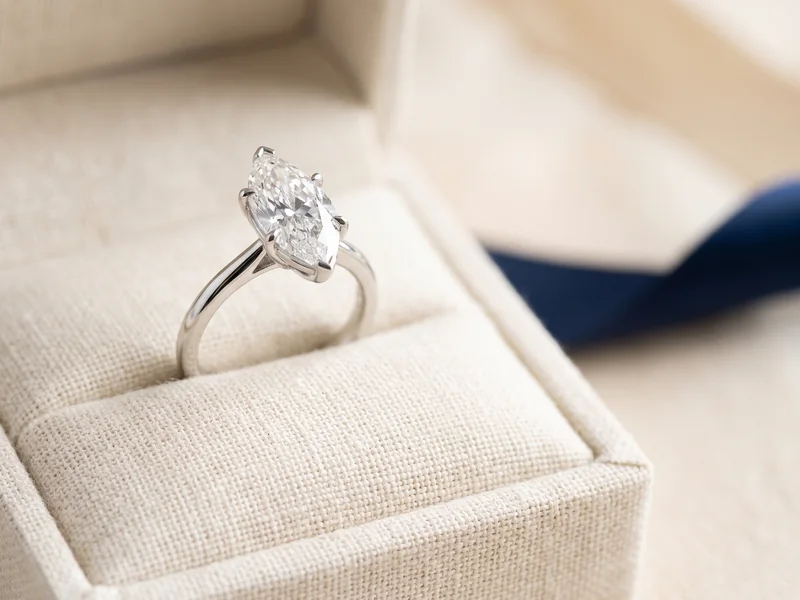
Whatever the ratio, both points need protecting. The usual approach is six claws: a V-claw (a V-shaped claw that wraps the tip) at each point, plus two claws along each side, or a bezel (a thin rim of metal around the edge). The ratio then shapes which style looks most natural:
- Classic 1.85–2.10: a north-south solitaire with two V-claws, the traditional look. Also suits a halo or slim side stones.
- Slim, above 2.10: longer points benefit from a bezel, half-bezel or halo, which shields the tips and frames the length.
- Chubby, below 1.80: works well set east-west (across the finger), where the width becomes a feature, or in a toi et moi (two-stone) design.
- Small marquise: slim accent stones in clusters, vintage halos and eternity bands.
Our page on setting styles for marquise diamonds has examples of each, and claws, bezels and halos that guard both tips explains how much metal each style places over the points. Because a marquise is long, a straight wedding band can leave a gap beside it; a contoured or slightly curved band usually sits closer.
Does the marquise diamond ratio change the price?
Ratio on its own is a modest price factor. Stones in the classic 1.85–2.10 range are the most sought after, so they tend to hold the typical price for their grades, while very short or very slim stones are sometimes priced a little lower because fewer people want them. Carat, colour, clarity and how well the outline is cut move the price far more.
Colour and clarity behave in a particular way in this shape. Body colour tends to gather at the points, where the stone is thinnest, so in white gold or platinum most people are happy from H colour or better, and I or J can look white in yellow or rose gold. For clarity, aim for eye-clean (no inclusions visible without magnification at normal distance), which usually means VS2 or a carefully chosen SI1, avoiding feathers (small internal cracks) near the tips. More on grades for this shape is in our marquise colour and clarity advice.
Marquise diamonds come in both natural and laboratory-grown diamond. Lab-grown diamonds are real diamond, with the same hardness and refractive index, grown in a laboratory rather than mined; they cost much less and are easy to find in larger sizes and specific ratios. Natural marquise diamonds are rarer. Both should come with an independent grading report from a lab such as GIA or IGI, stating clearly whether the stone is natural or lab-grown.
| 1 ct marquise, G–H, VS | Approximate price range (AUD) |
|---|---|
| Lab-grown | about $1,000–$3,000 |
| Natural | about $5,000–$12,000 |
These are broad ranges only; prices change with the market and the exact grades. A marquise usually costs less per carat than a round of the same weight, colour and clarity, and our page on how price per carat differs between shapes sets out the pattern across the main cuts.
Browse marquise diamonds: natural and lab-grown
How do you check a marquise diamond ratio? Step by step
- Read the report. Note the measurements, colour, clarity, polish, symmetry and whether the diamond is natural or lab-grown.
- Work out the ratio. Divide the length by the width; aim for about 1.85–2.10 for a classic marquise. Our guide on how to calculate ratio from a report has worked examples.
- Check depth and table. Around 58–62% depth and 53–63% table is a sensible starting point.
- Judge symmetry by eye. Points aligned, matching wings, even shoulders and a centred belly.
- Watch a 360° video. Look for a bow-tie that stays dark and for inclusions or a very thin girdle at either point.
- Compare face-up size. Use the millimetre measurements, not carat weight alone.
- Plan the setting. Make sure both points will sit under V-claws, a bezel or a halo before you commit to the stone.
Free consultation
Talk to a gemologist
Compare stones in person or online with Raj Sood, Graduate Gemologist (GIA), AJP (GIA).
Book a consultationFAQ
Common questions
What is a good ratio for a marquise diamond?
Most people choose a ratio between 1.85 and 2.10, with 2.00 as the classic proportion. Below about 1.75 the stone looks short and wide; above about 2.20 it looks very slim.
Is a 1.8 ratio marquise too chubby?
Not necessarily. A 1.80 marquise is fuller than the classic shape and covers more of the finger's width, which some people prefer, and it suits east-west settings well. Check that the symmetry is good and the bow-tie is soft.
How big is a 1 carat marquise diamond in mm?
At a ratio of about 2.00, a 1 carat marquise typically measures around 12 × 6 mm. A slimmer stone will be longer and narrower, and a deeper cut will look smaller face-up.
Does a higher ratio make a marquise look bigger?
It makes it look longer, not necessarily bigger overall. The face-up area stays similar, but a slim stone elongates the finger while a fuller one looks wider across the middle.
Why do marquise diamonds have a bow-tie?
Light leaks out through the belly of long, narrow shapes, creating a darker band across the middle. A faint bow-tie that moves is normal; one that stays dark from every angle suggests poor proportions.
Can I get a lab-grown marquise diamond in a specific ratio?
Yes. Lab-grown marquise diamonds are widely available, so it is usually easier to find a particular ratio and size, and they cost much less than natural stones of similar grades.

Ask a gemologist
Not sure which diamond to choose?
Raj Sood is a Graduate Gemologist (GIA) and master jeweller. Bring the stones you are considering, or send the reports, and he will tell you honestly which one is better and why.
Keep learning
Related guides
 Diamond ShapesMarquise Cut Diamonds Melbourne
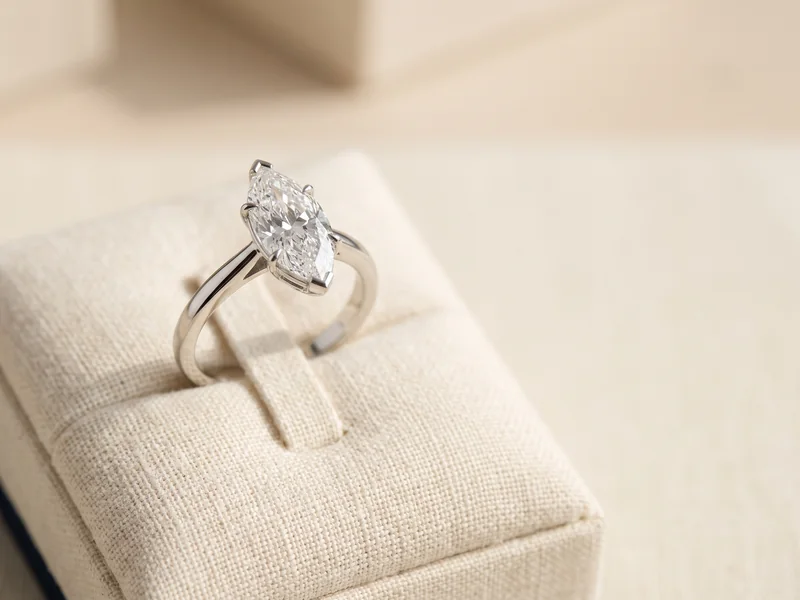 Engagement Rings & SettingsBest Settings for Marquise Diamonds
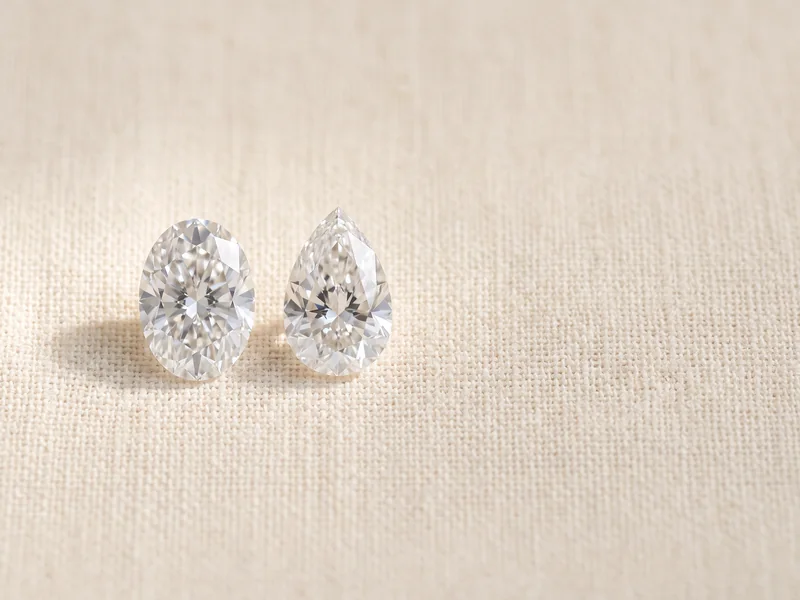 Diamond ShapesProtecting Marquise Diamond PointsDiamond ShapesMarquise vs Pear DiamondsDiamond ShapesUnderstanding Diamond Shapes
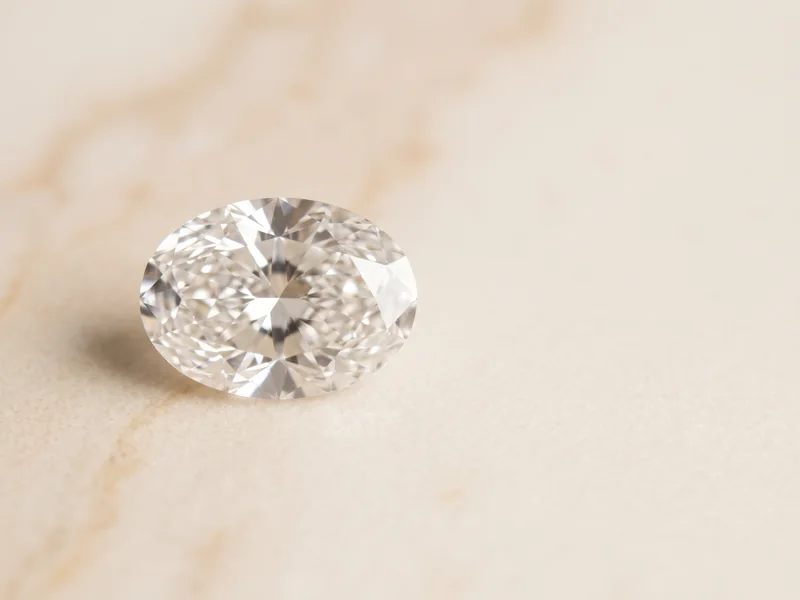 Diamond Anatomy & LightDiamond Length to Width Ratio GuideDiamond ShapesMarquise vs Moval Diamonds
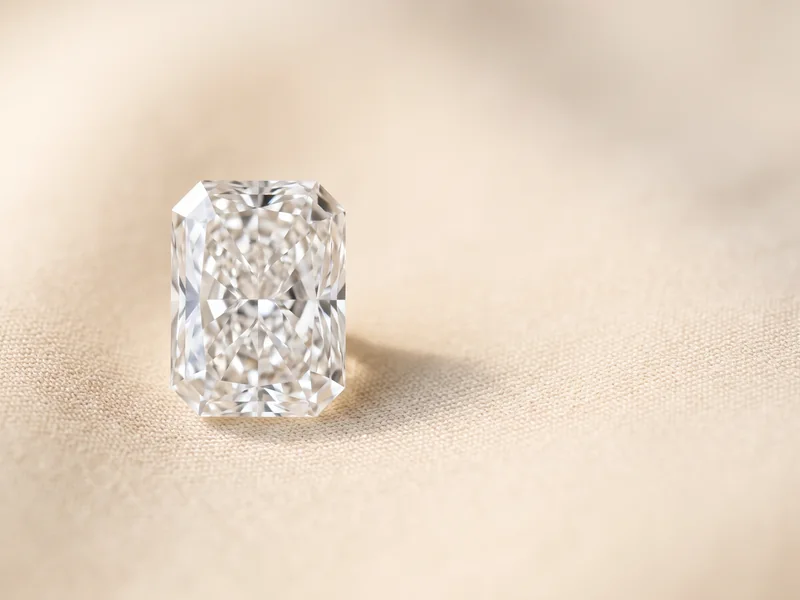 Diamond ShapesRadiant Diamond Length-to-Width Ratio Guide
Explore more
More guides on this topic
Education