
- Education
- Fancy Colour Diamonds
- Orange Diamonds Guide: Colour, Grades, Rarity and Settings
Fancy Colour Diamonds
Orange Diamonds Guide: Colour, Grades, Rarity and Settings
Orange diamonds are among the rarest fancy colours, and the colour name on a report can hide a lot of brown or yellow. Here is what causes the colour, how it is graded, and how to tell natural, lab-grown and treated stones apart.
 Reviewed by Raj Sood, Graduate Gemologist (GIA), AJP (GIA)Master jeweller and Graduate Gemologist (GIA) · reviewed 4 November 2026
Quick answer
Orange diamonds are fancy colour diamonds whose colour comes mainly from a defect, thought to be nitrogen-related, that absorbs blue light. Pure orange is one of the rarest natural colours; most stones show yellow, brown or pink modifiers. GIA grades intensity up to Fancy Vivid. Lab-grown and treated orange diamonds cost far less and must be disclosed on the report.
What are orange diamonds?
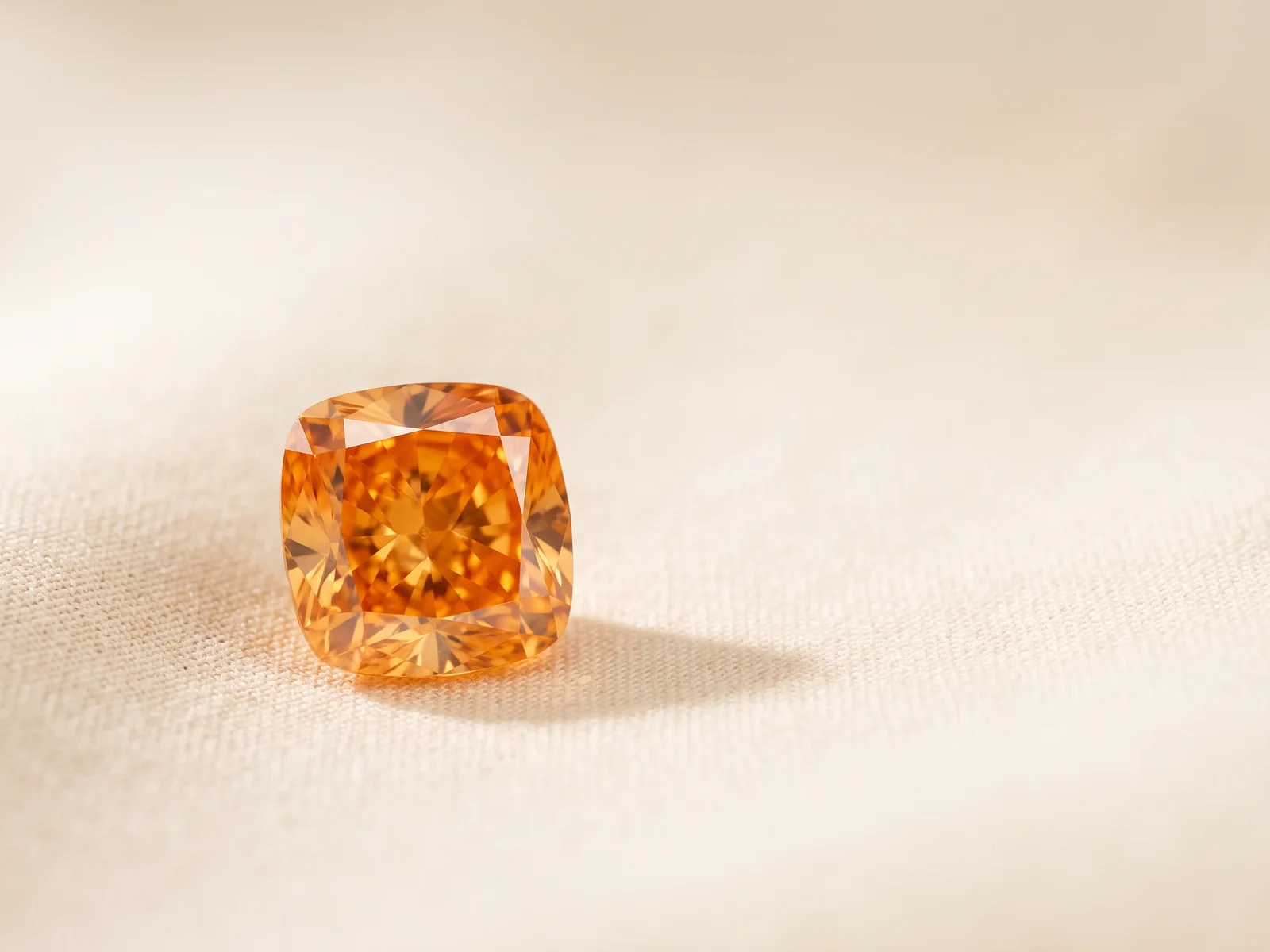
Orange diamonds are natural or laboratory-grown diamonds with a distinct orange body colour, strong enough to sit outside the D-to-Z scale used for white diamonds. Once a diamond's colour goes beyond that scale, or shows a hue other than light yellow or brown, it is called a fancy colour diamond and graded on a separate system. Our complete guide to fancy colour diamonds covers the whole family; this page focuses on orange.
Gemmologically, an orange diamond is still diamond: pure carbon, 10 on the Mohs hardness scale, with a refractive index of about 2.42. Only the colour is different. In the trade a pure orange is sometimes nicknamed a 'pumpkin' or 'fire' diamond, but those are sales names, not grades. On a grading report you will see a hue such as Orange, Yellowish Orange or Brownish Orange, followed by an intensity grade such as Fancy Intense.
Most orange diamonds sit on a colour spectrum shared with yellows and browns. Push the colour one way and you arrive at yellow and canary diamonds; push it the other way and it becomes brown. That shared territory is why reading the exact colour wording matters so much. If any term on this page is new to you, our plain-English jewellery glossary explains it.
What causes the colour in orange diamonds?
Colour in diamond comes from tiny defects in the crystal: carbon atoms that are missing, out of place or replaced by another element. Each defect absorbs certain wavelengths of light, and what reaches your eye is the light left over.
In most natural orange diamonds, gemmologists measure a broad absorption band centred near 480 nanometres, in the blue part of the spectrum. Removing blue light shifts what remains towards yellow and orange. This '480 nm band' is thought to be linked to nitrogen-related defects, but its exact structure is still being researched. When it combines with the defects that make yellow or brown, you get the yellowish and brownish oranges that make up most of the market. A clean, strong orange needs the 480 nm band on its own, which is why it is so rare.
- Orange: mainly the 480 nm band, usually alongside some nitrogen.
- Yellow: nitrogen atoms replacing carbon in the crystal, as in canary diamonds.
- Brown: plastic deformation, where pressure in the earth bent the crystal lattice.
- Pink and red: also linked to deformation; see how pink diamonds get their colour and why red diamonds are rarer still.
That overlap matters when you buy. The same deformation that colours champagne and cognac brown diamonds often appears in orange stones, adding a brown modifier that softens the colour and lowers the price. A pinkish orange, on the other hand, often combines the 480 nm band with deformation-related pink colour.
How are orange diamonds graded for colour and intensity?
Fancy colour diamonds are graded face-up (looking down through the table, the large top facet) under controlled lighting, against colour references. The colour grade has two parts: the hue, meaning orange plus any secondary colour (called a modifier), and the intensity, meaning how strong and saturated the colour looks. Clarity and measurements are recorded too, but for coloured diamonds the colour drives most of the value.
| GIA intensity grade | What it looks like in orange |
|---|---|
| Faint, Very Light, Light | Barely tinted; rarely described as orange at these levels |
| Fancy Light | Soft, pale peach-orange |
| Fancy | Clear orange of moderate strength |
| Fancy Intense | Strong, saturated orange |
| Fancy Vivid | The highest saturation; bright and pure, the rarest grade |
| Fancy Deep | Strong colour with a darker tone |
| Fancy Dark | Dark tone, often reading brownish |
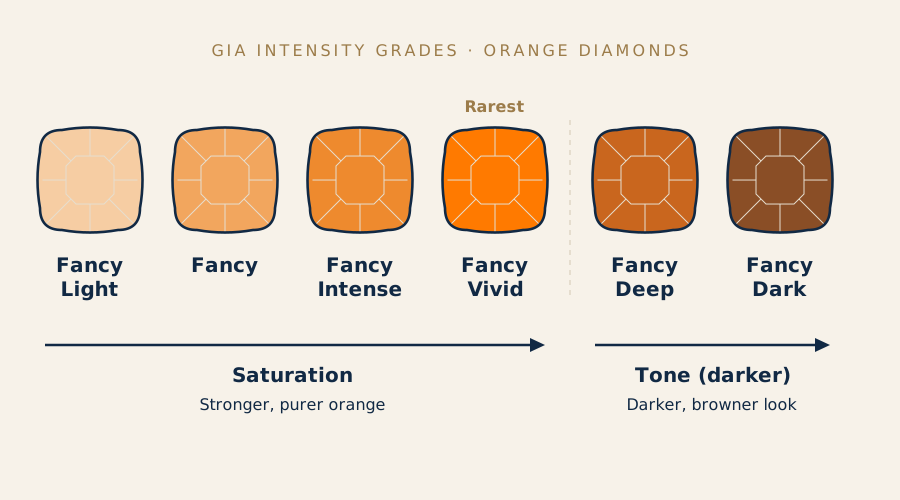
The hue is written with the main colour last. 'Yellowish Orange' is mainly orange with some yellow; 'Orangy Yellow' is mainly yellow with some orange. 'Orangy' is the modifier form of orange. Common descriptions include Orange, Yellowish Orange, Reddish Orange, Pinkish Orange, Brownish Orange and Brownish Yellowish Orange. A plain 'Orange' with no modifier at Fancy Intense or Fancy Vivid is the rarest of all, and a reddish orange at those grades is close behind.
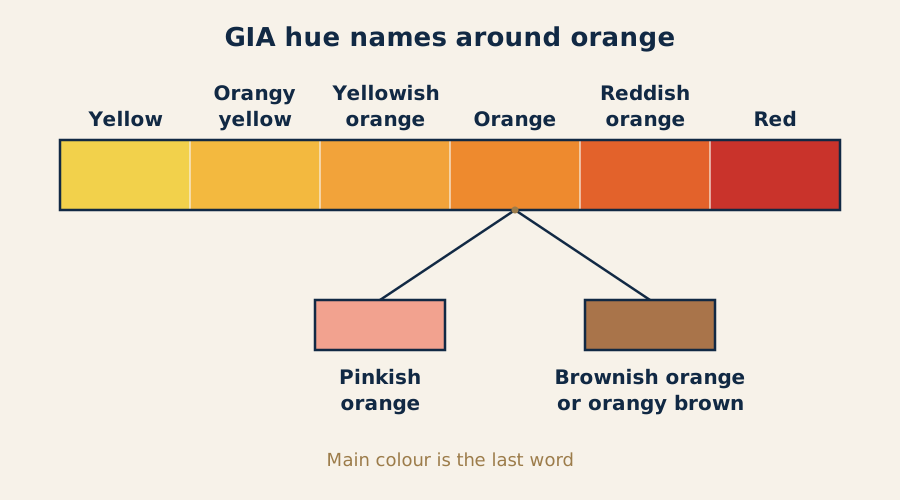
Our guide on how labs judge fancy colour hue, tone and saturation explains the method in detail, including why two stones with the same grade can still look slightly different side by side.
Related guideBrown, Champagne and Cognac DiamondsHow rare are natural orange diamonds?
A strong, pure orange is one of the rarest natural diamond colours; red is among the few that turn up less often. Most natural orange diamonds that reach the market are under a carat and carry a yellow or brown modifier. Stones graded plain Orange at Fancy Vivid are seen only occasionally, even by the major labs.
Two famous stones show the scale. The Pumpkin Diamond, a 5.54 carat Fancy Vivid Orange, was bought by Harry Winston at auction in 1997, the day before Halloween, which gave it its name. The Orange, a 14.82 carat Fancy Vivid Orange pear shape, sold at Christie's Geneva in November 2013 for about US$35.5 million, roughly US$2.4 million per carat, and was described at the time as the largest known Fancy Vivid Orange diamond.
Australia's part in the story comes through Argyle. The Argyle mine in Western Australia's East Kimberley operated from the mid-1980s until November 2020 and, at its peak, produced a large share of the world's diamonds by volume, most of them brown. Argyle's marketers presented those browns as 'champagne' and 'cognac' on their own C1–C7 scale, and the darker cognac end often reads as brownish orange. Argyle is best remembered for its pinks, some of which carried orange modifiers, but it was never a steady source of pure orange. Since the closure, Argyle-origin coloured diamonds come only from existing stock, so documented provenance matters.
To see where orange sits among other rarities, compare it with natural blue diamonds, coloured by boron, green diamonds coloured by natural radiation and purple and violet diamonds.
Not sure which one is right?
Send us the stones you are looking at and our gemologist will tell you which to choose and why.
Is an orange diamond natural, lab-grown or treated?
Because natural orange is so rare, most orange diamonds you see online are lab-grown or treated. All three are real diamond with the same hardness and refractive index. What differs is where the colour came from, and that changes the price by a very large margin.
- Natural orange diamond: mined, with colour that formed in the earth.
- Treated orange diamond: a natural diamond whose colour was changed after mining, usually by HPHT processing (high pressure, high temperature) or by irradiation followed by heating, called annealing. A few are coated with a thin colour film, which can wear or chip off. Our page on HPHT and irradiation colour treatments explains each method.
- Lab-grown orange diamond: grown in a laboratory by CVD (chemical vapour deposition) or HPHT, with colour usually created or enhanced by treatment after growth.
The grading report is how you tell them apart; you cannot reliably do it by eye. GIA's coloured diamond reports include a colour origin line, and the wording is worth knowing:
| Report wording | What it means | Example |
|---|---|---|
| Colour origin: Natural | Colour formed in the earth; no evidence of treatment | Fancy Intense Yellowish Orange, Natural |
| Colour origin: Treated, with a comment such as 'HPHT processed' or 'Artificially irradiated' | Natural diamond, colour changed after mining | Fancy Vivid Orange, Treated, irradiated and annealed |
| Colour origin: Undetermined | The lab could not confirm the origin with current testing | Treat it as unproven and price it accordingly |
| Laboratory-grown report, with a note on post-growth treatment | Grown in a laboratory; colour often altered after growth | Fancy Vivid Orange, laboratory-grown, CVD, post-growth treatment |
| Identification only, coating noted | Surface coating detected; no colour grade given | Not graded as a fancy colour |
GIA also laser-inscribes the girdle (the thin outer edge) of lab-grown diamonds it grades, and of diamonds with HPHT or irradiation treatment, so the disclosure travels with the stone. Other labs such as IGI grade lab-grown fancy colours and state the origin and any treatment on the report.
Which shapes and clarity suit an orange diamond?
Cutters of coloured diamonds aim to maximise colour rather than white sparkle. Shapes with many crossing facets and a deeper pavilion (the lower half of the stone) bounce light through more of the diamond, which intensifies the face-up colour. That is why so many orange diamonds are cut as:
- Radiant and cushion cuts: the most common choice; they concentrate colour well and keep weight from the rough.
- Pear and oval shapes: popular for pendants and rings, often with deeper colour towards the point or ends.
- Heart shapes: less common, but suit pinkish and reddish oranges.
- Round brilliants: uncommon in orange, because the cut returns a lot of white light that can dilute colour.
For clarity, aim for an eye-clean stone, meaning no inclusions (internal features) you can see without magnification at normal viewing distance. Natural orange diamonds are often included, and SI clarity is common and acceptable when the colour is strong. Colour hides small inclusions well. The ones to avoid are feathers (small internal cracks) that reach the surface near a point or corner, where they can weaken the stone.
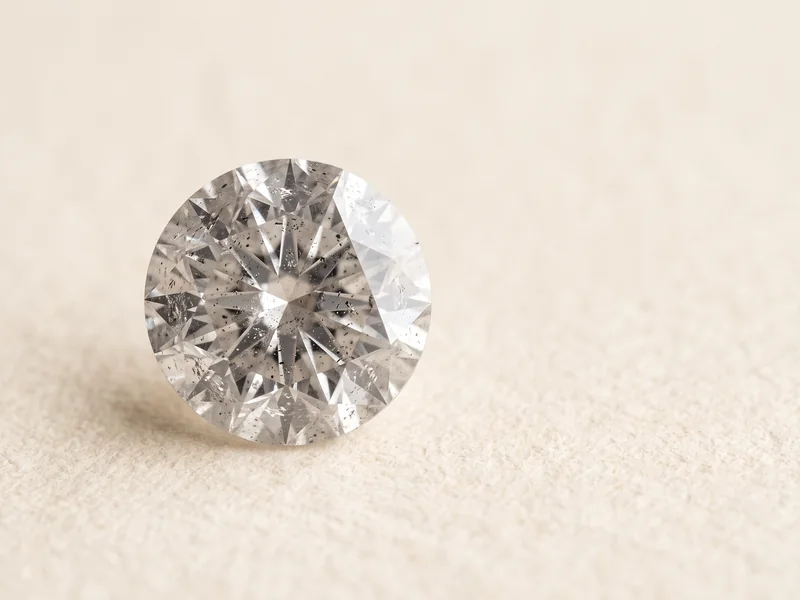
Orange is a colour where inclusions are something to manage, not a feature. That contrasts with grey and salt-and-pepper diamonds, where the inclusions are a large part of the look.
What is the best setting and metal for an orange diamond ring?
Metal colour changes how orange reads. Warm metals reflect warm light into the diamond; white metals reflect cooler light. A rough guide for an orange diamond ring:
- Yellow gold: deepens the orange and suits yellowish oranges. It can make a pale Fancy Light stone look stronger.
- Rose gold: flatters pinkish and reddish oranges and gives a soft, warm look overall.
- Platinum or white gold: gives a crisp contrast and suits a strong Fancy Intense or Vivid orange. Many people set the stone in yellow gold claws on a white metal band to keep the warmth under the diamond.
- Bezel setting: a thin rim of metal around the edge, which protects corners and points and frames the colour.
- Halo: a ring of small white diamonds makes the centre look larger and sharpens the orange by contrast.
An orange diamond engagement ring is perfectly practical for everyday wear, because diamond is Mohs 10. What wears is the setting, so check claws every year or two. For side-by-side examples, see our guide to metal and setting choices for coloured diamonds and our ideas for coloured diamond engagement rings.
How does an orange diamond compare with orange sapphire?
| Natural orange diamond | Lab-grown orange diamond | Treated orange diamond | Orange sapphire | |
|---|---|---|---|---|
| How the colour forms | In the earth, mainly the 480 nm band | Usually created or enhanced after growth | Changed after mining by HPHT, irradiation or coating | Trace elements such as iron and chromium, often heated or beryllium-diffused |
| Hardness (Mohs) | 10 | 10 | 10 | 9 |
| Refractive index | about 2.42 | about 2.42 | about 2.42 | about 1.76–1.77 |
| Look | Bright, high sparkle | Bright, high sparkle | Bright, high sparkle | Rich colour, softer sparkle |
| Report shows | Colour origin: Natural | Laboratory-grown | Colour origin: Treated | Natural or lab-created; heat treatment noted |
| Rough price per carat (AUD) | about $10,000 up to the millions | about $1,000–$4,000 | about $2,000–$8,000 | about $500–$3,000 |
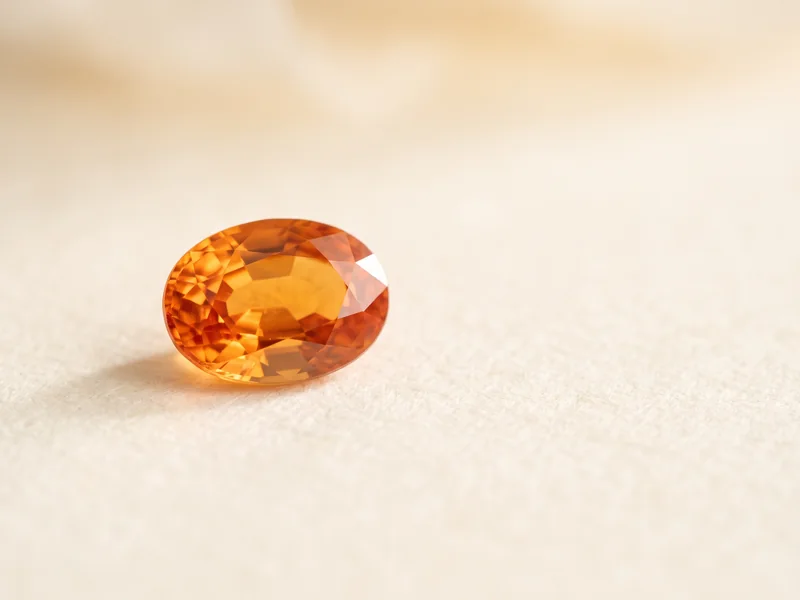
If you want a strong orange colour for everyday wear on a smaller budget, orange sapphire and the pinkish-orange padparadscha is the closest alternative. It is one step softer on the Mohs scale but still very durable, and a natural orange sapphire usually costs far less than a natural orange diamond. A lab-created sapphire costs less again.
Within diamonds, orange is one of the brightest options. Darker choices such as opaque black diamonds look very different and are mostly treated, while cognac browns give a similar warmth at a fraction of the price of pure orange.
How much do orange diamonds cost in Australia?
Price depends first on origin (natural, treated or lab-grown), then on hue and intensity, then on size. A brown modifier lowers the price sharply; a pure orange or reddish orange at Fancy Intense or Vivid raises it dramatically. Clarity matters much less than it does for white diamonds.
| Orange diamond type | Approximate price per carat (AUD) |
|---|---|
| Lab-grown, Fancy Intense to Vivid | about $1,000–$4,000 |
| Treated natural, Fancy Intense to Vivid | about $2,000–$8,000 |
| Natural Brownish or Yellowish Orange, Fancy | about $10,000–$40,000 |
| Natural Orange, Fancy Intense | about $60,000–$200,000+ |
| Natural Orange, Fancy Vivid | into the hundreds of thousands, with record stones far higher |
These are broad ranges only; prices move with the market, and natural orange diamonds are traded so rarely that each stone is priced individually. Price per carat also rises steeply with size, so a 1 carat natural orange costs much more than twice a 0.50 carat of the same grade. Natural and lab-grown stones look the same to the eye; the difference is origin and rarity, not beauty. A natural orange diamond is a rare natural object, but it should be bought because you love it, not as a way to make money.
Shop orange diamonds: natural and lab-grown
How do you choose an orange diamond? Step by step
- Decide on origin. Natural, treated or lab-grown; each suits a different budget, and each must be stated on the report.
- Read the colour origin line. Look for Natural, Treated (with the treatment named), Undetermined or Laboratory-grown.
- Read the hue right to left. Make sure orange is the last word, and note any brownish, yellowish or pinkish modifier.
- Check the intensity grade. Fancy Intense and Fancy Vivid show the strongest colour; Fancy Deep is darker.
- Watch a video in daylight. Check that the colour is even across the face-up stone and that no inclusions sit near the edges.
- Compare millimetre measurements. Coloured diamonds are often cut deep, so a carat can face up smaller than you expect.
- Choose metal and setting together. Yellow or rose gold warms the colour; a bezel or halo protects corners and points.
Free consultation
Talk to a gemologist
Compare stones in person or online with Raj Sood, Graduate Gemologist (GIA), AJP (GIA).
Book a consultationFAQ
Common questions
Are orange diamonds real diamonds?
Yes. Natural, treated and lab-grown orange diamonds are all real diamond, with a hardness of 10 and a refractive index of about 2.42. The grading report states which type you have.
What causes the colour in orange diamonds?
In most natural orange diamonds the colour comes from a broad absorption band near 480 nanometres, thought to be linked to nitrogen-related defects. Yellow or brown modifiers come from nitrogen and crystal deformation respectively.
Are orange diamonds rare?
A strong, pure natural orange is one of the rarest diamond colours. Brownish and yellowish oranges are more common, and lab-grown and treated orange diamonds are widely available.
How much is a natural orange diamond worth?
It depends heavily on the hue and intensity. A brownish or yellowish orange may cost about $10,000–$40,000 per carat, while a pure Fancy Vivid Orange can reach hundreds of thousands of dollars per carat or more.
Can you get a lab-grown orange diamond?
Yes. Lab-grown orange diamonds are grown by CVD or HPHT, and their colour is usually created or enhanced after growth. They cost a small fraction of a natural orange diamond.
What metal suits an orange diamond ring?
Yellow and rose gold deepen and warm the orange, while platinum and white gold give crisp contrast to a strong colour. Yellow gold claws on a white metal band combine both.

Ask a gemologist
Not sure which diamond to choose?
Raj Sood is a Graduate Gemologist (GIA) and master jeweller. Bring the stones you are considering, or send the reports, and he will tell you honestly which one is better and why.
Keep learning
Related guides
 Fancy Colour DiamondsHow Fancy Colour Diamonds Are Graded
 Fancy Colour DiamondsTreated Colour Diamonds (HPHT and Irradiation)
 Fancy Colour DiamondsBest Settings and Metals for Coloured Diamonds
 GemstonesOrange Sapphire
 Fancy Colour DiamondsGrey and Salt-and-Pepper Diamonds
 Fancy Colour DiamondsRed Diamonds
 Fancy Colour DiamondsGreen Diamonds
Explore more
More guides on this topic
Education